The bond with the town
Italia.it, on its pages about Puglia and about Polignano a Mare, identifies the town as the birthplace of Domenico Modugno, author of Nel blu dipinto di blu, which the source calls the most famous Italian song in the world. It is a biographical bond, different from that of a film shot here: it concerns not a scene but a person’s origin and the way his community remembers him.
The Municipality of Polignano a Mare, presenting its cultural project, speaks of Modugno as one of the most important figures in the history of Italian music, who carried the town’s name around the world. Being his birthplace, the administration writes, is a source of pride but also a cultural responsibility.
Knowing this bond lets you set a musical story beside the coast without attributing every song to a precise spot in town. It is more useful as a key to listening: the same cliff, light and sea look different after hearing a voice that set out from here.
Sources: Italia.it — Puglia e Domenico Modugno · Italia.it — Polignano a Mare · Comune di Polignano a Mare — Domenico Modugno e la canzone d’autore: Città della Musica
Largo Gelso and the statue
The municipality identifies Largo Gelso as the place where the statue of Domenico Modugno stands, and lists it among the town’s places in the pages of the events held there. Italia.it places the statue on the seafront, next to Lama Monachile, the small beach that splits the cliff and is the most photographed spot in town.
The artist’s memory is therefore present in public space as well as in recordings. The municipality has also chosen this square as a stage for concerts devoted to his music: in summer 2026, for example, the Polignano a Mare International Jazz Festival opened at Largo Gelso with a project setting Modugno’s songs in dialogue with those of Antônio Carlos Jobim.
A stop in front of the statue can be the starting point for listening and comparing the singer’s voice with the image of the town. Notice the relationship between figure, passage and visitors’ gazes: the statue is not just a place for a photograph but a form through which a town makes a memory visible.
Sources: Comune di Polignano a Mare — Largo Gelso · Comune di Polignano a Mare — Modugno & Jobim a Largo Gelso · Italia.it — Polignano a Mare
An artist across song, theatre, film and television
The Municipality of Polignano a Mare describes Modugno as an artist who moved across song, theatre, film and television, constantly experimenting with different languages without losing his identity. Starting from Puglia, the source notes, he built a voice able to speak to the world, holding together roots and international openness, tradition and innovation.
This reading explains why the initiatives devoted to him are not only about music. In 2026 the municipality presented a first event titled Nel segno di Domenico Modugno, subtitled songwriting, cinema, places of the heart, organised with the Club Tenco and the Centro Sperimentale di Cinematografia – Cineteca Nazionale, precisely to reflect his many-sided artistic nature.
For travellers this means the Modugno theme can be approached from several sides: listening to the songs, watching a period film or television programme, reflecting on the craft of the performer. Each person can choose their own way in, as long as it stays tied to the artist’s public work and the way his town preserves it.
Sources: Comune di Polignano a Mare — Domenico Modugno e la canzone d’autore: Città della Musica · Comune di Polignano a Mare — Nel segno di Domenico Modugno
Polignano, City of Music
Polignano a Mare Città della Musica is the trademark registered by the municipality for a cultural project that, according to the administration, aims to go beyond simply organising events. The idea, the source recalls, takes up an intuition from the 1990s by a fellow citizen, Pierluigi Galluzzi, who already imagined Polignano as a true city of music.
The municipality explains that a city of music is not a calendar of concerts but a place where music becomes a stable part of community life: training, creative residencies, original productions, partnerships with schools, universities and cultural institutions. At its centre is songwriting, understood not as a closed season of the past but as a creative attitude that keeps changing and engaging with other languages.
The starting point remains Modugno, but the source stresses not stopping at nostalgia: preserving a legacy means keeping it alive. For visitors it is a chance to fit a concert or public talk into the trip, always checking the official programme for the current year.
Sources: Comune di Polignano a Mare — Domenico Modugno e la canzone d’autore: Città della Musica
April and September: events in Modugno’s name
In 2026 the municipality split the Modugno project into two moments for the first time. In April there were three days conceived as an open workshop, with meetings with students, guided visits, excursions, conferences, screenings and concerts; the programme also included signing an agreement with other towns linked to the artist’s life, among them San Pietro Vernotico, to promote his figure and work.
The main event took place from 4 to 7 September 2026, in the week marking the anniversary of Modugno’s death. The municipality presented it as the core of City of Music, organised with the Apulia Region and Puglia Culture and devoted to great Italian songwriting; between April and September the town also hosted other genres, from tango to the jazz festival.
These dates describe the 2026 edition and are not a guaranteed calendar for later years. Anyone wishing to time the trip with an event devoted to the artist should check the municipality’s official announcements; those arriving at other times still find the statue, the seafront and the town that remembers him.
Sources: Comune di Polignano a Mare — Nel segno di Domenico Modugno · Comune di Polignano a Mare — Città della Musica: tra Domenico Modugno e la canzone d’autore
The clifftop town
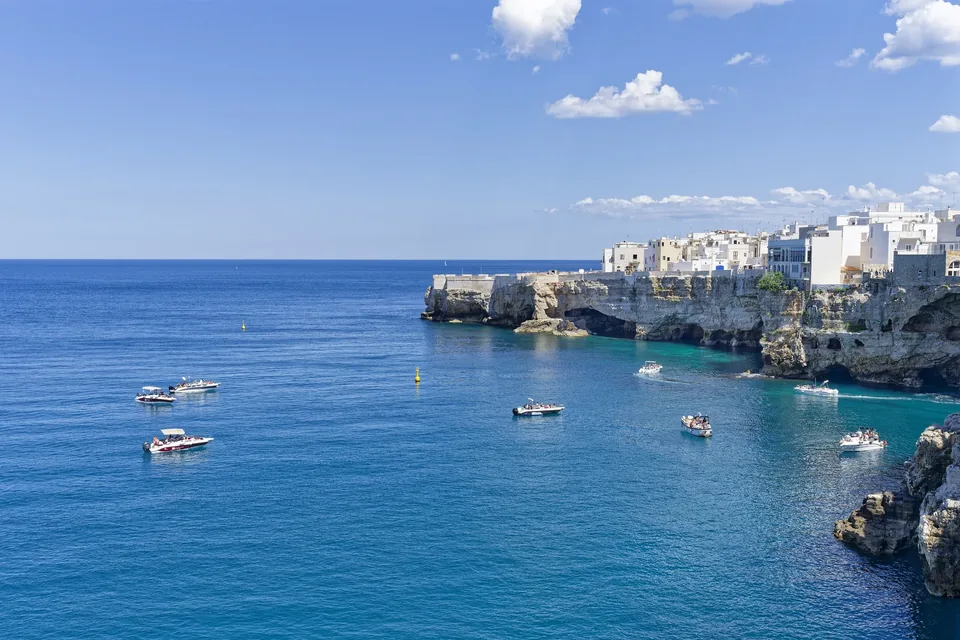
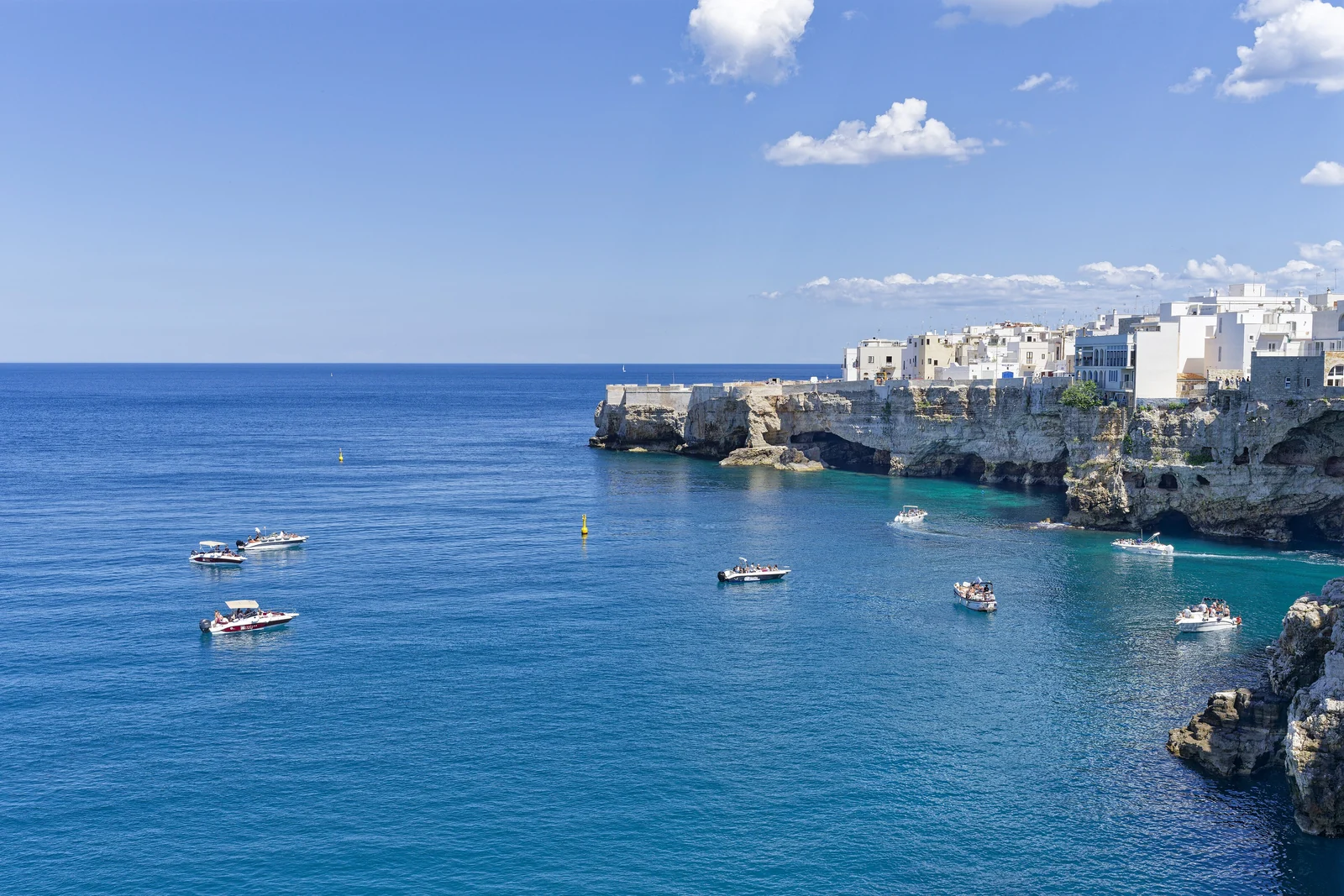
Italia.it describes Polignano a Mare perched on the edge of a high Adriatic cliff. The historic core, inhabited since the Neolithic, is a spread of white medieval houses, entered through the sixteenth-century Arco Marchesale, also called Porta Grande, which until 1780 was the only way into the town, then surrounded by a moat with a drawbridge.
In the centre are the thirteenth-century Chiesa Matrice, Palazzo Marchesale and the Clock Palace; every lane, the source notes, sooner or later ends at a view over the sea. The bridge behind Lama Monachile rests on a Roman bridge of the Via Traiana. On the other side of town is the museum of the Pino Pascali Foundation, devoted to another artist born in Polignano, while beneath the town the sea has carved some twenty caves.
The town thus offers more than one thread: Modugno’s music, Pascali’s contemporary art, the ancient history of the Via Traiana. To avoid reducing the visit to a single image, alternate these themes and give the historic centre time in quieter hours too.
Sources: Italia.it — Polignano a Mare
A voice before the view
To know Polignano through Modugno, we suggest listening before the walk. Without turning it into a music history lesson, you can notice three things: how a phrase begins, the change in intensity, the gesture accompanying the voice in images of the artist. Afterwards, the town offers a scale different from that of the stage.
The interest lies in comparing a familiar memory with a new presence. A song listened to well can leave a more fruitful question than many melodies used only as background for a photograph. You can then continue the walk looking for another way to tell the place, through a building, a voice or an object.
For families, this comparison can open a conversation about what each person recognises in a song and how it changes across generations. Grandparents can say where they first heard it, younger travellers can look for a recent version: the biographical thread stays precise, but it lets in the lives of those travelling.
Music, coast and an inland chapter
Picture a stop in Polignano with time for listening, walking and a separate pause at the table. The next day can shift perspective and lead inland, where another town or a farming theme adds variety. It is a way of not reducing the whole trip to the same sea view.
Choose the period according to the pace you want and any music programme actually published: Modugno’s memory remains a readable theme even without a concert. In summer the town is very busy and Lama Monachile is often crowded; in spring and autumn the clifftop walk is quieter and the historic centre can be observed calmly.
At the end of the visit, listening again can reveal details of the voice that went unnoticed before the trip. It is the simplest way to take the town home: not one more photograph, but a song that from now on will be tied to a precise place, a cliff and a square by the sea.
A thread for your journey
Song, walking and coast in Polignano, complementing an inland journey.
Talk to us