
At the foot of the boats
The Terre di Bari Guest Card guide explains how the city’s harbour is organised. The new port, mainly commercial, includes to the west the San Cataldo pier with its nineteenth-century lighthouse. Further south lies the old port, bounded by Sant’Antonio pier to the north and San Nicola pier to the south.
It is this second pier that bears the dialect name N’ dèrr’ a la lanze. The source links it to the lanz, the wooden boats, and to the habit of fishermen who, once ashore, threw the fish for sale straight onto the ground: the phrase literally means at the foot of the boats.
The name is a small lesson in urban history. It points to neither a monument nor an event, but to a gesture repeated every day, which for generations defined the relationship between the city and the sea. Stopping here means looking at Bari from the point where fishermen’s work met the life of the nearby neighbourhoods.
A city looking east
Italia.it presents Bari as the gateway to the East, thanks to the long tradition of trade that shaped its history. Settlement dates back to the Bronze Age; the city then passed to the Peucetians, Goths, Byzantines and Lombards, spent a period as a small emirate and finally returned to the Eastern Empire, which made it the main political, military and commercial centre of its Italian territories.
The same source recalls that Bari keeps the memory of medieval seafaring ventures alongside its monuments and churches. After the Normans and Swabians came the Angevins, the Aragonese and the era of Isabella of Aragon; in the nineteenth century, under French rule, the new town was born with its grid plan.
This long past reads well from the harbour. San Nicola pier lies at the base of the peninsula on which the old town stands: from here you see together the edge of the walls, the outline of the churches and the line of the seafront, the three ages that built today’s Bari.
9 May 1087: the relics enter the harbour
The pier’s name points to the city’s patron, who arrived from the sea. The Basilica of Saint Nicholas recounts that in 1087 sixty-two Bari sailors and merchants set out in three grain-laden ships bound for Antioch. On the route lay Andriake, the port of Myra, where the saint was buried, already venerated in Bari as protector of seafarers.
According to the Basilica’s account, the city was going through a difficult time: it had lost its role as Byzantine capital after the Norman conquest, and trade with the East was in crisis. Returning from Antioch, the men of Bari reached the church at Myra and took the saint’s bones, bringing them home after a voyage with many stops.
The ships entered Bari’s harbour on the afternoon of Sunday 9 May, welcomed by a cheering crowd. From then on, the source explains, the saint was also known as Saint Nicholas of Bari. Looking at the water of the old harbour with this story in mind changes how the place feels: it was here that the city began a new chapter.
Sources: Basilica Pontificia di San Nicola — Traslazione delle reliquie
Bari Vecchia between the two harbours
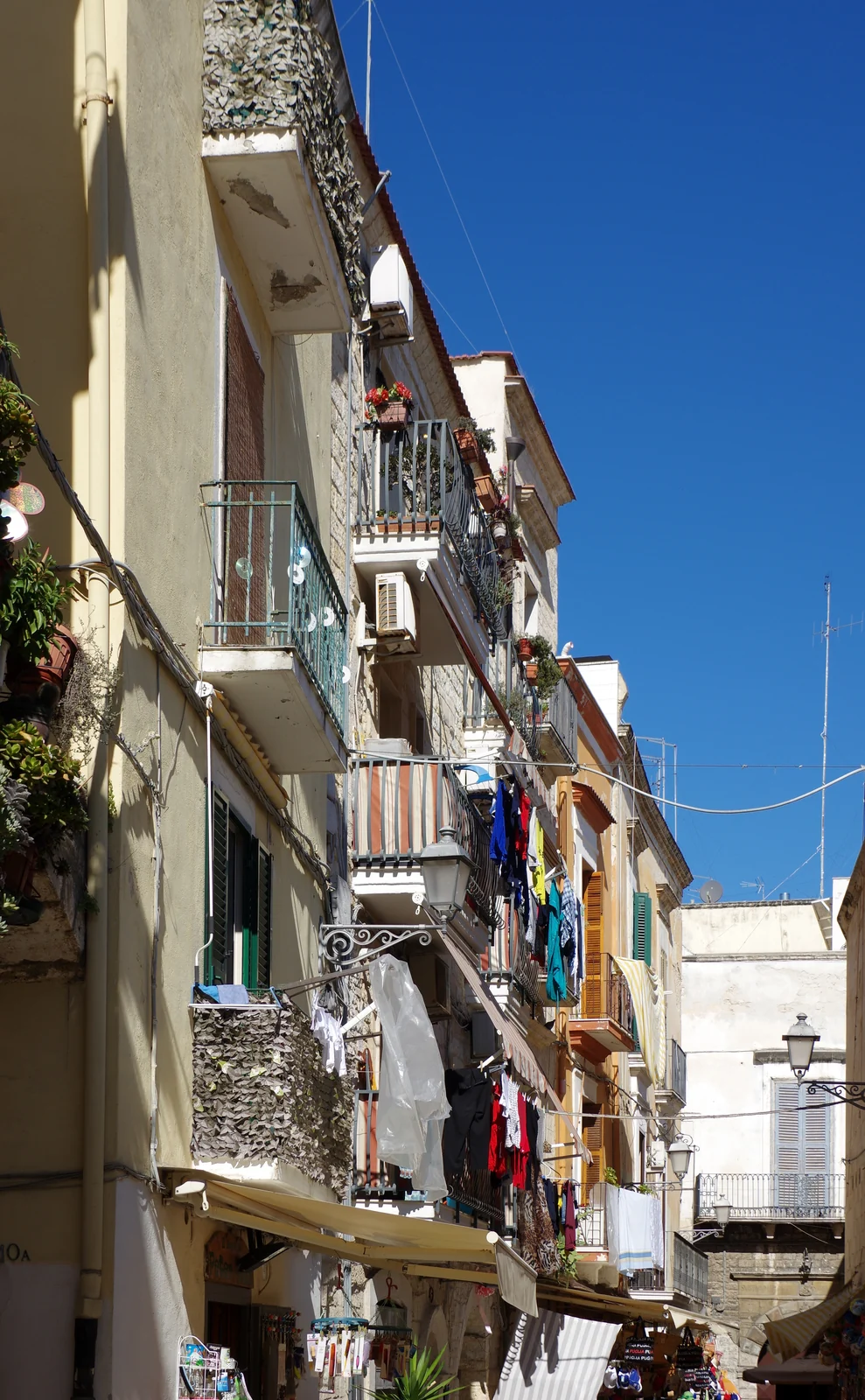
Behind the pier begins Bari Vecchia. Italia.it describes it as the old quarter, also called the San Nicola quarter, enclosed by the walls on the peninsula between the city’s two harbours. The name old town spread from the nineteenth century, to distinguish it from the new town built from 1813 under Joachim Murat.
The street plan, the source says, is Byzantine, with buildings ranging from the eleventh to the seventeenth century. Among the lanes there are some forty churches and chapels and more than a hundred votive shrines; standing out are the Basilica of Saint Nicholas, with the patron’s relics, and the Cathedral of San Sabino, an example of Apulian Romanesque. In the old Jewish quarter the traces of two synagogues can be recognised, while the Norman-Swabian Castle dominates the edge of the historic centre.
The quarter was regenerated in the early 2000s and is very lively today. From the pier a few steps are enough to enter the maze of streets: a quick shift from the waterline to the intimate scale of the lanes.
Sources: Italia.it — Bari Vecchia
The theatre built on the water
At the end of Corso Vittorio Emanuele, on the edge of the medieval town, Teatro Margherita adds another relationship between city and sea. The Ministry of Culture catalogue describes it as an Art Nouveau building from 1912 to 1914, raised on piles set in the water. After a long structural and façade restoration it was converted into an exhibition centre for contemporary arts.
The same entry places the Margherita in a broader context: in the 1920s Bari enjoyed great cultural ferment, shown by many theatres concentrated in little more than a kilometre and a half of the centre. Besides the Margherita, still open are the Piccinni, inaugurated in 1854 on Corso Vittorio Emanuele, the Petruzzelli on Corso Cavour, inaugurated in 1903, and the Kursaal Santalucia, an Art Nouveau example from 1927 reopened in 2021.
A theatre built literally on the sea lets you read the harbour as an architectural landscape too. From San Nicola pier the Margherita is a visual landmark linking fishermen’s work with the early twentieth-century bourgeois city.
Sources: Ministero della Cultura, Catalogo generale dei beni culturali — Teatri del primo Novecento a Bari
Three viewpoints on the harbour
For a walk we suggest three ways of looking: first the relationship between boats and land, then the waterline, finally Teatro Margherita. A dialect name leads to the memory of work; a building introduces urban history; the horizon recalls the routes along which the city received goods and people.
You can observe the same space from different points and ask what becomes the protagonist: a gesture, a façade, a passage. The pier thus gains depth even without a special event. Giving each reading a few minutes makes comparison with historical images more interesting than a hurried snapshot.
A practical tip: arrive from the seafront and leave the old town for later. This way you first sense the open scale of the harbour, with its movement and sounds, and only afterwards the density of the lanes. Early morning and late afternoon usually offer softer light for observing the coastline.
A place name is a way in
N’ dèrr’ a la lanze invites attention to language, not only to the view. Note the name and link it to what you have learned about the place’s function. Then look at the city at another scale: the relationship between harbour, streets and meeting places, and the way dialect keeps information that maps do not record.
The question is what image of Bari emerges when you start from an everyday gesture rather than a monument. The pier tells of a working city, the basilica of a devotional city, the theatre of a bourgeois city of entertainment: three faces living side by side within a few hundred metres.
This approach leaves room for food too, but tasting can follow the walk: first understand the context, then choose a dish that genuinely interests you. Families with children can turn the dialect name into a small translation game, looking for other places in the city with names tied to the sea.
A thread between sea and old town
Picture this chapter alongside a walk in the old town, keeping time for the pier separate from time for an interior or a museum. The harbour offers an open, urban reading; architecture adds documents and details. Together, the two moments make a coherent half-day without any need to rush.
As for timing, what matters is the kind of observation you want: light and views, a cultural visit, or a day with a food break. Those arriving during the May days devoted to the patron will find a much busier city tied to ritual; in other months the pier remains a quiet place, suited to a longer stop.
There is no need to build everything around a single product. The richest thread is the relationship between work, words and landscape: three ways of knowing Bari that can continue in a conversation at the table and, if the journey goes on, towards other harbours on the Apulian coast, where the same relationship between boats and town returns with different accents.
A thread for your journey
A part of town to read through work, language and memories of the sea.
Talk to us
