
The place and its history
Italia.it describes the basilica as an imposing building in Bari’s old town, with the massive, sober look typical of Norman architecture. It is a place of deep spirituality not only for local worshippers but for pilgrims from all over the world, because its crypt keeps the relics of Saint Nicholas, patron of the Apulian capital.
The source recalls that the church rose on the site of the residence of the catepan, the Byzantine governor of southern Italy between 968 and 1071, reusing many of its materials in construction between 1087 and 1100. Inside it points to three works not to miss: the throne of Abbot Elias, one of the masterpieces of Apulian Romanesque sculpture, the silver altar dedicated to the saint and the sixteenth-century mausoleum of Bona Sforza, Queen of Poland and Duchess of Bari.
Italia.it also notes that the basilica draws Orthodox faithful, who celebrate their own liturgies there. Alongside Catholic devotion, the place thus welcomes different traditions, and this coexistence is one of the most recognisable features of its identity.
Sources: Italia.it — Basilica di San Nicola
From the catepan’s residence to the basilica
The Basilica’s website explains that the church did not have religious origins. It was a civil building where the catepan lived, a figure between governor of Byzantine Italy and military commander: Bari was his seat from 968 until 1071, when, after a three-year siege, the city opened its gates to Robert Guiscard. Under the Normans Bari lost its role as capital and much of its trade, already in crisis because of the Muslim advance in Asia Minor.
It was in this context that the people of Bari brought the relics of Saint Nicholas to their city, as they lay along their usual trade route. News of it, the source notes, spread through Europe with exceptional speed, and a legend of the time describes the saint as the city’s new and more powerful catepan.
After a dispute between the people, who wanted a church devoted to the saint, and the archbishop, who wanted the relics in the cathedral, construction was entrusted to the Benedictine abbot Elias. Work began on 8 July; by September 1089 the crypt was ready, and on 1 October Pope Urban II placed the relics there.
Sources: Basilica Pontificia di San Nicola — Dalla residenza del Catepano alla Basilica nicolaiana
The relics’ voyage and the early years
The Basilica tells the story of the translation in detail. In 1087 sixty-two Bari sailors and merchants set out on three grain ships for Antioch; on the way back they reached Myra, in present-day Turkey, where the saint had been buried for some seven hundred and fifty years, and took his bones. After a voyage with many stops, they entered Bari’s harbour in May, welcomed by a cheering crowd.
The Archdiocese of Bari-Bitonto adds that when the crypt was consecrated in 1089, Urban II also consecrated Elias as Archbishop of Bari. Work was overseen by Elias, who died in 1105, and by his successor Eustathius. The basilica was consecrated only on 22 June 1197 by Conrad, Bishop of Hildesheim and chancellor of Emperor Henry VI, on behalf of Pope Celestine III. Elias is buried in the basilica, where some of the sailors who took part in the translation also rest.
From then on, the Basilica concludes, the saint was known not only as Nicholas of Myra but as Saint Nicholas of Bari: a name that forever binds his figure to the city and its harbour.
Sources: Basilica Pontificia di San Nicola — Traslazione delle reliquie · Arcidiocesi di Bari-Bitonto — Pontificia Basilica di San Nicola: storia
The prototype of Apulian Romanesque
The Archdiocese describes the basilica as the prototype of Apulian Romanesque: massive walls, a three-part façade with three portals, a heavy transept. Materials from several churches were used to build it, which would explain the different heights of the two towers and the different lengths of the sides; the Basilica’s website specifies that the north side is about two metres longer than the south. The main portal is sober, between two columns resting on bulls; the Lions’ Portal is rich in ornament and symbolic meaning.
The interior has three naves divided by columns and piers, with a twelfth-century ciborium. Between the altar and the apse stands Elias’s throne, a single block of marble with eleventh-century Byzantine-Apulian decoration, supported by telamons whose faces are strained with effort. Behind it is the funerary monument of Bona Sforza, who died in Bari in 1557, showing the queen at prayer between Saint Stanislaus and Saint Nicholas.
In the seventeenth century the Baroque left its mark on the ceiling with Carlo Rosa’s large canvases, on the silver altar and on the pulpit.
Sources: Arcidiocesi di Bari-Bitonto — Pontificia Basilica di San Nicola: storia · Basilica Pontificia di San Nicola — Architettura
The crypt and the saint’s tomb
The Basilica’s website recalls that the tomb was ready on 1 October 1089, when Urban II consecrated its altar; inside are two inscriptions of the time, one by Duchess Sichelgaita, wife of Robert Guiscard. Austere like an ancient altar, the tomb was soon clad in silver; in 1319 it received a covering donated by King Stefan Uroš II Milutin of Serbia. In the Baroque age that altar was melted down and remade by Neapolitan artists, and with the 1953–57 restoration the silver altar was moved to the upper church, giving the tomb back its austere character.
The source explains that the saint’s bones, about two thirds of the skeleton, lie at floor level. From the tomb the manna is collected, the liquid the faithful regard as a sign of holiness.
The Archdiocese adds that materials from Byzantine and Lombard churches were used for the crypt, and that behind a grille stands the so-called miraculous column, linked to a legend. In 1966 an Eastern chapel was set up there for Orthodox liturgy. We suggest distinguishing here a moment to observe and one to remain in silence.
Sources: Basilica Pontificia di San Nicola — La tomba del santo · Arcidiocesi di Bari-Bitonto — Pontificia Basilica di San Nicola: storia
A bridge between East and West
The Archdiocese recounts that liturgies of various Eastern Churches are not unusual in the basilica, from Byzantine-Greek to Byzantine-Slavic, from Coptic to Armenian, and that the shrine is a constant pilgrimage destination for many Eastern countries. In 1981 a chapel for Europe was also established, dedicated to Saints Cyril, Methodius and Benedict.
On 26 February 1984 John Paul II stopped at the tomb as an ecumenical pilgrim and, together with the Orthodox metropolitan of Myra, relit the single-flame lamp that burns beside the saint’s altar, a sign of the shared path of the Churches of East and West. In 1969 an Ecumenical Centre with an Institute of Ecumenical Theology had been founded. Since 1951 the basilica has been in the care of the Dominican friars, and since 1968 it has been a pontifical basilica.
The Treasury Hall holds votive gifts such as those of Charles II of Anjou from 1304 and an icon given by a king of Serbia in 1327, as well as paintings, icons and Russian lamps. For those crossing the old town, this perspective explains the presence of many languages and devotions in a place rooted in its neighbourhood yet open to distant ties.
Sources: Arcidiocesi di Bari-Bitonto — Pontificia Basilica di San Nicola: storia
The Nicholas Museum
The Ministry of Culture presents the Nicholas Museum, housed a few steps from the basilica in the rooms of the former Pilgrims’ Hospice, within the so-called Nicholas Citadel. The basilica has entrusted its management to an academy that renewed the exhibition route in 2019, with an audio guide in several languages available through an app.
The ground floor crosses the ages, from Greco-Roman to Byzantine to Norman-Swabian. Among the most important works the entry cites the votive crown and enamel of Roger II and a parchment with the seal of Frederick II of Swabia. The route continues with the so-called Treasure of Saint Nicholas: vestments, codices, liturgical objects, the original seal of the tomb, the parchment of the sixty-two sailors, Abbot Elias’s crozier and the cloth of the manna, along with tapestries, reliquaries and votive offerings.
Visiting the museum after the basilica gives the story a concrete face: the sailors’ parchment and Elias’s crozier turn names read in the sources into objects you can see up close. Booking is made through the channels indicated by the museum.
The May and December feasts
The Basilica’s website explains that the feasts of the first centuries after the translation are poorly documented. A Russian account already speaks of a great feast established by the pope, bishops and citizens and repeated every year; later papal bulls begin to distinguish the feast of 6 December from that of 9 May, linked to the relics’ arrival. Around 1200 the Consuetudines Barenses mention two feasts and two fairs.
In the early twentieth century, the same source recalls, the May feasts drew thousands of pilgrims, mainly from Abruzzo, Molise, Campania and various parts of Puglia, welcomed with bands, fireworks and a meal offered by the basilica to those who came from afar. In 1952 the Maggio di Bari was born, separating civic events from religious ones; the 1950s were the golden age of the historical procession.
Pilgrims still come, the source concludes, and the city’s task is to welcome them. Those wishing to experience the feasts should check the year’s official programme; those seeking a quieter experience can choose another period.
Sources: Basilica Pontificia di San Nicola — Feste di San Nicola: i primi tempi · Basilica Pontificia di San Nicola — Feste di San Nicola: il XX secolo
Romanesque and layers: two ways of looking
During the visit take a first look at the whole: proportions, light, the relationship between naves and the space you walk through. Then a second look at the individual objects recalled by the history of the place. A throne, an altar and a funerary monument do not tell the same period or function; relating them helps recognise the layers, from eleventh-century Romanesque to seventeenth-century Baroque.
It is more useful to choose two details to understand than to photograph everything without order. For those unfamiliar with religious architecture, the question can be simple: where does the eye go, and what distinguishes the place of devotion from other spaces? The presence of the relics changes how you meet the building, and contemplation should not be treated as an obstacle to the visit.
Pilgrims and art lovers may find different questions in the same space. The visit leaves a precise memory when you accept a slower pace than a tourist stroll, respecting the celebrations under way and those taking part.
From the basilica to the lanes, without changing theme
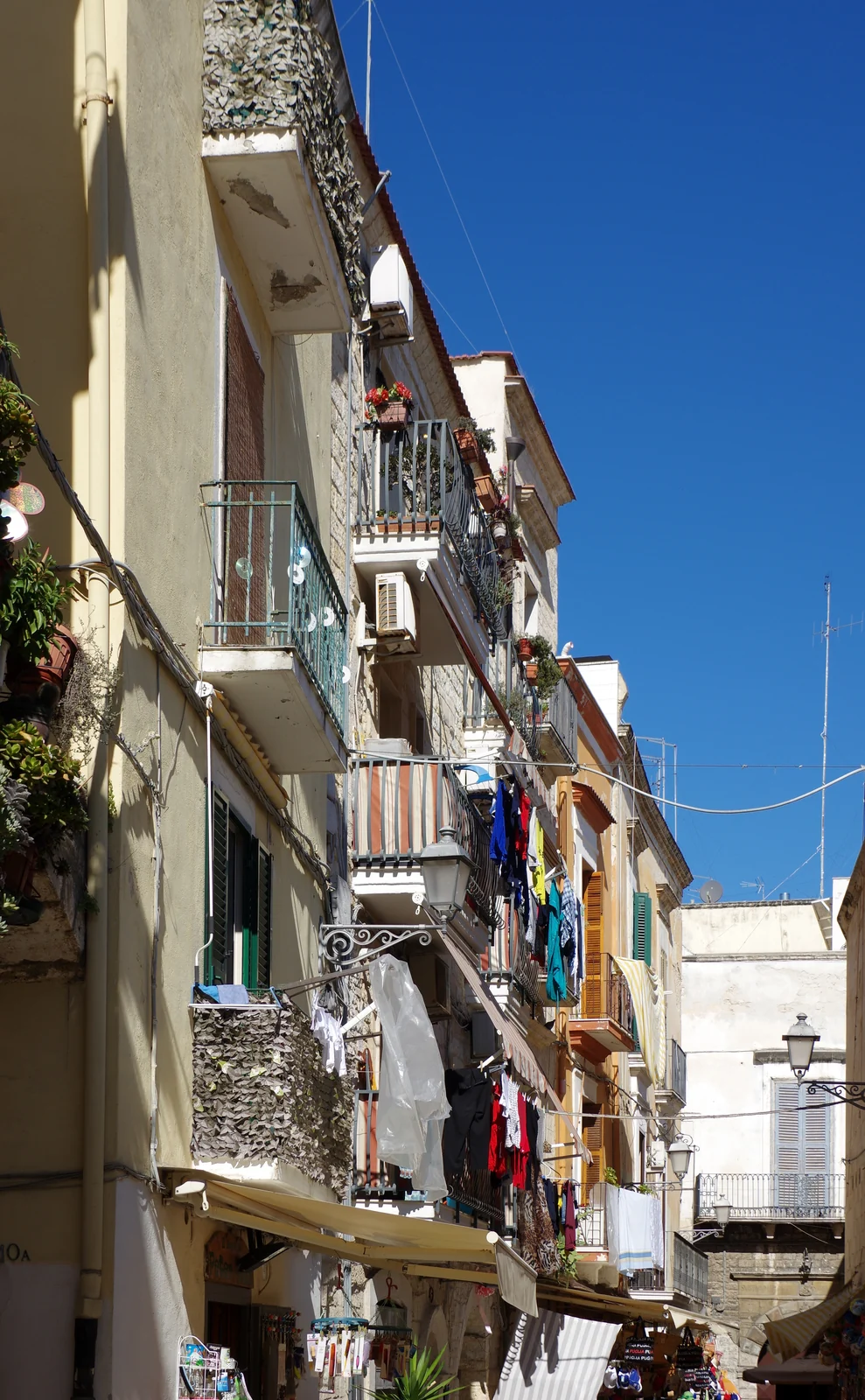
The suggested route continues through the old town, looking for the relationship between a great building and the small spaces around it. A square opens the view, a lane narrows it, a threshold introduces another use of space. The open area in front of the basilica, with the pilgrims’ portico, the museum and the nearby church of San Gregorio, shows how a whole quarter grew around the saint.
At the table the theme can shift to the everyday gestures of the neighbourhood, keeping the religious visit distinct from the food break. A walk to the old harbour, where the relics arrived, closes the circle of the story and links the basilica to the sea.
As for timing, choose what you want to experience: a quiet trip focused on architecture or a celebration identified in the calendar of the specific edition, in May or December. The two experiences have very different rhythms and deserve to be planned as such. Either way, arriving in the morning is worthwhile, when light enters the windows and the old town begins its day.
A thread for your journey
Separate time for studying the architecture from time for reflection. The relationship between the basilica and old town invites a slow walk attentive to neighbourhood life.
Talk to us
