
APULICA / FAITH
Cathedral of St Nicholas the Pilgrim
Cathedral · Trani · Puglia
In brief
- Construction began in 1099 at the wish of Bishop Bisanzio, after the death of the young pilgrim Nicholas, who had come to Trani from Greece. (Basilica Cattedrale di Trani - Storia, da Cattedrale paleocristiana a Basilica oggi)
- It stands on the seafront and is built of Trani stone, a pale local limestone with a pinkish tint. (Italia.it - Cattedrale di Trani, San Nicola Pellegrino · Basilica Cattedrale di Trani - Storia, da Cattedrale paleocristiana a Basilica oggi)
- Beneath the upper church lie the church of St Mary, the crypt of St Nicholas and the hypogeum of St Leucius, a remnant of the older cathedral. (Italia.it - Cattedrale di Trani, San Nicola Pellegrino · Basilica Cattedrale di Trani - Storia, da Cattedrale paleocristiana a Basilica oggi)
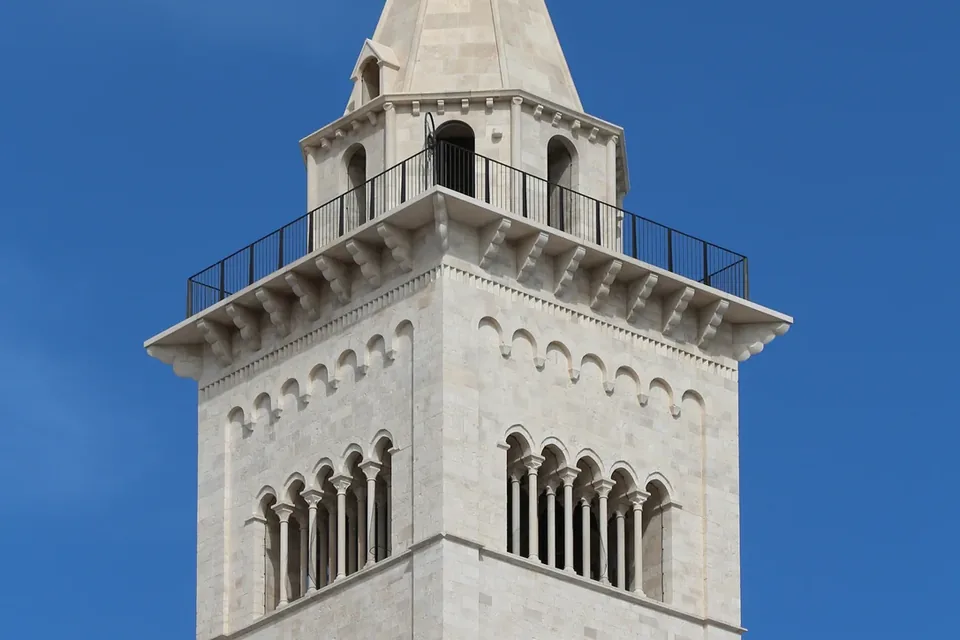
- The bell tower, 59 metres high, bears the signature of Nicolaus sacerdos et protomagister. (Italia.it - Cattedrale di Trani, San Nicola Pellegrino · Basilica Cattedrale di Trani - Storia, da Cattedrale paleocristiana a Basilica oggi)
- Barisano da Trani's original 12th-century bronze door is kept inside; a copy hangs outside. (Italia.it - Cattedrale di Trani, San Nicola Pellegrino · Basilica Cattedrale di Trani - Storia, da Cattedrale paleocristiana a Basilica oggi)
Festivals and dates
- Solemnity of the Transitus of St Nicholas the Pilgrim: 2 June (preceded by celebrations from 20 May) (Basilica Cattedrale di Trani - San Nicola Pellegrino di Trani · Arcidiocesi di Trani-Barletta-Bisceglie - Solenni festeggiamenti per il 932° anniversario del Transito)
- Patronal feast of St Nicholas the Pilgrim: late July - early August (in 2026 from 29 July to 3 August) (Arcidiocesi di Trani-Barletta-Bisceglie - Trani celebra San Nicola il Pellegrino: dal 29 luglio al 3 agosto)
- Summer
A cathedral built on the sea
The cathedral stands where an older church dedicated to the Virgin, documented from the 9th century, once stood. That building was demolished to make way for the new one, but its underground chapel dedicated to St Leucius, first bishop of Brindisi, and fragments of its mosaic floor survive.
The great church was begun in 1099 by Bishop Bisanzio, after the death and canonisation of the young pilgrim Nicholas, who had landed at Trani from Greece. It was built with public funds to a bold, unified plan designed to isolate the building from seawater rising from below; the work occupied the community for decades. The upper church was completed in the last decades of the 12th century, and the saint's relics were translated into it in 1143.
In the second half of the 12th century Archbishop Bertrand commissioned the marble portal, entrusted to the Trani sculptors Bernardo and Eustasio, and the bronze door by Barisano. The bell tower, begun in the 13th century, soon showed stability problems: in 1957 the heritage authority dismantled it stone by stone to rebuild its foundations.
Sources: Italia.it - Cattedrale di Trani, San Nicola Pellegrino · Basilica Cattedrale di Trani - Storia, da Cattedrale paleocristiana a Basilica oggi · Basilica Cattedrale di Trani - San Nicola Pellegrino di Trani
Nicholas, the young man of the 'Kyrie eleison'
St Nicholas the Pilgrim should not be confused with St Nicholas of Bari: he was a young Greek who walked the streets repeating the invocation 'Kyrie eleison'. According to the cathedral's chronology, this got him thrown out of home by his mother, mistreated by the monks he had been entrusted to and, in Taranto, flogged on the bishop's orders. In 1092 he sailed towards Otranto and passed through several places along the coast.
On 20 May 1094 he reached Trani, where his street preaching drew children and won the approval of Archbishop Bisanzio, who allowed him to stay. He fell ill soon afterwards and died on 2 June, aged 19. He is patron of the city and of the archdiocese of Trani-Barletta-Bisceglie.
The devotion is still alive: during the feast the cathedral stays open late into the evening for the veneration of the relics, and in the small church built where the saint died Orthodox faithful have also gathered to pray together.
Sources: Basilica Cattedrale di Trani - San Nicola Pellegrino di Trani · Arcidiocesi di Trani-Barletta-Bisceglie - Trani celebra San Nicola il Pellegrino: dal 29 luglio al 3 agosto · Arcidiocesi di Trani-Barletta-Bisceglie - La Notte di San Nicola 2025 (programma)
Three stacked churches and Barisano's door
The cathedral combines church, crypt and hypogeum, flanked by a 59-metre bell tower that opens at its base with a pointed arch. A double staircase leads up the façade to the portal, while a wide opening beneath the stairs gives access to the lower churches.
The upper church, dedicated to the Virgin of the Assumption, has three naves with galleries and paired columns; in the presbytery there are traces of the original mosaic floor, similar to that of Otranto Cathedral. The crypt of St Nicholas, beneath the presbytery, is tall and bright, with cross vaults on columns of Greek marble, and holds the saint's relics. Lower still, about a metre and a half below sea level, lies the hypogeum of St Leucius, a Lombard-period chapel with a central chamber for relics and an ambulatory for the faithful.
Do not miss Barisano da Trani's bronze door: 32 panels with saints, apostles, scenes of Christ's life and Eastern-style motifs. The original is kept inside, while a 2012 copy hangs outside. The marble portal uses Old Testament images to build a narrative devoted to Christ as the Word.
Sources: Italia.it - Cattedrale di Trani, San Nicola Pellegrino · Basilica Cattedrale di Trani - Storia, da Cattedrale paleocristiana a Basilica oggi
2 June and the summer feast
Trani honours its patron at two moments. The first is the anniversary of the Transitus, the saint's death: in 2026 the celebrations, organised by the Confraternity of St Nicholas the Pilgrim with the archdiocese and the municipality, began on 20 May, the day he arrived in the city, and culminated on 2 June with a concelebrated Mass led by the archbishop and a procession through the streets with the saint's image.
The second is the patronal feast of late July and early August, which in 2026 runs from 29 July to 3 August. After a three-day preparation in the parishes, with the peregrinatio of the saint's image, the Sunday is devoted to Mass with the archbishop and the procession with the effigy, accompanied by confraternities and authorities, to the cathedral.
On the final day, the patron's liturgical feast, after the solemn Mass the statue of St Nicholas is carried to the port and taken on board, landing at the Colonna pier and returning to the cathedral in the evening. In 2025 the feast opened with a 'night of St Nicholas' spread across the historic centre, with the cathedral open late.
Sources: Arcidiocesi di Trani-Barletta-Bisceglie - Trani celebra San Nicola il Pellegrino: dal 29 luglio al 3 agosto · Arcidiocesi di Trani-Barletta-Bisceglie - Solenni festeggiamenti per il 932° anniversario del Transito · Arcidiocesi di Trani-Barletta-Bisceglie - La Notte di San Nicola 2025 (programma)
How the visit works
The cathedral stands on a wide square overlooking the sea, beyond the historic centre and the port, facing Frederick II's castle. Visitor reception is handled by the basilica itself through its official website, Basilica Cattedrale di Trani (www.cattedraletrani.it): groups of seven or more, with or without an authorised guide, must book entry in advance, while smaller groups may enter without booking.
The guided route starts in the lower churches and ends in the upper church. The crypt of St Nicholas, which holds the Blessed Sacrament and the saint's relics, is reserved for prayer and is not open to tourist visits. Visits are suspended during services, clothing covering shoulders and legs is required, and photographs may not be taken without written permission from the diocesan curia.
Sources: Italia.it - Cattedrale di Trani, San Nicola Pellegrino · Basilica Cattedrale di Trani - Visita la Cattedrale di Trani · Italia.it - Trani, borgo in Puglia: cosa vedere
The place
Trani
Cathedral, castle and Jewish heritage for a coastal ending with cultural depth.
Read the guide →Photo: Bernard Gagnon / Wikimedia Commons — CC0 · Resized and converted to WebP.

Sources
- Italia.it - Cattedrale di Trani, San Nicola Pellegrino
- Basilica Cattedrale di Trani - Storia, da Cattedrale paleocristiana a Basilica oggi
- Basilica Cattedrale di Trani - San Nicola Pellegrino di Trani
- Arcidiocesi di Trani-Barletta-Bisceglie - Trani celebra San Nicola il Pellegrino: dal 29 luglio al 3 agosto
- Arcidiocesi di Trani-Barletta-Bisceglie - Solenni festeggiamenti per il 932° anniversario del Transito
- Arcidiocesi di Trani-Barletta-Bisceglie - La Notte di San Nicola 2025 (programma)
- Basilica Cattedrale di Trani - Visita la Cattedrale di Trani
- Italia.it - Trani, borgo in Puglia: cosa vedere