
APULICA / FAITH
Holy Week Rites: Church of the Carmine and San Domenico Maggiore
Church · Taranto · Puglia
In brief
- The rites are entrusted to the Archconfraternity of the Carmine and the Confraternity of the Addolorata and San Domenico. (Arciconfraternita del Carmine - Taranto - Settimana Santa · Comune di Taranto - Riti della Settimana Santa 2025: modifiche alla viabilità)
- The brothers' slow, swaying step is called 'nazzecata' in the Taranto dialect. (Arciconfraternita del Carmine - Taranto - Settimana Santa)
- Since 1765 the Procession of the Sacred Mysteries has been organised by the Carmine Confraternity, to which the Calò family donated the statues. (Arciconfraternita del Carmine - Taranto - La Storia · CEI - Ufficio per le comunicazioni sociali - Una app aiuta a vivere la processione)
- The Procession of the Mysteries leaves the Church of the Carmine at 5 pm on Good Friday and returns on the morning of Holy Saturday. (Arciconfraternita del Carmine - Taranto - Settimana Santa · CEI - Ufficio per le comunicazioni sociali - Una app aiuta a vivere la processione)
- The wooden statue of Our Lady of Sorrows is kept in the church of San Domenico Maggiore, in the old town. (Italia.it - Chiesa di San Domenico Maggiore a Taranto)
Festivals and dates
- Pilgrimage of the Carmine 'poste' to the Altars of Repose (perdoni): Holy Thursday from 3 pm into the night, resuming at dawn on Good Friday (Arciconfraternita del Carmine - Taranto - Settimana Santa · Comune di Taranto - Riti della Settimana Santa 2025: modifiche alla viabilità)
- Procession of Our Lady of Sorrows: night between Holy Thursday and Good Friday (Italia.it - Chiesa di San Domenico Maggiore a Taranto · Comune di Taranto - Riti della Settimana Santa 2025: modifiche alla viabilità)
- Procession of the Sacred Mysteries: from 5 pm on Good Friday to the morning of Holy Saturday (Arciconfraternita del Carmine - Taranto - Settimana Santa · CEI - Ufficio per le comunicazioni sociali - Una app aiuta a vivere la processione · Comune di Taranto - Riti della Settimana Santa 2025: modifiche alla viabilità)
- Spring
Confraternities and rites since the 16th century
In Taranto the pilgrimage to the Altars of Repose, set up in the churches on Holy Thursday, has existed at least as long as the confraternities, that is, since the 16th century. The Carmine Confraternity was formally established by archiepiscopal decree on 10 August 1675 in the Church of the Carmine, the former Santa Maria della Misericordia entrusted to the Carmelites in 1577.
1765 was a decisive year: the Calò family, who for about seventy years had carried the statues of the Dead Christ and Our Lady of Sorrows in procession on Good Friday, gave them to the Church of the Carmine, and the confraternity has organised the Procession of the Sacred Mysteries ever since. In 1777 a decree of Ferdinand IV granted the Carmine brothers precedence in visiting the Altars of Repose, and in 1875 Pius IX gave those making the pilgrimage the indulgences of Rome's seven churches.
Since the years after the Second World War the Carmine Confraternity has been the only one in the city to keep the pilgrimage of the 'poste'. The night procession of Our Lady of Sorrows, by contrast, belongs to the church of San Domenico Maggiore and the Confraternity of the Addolorata and San Domenico. In 2025 the 350th anniversary of the Archconfraternity of the Carmine was marked by a special Holy Year granted by Pope Francis.
Sources: Arciconfraternita del Carmine - Taranto - Settimana Santa · Arciconfraternita del Carmine - Taranto - La Storia · Italia.it - Chiesa di San Domenico Maggiore a Taranto · CEI - Ufficio per le comunicazioni sociali - Una app aiuta a vivere la processione · Comune di Taranto - La Processione dei Misteri nella Città Vecchia? · Arciconfraternita del Carmine - Taranto - La Chiesa
Perdoni, poste and the nazzecata
The most recognisable feature of the Taranto rites is the brothers' step: extremely slow, with a constant swaying that locals call the 'nazzecata'. On Holy Thursday the Carmine brothers, the 'perdoni', go out in pairs called 'poste', wearing the ritual habit with the hood drawn over the face, hat and pilgrim's staff, traditionally barefoot, and visit the Altars of Repose of the churches of the Borgo and the Old Town one after another.
On reaching a church, each pair approaches the altar, makes its reverences and relieves the previous pair, then pauses in adoration before the Blessed Sacrament. The rite combines personal penance and communal prayer: before the Triduum the brothers attend a penitential liturgy, because the habit is worn in a state of grace.
During the night the statue of Our Lady of Sorrows is carried in procession from San Domenico, while on Good Friday the Procession of the Mysteries retraces the Passion, from the Garden of Gethsemane to the Dead Christ, followed by Our Lady of Sorrows. The municipality regards them as fundamental to Taranto's history and culture, and every year they draw thousands of visitors.
Sources: Arciconfraternita del Carmine - Taranto - Settimana Santa · Italia.it - Chiesa di San Domenico Maggiore a Taranto · Comune di Taranto - La Processione dei Misteri nella Città Vecchia?
The two churches and the statues of the Mysteries
The church of San Domenico Maggiore, in the northern part of the old town, was founded in 1302 with a Dominican convent in place of the Benedictine church of San Pietro Imperiale, which had itself risen over a Greek-era temple. It has a Gothic façade raised above Via Duomo, reached by an 18th-century Baroque double staircase; one of its chapels holds the wooden statue of Our Lady of Sorrows.
The Church of the Carmine, in the Borgo, has a façade and a tall bell tower from 1937. Inside are the 17th-century panel of Our Lady of Mount Carmel behind the altar, a painting by Paolo De Matteis, the stucco work of vault, dome and walls and, in the middle of the nave, two stucco Crosses of the Mysteries; a shrine halfway along the nave holds the old statue of Our Lady of Sorrows.
The statues of the Procession of the Mysteries include Christ in the Garden, made in 1924 by Salvatore Saquegna of Lecce; the Column, the Ecce Homo and the Fall, made in 1901 by Giuseppe Manzo; then the Crucifix, the Holy Shroud, the Dead Christ and Our Lady of Sorrows, the last two coming from the Calò family's original procession.
Sources: Arciconfraternita del Carmine - Taranto - Settimana Santa · Italia.it - Chiesa di San Domenico Maggiore a Taranto · Arciconfraternita del Carmine - Taranto - La Chiesa
From Holy Thursday to Holy Saturday
Holy Week has no fixed date: it follows Easter, between March and April. On Holy Thursday at 3 pm the Carmine 'poste' begin the pilgrimage to the Altars of Repose, which ends around midnight with the return to the Carmine and resumes at first light on Good Friday until mid-morning. On Thursday afternoon, at the Carmine, the spiritual father celebrates the Mass of the Lord's Supper with the washing of the feet of twelve brothers.
During the night between Holy Thursday and Good Friday the procession of Our Lady of Sorrows leaves the church of San Domenico and crosses the old town and the Borgo; along the way it pauses in front of the Church of the Carmine for a moment of prayer, and the pairs who cross its path kneel before the Cross of the Mysteries and the Virgin.
At 5 pm on Good Friday the Carmine door opens on the 'troccolante', the only brother wearing his hat, who opens the Procession of the Sacred Mysteries with the troccola clapper; bands, the banner, the Cross of the Mysteries and the statues follow, each preceded by four pairs of brothers. According to the Italian Bishops' Conference communications office the procession takes about fourteen hours to cover two kilometres; it returns to the Carmine around 9 am on Holy Saturday, to the funeral march 'Jone'.
Sources: Arciconfraternita del Carmine - Taranto - Settimana Santa · CEI - Ufficio per le comunicazioni sociali - Una app aiuta a vivere la processione · Comune di Taranto - Riti della Settimana Santa 2025: modifiche alla viabilità
Attending the rites
The processions cross the Borgo and the old town, and during the rites the Municipality of Taranto closes the old town and the route streets to traffic; while the Altars of Repose pilgrimage, the Addolorata and the Mysteries are passing, public transport cannot enter the old town either. It is therefore best to move on foot and to check in advance the traffic orders published by the municipality.
To follow the Procession of the Mysteries, the Archconfraternity of the Carmine offers the free 'Decor Carmeli Taranto' app, which shows its position in real time and offers prayers and reflections; programmes and news are published on the official website of the Archconfraternity of the Carmine (www.confraternitadelcarmine.it).
Sources: Italia.it - Chiesa di San Domenico Maggiore a Taranto · CEI - Ufficio per le comunicazioni sociali - Una app aiuta a vivere la processione · Comune di Taranto - Riti della Settimana Santa 2025: modifiche alla viabilità · Arciconfraternita del Carmine - Taranto - Home
The place
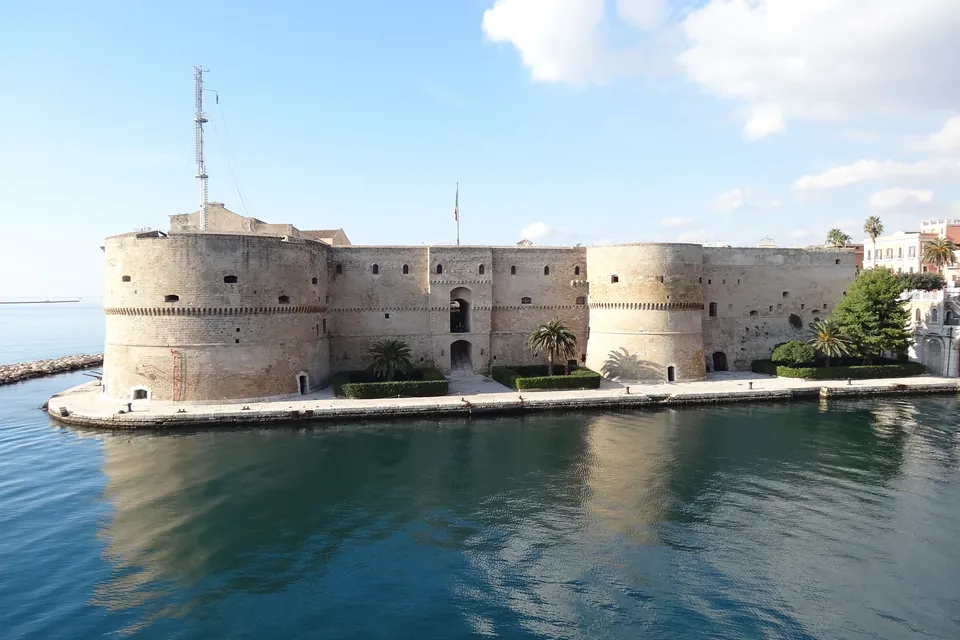
Taranto
Taranto: two seas and archaeology.
Read the guide →Photo: Livioandronico2013 / Wikimedia Commons — CC BY-SA 3.0 · Resized and converted to WebP.
.JPG)
Sources
- Arciconfraternita del Carmine - Taranto - Settimana Santa
- Arciconfraternita del Carmine - Taranto - La Storia
- Italia.it - Chiesa di San Domenico Maggiore a Taranto
- CEI - Ufficio per le comunicazioni sociali - Una app aiuta a vivere la processione
- Comune di Taranto - Riti della Settimana Santa 2025: modifiche alla viabilità
- Comune di Taranto - La Processione dei Misteri nella Città Vecchia?
- Arciconfraternita del Carmine - Taranto - La Chiesa
- Arciconfraternita del Carmine - Taranto - Home