Why go
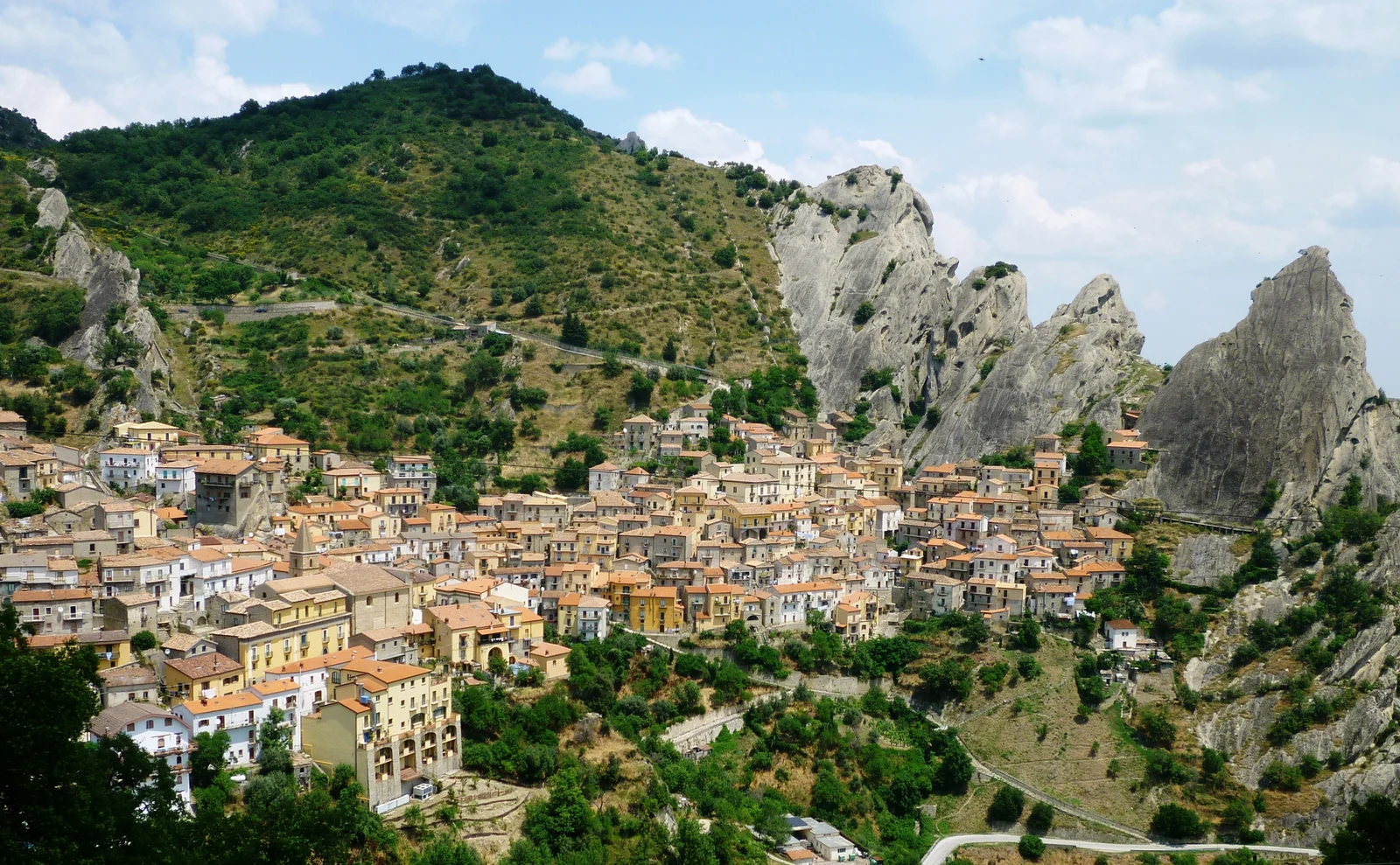
Castelmezzano is one of the most striking villages in Basilicata: a small town in the province of Potenza gathered in a hollow of rock beneath the sandstone spires of the Piccole Dolomiti Lucane. The municipality notes that you enter through a tunnel cut in the stone, after a gorge, and that on leaving it the whole village appears at once, its houses roofed in sandstone slabs and wedged among the cliffs. This balance between houses and rock earned it the label of a nature-town and a place in the club of the Most Beautiful Villages in Italy.
The rock faces around the village have shapes that tradition has named: the golden eagle, the owl, the anvil, the lion's mouth, the great mother. The Gallipoli Cognato Piccole Dolomiti Lucane regional park, to which Castelmezzano belongs, describes them as giants risen from the sea.
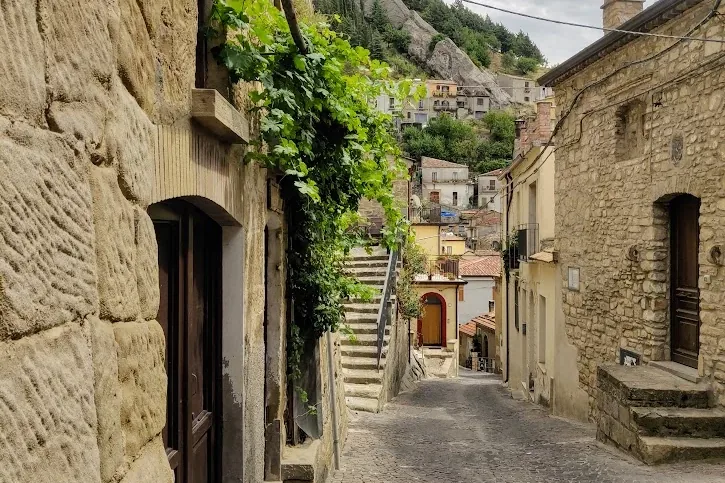
Come here to walk among stairways and lanes, to take in the landscape from a viewpoint, to try the Volo dell'Angelo or the via ferratas, and to meet a community that has kept old festivals such as the September Maggio.
Sources: Comune di Castelmezzano — Il paese · Parco Gallipoli Cognato Piccole Dolomiti Lucane — Castelmezzano · Parco Gallipoli Cognato Piccole Dolomiti Lucane — Le Piccole Dolomiti Lucane · Italia.it — Castelmezzano
History
The municipality traces the area's origins to the sixth and fifth centuries BC, when Greek settlers moved up the Basento valley and founded a settlement called Maudoro. In the tenth century Saracen raids drove people to look for a safer site: tradition tells of a shepherd, Paolino, who found these steep rocks from which attackers could be repelled by rolling boulders down. The park recalls that Arabs reached this area and Pietrapertosa in the early ninth century, leaving a way of settling that uses nature as both resource and defence.
Between the eleventh and thirteenth centuries the Normans built the castle. The name comes from Castrum Medianum, the middle castle between those of neighbouring towns. Decline followed under the Angevins and a series of feudal lords under the Aragonese; the De Leonardis family ruled from 1580 to 1686, followed by marriage by the De Lerma, until the early nineteenth century.
In the nineteenth century the rocks and woods sheltered brigands. At the end of the century many families emigrated overseas, as happened in much of inland Basilicata.
Sources: Comune di Castelmezzano — Storia · Parco Gallipoli Cognato Piccole Dolomiti Lucane — Castelmezzano
What to see
The heart of the village is Piazza Caizzo, with the mother church of Santa Maria dell'Olmo. The municipality describes its Romanesque facade in local stone, with four columns and a lintel carved with flowers, lions and double-headed eagles, and inside the wooden statue of the Madonna dell'Olmo, dated to the late thirteenth century, and a Holy Family by Giovanni De Gregorio, known as Pietrafesa, a Lucanian painter working between late Mannerism and the Baroque.
From the town hall the main street leads to the ruins of the Norman castle: part of the curtain wall survives, with a rainwater cistern and a long stairway cut into the rock that climbs to a lookout over the Basento valley. Along the way are the eighteenth-century Palazzo Ducale of the De Lerma, with a rusticated doorway and loggia, and the nineteenth-century Palazzo Coiro, with wrought-iron balconies.
Outside the village, paths, stairways and small bridges descend into the valley of the Caperrino stream, where you can see the remains of old mills roofed with stone slabs called chiang and a single-arched bridge, perhaps Roman, from which you can climb up towards Pietrapertosa.
Sources: Comune di Castelmezzano — Il paese · Parco Gallipoli Cognato Piccole Dolomiti Lucane — Castelmezzano
Food and wine
Castelmezzano's cooking is that of inland Basilicata: handmade pasta, pulses, meat and cheese. Italia.it lists among the region's typical dishes strascinati and other semolina pastas, lucanica sausage, caciocavallo podolico made with milk from free-ranging cows, and peperoni cruschi, peppers dried in the air and fried for a few seconds until crisp. The Slow Food Presidium for caciocavallo podolico covers precisely the towns of the Lucanian Apennines and the Matera hills.
The Gallipoli Cognato park describes the produce of the protected area: cheeses and dairy from Podolica milk, traditional cured meats, honey, oil, preserves and mushrooms, born of a close bond between herding, woodland and community.
One dish tells the village calendar well. On 13 December, for the feast of Saint Lucy, the municipality describes the cuccia festival: in front of the mother church a large cauldron cooks broad beans, wheat, chickpeas and grass peas, which are blessed and handed out to the faithful after Mass as a wish for good fortune.
Sources: Italia.it — Prodotti e piatti tipici lucani · Fondazione Slow Food — Caciocavallo podolico della Basilicata · Parco Gallipoli Cognato Piccole Dolomiti Lucane — Prodotti tipici · Comune di Castelmezzano — Festività
Things to do
The Volo dell'Angelo is the best-known experience: a steel cable stretched between Castelmezzano and Pietrapertosa that you ride in a harness, high above the Lucanian Dolomites. The official site describes two lines, San Martino from Pietrapertosa to Castelmezzano and Peschiere in the opposite direction, each about a kilometre and a half long. The Castelmezzano starting station is reached by a short walk after the shuttle, so hiking shoes are needed; solo flights are allowed from age fourteen, with weight and height limits set by the operator.
If you prefer to stay on the rock, the Salemm via ferrata on the Castelmezzano side is about 1.7 kilometres long with 249 metres of ascent and EEA difficulty; the Nepalese Bridge, hanging up to 35 metres above the ground, links it with the Pietrapertosa ferrata. The operator requires specific equipment, which can be hired, and recommends a guide for beginners.
Gentler is the Path of the Seven Stones, an old farm track of about two kilometres between the two villages, with seven installations inspired by the tale Vito ballava con le streghe. The village also has a rail-mounted alpine coaster more than a kilometre long.
Sources: Volo dell'Angelo — L'esperienza · Volo dell'Angelo — Domande frequenti · Volo dell'Angelo — Via Ferrata Salemm · Volo dell'Angelo — Ponte Nepalese delle Dolomiti Lucane · Volo dell'Angelo — Percorso delle Sette Pietre · Volo dell'Angelo — Slittovia delle Dolomiti Lucane · Italia.it — Il Volo dell'Angelo
When to go
Spring, summer and early autumn are the best seasons for walking and for the outdoor attractions. Italia.it notes that the Volo dell'Angelo runs in the fine season; the operator's published calendar changes every year and, in May, opening also depends on the monitoring of nesting birds carried out by the park's scientific committee. The operator advises against the via ferratas in rain, snow or wind.
The municipality's festival calendar is full. The first Sunday in May honours the Madonna del Bosco; forty days after Easter, the Madonna of the Ascension; on 18 and 19 August the patron Saint Roch. Between 11 and 13 September, for Saint Anthony of Padua, the village celebrates the Maggio, the marriage of the trees: a Turkey oak trunk hauled by pairs of oxen and a holly crown carried by young men are joined, raised and climbed, as happens in other nearby towns.
Winter is colder and quieter. On 13 December the feast of Saint Lucy and the sharing of the cuccia are a good moment to see village life away from the busiest months.
Sources: Italia.it — Il Volo dell'Angelo · Volo dell'Angelo — Calendario di apertura · Volo dell'Angelo — Ponte Nepalese delle Dolomiti Lucane · Comune di Castelmezzano — Festività · Comune di Castelmezzano — Il paese
Getting there and around
By car, take the SS407 Basentana, which runs down from Potenza towards Metaponto. The Volo dell'Angelo operator gives the Albano exit for Castelmezzano when coming from Potenza; from Naples and Salerno follow the motorway to Sicignano and then the link road to Potenza; from Bari and Matera join the Basentana towards Potenza. The park notes that its headquarters, at Palazzo near Accettura, lie about thirty kilometres from Potenza.
Without a car the reference point is Potenza, reached by Ferrovie dello Stato trains via Foggia or via Taranto, or by Ferrovie Appulo Lucane. From Potenza the Volo operator points to regional bus lines for Castelmezzano. The nearest airports mentioned by the park are Bari Palese and Naples Capodichino. Connections to the park villages are few, so check them before setting off.
The village is visited on foot. Cars are left at the entrance to the village and along the provincial road; on Volo opening days a shuttle links the centre with the paths leading to the stations. Lanes and stairways are steep: wear comfortable shoes.
Sources: Volo dell'Angelo — Come arrivare · Parco Gallipoli Cognato Piccole Dolomiti Lucane — Come arrivare · Volo dell'Angelo — Domande frequenti
Where to stay
The municipality's hospitality page lists several properties in the village and its rural districts: mostly bed and breakfasts and houses in the old centre, along with a few farm stays, hotels and an inn. Many occupy homes in the old village, among lanes, stairways and mansions; others are in the countryside, along the provincial road or in outlying districts.
Staying in the village has a practical advantage: in the evening, when day visitors leave, Castelmezzano grows quiet and the lit-up rocks become the main show. It is also the easiest option if you want to start early on a via ferrata or be on time at the ticket office for the flight. Travellers with a car who want more space can choose a farm stay in the surrounding countryside, perhaps with farm produce.
On summer weekends, during the September Maggio and on holiday weekends demand rises, so book ahead; Pietrapertosa, reachable on foot along the Path of the Seven Stones, also has rooms. Apulica does not list specific properties here: the choice is made case by case, weighing access, stairs and the kind of trip.
Sources: Comune di Castelmezzano — Ospitalità · Comune di Castelmezzano — Il paese · Volo dell'Angelo — Percorso delle Sette Pietre
Nearby
Pietrapertosa, the twin village on the other side of the Lucanian Dolomites, is linked to Castelmezzano by paths, roads and the Volo dell'Angelo cable. The park places it at about a thousand metres, at the foot of the peaks, with views across the whole Dolomite landscape. Between the two villages, the Caperrino valley with its old bridge and mills is crossed on foot along the old farm track of the Seven Stones.
To the east you enter the Gallipoli Cognato forest and reach Accettura, known for its Pentecost Maggio and the Museum of Tree Rituals: a good complement to Castelmezzano's September Maggio, showing how the same rite changes from village to village. On Monte Croccia, in the state anthropological reserve, you can see the remains of the megalithic walls of the Lucanian settlement of Croccia Cognato.
The Palazzo visitor centre, in the heart of the forest, offers information, maps and a natural history museum, and is the starting point for many park trails. With more days, continue towards Matera or Potenza, combining rock, woodland and towns.
Sources: Parco Gallipoli Cognato Piccole Dolomiti Lucane — Le Piccole Dolomiti Lucane · Comune di Castelmezzano — Il paese · Volo dell'Angelo — Percorso delle Sette Pietre · Italia.it — Accettura · Parco Gallipoli Cognato Piccole Dolomiti Lucane — Cultura e tradizioni · Italia.it — Riserva naturale antropologica Monte Croccia · Parco Gallipoli Cognato Piccole Dolomiti Lucane — Centro attrezzato Palazzo
Local tourist information
Local tourist offices help with opening times, events and transport on the day.
- Centro accoglienza visitatori del Parco Gallipoli Cognato Piccole Dolomiti Lucane — Centro attrezzato «Palazzo» · Località Palazzo, 75011 Accettura (MT) · +39 347 095 7967 · info@parcogallipolicognato.it · Official website
Source: Parco Gallipoli Cognato Piccole Dolomiti Lucane — Centro attrezzato Palazzo · checked on
Where to stay
In the municipality of Castelmezzano the national database of the Ministry of Tourism lists 44 accommodation businesses with a verified CIN code: 2 hotels, 18 other licensed accommodation and 24 other types such as B&Bs and private rentals.
Sources: Ministero del Turismo – Banca Dati Strutture Ricettive (dashboard pubblica), 2026-10-12
YOUR JOURNEY
How to shape a journey here
Spend time in the town before choosing an activity. Looking at how houses meet the rock is already an essential part of the visit.
Talk to us about it