Giovinazzo and Our Lady of Corsignano
The Diocese of Molfetta, Ruvo, Giovinazzo and Terlizzi documents Giovinazzo’s celebration of Our Lady of Corsignano on 23 August 2026, including the homily given during the feast. This record concerns the recent edition and helps explain the town’s bond with its patronal devotion; it is not a timetable for future editions.
The municipal tourism portal places the patron feast in August and describes its two faces: the religious celebration and the historical re-enactment of the procession recalling the transfer of the painting, in the third week of the month. For the town it is the moment when the memory of the icon returns to the streets.
Anyone wishing to take part should therefore wait for the official programme of the new edition, published by the parish and the municipality. Those arriving at another time can read the same places more calmly, starting from the cathedral and the old centre facing the sea.
Sources: Diocesi di Molfetta Ruvo Giovinazzo Terlizzi — Festa della Madonna di Corsignano, Giovinazzo · Discover Giovinazzo (Comune di Giovinazzo) — Eventi della tradizione
Molfetta and Our Lady of the Martyrs
For Molfetta, the same diocese records the feast of Our Lady of the Martyrs on 8 September 2026, again through the homily of the celebration. Both dates refer to documented 2026 celebrations rather than a timetable for future editions, and should be read as the trace of an appointment the town renews every year.
The shrine linked to this devotion is the basilica of Santa Maria dei Martiri, which Italia.it describes as a nineteenth-century building with Norman origins going back to the twelfth century. Its story is entwined with the harbour, which the same source sees as the centre around which the town grew, visited in the Middle Ages by merchants and by traffic linked to the Crusades.
For travellers, the September feast is a chance to see Molfetta at its most crowded; at any other time the basilica, the harbour and the old town remain the places from which to understand the meaning of the devotion.
Sources: Diocesi di Molfetta Ruvo Giovinazzo Terlizzi — Festa della Madonna dei Martiri, Molfetta · Italia.it — Molfetta
The icon that came from the sea
Giovinazzo’s tourism portal reconstructs the story of the icon of Maria Santissima di Corsignano, which traditional accounts date to the twelfth century. Lacking certain records of its discovery, tradition relies on a text titled Istoria di S. Maria di Corsignano, telling of a French crusader who landed at Brindisi in 1188.
According to this account the crusader, tired and worn by his time in the Holy Land, stopped at the old hamlet of Corsignano, in Giovinazzo’s territory, to rest and recover. The inhabitants welcomed him and, in gratitude, he gave them a sacred image of the Madonna and Child, said in the narrative to come from the main church of Edessa. A fourteenth-century parchment, the source adds, shows that the icon had by then become the symbol of the town’s religious life.
The story is useful even to visitors who do not share the devotion: it ties the town to Mediterranean routes, to the theme of hospitality and to the idea of a gift returned, which the August re-enactment keeps staging.
Sources: Discover Giovinazzo (Comune di Giovinazzo) — Eventi della tradizione
Giovinazzo: three names and a cathedral by the sea
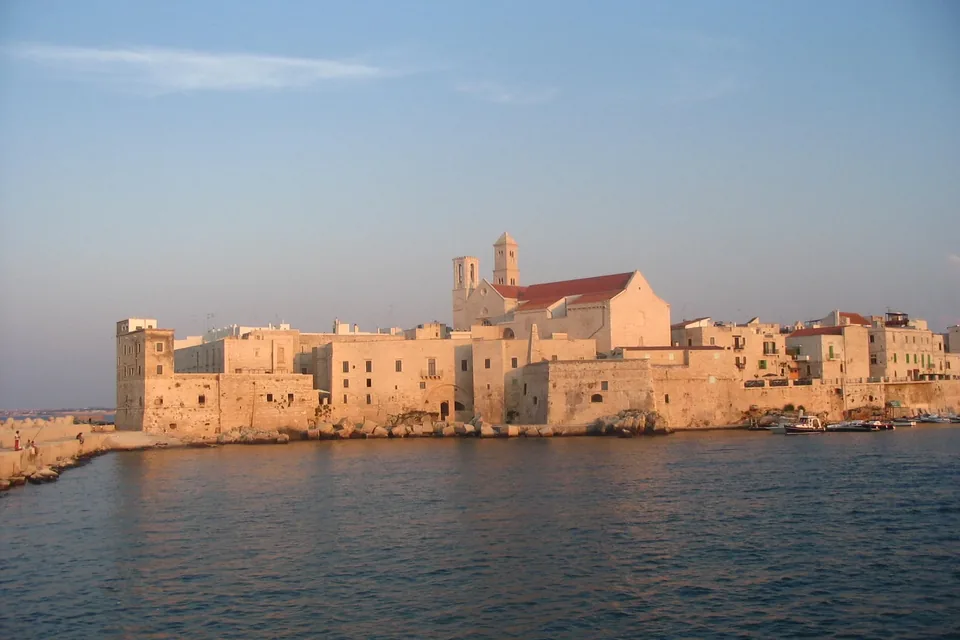
The municipal portal tells of Giovinazzo as a town that has changed its name three times: Natiolum in Roman times, Juvenatium in the Middle Ages and finally Giovinazzo. Beneath the old centre, the same source notes, lies a thick layer of older structures, shown by the cathedral crypt and the walls supporting Palazzo Ducale. At the end of the eighteenth century a visit by the sovereigns of Naples led the town to fill an inlet of the harbour and create the large square from which modern expansion began.
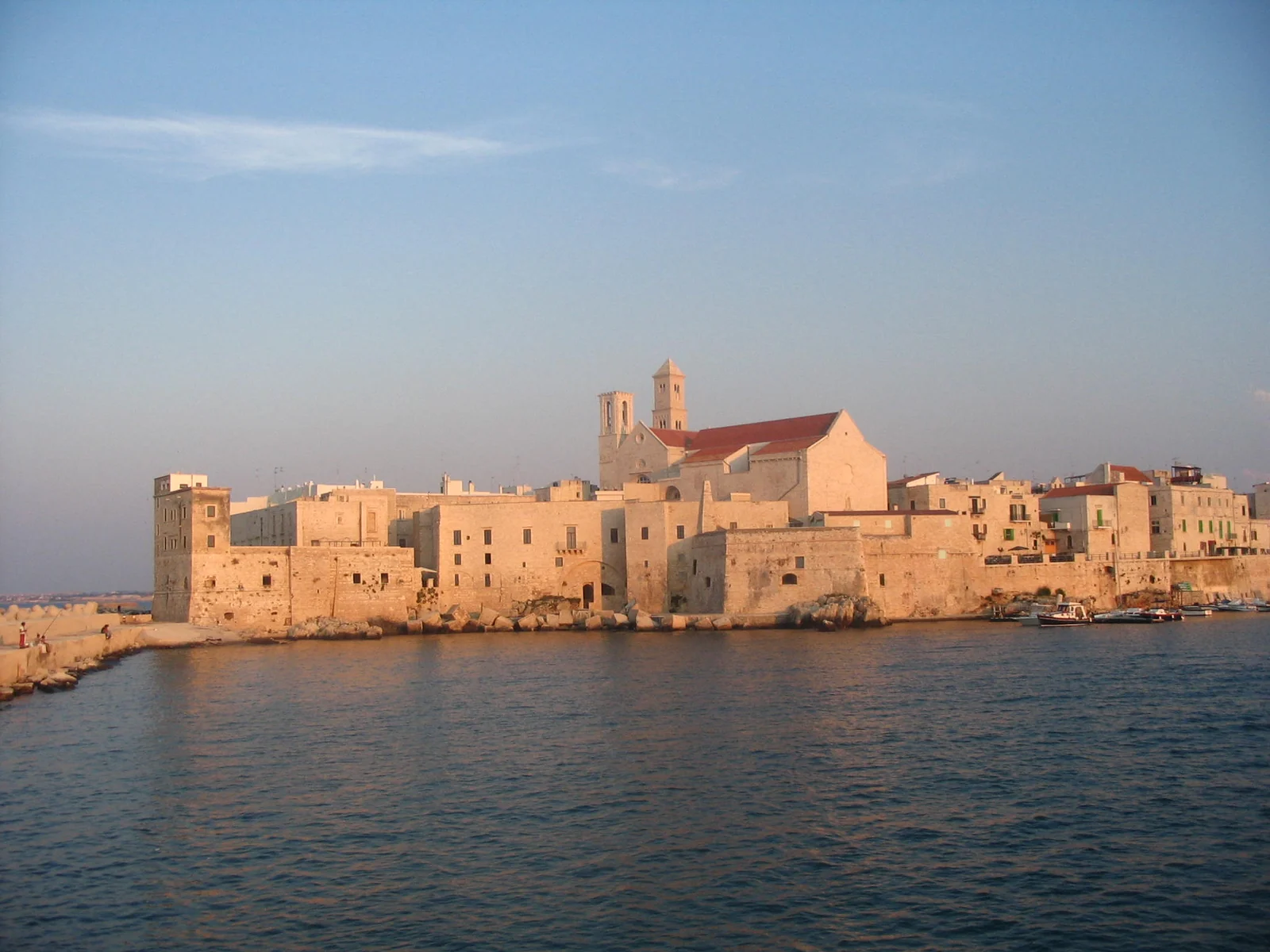
The Ministry of Culture’s general heritage catalogue describes the co-cathedral of Santa Maria Assunta, overlooking the sea from a raised position. Its construction is attributed to the Norman period: scholars give 1150 for completion of the crypt and 1180 for the upper church, consecrated in 1283. The two apse towers have become the symbol of the town.
The entry also recalls many later works, up to the eighteenth-century rebuilding of the naves and twentieth-century restorations: crypt, presbytery and the outer transept remain from the medieval phase.
Sources: Discover Giovinazzo (Comune di Giovinazzo) — La storia · Ministero della Cultura, Catalogo generale dei beni culturali — Cattedrale di Giovinazzo
Molfetta: harbour, old town and two landmark churches
Italia.it presents Molfetta as an active fishing port, probably founded in Roman times and later contested by Goths, Byzantines, Lombards and Normans. The old town has an elliptical plan and spreads over a small peninsula, crossed by lanes lined with buildings such as the Palazzo di Città, the twelfth-century Hall of the Templars and Palazzo Giovene.
The same source points to the Baroque cathedral, with the adjoining bishop’s palace housing the Diocesan Museum, and to the Seminary library, kept in a hall frescoed at the end of the nineteenth century, which also holds the so-called Red Book with the town’s history between the fourteenth and sixteenth centuries.
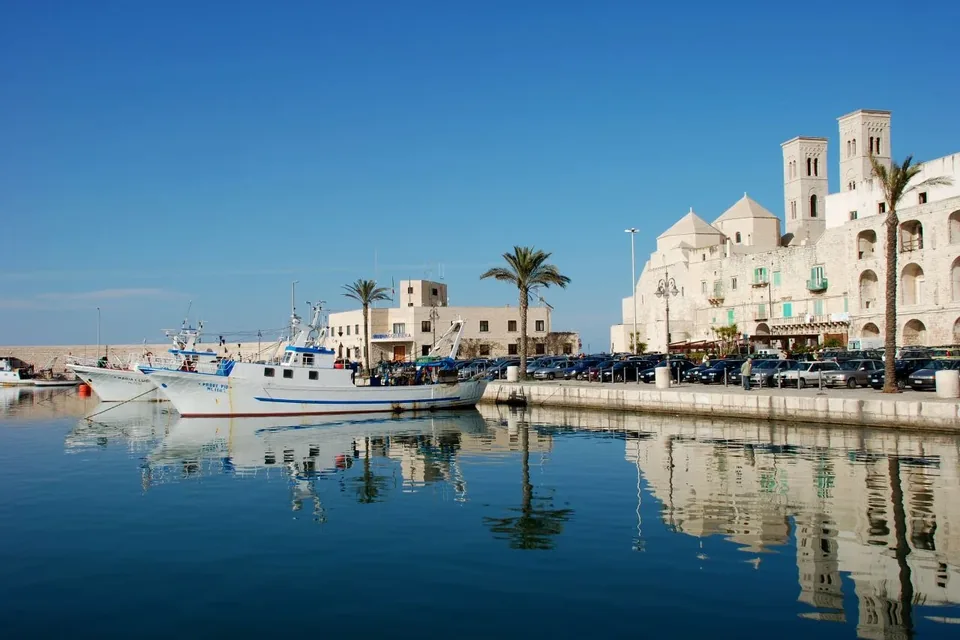
On the harbour stands the old Duomo of San Corrado, which Italia.it considers the town’s most significant Romanesque building, recognisable by its pyramid-shaped domes. A walk among fishing boats and shipyards, the source suggests, conveys Molfetta’s maritime vocation well: the same vocation that gives meaning to the devotion to Our Lady of the Martyrs and her shrine.
Sources: Italia.it — Molfetta
The Pulo: Molfetta’s oldest memory
To complete your reading of the town, head inland. Italia.it describes the Pulo as a large karst depression a couple of kilometres from the centre, source of Neolithic finds. The Municipality of Molfetta tells the story of this place in the Pulo Civic Archaeological Museum, housed in an eighteenth-century building, Casina Cappelluti, once a quarantine station.
The museum displays material found in excavations carried out between 1997 and 2008. On the ground floor, panels explain the geology, flora and fauna of the sinkhole; the lower level traces the history of the sixteenth-century Capuchin convent and of the Bourbon Royal Nitre Works, where saltpetre was extracted for gunpowder. The upper floor is devoted to prehistory, with a timeline from the Palaeolithic to the Iron Age and a focus on the Neolithic village.
It offers a useful counterpoint to the feast: alongside Marian devotion, Molfetta preserves the traces of communities who lived in this territory many thousands of years earlier.
Sources: Italia.it — Molfetta · Comune di Molfetta — Museo Civico Archeologico del Pulo
A calendar that spans the year
The patron feast is not the only appointment marking time in Giovinazzo. The municipal portal recalls the Bonfires of Saint Anthony on 17 January, included in the regional register of ritual fires: large bonfires are lit and broad beans and meat rolls cook in terracotta pots, offered to guests with olives and wine amid improvised music and dancing. The same day, a popular saying quoted by the source reminds us, also marks the start of Carnival.
In spring Holy Week brings rites celebrated with wide participation; in summer, between June and September, the town offers music, dance, poetry and theatre across its territory. In December the lighting of the tree in Piazza Vittorio Emanuele II opens the Christmas season, with decorations in the historic centre.
For a trip this calendar is valuable: it lets you choose between the intensity of the August feast, the winter fire and the spring rites, checking each time the dates and programme of that year’s edition.
Sources: Discover Giovinazzo (Comune di Giovinazzo) — Eventi della tradizione
Two towns, two ways of gathering
Begin with the questions a feast makes visible: where the community meets, which gestures it recognises, what changes in the rhythm of the day. Personal devotion is not required to observe this relationship with respect; it is enough to make room for other people’s time and not turn the rite into a backdrop.
For those returning to a family place, the comparison may start from a memory told at the table; for first-time visitors, from a building or a square. A feast becomes easier to understand when the town is known before or after the collective moment, rather than only on one crowded evening.
Giovinazzo and Molfetta can be two chapters of the same journey north of Bari. In each stop we suggest a walk with a clear theme, followed by a pause to listen to what the place brought to mind. The harbour can open a conversation about work and the sea, a lane about the smaller life of the town.
When to go: feast or time of return
The 2026 dates documented by the diocese describe a past edition. To build a trip around the feast, we rely only on the calendar of the next edition once it is published; for a journey of memory, the choice may instead start from when the people you wish to share the return with are available.
We would always leave time to revisit a place alone and then tell others about it. These are two different ways of travelling: joining a collective moment or recovering a personal relationship with a street, a church, a stretch of coast. The same town can offer both, at separate times and with a different pace.
The meal need not imitate a feast: it can gather stories and differences between the two days, one for Giovinazzo and one for Molfetta. Outside the celebrations both towns are easy to visit calmly, and their bond with their patron saints can be read in buildings, sacred images and the everyday relationship with the harbour.
A thread for your journey
A return-journey idea beginning with people and the places they remember.
Talk to us