Why go
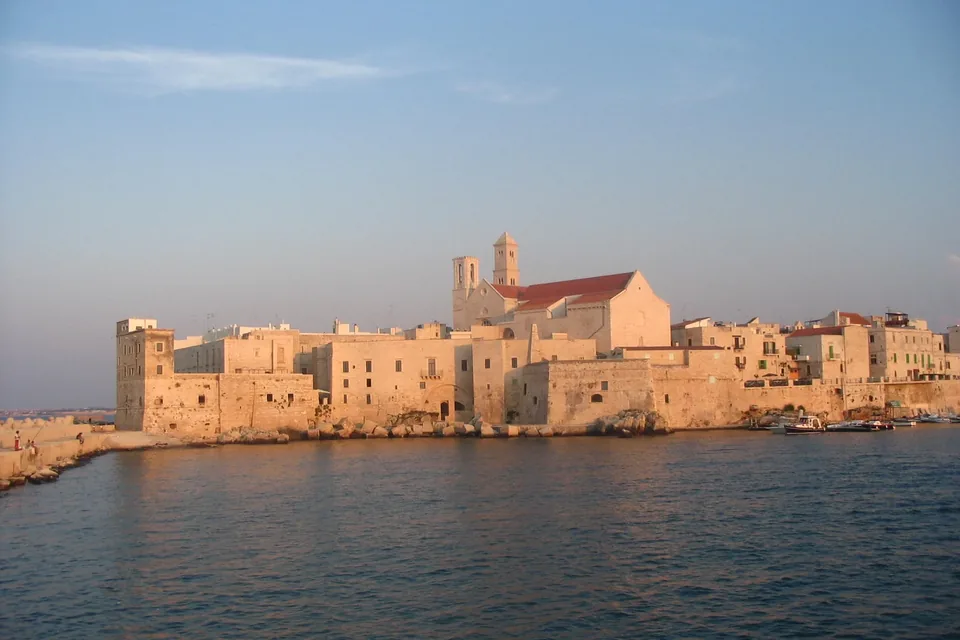
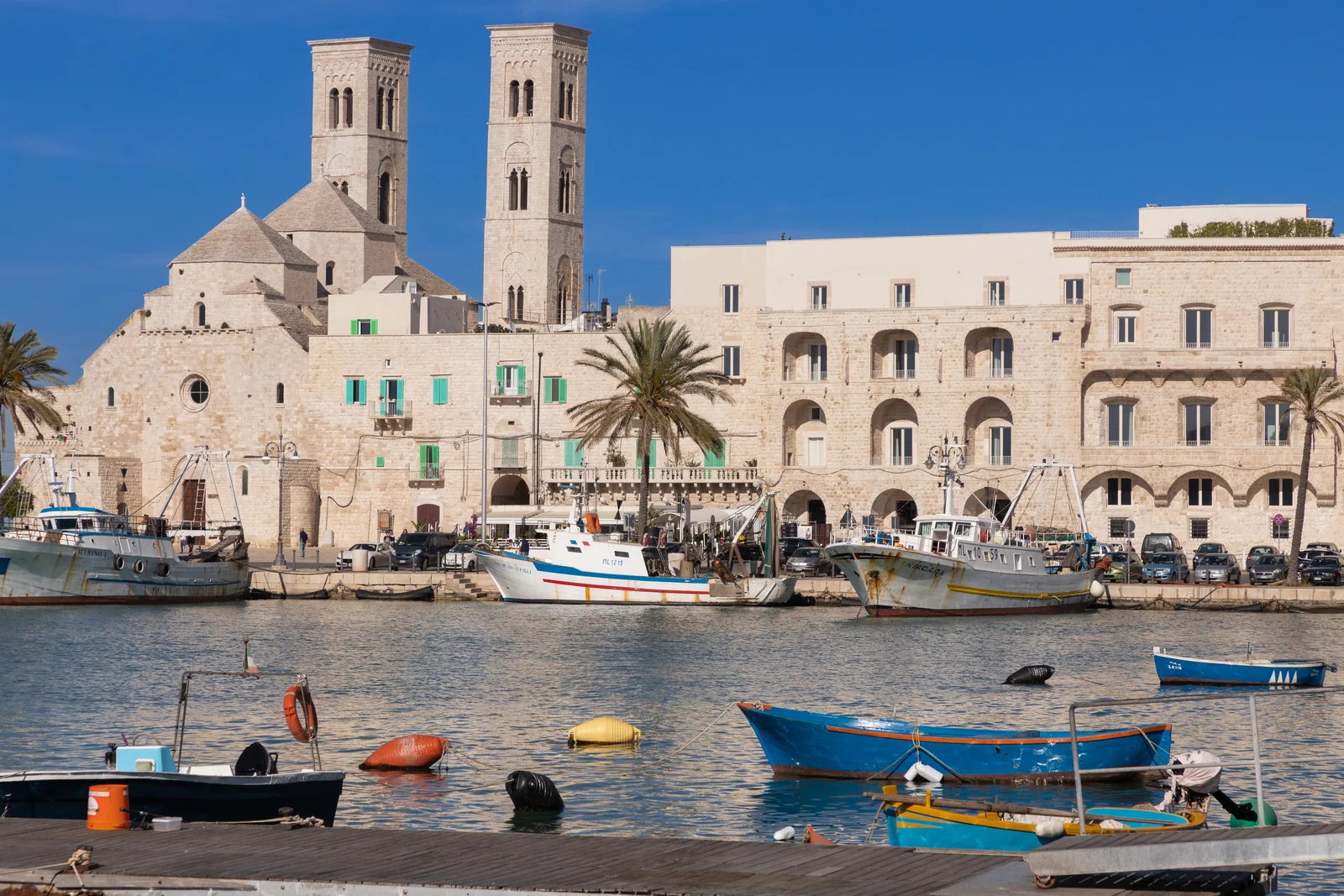
Molfetta, just over twenty kilometres north of Bari, is a seafaring town in every sense. The Region's tourism portal describes it as one of Puglia's most important fishing centres, with a fishing fleet among the largest in the lower Adriatic, and its harbour, always busy, is its heart: boats, shipyards and the old buildings of the town reflected in the water.
The old town occupies a small peninsula and has an elliptical plan with lanes laid out in a herringbone pattern. It is dominated by the Old Cathedral of San Corrado, which the Ministry of Tourism's portal calls the largest church in the region in Apulian Romanesque style, with its row of pyramidal domes and two towers facing the sea.
Molfetta also has other chapters: the Baroque cathedral and the Diocesan Museum with its picture gallery, the Seminary library with over 40,000 volumes, the sanctuary of the Madonna dei Martiri linked to the Crusaders and, inland, the Pulo, a large karst sinkhole inhabited since the Neolithic. It suits those who love working harbours, Romanesque art and archaeology.
Molfetta is also a town of the Church: its cathedral is the seat of the diocese of Molfetta-Ruvo-Giovinazzo-Terlizzi, unified by the decree of 30 September 1986, and the town hosts the Pontifical Apulian Regional Seminary, founded in Lecce in 1908, moved to Molfetta in 1915 and inaugurated in its Molfetta seat in 1926; according to the diocese it is still the seat of the Apulian Bishops’ Conference. The painter Corrado Giaquinto came from Molfetta: after training in Naples he worked in Rome between 1727 and 1753, stayed in Turin and finally reached the Spanish court.
Sources: Viaggiare in Puglia (Regione Puglia) — Molfetta · Italia.it — Molfetta · Italia.it — Duomo Vecchio di San Corrado · Diocesi di Molfetta-Ruvo-Giovinazzo-Terlizzi — Storia: la nuova comunità diocesana · Diocesi di Molfetta-Ruvo-Giovinazzo-Terlizzi — Storia: dal 1818 al Vaticano II · Diocesi di Molfetta-Ruvo-Giovinazzo-Terlizzi — Corrado Giaquinto e la formazione di un linguaggio pittorico europeo
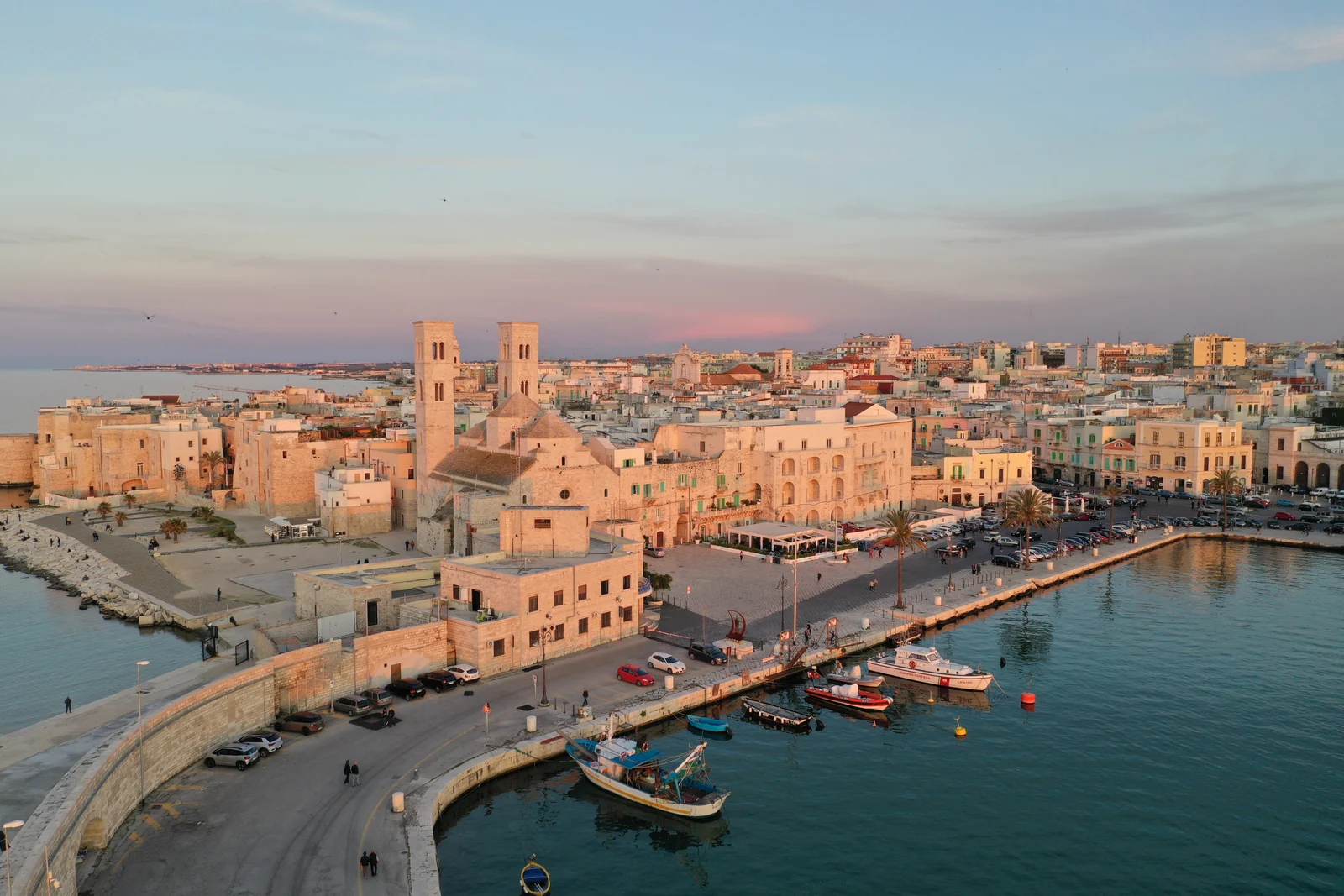
Photo: Pakycassano / Wikimedia Commons — CC BY-SA 4.0 · Resized and converted to WebP.
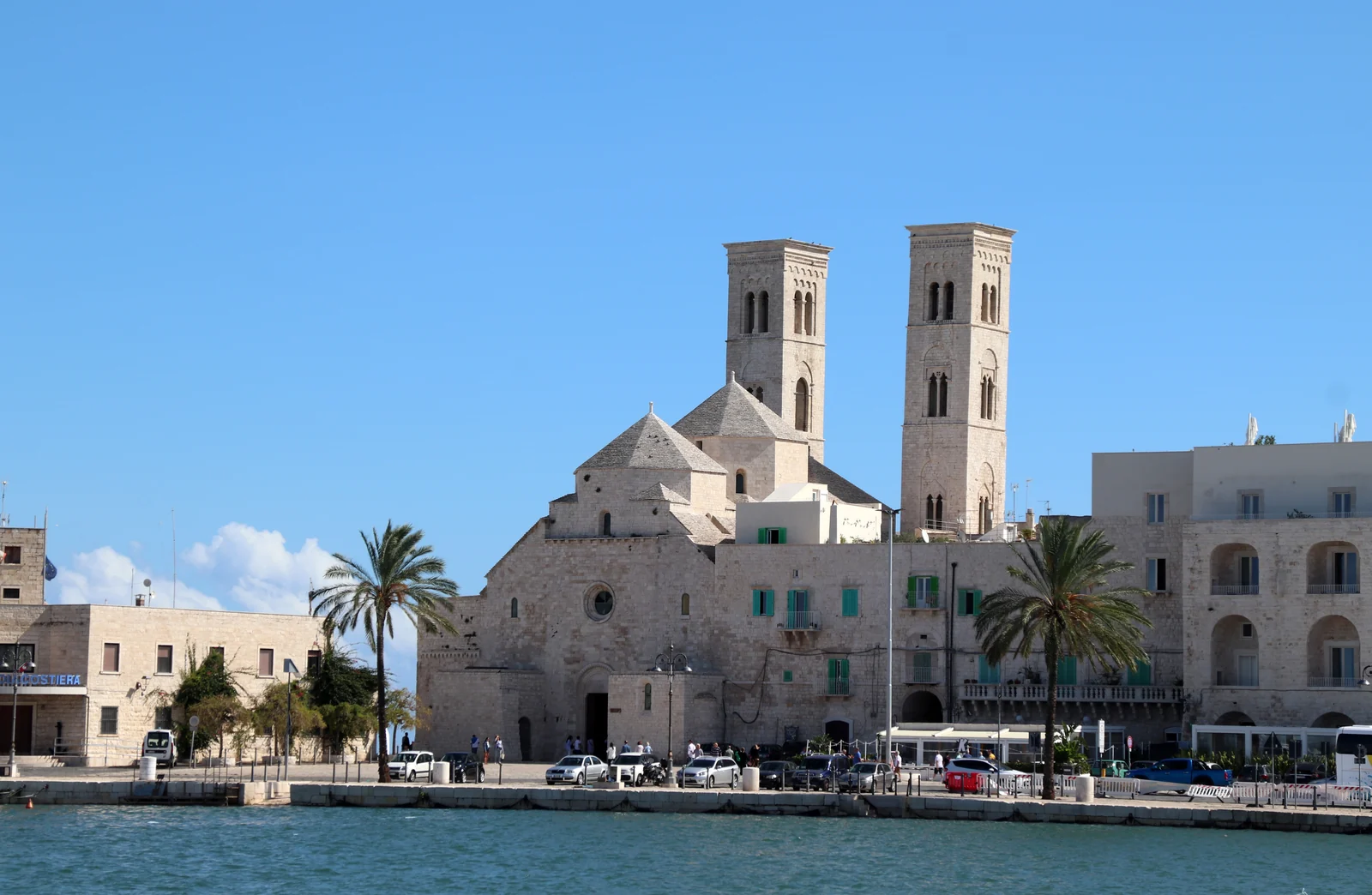
Photo: Lorenzo.Antonicelli / Wikimedia Commons — CC BY-SA 4.0 · Resized and converted to WebP.
History
Molfetta's origins are very old. The Pulo, a couple of kilometres from town, hosted a Neolithic settlement; from this area come pottery fragments known as “Molfetta ware”, found all over the Mediterranean. The town was probably founded in Roman times and, after the fall of the Empire, passed to the Goths, Byzantines, Lombards and Normans.
According to the Ministry of Tourism's portal, its whole history revolves around the harbour, where merchants arrived from the Maritime Republics, Greece and Dalmatia and much of the Crusader traffic passed through. The sanctuary of the Madonna dei Martiri stands near the hospital where returning crusaders were treated and keeps an old Byzantine icon that legend says was brought from the East.
The Old Cathedral, dedicated to the patron Saint Conrad, a Bavarian nobleman who after a youth as a crusader withdrew as a hermit to the Bari area, was begun around the middle of the twelfth century and completed in the following one; until 1882 its façade on the harbour rose straight out of the water. In the sixteenth century a Capuchin friary was built in the Pulo, and under the Bourbons a royal saltpetre works extracted nitre there for gunpowder.
The history of the diocese adds further pieces. Molfetta, recorded as a locus in the tenth century and as a civitas in the eleventh, was a fief of the counts of Conversano and became a bishop’s see with the Norman conquest. A document of March 1162 is the founding act of the sanctuary outside the walls dedicated to the Virgin and to the pilgrims, the “martyrs of Christ”, buried there: together with the pilgrims’ hospital it became a stop on the coastal road between the sanctuary of Saint Michael on the Gargano and the basilica of Saint Nicholas in Bari, reaching out across the Adriatic towards the Holy Land. In 1208 the bishop signed the renewal of the trade agreement between the town and Ragusa, concluded sixty years earlier.
Saint Conrad, son of the Duke of Bavaria Henry the Black and a Cistercian monk, was buried by the cave of Santa Maria ad cryptam, at Modugno; when the monks left the cave, probably within the first twenty years of the fourteenth century, his relics were brought to the old cathedral of Molfetta, and a fourteenth-century missal sets his feast on 9 February. In 1399 King Ladislaus of Anjou granted the town the fair of 8 September, which spread the fame of the sanctuary of the Madonna dei Martiri; among its visitors the diocese recalls Anselm Adorno, a knight of the Holy Sepulchre returning from the Holy Land in 1470-1471.
In 1610 the Jesuits arrived, with the church of Sant’Ignazio and their college. After their expulsion from the Kingdom of Naples in 1767, Bishop Gennaro Antonucci moved the cathedral, the bishop’s palace and the seminary in 1785 into the Jesuit church and college, inside the new town walls, and the old cathedral became the parish of San Corrado. In the twentieth century the town reached 65,000 inhabitants; from 1982 to 1993 its bishop was Antonio Bello, national president of Pax Christi from 1985.
Sources: Italia.it — Molfetta · Italia.it — Duomo Vecchio di San Corrado · Comune di Molfetta — Museo Civico Archeologico del Pulo · Regione Puglia — cartoguida Monumenti e Feste · Diocesi di Molfetta-Ruvo-Giovinazzo-Terlizzi — Storia: dalle origini al tardo medioevo · Diocesi di Molfetta-Ruvo-Giovinazzo-Terlizzi — Storia: dal concilio di Trento al 1818 · Diocesi di Molfetta-Ruvo-Giovinazzo-Terlizzi — Storia: dal 1818 al Vaticano II · Diocesi di Molfetta-Ruvo-Giovinazzo-Terlizzi — Storia: la nuova comunità diocesana
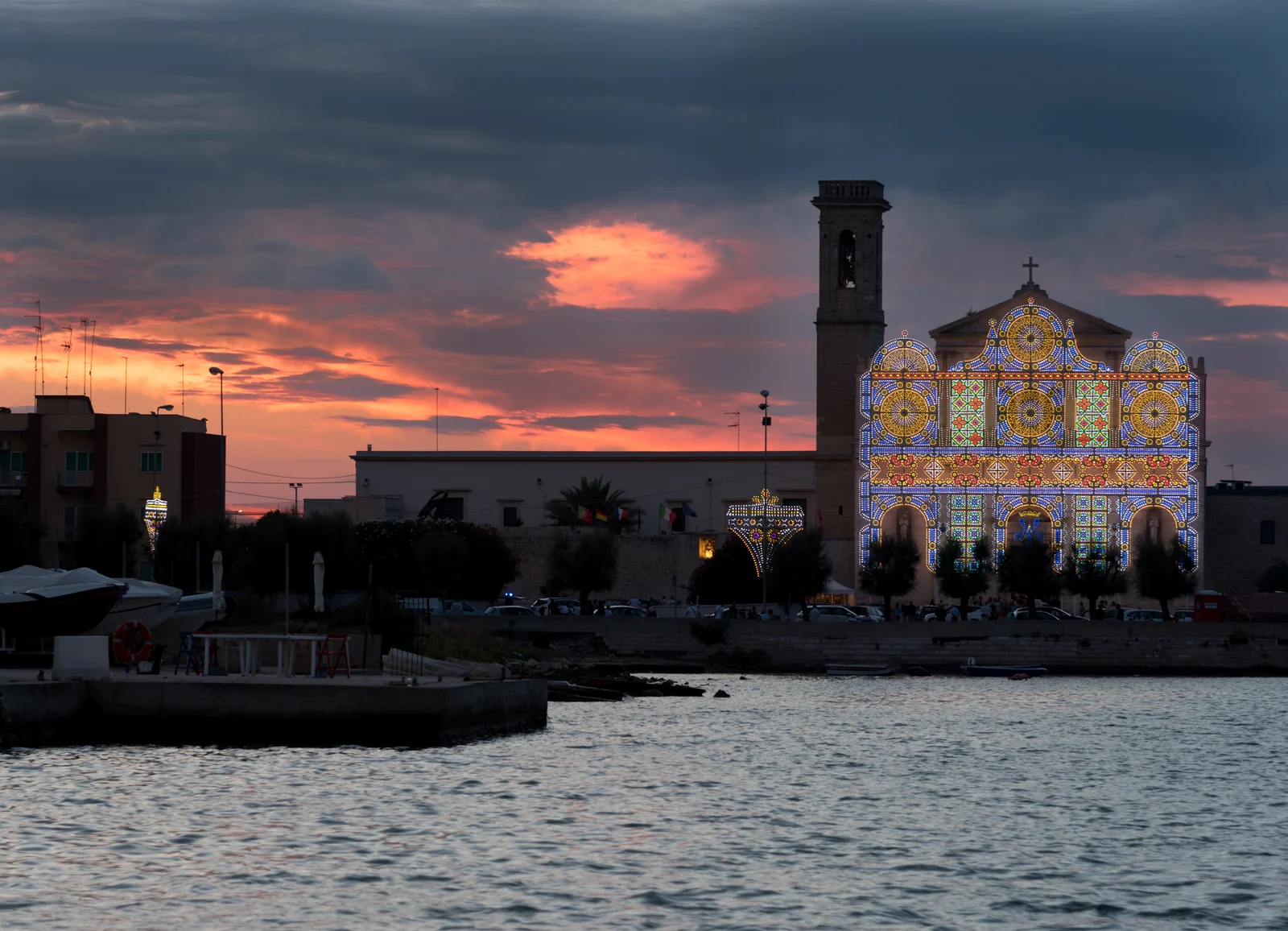
Photo: Leo Piccinni / Wikimedia Commons — CC BY-SA 4.0 · Resized and converted to WebP.
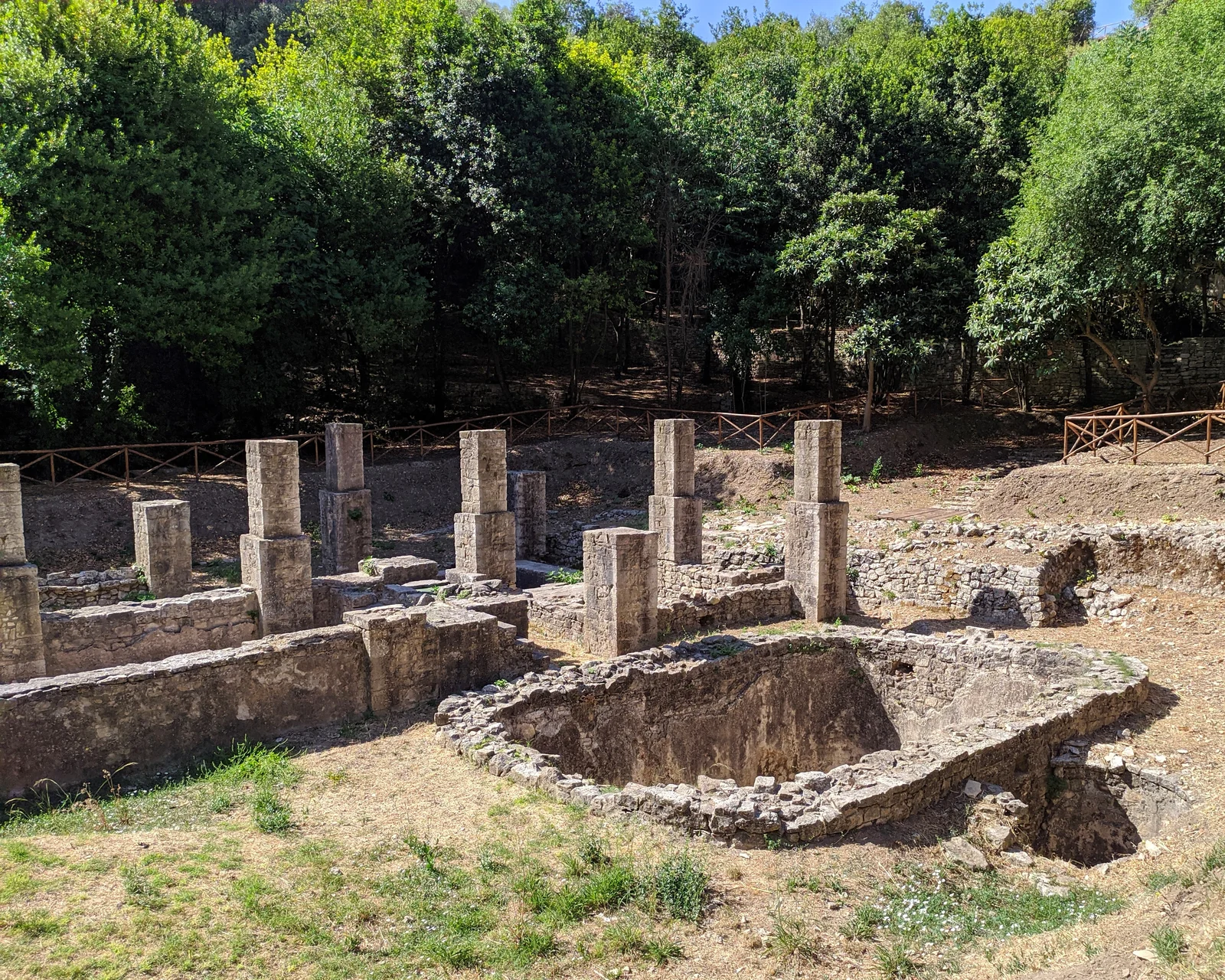
Photo: Lorenzo p photos / Wikimedia Commons — CC BY-SA 4.0 · Resized and converted to WebP.
What to see
The Old Cathedral of San Corrado is the town's emblem. Three pyramidal domes of different sizes cover the nave, and the two bell towers, one of which was used to spot incoming ships, are a rare example surviving intact. The three-nave interior keeps the twelfth-century Saracen holy-water stoup, a stone panel in the chapel of Saint Michael and a thirteenth-century relief beneath the high altar; curiously, the roof slabs are of the same stone as the trulli of Alberobello.
In the old town you come across the Palazzo di Città with the adjoining twelfth-century Templars' hall, the fifteenth-century Palazzo Giovene, the church of Sant'Andrea and the Torrione Passari, a remnant of the old walls. Outside the old town, the Baroque cathedral of the Assunta holds the remains of Saint Conrad; in the adjacent bishop's palace the Diocesan Museum displays sacred art and Neolithic finds from the Pulo, and its picture gallery spans the sixteenth century to today, with the Dormitio Virginis attributed to Marco Cardisco, made for the high altar of the old cathedral, and the Pietà by Bernardo Cavallino.
The Town Hall houses a contemporary art collection with works by, among others, Renato Guttuso. Just outside town stands the basilica sanctuary of the Madonna dei Martiri.
Of the Old Cathedral, the Ministry of Tourism’s portal also notes its secluded position away from the centre, a few steps from the sea, the blind side arcades that recall the basilica of Saint Nicholas in Bari and the Saracen holy-water stoup, a man with exotic features. Today’s cathedral is the former Jesuit church, cathedral since 1785: according to the diocese the Bari architect Giuseppe Gimma and the Tabacchi brothers, stucco workers from Lombardy, worked there, and the town’s churches hold canvases by Gaspar Hovic, Bernardo Cavallino, Corrado Giaquinto, Fedele Fischetti, Vito Calò and Carlo Rosa.
The Diocesan Museum, in Via Entica della Chiesa, is housed in the Bishop’s Seminary, formerly the Jesuit college built from 1610. According to the Ministry of Culture’s page, the first museum rooms date from the 1830s, with the collection of finds from the Pulo that belonged to the archpriest Giuseppe Maria Giovene (1753-1837), later enlarged with finds from Terlizzi and Bisceglie; the Museum and Picture Gallery was founded in 1980 and, reorganised, reopened to the public on 18 June 2009.
The basilica of the Madonna dei Martiri, a minor basilica, is a nineteenth-century building of Norman origin, from the twelfth century. It holds the Byzantine-style icon of the Madonna Glikophylousa and, since the first half of the nineteenth century, the statue of the Madonna dei Martiri by the Neapolitan sculptors Francesco and Giuseppe Verzella; in 1828 the new adjoining friary was entrusted to the Friars Minor.
Sources: Italia.it — Duomo Vecchio di San Corrado · Italia.it — Molfetta · Museo Diocesano — pittura del XVI e XVII secolo · Viaggiare in Puglia (Regione Puglia) — Molfetta · Diocesi di Molfetta-Ruvo-Giovinazzo-Terlizzi — Storia: dal concilio di Trento al 1818 · Ministero della cultura — Museo diocesano Molfetta · Diocesi di Molfetta-Ruvo-Giovinazzo-Terlizzi — Chiese giubilari in diocesi · Regione Puglia — cartoguida Monumenti e Feste · Diocesi di Molfetta-Ruvo-Giovinazzo-Terlizzi — Storia: dal 1818 al Vaticano II
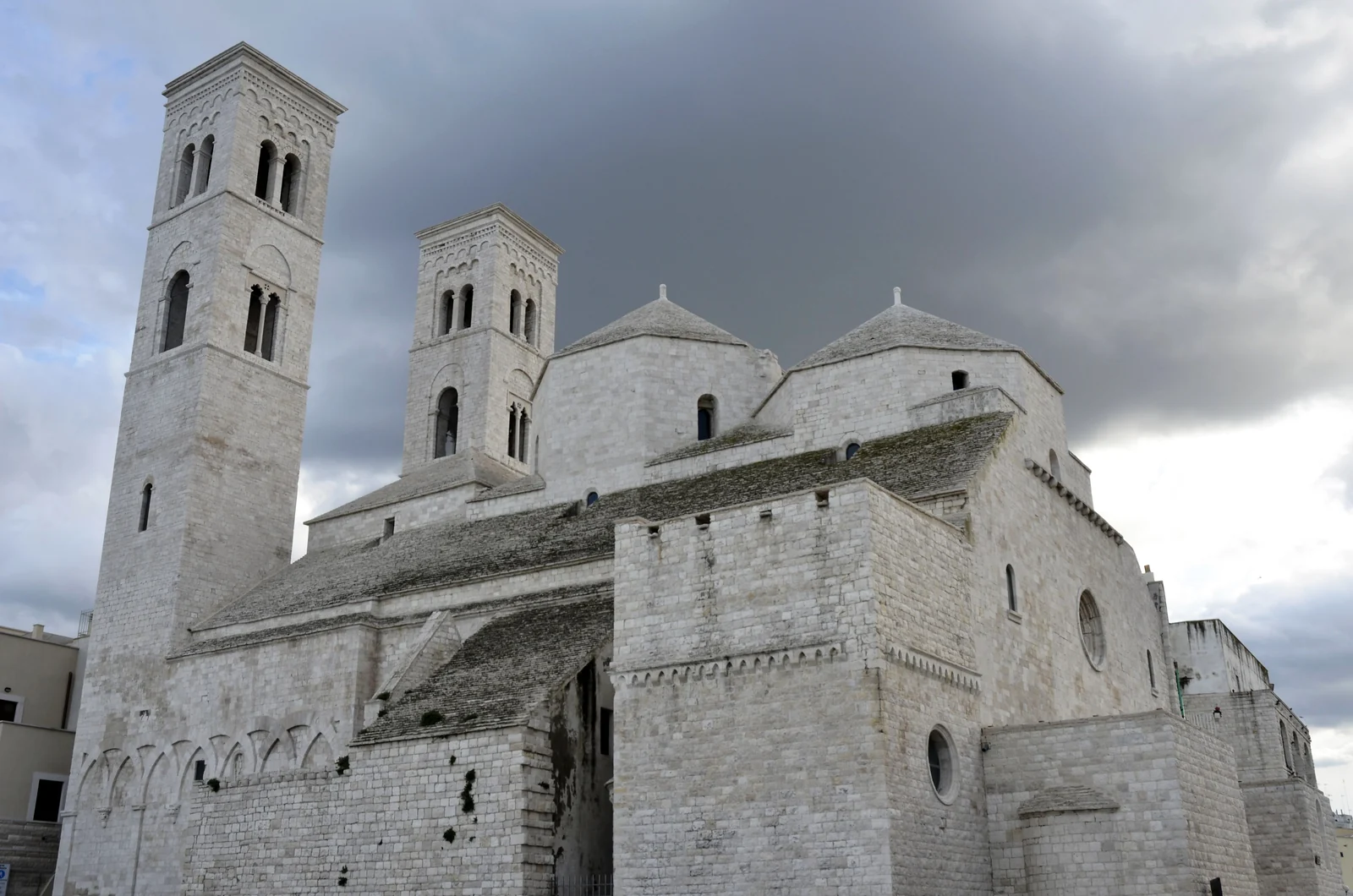
Photo: Nikowiky / Wikimedia Commons — CC BY-SA 4.0 · Resized and converted to WebP.
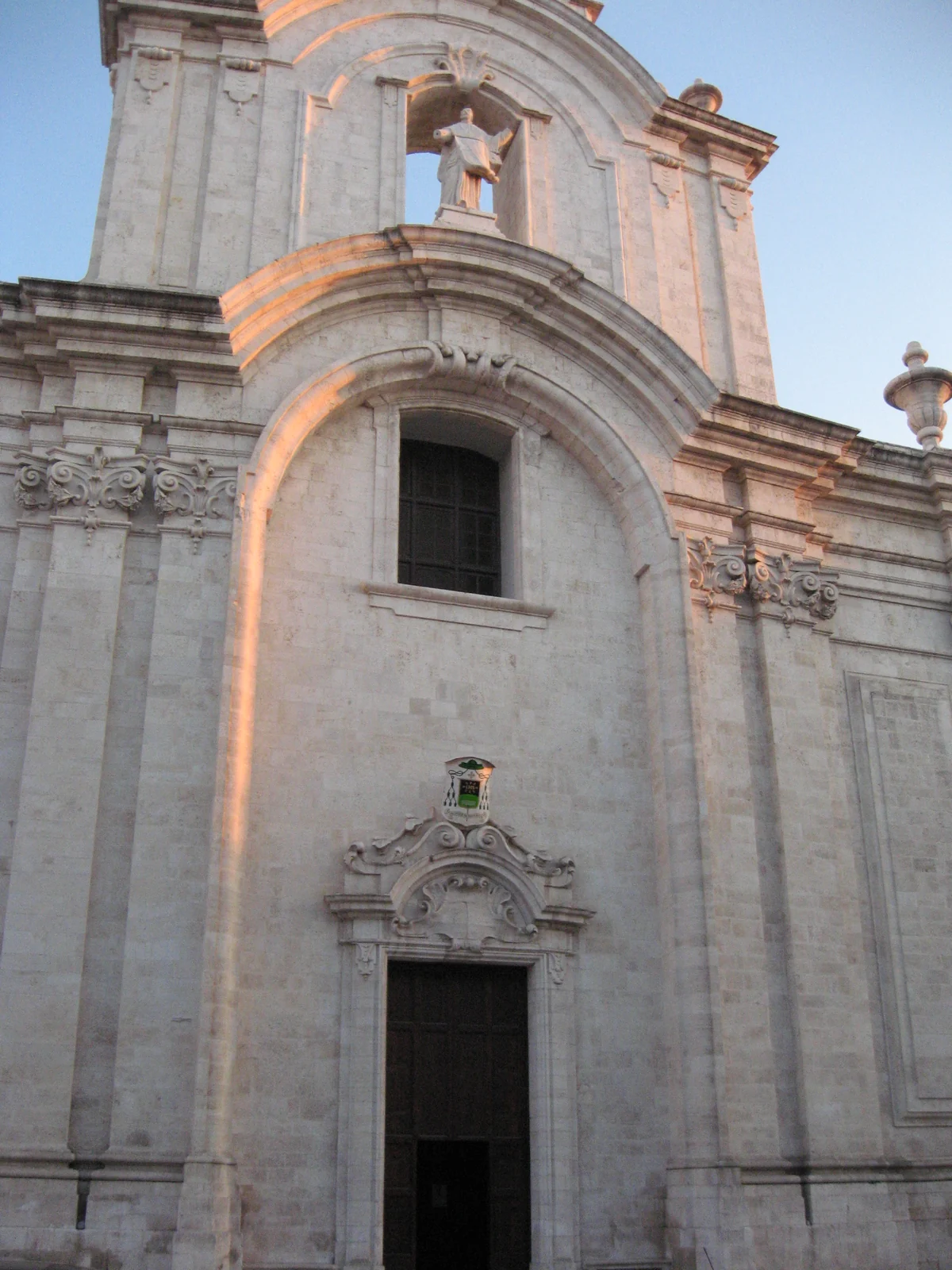
Photo: Istvánka / Wikimedia Commons — CC BY-SA 3.0 · Resized and converted to WebP.
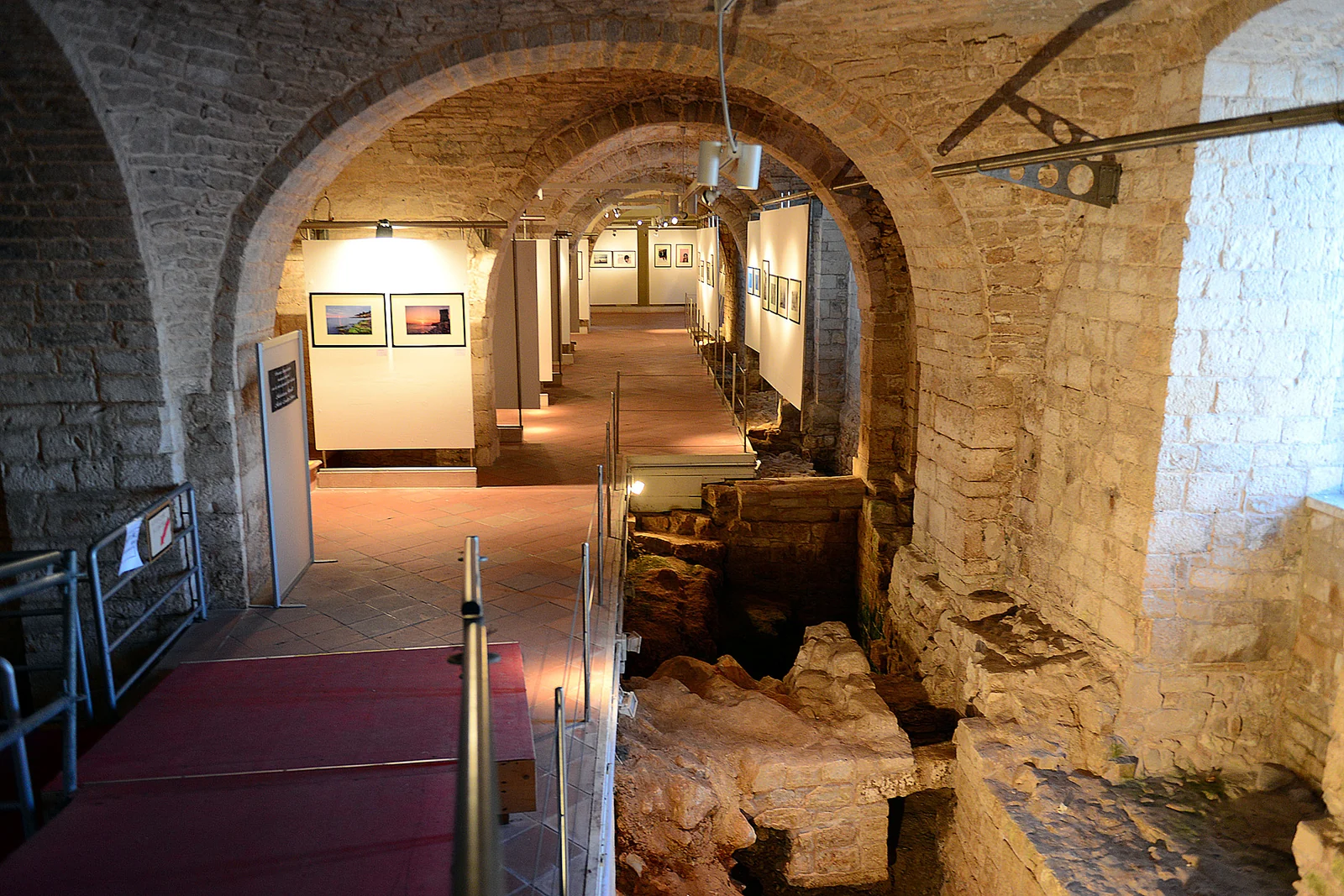
Photo: Diana Cimino Cocco / Wikimedia Commons — CC BY-SA 4.0 · Resized and converted to WebP.
Food and wine
With one of the largest fishing fleets in the lower Adriatic, Molfetta's cooking starts at the harbour. The regional portal describes the ever-busy port, and the Ministry of Tourism mentions the constant movement of fishing boats and shipyards: this is where the catch arrives before reaching the town's restaurants and trattorias.
At Easter, homes and bakeries make scarcelle. Puglia's atlas of traditional products describes them as sweet biscuits made with flour, sugar, oil and eggs, shaped as rings, baskets, doves and more, with a hard-boiled egg set into the dough and decorated with sugar sprinkles or icing. They are made during Holy Week or the week before; the original shape is a wheel and the name literally means ring cake. To eat them, tradition says, the eggs must be “released from prison” by breaking the pastry that holds them.
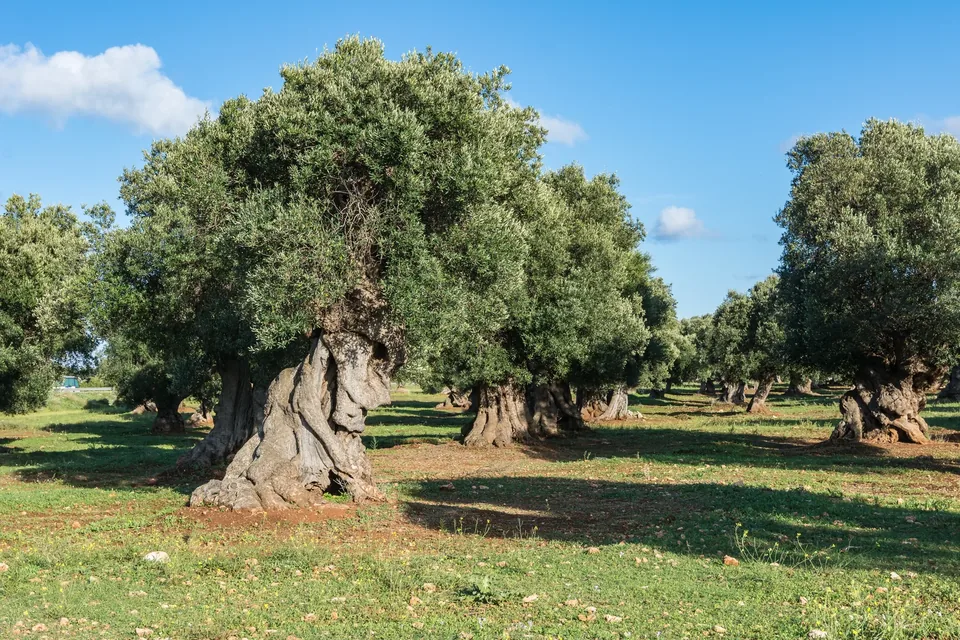
The countryside around Molfetta lies in the area of Terra di Bari PDO extra virgin olive oil, which covers the provinces of Bari and Barletta-Andria-Trani and is made mainly from Coratina, Cima di Bitonto and Cima di Mola olives.
More precisely, the Ministry of Agriculture’s specification places Molfetta in the area of the “Bitonto” geographical mention of the Terra di Bari PDO, together with twenty-four other municipalities including Bitonto, Giovinazzo, Ruvo and Terlizzi: with this mention the oil comes from Cima di Bitonto, also called Ogliarola barese, and Coratina olives for at least 80%. In the European eAmbrosia register Terra di Bari is a registered PDO, protected since 1997. Scarcelle, the regional atlas notes, have been on the national list of traditional food products since 2001.
Sources: Viaggiare in Puglia (Regione Puglia) — Molfetta · Atlante PAT Puglia — Scarcelle · Qualigeo (Fondazione Qualivita) — Terra di Bari DOP · Italia.it — Molfetta · Ministero dell’agricoltura (MASAF) — Disciplinare dell’olio extravergine di oliva DOP «Terra di Bari» (D.M. 4 settembre 1998) · Commissione europea, eAmbrosia — Terra di Bari, DOP registrata (PDO-IT-1542)
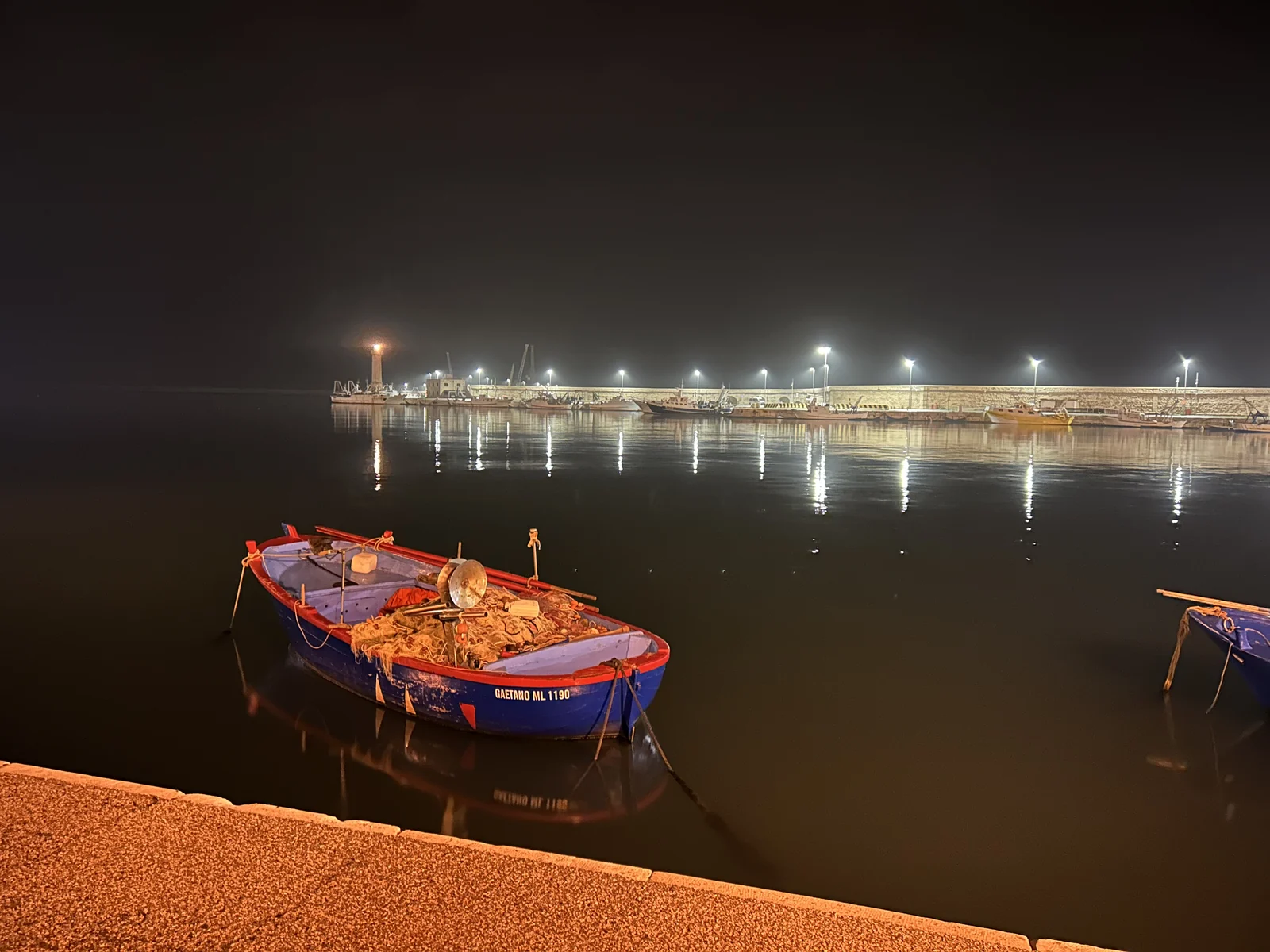
Photo: Bellavarda / Wikimedia Commons — CC0 · Resized and converted to WebP.
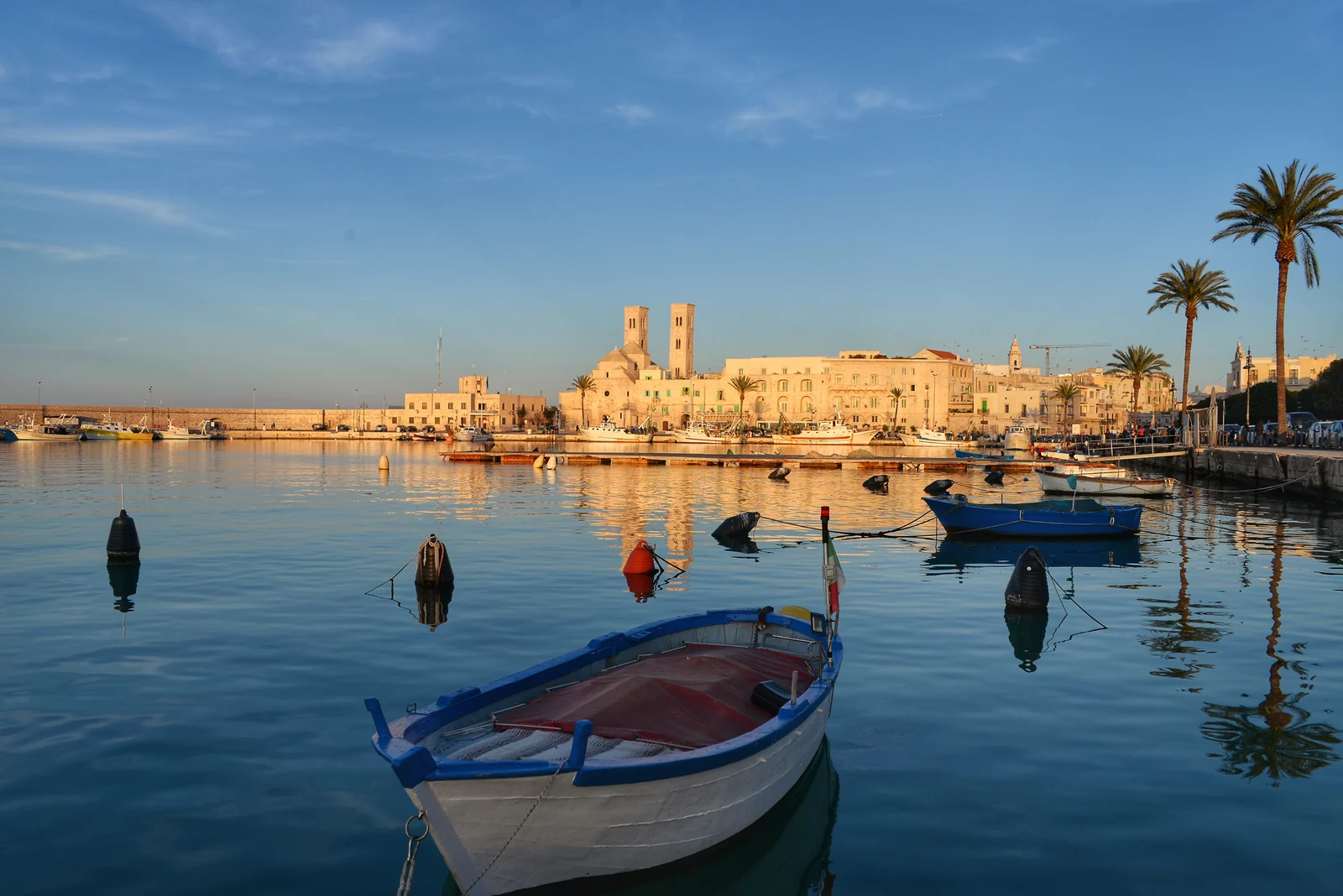
Photo: Madi.c.ph / Wikimedia Commons — CC BY-SA 4.0 · Resized and converted to WebP.
Things to do
The Pulo of Molfetta is an experience in itself: a karst sinkhole about 170 metres across and 30 deep, next to whose plateau a Neolithic village stood. The Pulo Civic Archaeological Museum, in the eighteenth-century Casina Cappelluti, once a lazaretto, holds finds from excavations carried out between 1997 and 2008: on the ground floor, panels on geology, flora and fauna; on the lower floor, the story of the Capuchin friary and the Bourbon saltpetre works; on the upper floor, prehistory, from daily life to stone and pottery working and the domestication of plants and animals.
In town, a walk along the harbour among fishing boats and shipyards conveys Molfetta's seafaring vocation, as the Ministry's portal notes; from the harbour you reach the Old Cathedral and enter the old town. The Seminary library is also worth a visit, in a hall frescoed in the late nineteenth century, with a sixteenth-century illuminated manuscript and the Libro Rosso, which records the town's history from 1323 to 1507.
The coastline consists mainly of sandy beaches, popular with young visitors; the mild climate and the wind, according to the regional portal, favour sailing and windsurfing. By bike, the eastern and western urban cycle paths start from the station.
Those who like to follow the pilgrims’ routes can reach the basilica of the Madonna dei Martiri, which according to the document of 1162 stood two miles north of the town, along the coastal road towards Bari; for the 2025 Jubilee the diocese designated it, with the cathedral, as a jubilee site of Molfetta. The Diocesan Museum, whose archaeological collection began with the Pulo finds of the archpriest Giovene, is a good complement to a visit to the sinkhole.
Sources: Comune di Molfetta — Museo Civico Archeologico del Pulo · Viaggiare in Puglia (Regione Puglia) — Molfetta · Italia.it — Molfetta · Diocesi di Molfetta-Ruvo-Giovinazzo-Terlizzi — Storia: dalle origini al tardo medioevo · Diocesi di Molfetta-Ruvo-Giovinazzo-Terlizzi — Chiese giubilari in diocesi · Ministero della cultura — Museo diocesano Molfetta
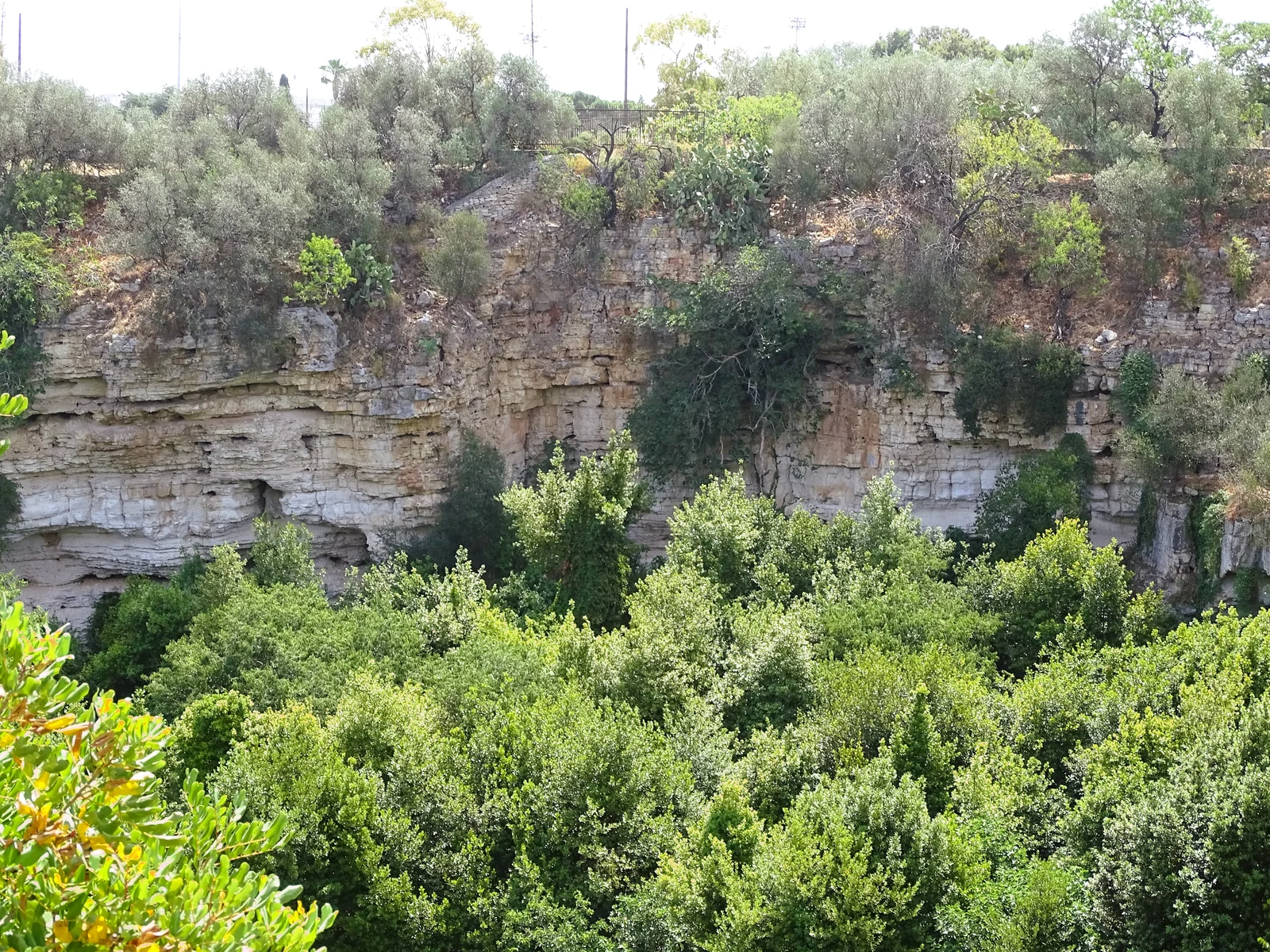
Photo: Lorenzo p photos / Wikimedia Commons — CC BY-SA 4.0 · Resized and converted to WebP.
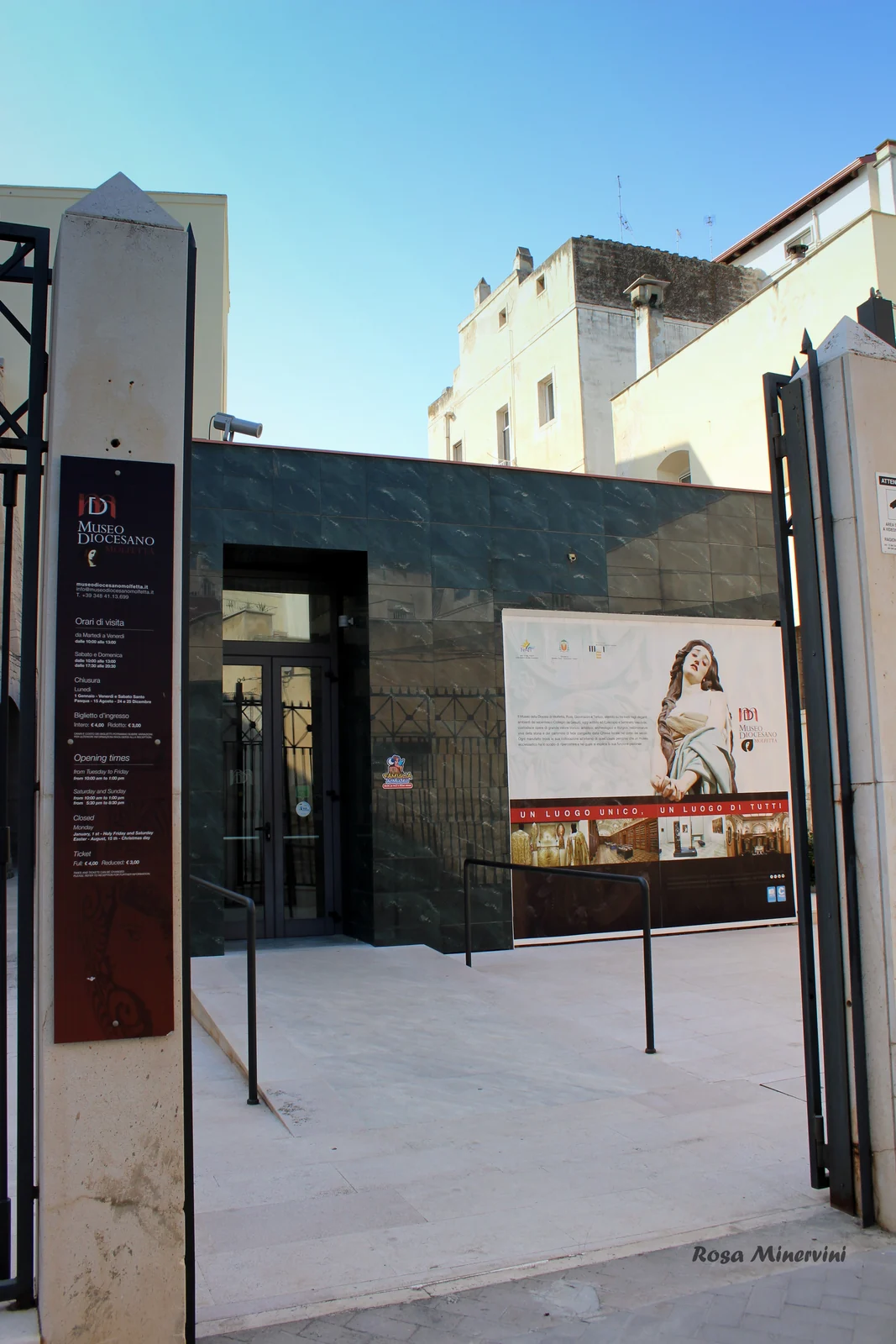
Photo: Rosa Minervini / Wikimedia Commons — CC BY-SA 4.0 · Resized and converted to WebP.
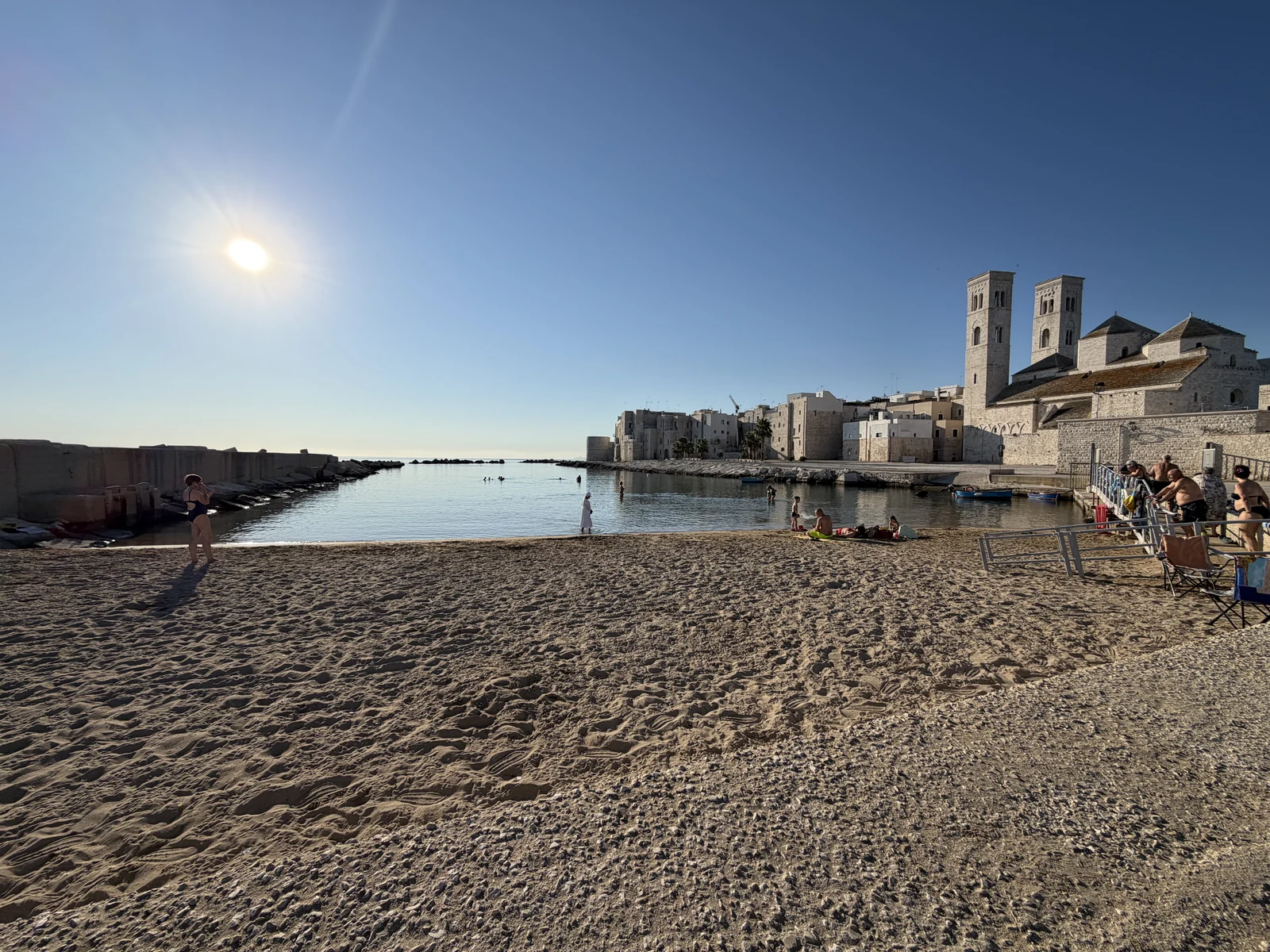
Photo: Distefanoangelo / Wikimedia Commons — CC BY-SA 4.0 · Resized and converted to WebP.
When to go
Molfetta can be visited in every season: the harbour, the old town and the museums are lively all year round. Summer brings the sea, the sandy beaches and sailing; spring and autumn are ideal for walks around town and a visit to the Pulo.
The religious calendar offers the most heartfelt moments. The Region's guide mentions the patronal feast of Saint Conrad on 9 February and that of the Madonna dei Martiri on 8 September: in September the “sagra a mare” takes place, when the statue of the Virgin is carried out to sea on festively decorated fishing boats and then in procession through the town.
During Holy Week and the week before, bakeries and pastry shops make Easter scarcelle, one of the sweets most closely tied to Easter in Puglia. For exact dates of celebrations and events, check each year the programme published by the municipality and the parishes.
Both dates have old roots: the feast of Saint Conrad on 9 February already appears in the cathedral’s fourteenth-century missal, and the fair of 8 September was granted by King Ladislaus of Anjou in 1399. According to the diocese, the sea festival of the Madonna dei Martiri took on its spectacular form in the nineteenth century. On the evening of Holy Thursday the archconfraternity of Santo Stefano carries the sorrowful mysteries in procession, with sixteenth-century wooden statues of the Neapolitan school.
Sources: Regione Puglia — cartoguida Monumenti e Feste · Atlante PAT Puglia — Scarcelle · Viaggiare in Puglia (Regione Puglia) — Molfetta · Diocesi di Molfetta-Ruvo-Giovinazzo-Terlizzi — Storia: dalle origini al tardo medioevo · Diocesi di Molfetta-Ruvo-Giovinazzo-Terlizzi — Storia: dal 1818 al Vaticano II · Diocesi di Molfetta-Ruvo-Giovinazzo-Terlizzi — Storia: dal concilio di Trento al 1818
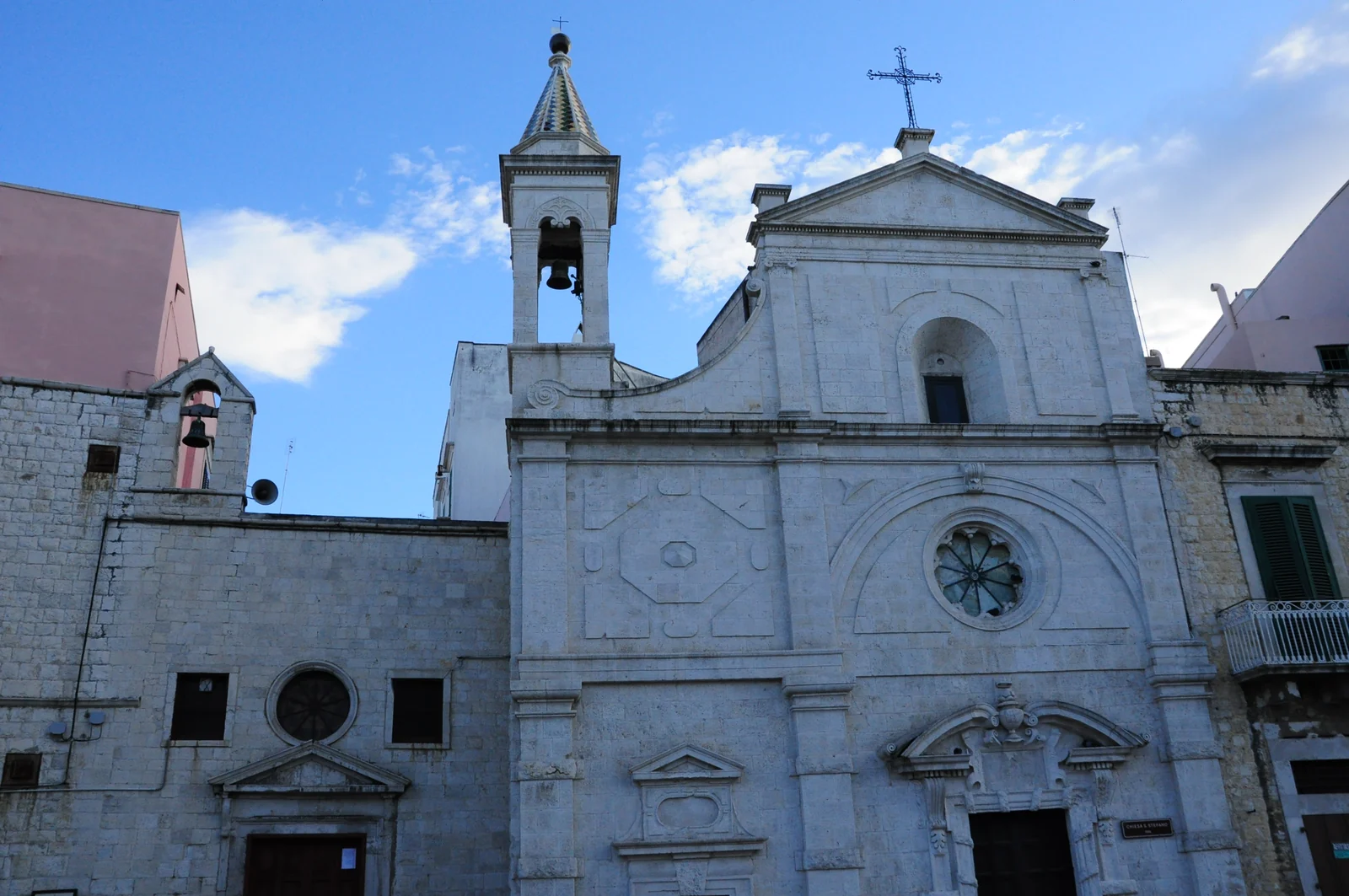
Photo: Diana Cimino Cocco / Wikimedia Commons — CC BY-SA 4.0 · Resized and converted to WebP.
Getting there and around
Molfetta's central station, on the Adriatic line, offers according to the regional tourism portal connections to every regional and long-distance destination. MTM buses serve the town and suburban areas, while intercity links are run by STP. The nearest airport is Bari, reached by transfer.
By car, Molfetta has its own exit on the A14 motorway, which the Alta Murgia Park also lists as an access point to the Murgia interior. In town it is easy to get around on foot and by bike: the eastern and western cycle paths link central areas starting from the station, and bicycles, e-scooters and electric mopeds can be hired via app, as well as scooters and cars.
The Pulo lies inland, a couple of kilometres from the centre. For tourist information there is the Molfetta Info-point in Via Piazza, in the old town.
Sources: Viaggiare in Puglia (Regione Puglia) — Molfetta · Viaggiare in Puglia (Regione Puglia) — Info-point Molfetta · Parco Nazionale dell'Alta Murgia — Come raggiungere il Parco
Where to stay
The old town, on the peninsula facing the harbour, is the most atmospheric choice for experiencing Molfetta on foot: B&Bs and apartments in historic buildings put the Old Cathedral, the cathedral and the quay within a few minutes' walk. Summer visitors may prefer places near the seafront and the sandy beaches; in the surrounding countryside, among the olive groves, there are masserie and farm stays for those travelling by car.
For dinner, Il Vecchio Gazebo, at Via Marconi 18/20, presents on its website a restaurant and pizzeria with long-fermented doughs and cooking that reinterprets Apulian dishes. It is an editorial reference, not an Apulica partnership.
With its station on the Adriatic line and its motorway exit, Molfetta is also a practical base for visiting Bari, Bisceglie and Trani and for heading inland to Alta Murgia.
Sources: Il Vecchio Gazebo — sito ufficiale del ristorante · Viaggiare in Puglia (Regione Puglia) — Molfetta · Italia.it — Molfetta
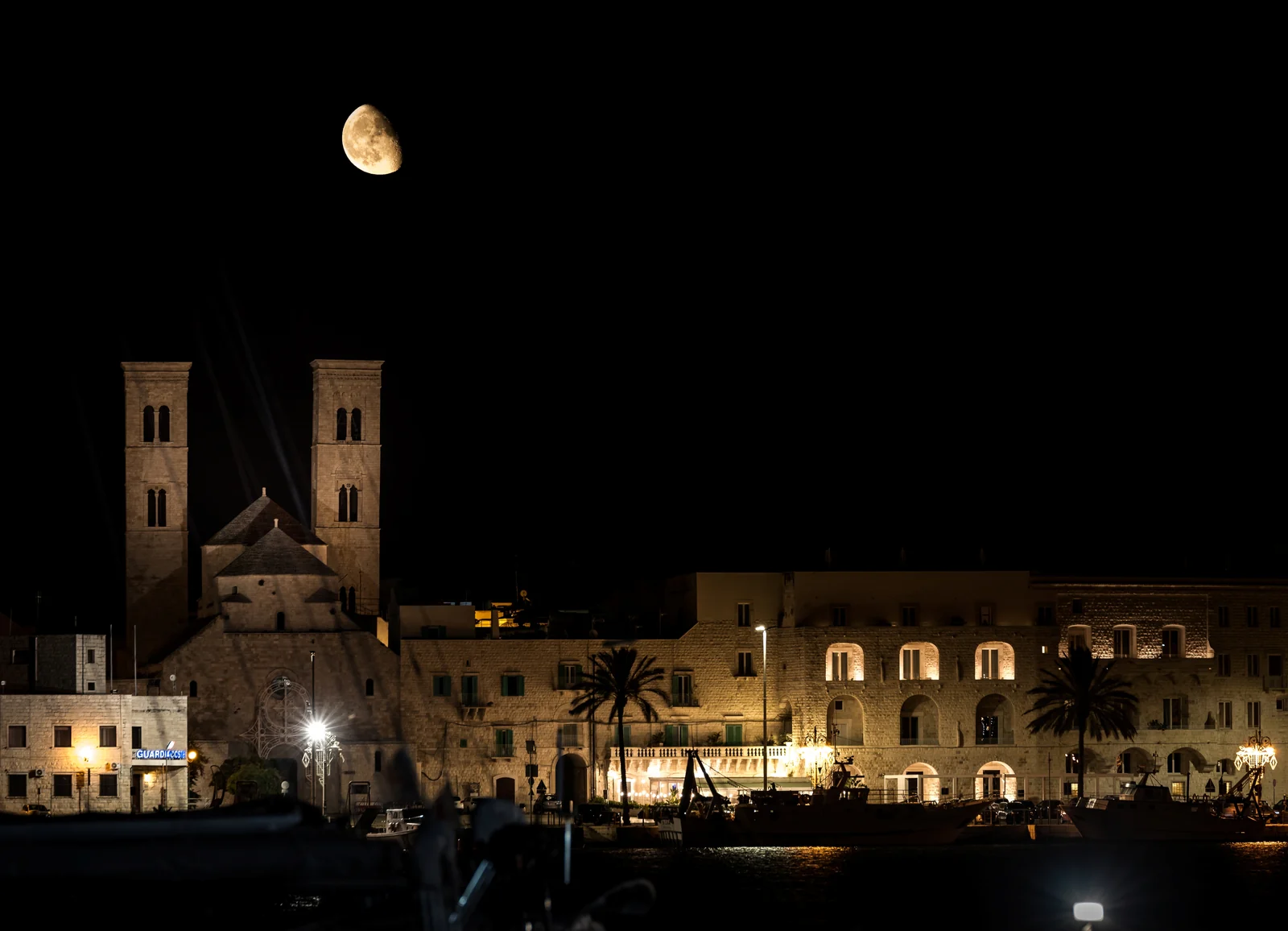
Photo: Leo Piccinni / Wikimedia Commons — CC BY-SA 4.0 · Resized and converted to WebP.
Nearby
To the north, along the coast, Bisceglie has an old town enclosed by Aragonese walls, the Swabian castle with the Torre Maestra, the Romanesque cathedral and, in the countryside, Bronze Age dolmens such as the Chianca; further on is Trani, with its cathedral by the sea and Frederick II's castle.
Towards Bari, by way of Giovinazzo, the coast continues with other seafaring towns; Bari itself, just over twenty kilometres away, is a short train ride.
Inland opens the Murgia landscape: the Alta Murgia National Park lists Molfetta among the motorway exits for reaching the towns of the plateau, such as Altamura, Gravina and Spinazzola. A trip of several days can alternate the harbours and Romanesque cathedrals of the coast with olive-grove countryside and inland villages.
Ruvo, Giovinazzo and Terlizzi belong to the same diocese as Molfetta and each has its co-cathedral; in Terlizzi the feast of the Madonna di Sovereto, the diocese recalls, is celebrated with a triumphal float. At Modugno, inland from Bari, stood the cave of Santa Maria ad cryptam where Saint Conrad was buried before his relics reached Molfetta.
Sources: Viaggiare in Puglia (Regione Puglia) — Bisceglie · Regione Puglia — cartoguida Monumenti e Feste · Parco Nazionale dell'Alta Murgia — Come raggiungere il Parco · Viaggiare in Puglia (Regione Puglia) — Molfetta · Diocesi di Molfetta-Ruvo-Giovinazzo-Terlizzi — Chiese giubilari in diocesi · Diocesi di Molfetta-Ruvo-Giovinazzo-Terlizzi — Storia: dal 1818 al Vaticano II · Diocesi di Molfetta-Ruvo-Giovinazzo-Terlizzi — Storia: dalle origini al tardo medioevo
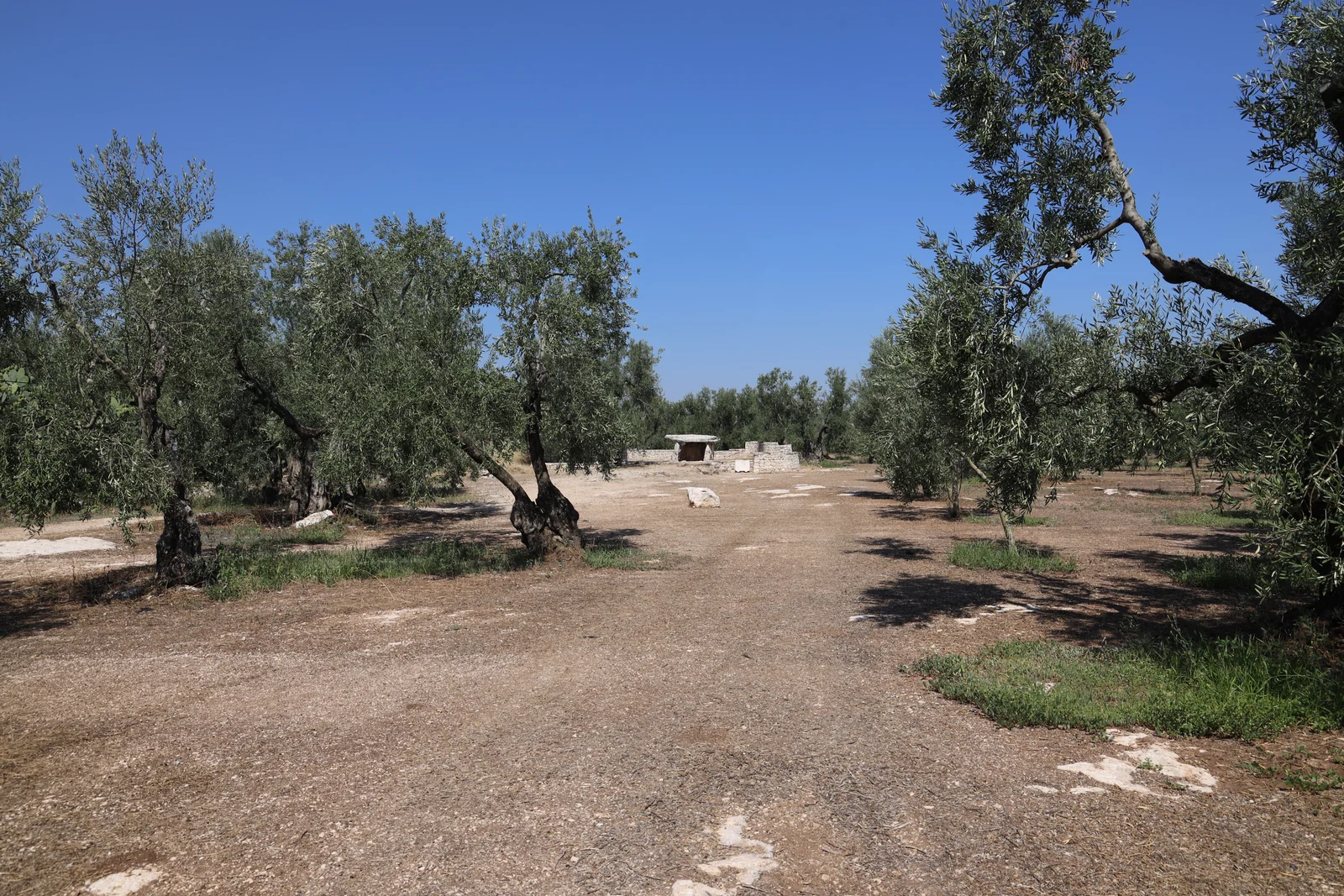
Photo: Fabrizio Garrisi / Wikimedia Commons — CC BY-SA 4.0 · Resized and converted to WebP.
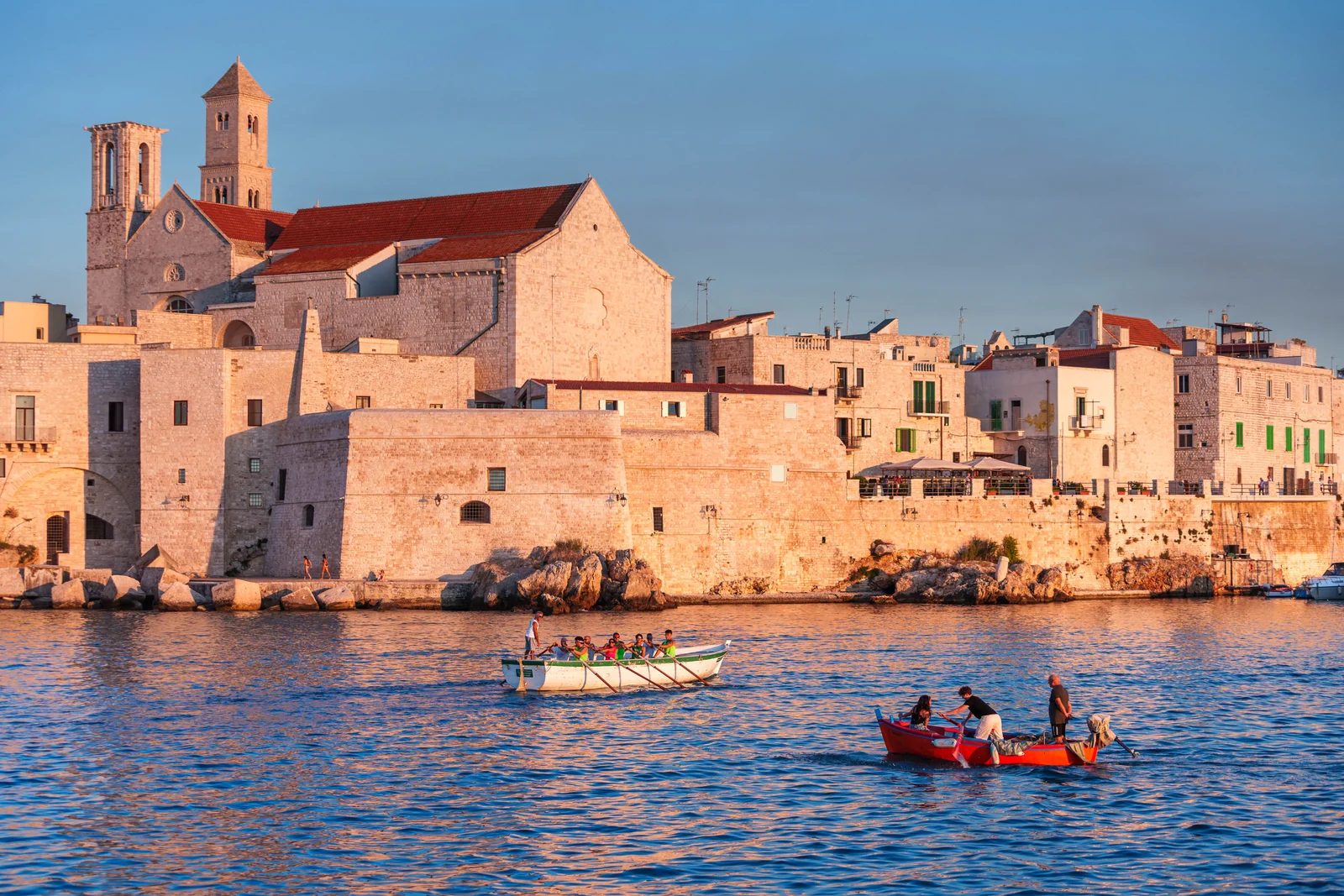
Photo: Pakycassano / Wikimedia Commons — CC BY-SA 4.0 · Resized and converted to WebP.
Local tourist information
Local tourist offices help with opening times, events and transport on the day.
- Info-point Molfetta · Via Piazza 27, 70056 Molfetta (BA) · +39 351 9869433 · [email protected]
Source: Viaggiare in Puglia (Regione Puglia) — Info-point Molfetta · checked on
Where to stay
In the municipality of Molfetta the national database of the Ministry of Tourism lists 282 accommodation businesses with a verified CIN code: 2 hotels, 65 other licensed accommodation and 215 other types such as B&Bs and private rentals.
Licensed businesses from the official list of accommodation named as the source in this section. Where the list gives it, the property's official identification code appears next to its name: the national CIN code, or the code assigned by the Region or by the body that keeps the list. Private individuals are not listed. This list is the official census of licensed businesses, not a list of Apulica partners: to stay in Molfetta you do not have to check one property after another yourself; write to Apulica and we look for the stay that suits your journey, checking availability and conditions before any confirmation.
DOGANA RESORT
Hotel · ★★★★★
CIN IT072029A100058239
AGRITURISMO LA FERROVIA
Farm stay
CIN IT072029B500063634
AL DUOMO BED AND BREAKFAST
B&B
CIN IT072029B400086463
Bellapulia Apartments
Guest rooms
CIN IT072029B400097246
BUFI HOME
Holiday home
CIN IT072029B400117057
SOGLOW BUSINESS CLASS APARTHOTEL
Hotel · ★★★★
CIN IT072029A100021889
B&B RE APARTMENTS PALAZZO MUSCATI DI REGINA VINCENZA
B&B
CIN IT072029B400033518
CASA GENZINO
Guest rooms
CIN IT072029B400116914
B&BIO
B&B
CIN IT072029B400117094
Corte Forno
Guest rooms
CIN IT072029B400096085
First the places that presented themselves to Apulica, the latest first; then one place of each type in turn, by official category and stars, then by name. No position is paid for.
All 34 entries in alphabetical order
Page 1 of 4
| Name | Type | CIN |
|---|---|---|
| AGRITURISMO LA FERROVIA | Farm stay | IT072029B500063634 |
| AL DUOMO BED AND BREAKFAST | B&B | IT072029B400086463 |
| B&B RE APARTMENTS PALAZZO MUSCATI DI REGINA VINCENZA | B&B | IT072029B400033518 |
| B&BIO | B&B | IT072029B400117094 |
| Bellapulia Apartments | Guest rooms | IT072029B400097246 |
| BUFI HOME | Holiday home | IT072029B400117057 |
| CASA GENZINO | Guest rooms | IT072029B400116914 |
| Corte Forno | Guest rooms | IT072029B400096085 |
| Cristalli di Sale | B&B | IT072029B400106862 |
| DOGANA RESORT | Hotel | IT072029A100058239 |
Ask Apulica for a stay in Molfetta We reply shortly, within a few hours at most, with a proposal for you to consider.
Sources: Regione Puglia – ARET Pugliapromozione (DMS), CC BY 4.0, 2026-10-12 · Ministero del Turismo – Banca Dati Strutture Ricettive (dashboard pubblica), 2026-10-12
YOUR JOURNEY
How to shape a journey here
We can design a day connecting architecture, museum and dining, or a focused Pulo visit, linking Molfetta with Giovinazzo, Bisceglie and the Murgia inland.
Plan your tripKeep exploring
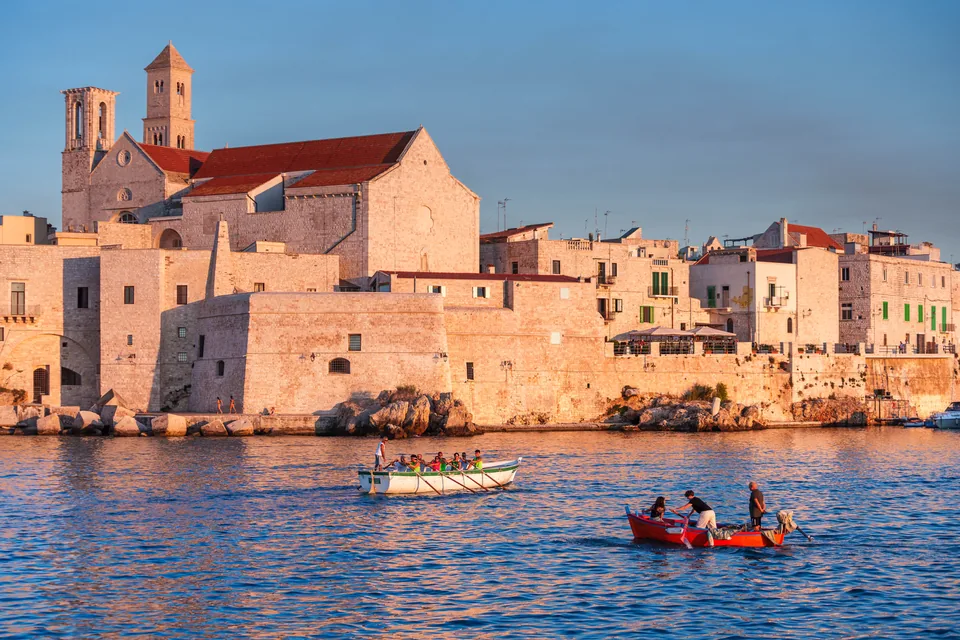
Giovinazzo
The old town, harbour and cooking shaped by farming and fishing traditions. A centre on a rocky promontory, the cathedral and a rice, potato and mussel tiella.
Read the guide →Photo: Pakycassano / Wikimedia Commons — CC BY-SA 4.0 · Resized and converted to WebP.
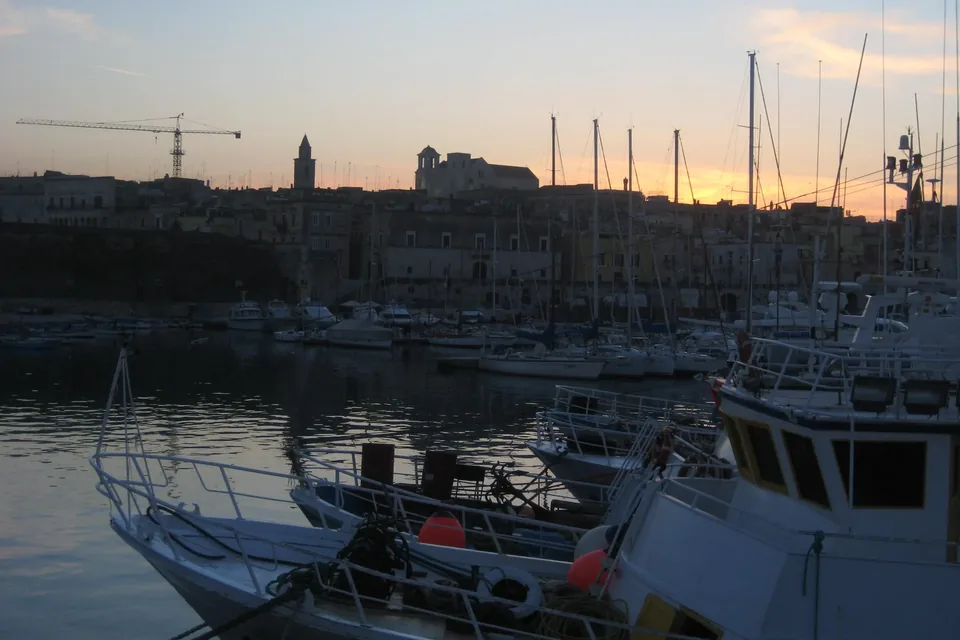
Bisceglie
From the La Chianca dolmen to the Romanesque town and harbour. Aragonese walls, a Swabian castle, Romanesque churches and the sospiro, a Slow Food Presidium.
Read the guide →Photo: Geppisimone at Italian Wikipedia / Wikimedia Commons — CC BY-SA 3.0 · Resized and converted to WebP.
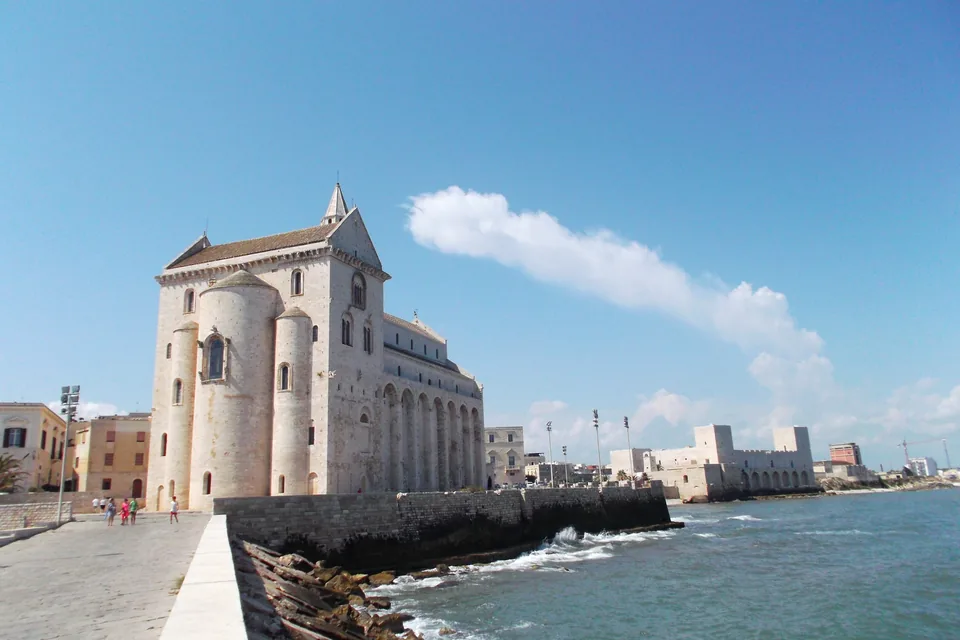
Trani
Cathedral, castle and Jewish heritage for a coastal ending with cultural depth. The Romanesque cathedral on the sea with Barisano’s bronze door, Frederick II’s castle of 1233, the two medieval synagogues of the Giudecca, the harbour and the monastery of Colonna on its peninsula.
Read the guide →Photo: Termauri / Wikimedia Commons — CC BY-SA 4.0 · Resized and converted to WebP.
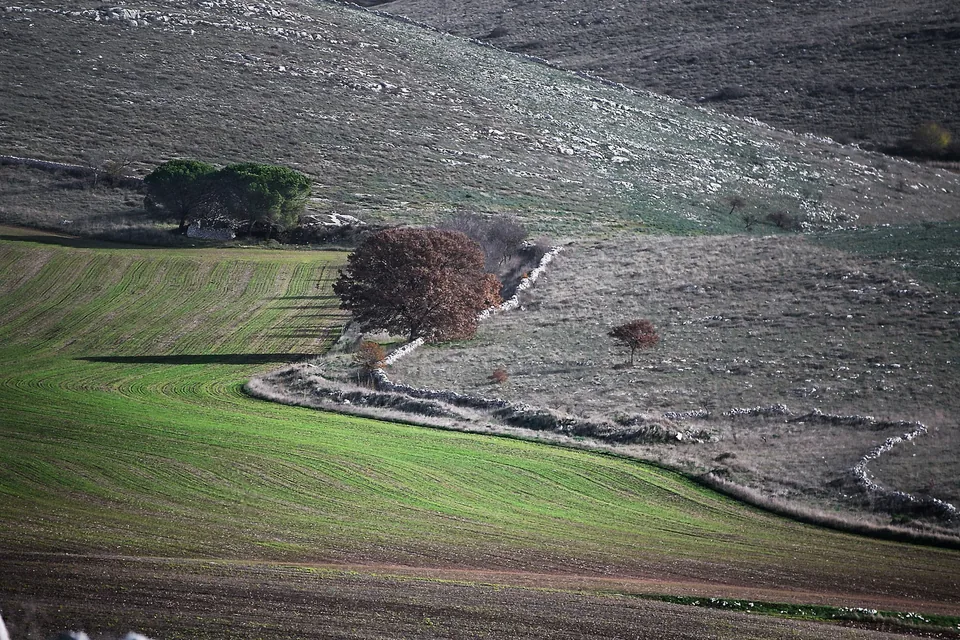
Alta Murgia
Stone, pasture and farming to explore the landscape beyond the towns. A national park of Mediterranean steppe, durum-wheat bread and cardoncello mushrooms.
Read the guide →Photo: Acquario51 / Wikimedia Commons — CC BY-SA 4.0 · Resized and converted to WebP.
Ruvo di Puglia
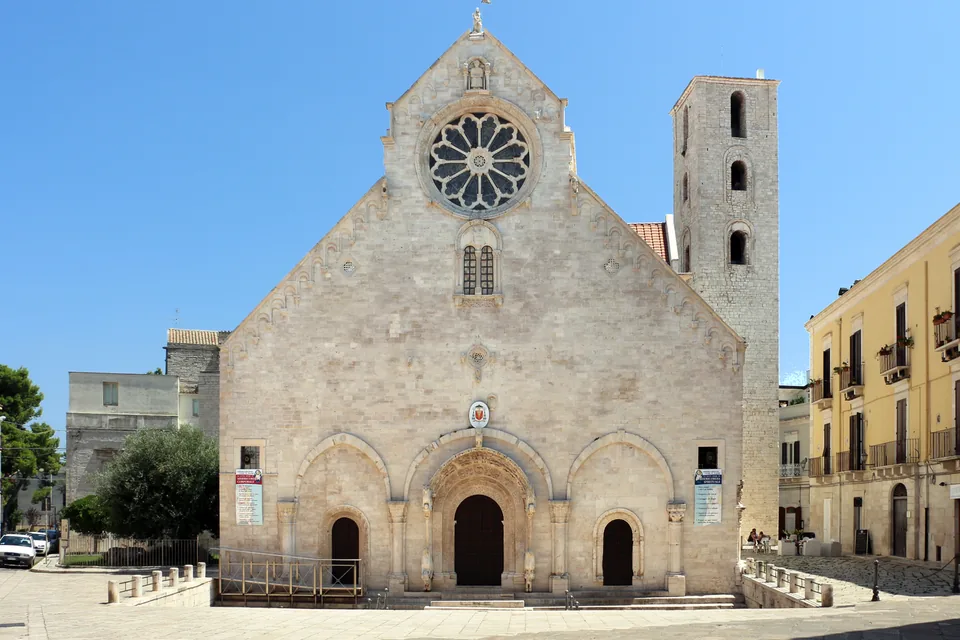
Ruvo di Puglia (BA), Puglia: 24,254 residents, 223.83 km². The official facts of the municipality, its town council website and its registered accommodation. The Romanesque co-cathedral, the Museo nazionale Jatta with the Talos vase, the old town, the Alta Murgia, the Holy Week rites and the cardoncello mushroom festival.
Read the guide →Photo: Sailko / Wikimedia Commons — CC BY 3.0 · Resized and converted to WebP.
Terlizzi
Terlizzi (BA), Puglia: 25,982 residents, 69.23 km². The official facts of the municipality, its town council website and its registered accommodation.
Read the guide →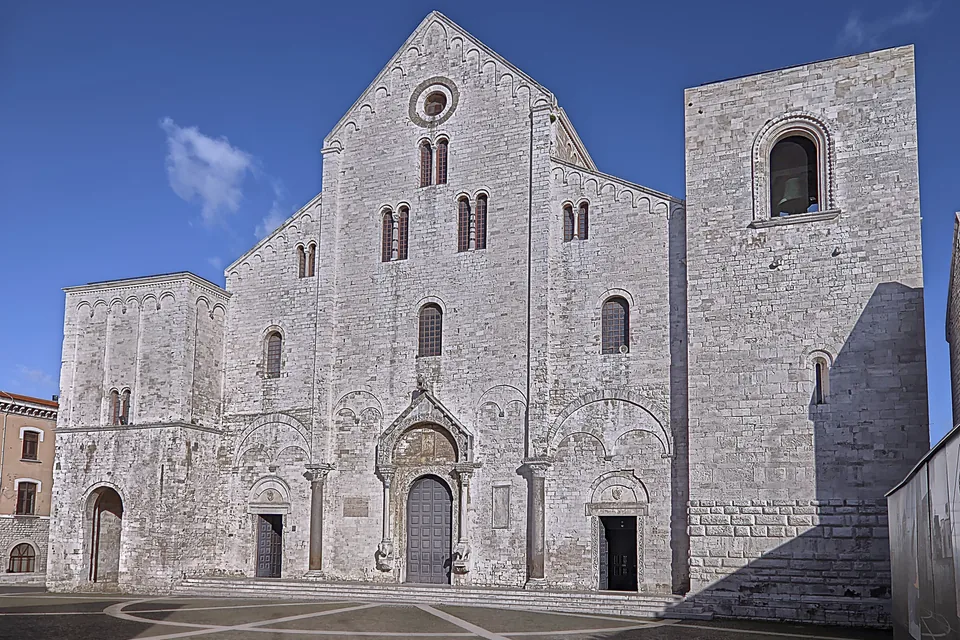
Bari
The old town as a first encounter with Puglia. The Basilica and relics of Saint Nicholas, Bari Vecchia between its two harbours, the Murat district, focaccia and orecchiette with turnip tops.
Read the guide →Photo: Acquario51 / Wikimedia Commons — CC BY-SA 4.0 · Resized and converted to WebP.
Modugno
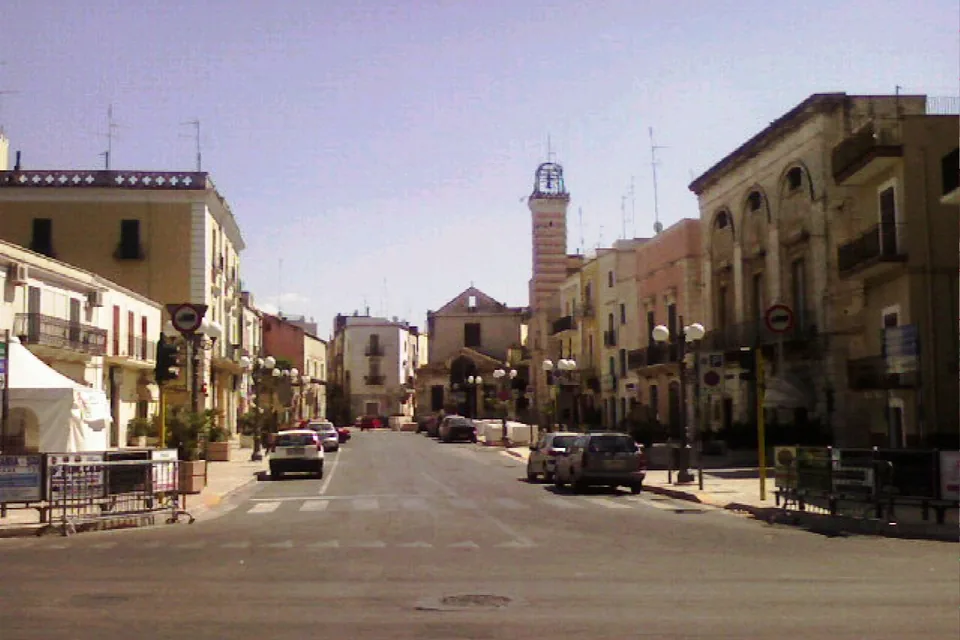
Modugno (BA), Puglia: 36,038 residents, 32.24 km². The official facts of the municipality, its town council website and its registered accommodation.
Read the guide →Photo: WikiGian / Wikimedia Commons — CC BY-SA 2.5 · Resized and converted to WebP.
Bitonto
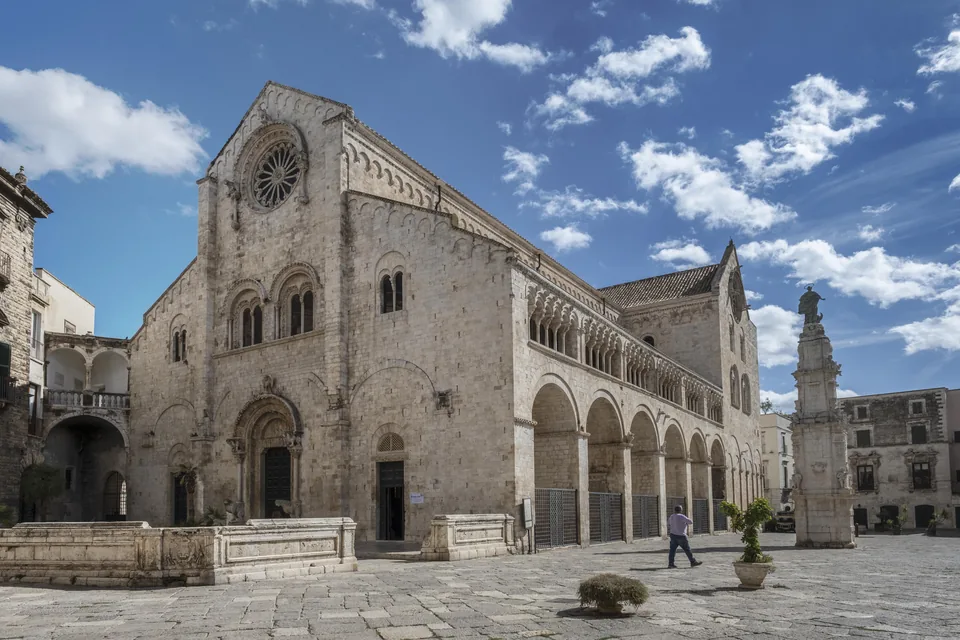
Bitonto (BA), Puglia: 52,958 residents, 174.34 km². The official facts of the municipality, its town council website and its registered accommodation. The Romanesque co-cathedral, the National Gallery of Puglia in Palazzo Sylos Calò, the Angevin round tower, the “Terra di Bari” PDO oil with the “Bitonto” mention, the feast of the Santi Medici and the Lama Balice.
Read the guide →Photo: Giugi30 / Wikimedia Commons — CC BY-SA 4.0 · Resized and converted to WebP.
“Come to Molfetta as a guest, not as a tourist: that is how these places truly let you know them.”