
APULICA / FAITH
Sanctuary of Saint Michael the Archangel
Cave sanctuary · Monte Sant'Angelo · Puglia
In brief
- The heart of the sanctuary is a natural cave which, according to tradition, was consecrated by the Archangel himself: hence its name, the 'Celestial Basilica'. (Le quattro apparizioni - Basilica Santuario San Michele · Santuario di San Michele Arcangelo - Italia.it)
- Since 25 June 2011 it has been part of the UNESCO site 'The Longobards in Italy. Places of Power (568-774 A.D.)'. (I Longobardi nella World Heritage List - Longobardi in Italia)
- From the 7th century it became the national sanctuary of the Lombards and served as the model for the shrines of Saint Michael across Europe, including Mont-Saint-Michel. (Complesso Santuariale di San Michele - Longobardi in Italia (sito UNESCO))
- The cave is entered through bronze doors made in Constantinople in 1076, with 24 panels. (Grotta di San Michele - Basilica Santuario San Michele · Il Calendario 2027 (Porte di bronzo) - Basilica Santuario San Michele)
- You descend to the cave along the 86-step Angevin staircase, which starts beside the octagonal bell tower commissioned by Charles I of Anjou. (Grotta di San Michele - Basilica Santuario San Michele · Santuario di San Michele Arcangelo - Italia.it)
Festivals and dates
- Feast of the Apparitions (May Dies festus): 8 May, preceded by a novena (La Festa delle Apparizioni: significati, eventi, immagini - Basilica Santuario San Michele · Novena e Festa delle Apparizioni: le immagini - Basilica Santuario San Michele)
- Feast of Saint Michael the Archangel: 29 September (Grotta di San Michele - Basilica Santuario San Michele · Dies festus (29 settembre) - Basilica Santuario San Michele)
- Spring
- Autumn
From pagan cave to Lombard sanctuary
The great limestone cave of the Gargano was probably already a place of worship in Greek and Roman times, linked to the seer Calchas and the physician Podalirius. Between the mid and late 5th century the cult of the Archangel Michael, which had come from the East, took root here. Its origin is told in the Liber de apparitione sancti Michaelis in monte Gargano, which recounts the apparitions to Lorenzo Maiorano, bishop of Siponto, dated by tradition to 490, 492 and 493.
After 560 the Gargano passed to the Lombard Duchy of Benevento, and from the 7th century the cave became the national sanctuary of the Lombards, who saw the Archangel as a warrior protector. The dukes paid for new stairways and a gallery for pilgrims, whose walls still bear about two hundred inscriptions, some in runic script. Devotion spread throughout the West and the Gargano shrine became the model for the European ones, Mont-Saint-Michel included.
In the Middle Ages it was one of the great destinations of Christendom, visited by popes, emperors and saints, including, according to tradition, Francis of Assisi in 1222. Between the 13th and 14th centuries the Angevins gave the complex its present layout, with a 'downhill' entrance from the town. In 2011 the sanctuary became part of the UNESCO site dedicated to the Lombards in Italy.
Sources: L'origine del Santuario - Basilica Santuario San Michele · Complesso Santuariale di San Michele - Longobardi in Italia (sito UNESCO) · Pellegrinaggi - Basilica Santuario San Michele · I Longobardi nella World Heritage List - Longobardi in Italia
The Archangel, the apparitions and forgiveness
Tradition records four apparitions. In the first, 'of the bull', an arrow shot at a bull in front of the cave turned back and struck the archer; the Archangel then revealed to Bishop Maiorano that the cave was sacred to him. The second, 'of the victory', is linked to a battle that tradition sets on 8 May and which sealed the bond between the cult of Michael and the Lombards. In the third, 'of the dedication', the Archangel announced that he had consecrated the cave himself: on 29 September the bishop celebrated the first Mass there. The fourth took place in 1656, during the plague, when Michael told Bishop Puccinelli to bless the stones of the cave by carving a cross and the letters M.A. on them.
Pilgrims still ask for these small stones, and the sanctuary stresses that they are not talismans but a sign of that event; they are issued only by the basilica. On the entrance arch is carved the phrase attributed to the Archangel: where the rock opens, there the sins of men will be forgiven. In 1997 the Church recognised the sanctuary as a place of 'Angelic Forgiveness', and confession is one of the main reasons for the pilgrimage.
The sanctuary is in the care of the Michaelite Fathers, the Congregation of Saint Michael the Archangel, whose motto recalls the meaning of the name Michael: 'Who is like God?'.
Sources: Le quattro apparizioni - Basilica Santuario San Michele · I sassolini della Grotta - Basilica Santuario San Michele · Cappella Penitenziale - Basilica Santuario San Michele · Padri Micheliti - Basilica Santuario San Michele
From the Angevin tower to the Sacred Cave
The visit begins in the upper atrium, dominated by the octagonal bell tower that Charles I of Anjou had built from 1274 in thanksgiving to the Archangel; originally 40 metres tall, it now measures 27. The two-arched façade has a niche with a statue of Saint Michael at its centre; from here an 86-step Angevin staircase, lined with the tombs of old local families, descends to the Bull's Gate, topped by a fresco of the first apparition.
The entrance to the cave is closed by bronze doors made in Constantinople in 1076 for Pantaleone of Amalfi: 24 inlaid panels showing biblical episodes involving angels and the apparitions to the bishop of Siponto. Inside, the Angevin nave joins the natural cave. Since 1507 the Altar of the Footprints has been dominated by the Carrara marble statue of the Archangel trampling the devil, attributed to Andrea Sansovino; the cave also holds the episcopal throne of Acceptus and the Lombard icon.
The TECUM Museums (Treasures of the Cult of Michael) include the Lapidary Museum, with over 200 sculptures dating from the 4th to the 16th century, the Devotional Museum and the Lombard crypts, uncovered in the 1949-1955 excavations and about 60 metres long, bearing inscriptions left by pilgrims between the 6th and 9th centuries.
Sources: Grotta di San Michele - Basilica Santuario San Michele · Santuario di San Michele Arcangelo - Italia.it · Musei Tecum - Basilica Santuario San Michele · Complesso Santuariale di San Michele - Longobardi in Italia (sito UNESCO) · L'Angelo, la Montagna, il Pellegrino - Basilica Santuario San Michele
The Archangel's two feasts
The sanctuary celebrates two major occasions. The Feast of the Apparitions, or May Dies festus, falls on 8 May and is preceded by a novena that starts at the end of April, with daily meditations. It commemorates the apparitions of 490, 492 and 493 and in particular the victory that tradition places on 8 May itself; since the town of Monte Sant'Angelo grew up around the cave, the feast also in a sense celebrates the town's origins. The solemn Mass is presided over by the archbishop and draws pilgrims, devotees and residents.
29 September, the day on which tradition says Bishop Maiorano celebrated the first Mass in the cave, is the feast of Saint Michael, which the whole population of Monte Sant'Angelo marks as a day of praise and gratitude. On this occasion the sword, taken from the hand of the Archangel's statue, is carried in solemn procession through the streets of the town.
Throughout the year pilgrims can also ask the sanctuary for the small stones from the cave, linked to the apparition of 22 September 1656.
Sources: La Festa delle Apparizioni: significati, eventi, immagini - Basilica Santuario San Michele · Novena e Festa delle Apparizioni: le immagini - Basilica Santuario San Michele · Le quattro apparizioni - Basilica Santuario San Michele · Dies festus (29 settembre) - Basilica Santuario San Michele · Grotta di San Michele - Basilica Santuario San Michele · I sassolini della Grotta - Basilica Santuario San Michele
Visiting the Celestial Basilica
Monte Sant'Angelo is reached by a winding road with a viewpoint over the Gulf of Manfredonia; the sanctuary is right in the centre, and from the basilica you step into the Junno quarter, with its alleys and white houses. Within the complex, next to the basilica, the Michaelite Fathers run the Hotel Casa del Pellegrino, a pilgrim reception house connected internally to the basilica, with a chapel, group rooms and daily spiritual assistance (official website: santuariosanmichele.it).
For confession, the sanctuary built the Penitential Chapel, or 'Chapel of Reconciliation', for the Jubilee of 2000; it also hosts communal penitential services. Visits to the TECUM Museums can be booked online on the sanctuary's website, with audio guides in Italian, English, French and Spanish.
In town, the Norman castle, the Tomb of Rothari and the San Francesco complex are also worth a stop; from the sanctuary San Giovanni Rotondo and the Gargano coast are about twenty minutes away, and the Umbra Forest, whose beech woods are also UNESCO heritage, about half an hour.
Sources: Monte Sant'Angelo - Italia.it · Hotel Casa del Pellegrino - Basilica Santuario San Michele · I sassolini della Grotta - Basilica Santuario San Michele · Prenotazione Musei Tecum - Basilica Santuario San Michele
Walks that reach it
The Way of Peace
L'Aquila, Basilica of Santa Maria di Collemaggio → Monte Sant'Angelo, Church of St Michael the Archangel · The official site gives 543 km on foot in its summary figures, but its descriptive text speaks of more than 520 km, and the waymarking page of 520 marked km. The cycling version measures 440 km. · The official site gives 37 stages in its summary figures and 35 stages in its descriptive text. The stage list numbers 29 main stages (13 and 14 are merged) plus eight variants marked "bis"; the guidebook describes 29 stages plus 3 stages of a mountain variant. By bike there are 9 stages.
Abruzzo, Molise, Puglia
Via Francigena in Southern Italy
Rome → Santa Maria di Leuca · more than 900 km from Rome to Santa Maria di Leuca · No reachable source gives the overall number of stages. In Puglia the regional guide splits its four described itineraries into 5, 5, 6 and 7 walking days.
Puglia, Campania
The place
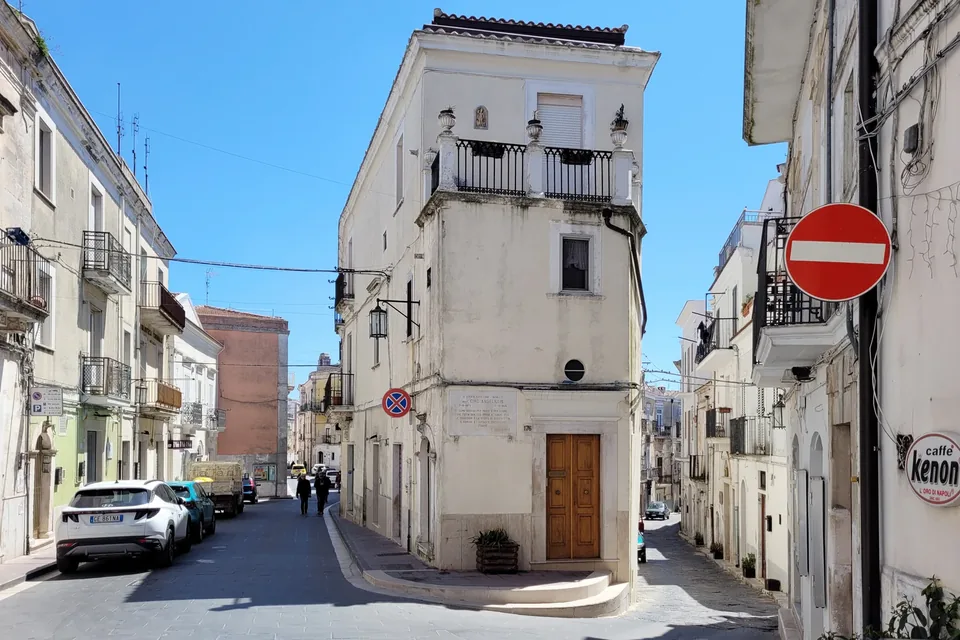
Monte Sant’Angelo
Monte Sant’Angelo: the cave and Junno quarter.
Read the guide →Photo: Bernard Gagnon / Wikimedia Commons — CC0 · Resized and converted to WebP.


Gargano
Gargano: villages, woodland and coast.
Read the guide →Photo: Bernard Gagnon / Wikimedia Commons — CC0 · Resized and converted to WebP.

Sources
- L'origine del Santuario - Basilica Santuario San Michele
- Le quattro apparizioni - Basilica Santuario San Michele
- Grotta di San Michele - Basilica Santuario San Michele
- Musei Tecum - Basilica Santuario San Michele
- Santuario di San Michele Arcangelo - Italia.it
- Complesso Santuariale di San Michele - Longobardi in Italia (sito UNESCO)
- I Longobardi nella World Heritage List - Longobardi in Italia
- Pellegrinaggi - Basilica Santuario San Michele
- La Festa delle Apparizioni: significati, eventi, immagini - Basilica Santuario San Michele
- Novena e Festa delle Apparizioni: le immagini - Basilica Santuario San Michele
- Il Calendario 2027 (Porte di bronzo) - Basilica Santuario San Michele
- Dies festus (29 settembre) - Basilica Santuario San Michele
- I sassolini della Grotta - Basilica Santuario San Michele
- Cappella Penitenziale - Basilica Santuario San Michele
- Padri Micheliti - Basilica Santuario San Michele
- L'Angelo, la Montagna, il Pellegrino - Basilica Santuario San Michele
- Monte Sant'Angelo - Italia.it
- Hotel Casa del Pellegrino - Basilica Santuario San Michele
- Prenotazione Musei Tecum - Basilica Santuario San Michele