What masseria means
The Municipality of Castellaneta offers a historical key useful for the whole region. Masserie as we understand them today, large buildings at the centre of a productive area, began to spread in the sixteenth century and reached their greatest expansion between the eighteenth and nineteenth centuries. Among the causes the source cites the land reform of Charles III of Bourbon, the abolition of feudalism in the Napoleonic period and the division of common lands after Unification.
The word itself changed meaning over time: depending on the place it referred to dwellings, land, arable fields, herds or farming contracts. In Castellaneta’s land registers of the seventeenth century and of 1750 the masseria is only the farming or grazing property, while the rural residence is called a tower; the 1815 register speaks of a rural house.
The same page notes that two thirds of the recorded masserie belonged to church bodies, and that the municipal territory counts over a hundred built before 1903. Keeping this history in mind avoids reducing a building to a single image: each masseria results from different owners, uses and transformations.
A set of spaces, not just a façade
The Apulia Region, presenting a programme devoted to rural architecture and landscape, lists the assets that bear witness to the traditional farming economy and the evolution of the landscape: farmhouses, masserie, trulli, oil mills, stables and mills, but also rural churches and wayside shrines, dry-stone walls, fountains and wells. The stated aim is to protect these assets of material and intangible culture and to encourage sustainable cultural tourism.
The list is valuable for travellers because it shifts attention from the main building to the whole. What matters is the relationship between different elements: an entrance, a courtyard and a storeroom can raise questions about how people and goods moved. Who passed through, what was stored, which rooms were devoted to work?
The beauty of the buildings becomes clearer when you also consider their function. A well tells of water management in a dry land, a chapel of the religious life of a small rural community, a dry-stone wall of how fields were divided and of the labour of those who built them stone by stone.
Sources: Regione Puglia — Architettura rurale: recupero e valorizzazione di edifici storici rurali
Montalbano: a fortified hamlet around a courtyard
Along the road from Fasano to Ostuni, at Montalbano, the Apulia Region points to one of the most interesting farm complexes in the Brindisi area: the fortified hamlet of Montalbano Vecchio, now known as Masseria Montalbano. The regional entry dates it to the sixteenth century and notes that it was bought by the Acquaviva d’Aragona, counts of Conversano.
The two-storey manor house faces a large inner courtyard linking the other buildings within the walls: servants’ quarters, stables, horse stalls, three large oil mills and a small frescoed church dedicated to the Blessed Virgin of the Rosary. The villagers, the source adds, lived in low terraced houses arranged in parallel rows not far from the main building.
Today the complex houses a hospitality business, but its form still reveals a complex organisation of rural life. The example helps read other masserie without assuming they are all alike: compare the size of the courtyard, the layout of the buildings and the relationship with the farmland outside.
Fasano: from abbey to masseria, with a museum oil mill
The Ministry of Culture entry tells the long history of the San Lorenzo masseria near Fasano, also known as the Abbey of San Lorenzo. Its origins go back to the twelfth century and to the rock-cut settlement of Lama di San Lorenzo; a crenellated tower rises on the left side of the building.
In the thirteenth century the property passed to the monastery of Santo Stefano in Monopoli, in the fourteenth it became a cardinal’s benefice, and until 1665 it was a grange of the abbey of the Greek monks of San Nicola di Casole near Otranto. In 1693 Cardinal Imperiale built a church dedicated to Saint Lawrence the Martyr; since 1798 the complex has belonged to the same family. The dwelling, in Murge tufa, is the oldest part and dates from the sixteenth century.
Opposite the farm manager’s house stands a restored eighteenth-century oil mill, home to the Olive Oil Museum with various processing tools; behind the palace lies an old citrus grove. Here the relationship between building, work and cultivation has precise elements to recognise, and the history of ownership shows how closely masserie were tied to religious bodies.
Sources: Ministero della Cultura — Museo dell’Olio d’Oliva di Fasano
The jazzi of the Alta Murgia: the herders’ farmstead
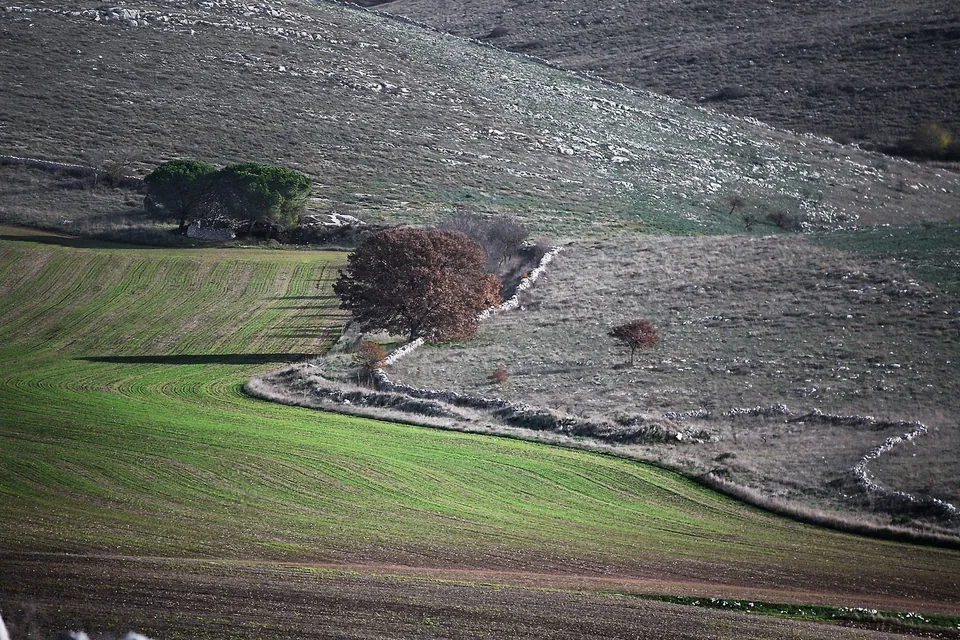
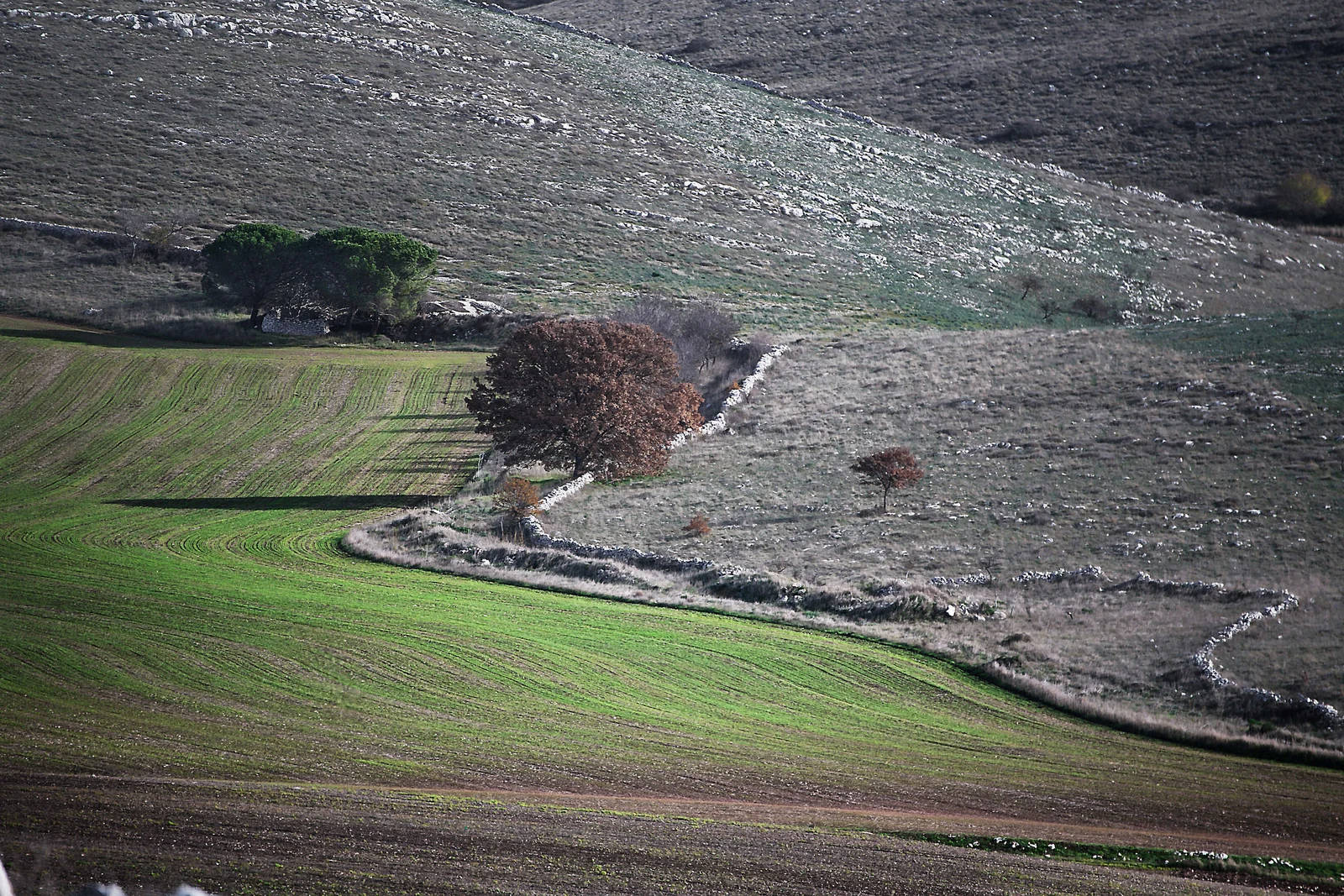
On the Murge plateau rural architecture takes another form. The Alta Murgia National Park presents Jazzo Tarantini as a notable example of dry-stone building, set in an area of steppe and fields on the side of a shallow karst groove. Jazzi, the Park explains, were used mainly for sheep farming.
They appear as large rectangular enclosures divided by inner walls. Along the sides are the animal shelters, called lamioni, and usually, on the opposite side, rooms for workers to live in and to process milk. These structures originate in transhumance, the seasonal migration of shepherds, flocks and workers handling milk and wool, already widespread in Roman times.
Visiting a jazzo alongside a farming masseria lets you compare two economies: that of oil and cereals, organised around courtyards and mills, and that of herding, built to receive moving flocks. It is a concrete way to understand how much the Apulian landscape results from different activities.
Three questions for reading the courtyard
When entering a masseria, look first for the route: which entrance people came through, what they crossed, which rooms faced the courtyard. Then the work: did the spaces need light, access for goods or closeness to animals? Finally the relationship with the fields, that is, where the building ended and cultivated land began.
These questions make the visit richer than a series of photographed façades. One detail can change the reading of the whole: a narrow passage, a threshold, a different room height, a tower suggesting the need for defence. Comparison works even between two examples, without expecting an identical plan.
Families with children can turn observation into a small game: spot the stable, the oil mill, the chapel, the well. The exercise also helps adults see the masseria as a small village, with distinct functions and an everyday life made of gestures repeated for generations.
From building to product, with a clear thread
On a journey between Ostuni, the Itria Valley and the Murge we would choose one farming theme at a time. For oil, reading the mill can come before a tasting; for herding, the jazzo can introduce cheeses; for rural life, the courtyard can be compared with the small spaces of a town.
The meal follows the visit rather than being a vague addition: asking how a product was transformed helps you taste it with more attention. As for timing, what matters is the gesture you want to see. Tasting stored oil and watching a seasonal process call for different plans; the building, by contrast, keeps readable traces all year.
In autumn and winter the olive harvest gives meaning to the mill; in spring the Murge plateau shows its steppe landscape; in summer the courtyards offer shade in the hottest hours. No season is compulsory: choose according to what you want to understand, and let the landscape complete the story.
Staying in a masseria, with an informed eye
Many historic masserie now welcome guests, as the Montalbano example shows. We do not name specific places here; instead we suggest choosing by type, distinguishing between complexes that keep a readable courtyard, farms still in operation and rural residences more deeply transformed.
Guests in a masseria can use the same method suggested for visiting. Look at where the stables stood, which rooms became bedrooms, what remains of the oil mill or chapel. Often the new function has kept the shape of the spaces, and recognising it makes the stay part of the journey rather than just a place to sleep.
It is also worth asking the hosts, when possible, about the building’s history and its relationship with the surrounding land: who still farms, what is produced, which parts were rebuilt. A precise answer is worth more than an adjective, and links the experience of hospitality to the rural history told by public sources.
A thread for your journey
A rural thread between Alta Murgia, the Itria Valley and Ostuni, connecting architecture and food.
Talk to us