Lino Banfi and Canosa’s Teatro Lembo
The Municipality of Canosa di Puglia documents an evening devoted to Lino Banfi, stage name of Pasquale Zagaria, whom the administration calls its most illustrious citizen and one of the best-known faces of Italian television and cinema. The central moment was the naming of the foyer of the Teatro comunale Raffaele Lembo after the actor, chosen because, the source recalls, his career began right there.
The municipality’s account mentions the characters that made him popular, such as Nonno Libero and Oronzo Canà, and his public role in a Carabinieri awareness campaign against scams targeting the elderly. The evening continued in Piazza Vittorio Veneto with the seventeenth edition of the Premio Dea Ebe – La Maschera Banfi, a local event devoted to comedy.
It is a public trace of the bond between actor and town, visible in a plaque and a cultural venue. It does not mean a meeting with the artist is available, nor that a museum has opened: the theatre remains a community space, open to associations, schools and citizens, as the same source stresses.
Sources: Comune di Canosa di Puglia — Canosa riabbraccia Lino Banfi
The theatre and ancient Canosa
The Municipality of Canosa describes the Teatro comunale Raffaele Lembo as a building inaugurated in 1926 in Art Nouveau style, with a hall of decorated boxes and a distinctive dome. During restoration a Roman archaeological site came to light, now visible from the stalls: a detail linking the place where Banfi’s career began to a far older story.
The same municipal source lists several archaeological sites in town. The basilica of San Leucio, now in ruins, dates from the sixth century and rose over a Hellenistic temple dedicated to Minerva. The Canusium funerary complex, dated between the late fourth and first centuries BC, includes three hypogea cut into the tufa, known as Lagrasta; another tomb keeps a third-century BC fresco of Cerberus, the three-headed dog symbolising passage to the afterlife. The Scocchera hypogea were found by chance in 1895.
Use the theatre as a way in and then widen your view: Canosa offers one of the richest archaeological layerings north of Bari, which deserves its own visit regardless of the famous name that made it known to many.
Sources: Comune di Canosa di Puglia — Teatro comunale Raffaele Lembo · Comune di Canosa di Puglia — Siti archeologici
Checco Zalone and Capurso
The Municipality of Capurso, on its page about culture and events, recalls that the town is the home of Checco Zalone, stage name of Luca Medici, and stresses his bond with the community. It is a reference to the local memory of comedy, which the municipality places alongside its presentation of the town’s cultural life.
The same page describes a programme organised into the so-called Seasons of Cultures. Summer evenings fill the municipal gardens, the basilica’s forecourt and cloister, Piazza Umberto, the municipal park and the lanes of the old town with songs, dances, stories and readings; among the main events the source cites a summer jazz festival and an amateur theatre festival. Carnival ends with a popular staging of the effigy’s funeral, accompanied by the band.
For the trip, Zalone’s name can introduce the town, leaving room afterwards for what you observe and for stories with other protagonists. Comedy, after all, often springs from observing everyday life: exactly what a walk through Capurso’s centre lets you discover.
Sources: Comune di Capurso — Manifestazioni, feste religiose ed eventi
Capurso and the Madonna del Pozzo
The heart of Capurso’s religious life is the Madonna del Pozzo. The municipality recounts that in the early eighteenth century a priest, Don Domenico Tanzella, seriously ill, had a vision of the Madonna inviting him to drink the water of an old well; lowering himself into it, he found a fresco of the Virgin, which art historians date to the sixteenth century. A small church stands over the well, and the ritual of tasting the water remains central for worshippers.
The basilica, designed by the Bari architect G. Sforza, was begun during the eighteenth century and completed in 1778, when the fresco was moved there; it is a whitewashed late Baroque building with a single nave and altarpieces by Vincenzo Fato. In 1852 the image was crowned, and in 2014 the town received the title Civitas Mariae.
Celebrations open on 20 May and culminate in the great feast on the last weekend of August, with four processions: among them the candle procession, lasting most of the day, and the evening procession of the triumphal cart pulled by worshippers from Bisceglie. Dates should always be checked for each edition.
Sources: Comune di Capurso — La Madonna del Pozzo · Comune di Capurso — I principali beni architettonici
Rubini, Scamarcio and Placido on screen
Apulia Film Commission documents Sergio Rubini as director and actor of L’uomo nero, written with Domenico Starnone and Carla Cavalluzzi, alongside Valeria Golino, Riccardo Scamarcio, Fabrizio Gifuni and Margherita Buy. The film tells of a man returning to Puglia and reliving his childhood; the listed locations range from San Vito dei Normanni to Mesagne, Brindisi, Taranto, Oria, Altamura and Bari. At the 2010 Bif&st it won awards for best leading actor and for production design.
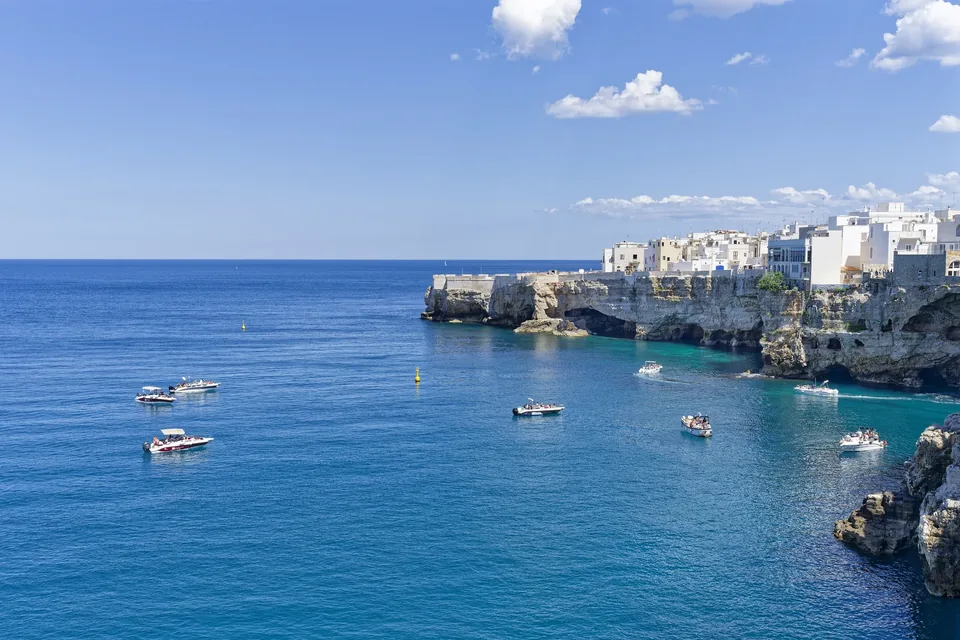
The same Film Commission lists Michele Placido in the cast of Marco Ponti’s Io che amo solo te, with Riccardo Scamarcio, Laura Chiatti and Maria Pia Calzone, a comedy set in Polignano a Mare and also filmed in Turi, Monopoli and Martina Franca.
These are artistic credits: they say who worked on a film and where it was shot, but they do not prove birth or biography in the locations. Keeping this information distinct avoids attributing to a town a bond the sources do not document, and lets you appreciate the performers’ work for what it is: a public work.
Sources: Apulia Film Commission — L’uomo nero · Apulia Film Commission — Io che amo solo te
A biography raises a question about the town
The starting point may be a familiar face, but we suggest arriving with a question about the relationship between person and place. A theatre keeps a different memory from a film: the first belongs to the town’s public space, the second builds a story through images and performers. Distinguishing these bonds makes the visit richer.
Look for a document, a plaque or a building, then widen your view to what surrounds it. In Canosa the foyer plaque leads to the theatre, the theatre to the Roman site beneath the stalls, and from there to the ancient city. In Capurso a comedian’s name leads to the summer squares, and the squares to the basilica and the well. The famous name thus gains a precise role: it introduces a local story without filling the whole route on its own.
It is also a matter of respect. The people mentioned are public figures for their work; the journey focuses on what communities have chosen to make visible, not on their private lives.
Comedy and storytelling: choose one thread
To prepare a day, choose a short comic moment or a scene and ask which gesture, word or situation makes it recognisable. In the town, curiosity can move towards the theatre, language and meeting places: the square, the churchyard, the street where people stroll in the evening.
A conversation between those who already know the artist and those discovering him on the trip helps avoid a visit made only of names. The meal offers a suitable time for that exchange. The question is not who the region’s most important face is, but which story lets you observe a particular place better.
Those travelling with young people can suggest a small exercise: spot in the town’s life a situation that could become a scene, a dialogue overheard at the market, a gesture repeated outside a café. It is a way to understand how actors and comic writers work, often starting from observing the people and places where they grew up, and to look at everyday Puglia more attentively.
A route between public memory and cinema
Picture the theme as a choice between chapters, not a collection of every Apulian actor. Canosa can shape a day around the theatre, Banfi’s memory and archaeology; Capurso half a day among squares, basilica and well; Bari or Polignano can open the comparison with cinema. Each place keeps its own story, and the trip leaves time for the town visit as well as the artistic reference.
Timing depends on interests. A published theatre programme can give a precise date; Capurso’s feasts in May and at the end of August show a town at its busiest; the Fanoje on the eve of the Immaculate Conception, with its great bonfire in the square, is a winter occasion. A reading of public spaces, by contrast, follows the pace the traveller chooses.
We do not promise meetings with artists or private itineraries: the route relies on public, documented places. The aim is to come back with an understood bond rather than a longer list of names, and with the sense of having known towns that have much to tell even without a famous face.
A thread for your journey
A theme connected with documented places and film, without private itineraries or promised meetings.
Talk to us