
APULICA / FRESH PASTA, BREAD AND PASTRY
Scaldatelli
PAT · Fresh pasta, bread and pastry · Puglia
In brief
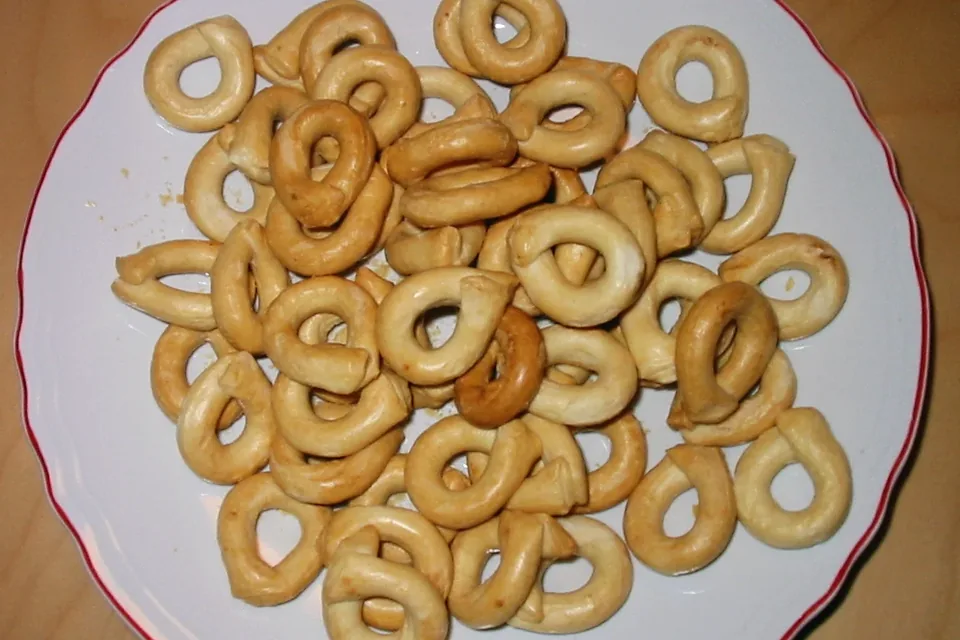
- Glossy golden taralli made with flour, extra virgin olive oil, white wine and fennel seed. (Atlante dei PAT di Puglia — Scaldatelli)
- They are first dipped in boiling water, the scalding that gives them their name, then air-dried for some hours and baked. (Atlante dei PAT di Puglia — Scaldatelli)
- Their stated area of origin is the province of Foggia. (Atlante dei PAT di Puglia — Scaldatelli)
History and origin
Scaldatelli are taralli from the province of Foggia, and their name describes the step that sets them apart: before going into the oven they are "scaldati", warmed, by dipping them in boiling water. The regional record of traditional products tells a story that places their origin in the fifteenth century.
A very poor peasant woman, the wife of a farm labourer, who spent her days alone, is said to have made little rings of dough and warmed them in water. Tasting them, she found them inedible; but she realised that once left to dry and baked in the oven they became delicious.
From the seventeenth century, in a poor, farming Puglia, scaldatelli spread among peasant families, sometimes in place of bread, which cost more, and became a gift exchanged as a sign of friendship and conviviality. They have been on the national list of traditional food products since 2001.
Sources: Atlante dei PAT di Puglia — Scaldatelli · Masaf — Elenco nazionale dei prodotti agroalimentari tradizionali, XXVI revisione (2026)
Area and method of production
The area of origin given is the province of Foggia, where scaldatelli are made all year round. The recipe in the regional record starts from a kilo of flour, or a mix of flour and durum wheat semolina, with 200 grams of extra virgin olive oil, a glass of white wine, a spoonful of fennel seeds and 20 grams of salt.
Everything is kneaded with lukewarm water into a firm, smooth, not too soft dough, which rests for about a quarter of an hour. It is then divided into pieces and rolled into sticks 10-15 centimetres long and as thick as a little finger, closed into a ring with light pressure of a finger; some versions shape them as little gates, figures of eight or snails.
Then comes the scalding: the shapes are dropped into boiling water until they float. They dry in the air for 4-10 hours and bake at 180-200 degrees for 20-30 minutes.
How to recognise it
Scaldatelli are recognised by their golden colour and glossy surface. They are crunchy and have a fragrant aroma blending the oil and wine of the dough.
As you chew them they leave a pleasant aftertaste of fennel, from the seeds added to the dough along with extra virgin olive oil and white wine.
The typical shape is a ring, closed by the press of a finger, but there are also elongated scaldatelli and, in versions made from longer sticks, shapes like little gates, figures of eight or snails. Their size follows that of the starting sticks, ten centimetres long or a little more and as thin as a finger.
In the kitchen
Scaldatelli were born as an everyday home food. In Puglia's peasant families, from the seventeenth century onwards, they could take the place of costlier bread, and they were offered and exchanged as a sign of conviviality and friendship.
The regional record links these taralli to a typical Apulian saying: "it all ended in tarallucci and wine", meaning a dispute was settled amicably, with nothing done. The saying pairs taralli with wine, the same ingredient that perfumes the dough together with extra virgin olive oil.
They are made and found all year round: the regional record lists direct sale by producers, traditional and specialist shops, and supermarkets.
Protection
- Traditional agri-food product (PAT) — Puglia, n. 283, 26th revision (Masaf — Elenco nazionale dei prodotti agroalimentari tradizionali, XXVI revisione (2026) · Atlante dei PAT di Puglia — Scaldatelli)
When
- Production: all year round (Atlante dei PAT di Puglia — Scaldatelli)
Where
Read more
Puglian taralli
Dough, two-stage cooking and aromas: understanding Puglian taralli beyond the aperitivo.
Read the guide →Photo: Marco Leogrande / Wikimedia Commons — Public domain · Resized and converted to WebP.
