
APULICA / FRESH PASTA, BREAD AND PASTRY
Sospiro di Bisceglie
PAT · Slow Food Presidium · Fresh pasta, bread and pastry · Puglia
In brief
- A light sponge cake shaped as two small domes, filled with vanilla custard and covered with a thin sugar glaze. (Fondazione Slow Food — Presidio Sospiro di Bisceglie)
- A legend ties it to the wedding of Lucrezia Borgia and Alfonso of Aragon, for which the Poor Clare nuns of Bisceglie are said to have made it. (Fondazione Slow Food — Presidio Sospiro di Bisceglie · Atlante dei PAT di Puglia (Regione Puglia, Università di Bari) — Sospiro di Bisceglie)
- The Presidium's pastry makers follow shared rules that favour local ingredients. (Fondazione Slow Food — Presidio Sospiro di Bisceglie)
- It is made all year round. (Fondazione Slow Food — Presidio Sospiro di Bisceglie)
History and origin
The sospiro, the "sigh", is the emblematic sweet of Bisceglie, which for this reason calls itself the "town of the sigh". Its history is intertwined with the convent of the Poor Clares: the regional record says that as early as the fifteenth century the nuns made "nuns' little sighs", sponge cake filled with custard and covered with pink icing.
From this comes the best-known legend, also told by the Slow Food Presidium: the Poor Clares are said to have made these sweets for the wedding of Lucrezia Borgia and Alfonso of Aragon, who had received the duchy of Bisceglie as a gift. The guests, comforted by the sweets during a wait full of sighs, would have given them their name. Another tale credits the shape to a young pastry cook's homage to the woman he loved.
The tradition is also tied to the word "giulebbe", the sugar syrup that coats the sweet: it comes from the Persian gu-lāb, rose water, which arrived through Arabic in the years of the Emirate of Bari, between 847 and 871. In 1526 Leandro Alberti, in his "Descrittione di tutta l'Italia", recalled in Bisceglie a "zebibo" sweet with sugar and spices, which some read as giulebbe. The first known handwritten recipe dates from the twentieth century. The sospiro has been on the national list of traditional products since 2014.
Sources: Atlante dei PAT di Puglia (Regione Puglia, Università di Bari) — Sospiro di Bisceglie · Fondazione Slow Food — Presidio Sospiro di Bisceglie · Masaf — Elenco nazionale dei prodotti agroalimentari tradizionali, XXVI revisione (2026)
Area and method of production
The production area is the province of Barletta-Andria-Trani, and above all Bisceglie, where the sospiro is made all year round. The Slow Food Presidium brings together a group of pastry makers who share a production protocol to safeguard the authentic recipe, based on a few ingredients largely from the area: eggs from free-range hens, Apulian flours and the zest of lemons from the Bisceglie countryside.
The method described by the regional record starts with the sponge. The yolks are whisked with most of the sugar until foamy, the whites to stiff peaks with the rest; the two are combined and the flour is folded in a little at a time.
Using a piping bag with a plain nozzle, the batter is piped onto trays, pushing down first and then easing the pressure upwards to form a small dome with a peak. After baking at 180 degrees the sospiri are filled with custard, which for the Presidium is made by infusing vanilla pods in milk, and coated with sugar icing, the giulebbe.
Sources: Fondazione Slow Food — Presidio Sospiro di Bisceglie · Atlante dei PAT di Puglia (Regione Puglia, Università di Bari) — Sospiro di Bisceglie
How to recognise it
The sospiro is recognised by its shape: a small dome with a peak, which tradition likens to a breast, and the Presidium describes as two small breasts. It is a little cake of very light sponge, scented with lemon zest.
Inside there is a vanilla custard; outside, a thin sugar glaze, the giulebbe, that covers it entirely. In the nuns' old version, the regional record notes, the icing was pink.
At Bisceglie the sospiro lives alongside other typical sweets of the town, which the association of historic pastry makers promotes together with it: mozzècapèine, sesemèinde and pezzèitte.
Sources: Fondazione Slow Food — Presidio Sospiro di Bisceglie · Atlante dei PAT di Puglia (Regione Puglia, Università di Bari) — Sospiro di Bisceglie
Where to taste it
The sospiro is tasted in Bisceglie, a town on the Adriatic a few kilometres from Bari, in the pastry shops that make it the traditional way; the regional record notes that local pastry makers have founded an association of historic pastry shops to promote this craft. During the Sagra delle Grotte di Santa Croce in Bisceglie, stands and events are devoted to the sospiro, and "Sospiro day" is organised by the pastry shops of the network.
A walk through the old town, as described by the national tourism portal, leads to the twelfth-century church of Santa Margherita with its pyramid-shaped dome, to the Swabian castle whose keep houses an ethnographic collection, to the eleventh-century church of Sant'Adoeno and the Romanesque cathedral, down to the small harbour with the remains of its eighteenth-century piers.
In the countryside around the town, among farmhouses and towers, stand Bronze Age megalithic monuments: the most significant is the Chianca dolmen, along the road towards Corato.
Sources: Fondazione Slow Food — Presidio Sospiro di Bisceglie · Atlante dei PAT di Puglia (Regione Puglia, Università di Bari) — Sospiro di Bisceglie · Italia.it (Ministero del Turismo) — Bisceglie
Protection
- Traditional agri-food product (PAT) — Puglia, n. 288, 26th revision (Masaf — Elenco nazionale dei prodotti agroalimentari tradizionali, XXVI revisione (2026))
- Slow Food Presidium — sospiro-di-bisceglie (Fondazione Slow Food — Presidio Sospiro di Bisceglie)
When
- Production: all year round (Fondazione Slow Food — Presidio Sospiro di Bisceglie)
Where
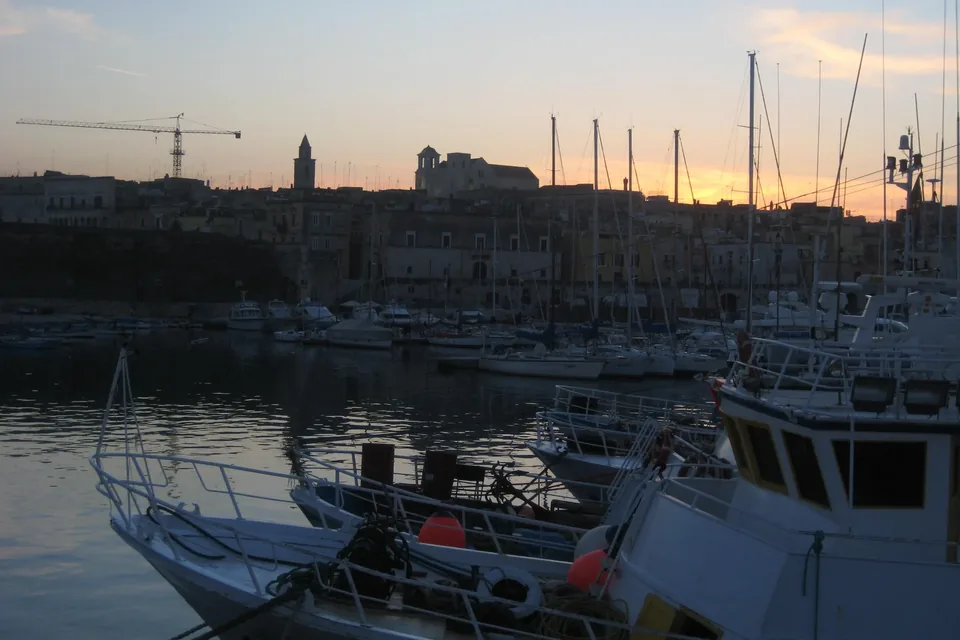
Bisceglie
From the La Chianca dolmen to the Romanesque town and harbour.
Read the guide →Photo: Geppisimone at Italian Wikipedia / Wikimedia Commons — CC BY-SA 3.0 · Resized and converted to WebP.
