
APULICA / FRESH PASTA, BREAD AND PASTRY
Taralli
PAT · Fresh pasta, bread and pastry · Puglia
In brief
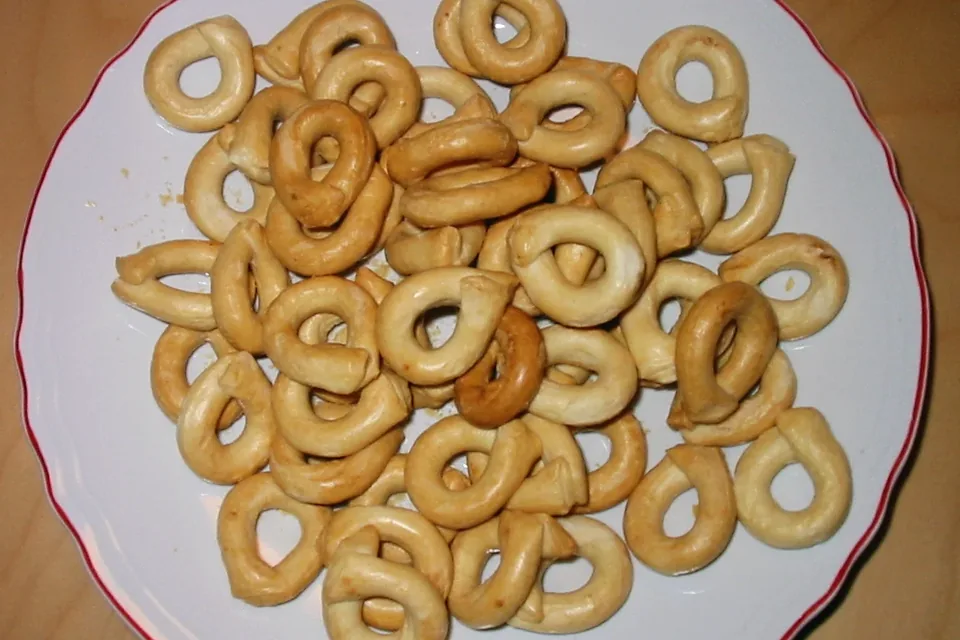
- Crunchy rings of unleavened dough made with flour, extra virgin olive oil and white wine. (Atlante dei PAT di Puglia — Taralli)
- The dough ropes are closed into rings and boiled before going into the oven. (Atlante dei PAT di Puglia — Taralli)
- There are many flavoured versions, for instance with fennel seed, olives or onion. (Atlante dei PAT di Puglia — Taralli)
History and origin
There are many theories about the origin of the name tarallo. Some trace it to the Latin «torrère», to toast, for its crunchy, lightly browned look; others to an Italic word, «tar», meaning to wrap; others to French words for round bread or for a drying room. The theory now considered most likely links it to the Greek «daratos», a kind of bread: the tarallo is, after all, a baked bread product.
Its origins seem to go back to the fifteenth century, and a legend credits its invention to a mother who had to feed her children: with only the flour, olive oil, salt and white wine she had in the larder she made a dough, divided it into thin strips, closed them into rings and baked them.
Since then the tarallo has become one of the symbols of Apulian baking and is listed among the region's traditional food products.
Sources: Atlante dei PAT di Puglia — Taralli · Masaf — Elenco nazionale dei prodotti agroalimentari tradizionali, XXVI revisione (2026)
Area and method of production
The dough for classic taralli is unleavened and made from flour, extra virgin olive oil and white wine. It is rolled into thin ropes, which are closed into rings.
The step that defines the Apulian tarallo is the double cooking: the rings are first boiled in water and only then go into the oven, where they become crunchy and take on their lightly browned colour.
The same technique appears in sweet versions, such as the egg tarallo of Gravina in Puglia: eggs are beaten by hand into the flour with sugar, oil and an anise liqueur; the small ropes, closed into circles and marked with the tip of a key, rest overnight, are then lowered a few at a time into boiling water, drained when they rise to the surface, scored all round and baked in a wood-fired oven.
Sources: Atlante dei PAT di Puglia — Taralli · Atlante dei PAT di Puglia — Tarallo all'uovo
How to recognise it
The tarallo is recognised by its ring shape and crunchy texture, with a lightly browned surface from baking. In the classic version the flavour is the simple one of extra virgin olive oil and white wine.
Variations are countless: herbs, fennel seeds, olives, onion or other vegetables are added to the dough, and every area has its preferences.
Besides savoury taralli, Puglia knows sweet taralli and bread taralli. In Gravina the wine tarallo, also called «piccilateddre», is sweet and crumbly and fragrant with local white wine; in the Foggia area the black taralli with vincotto, up to twenty centimetres across, are dark, crumbly and spiced, with chocolate, almonds, cocoa, cinnamon and cloves.
Sources: Atlante dei PAT di Puglia — Taralli · Atlante dei PAT di Puglia — Tarallo al vino · Atlante dei PAT di Puglia — Taralli neri con vincotto
In the kitchen
Taralli are made and eaten all year round, as a snack or an accompaniment, and their story is bound up with the occasions of family and religious life.
In Gravina in Puglia, at the meal after a wedding, the «tavola di li piccilateddre» was laid, with wine and egg taralli among the stars. Also in Gravina, the Immacolata tarallo is a bread shaped like a large crown, flavoured with fennel seeds, recalling the Virgin's halo: by tradition it is eaten at midday on 7 December in place of lunch, as an act of fasting and devotion.
In the Foggia area, black taralli with vincotto are above all a Christmas sweet, which tradition says was created by cloistered nuns in the second half of the sixteenth century.
Sources: Atlante dei PAT di Puglia — Taralli · Atlante dei PAT di Puglia — Tarallo al vino · Atlante dei PAT di Puglia — Tarallo all'uovo · Atlante dei PAT di Puglia — Tarallo dell'Immacolata · Atlante dei PAT di Puglia — Taralli neri con vincotto
Where to taste it
Taralli are found all over Puglia, in supermarkets, traditional shops, specialist stores and directly from the makers, all year round. To discover the versions tied to particular places, though, it pays to follow the festivals.
Gravina in Puglia, on the edge of the Alta Murgia, is a must: this is the home of the wine tarallo, the egg tarallo and the Immacolata tarallo, and the Tarallo Festival renews the custom of making them for 8 December in thanksgiving to the Virgin. In the province of Foggia, at Christmas time, black taralli with vincotto appear at fairs and festivals.
Wherever you travel, from Bari to the Salento, the tarallo is a first taste of Apulian baking.
Sources: Atlante dei PAT di Puglia — Taralli · Atlante dei PAT di Puglia — Tarallo dell'Immacolata · Atlante dei PAT di Puglia — Taralli neri con vincotto · Atlante dei PAT di Puglia — Tarallo al vino · Atlante dei PAT di Puglia — Tarallo all'uovo
Protection
- Traditional agri-food product (PAT) — Puglia, n. 292, 26th revision (Masaf — Elenco nazionale dei prodotti agroalimentari tradizionali, XXVI revisione (2026) · Atlante dei PAT di Puglia — Taralli)
When
- Production: all year round (Atlante dei PAT di Puglia — Taralli)
Where
Read more
Puglian taralli
Dough, two-stage cooking and aromas: understanding Puglian taralli beyond the aperitivo.
Read the guide →Photo: Marco Leogrande / Wikimedia Commons — Public domain · Resized and converted to WebP.
