
APULICA / CHEESES
Scamorza
PAT · Cheeses · Puglia
In brief
- A fresh pasta filata cheese of cow's milk, pear-shaped with a small head and tied with raffia. (Atlante dei PAT di Puglia (Regione Puglia, Università di Bari) — Scamorza)
- Sizes range from under a hundred grams up to the scamorzone, just under a kilo; a version smoked over straw and beech shavings also exists. (Atlante dei PAT di Puglia (Regione Puglia, Università di Bari) — Scamorza)
- In Puglia the traditional area is the whole region, and it is made all year round. (Atlante dei PAT di Puglia (Regione Puglia, Università di Bari) — Scamorza)
History and origin
Scamorza is one of the most widespread pasta filata cheeses in Puglia, listed among Italy's traditional food products since 2001 with the whole region as its area of origin. Tradition ties it closely to caciocavallo, the other great stretched-curd cheese of the area.
The story goes that it was born almost by chance: while making caciocavallo, some cheesemaker cut the curd into smaller pieces and worked it at a slightly lower temperature, obtaining a softer paste. The name also comes from the cheesemaker's gesture: it is said to derive from the dialect word scamozzare, meaning to pinch off part of the stretched curd by hand to shape it.
In everyday speech the word also has a playful sense, used for someone with a small head, a sign of how deeply this pear-shaped cheese has entered daily language.
Sources: Atlante dei PAT di Puglia (Regione Puglia, Università di Bari) — Scamorza · Masaf — Elenco nazionale dei prodotti agroalimentari tradizionali, XXVI revisione (2026)
Area and method of production
The traditional record describes a process that starts from raw cow's milk, filtered and warmed to 36-38 °C in tinned copper or steel vats. A natural whey starter, made from the previous day's whey, is added, followed by calf or kid rennet. The curd, broken by hand with a wooden tool to the size of a chickpea or a walnut, ripens on wooden tables or in vats for a few hours, sometimes up to a day.
Stretching is done by hand, with a stick and near-boiling water, until the paste is compact and firm. It is shaped into the classic pear with a small head, tied with raffia and firmed in cold water before brining.
For the smoked version, the cheeses are dried and then smoked over straw and beech shavings. Scamorza is made throughout Puglia and in every month of the year.
Sources: Atlante dei PAT di Puglia (Regione Puglia, Università di Bari) — Scamorza
How to recognise it
Scamorza has the typical pear shape, with a short neck or small head, and is tied with raffia. The classic cheese is 7-9 centimetres across and 10-12 long and weighs around 250-350 grams, up to half a kilo; today there are also pieces under a hundred grams and the scamorzone, which stays under a kilo.
The rind is thin, white or straw-yellow depending on ripening, which ranges from a few days to about three weeks for the more mature versions. Under the rind the paste forms overlapping layers, with no holes.
The taste is sweet or slightly savoury and the aroma delicate. In the smoked version the skin turns golden and full-flavoured, with a smoky finish, while the inside stays soft and only lightly scented.
Sources: Atlante dei PAT di Puglia (Regione Puglia, Università di Bari) — Scamorza
In the kitchen
The regional record stresses scamorza's great versatility in the kitchen, thanks to its texture and the way it behaves with heat. Fresh, it is enjoyed on its own or as a table cheese; the smoked version brings its smoky note to dishes.
Among the recipes listed by the atlas of Puglia's traditional products is the panzerotto with scamorza and tomatoes, one of the most typical ways of using it as a filling. The same record also recalls the tradition of little scamorza animals, small figures shaped from the stretched curd that in Puglia are made with real manual skill.
At village fairs and festivals scamorza appears both for tasting and as an ingredient in traditional dishes.
Sources: Atlante dei PAT di Puglia (Regione Puglia, Università di Bari) — Scamorza
Where to taste it
As a cheese of the whole region, scamorza can be found all over Puglia, from the Gargano to the Salento. The traditional record names dairies, specialist shops, farms and agriturismi as places to buy it, where it is often freshly made.
Village fairs and festivals are another chance to taste it, on its own or in traditional dishes. Visitors to the Puglia countryside can look for it in village dairies, alongside scamorza di pecora, the sheep's milk version that the regional atlas links to this cheese, and the area's other stretched-curd cheeses.
Sources: Atlante dei PAT di Puglia (Regione Puglia, Università di Bari) — Scamorza
Protection
- Traditional agri-food product (PAT) — Puglia, n. 57, 26th revision (Masaf — Elenco nazionale dei prodotti agroalimentari tradizionali, XXVI revisione (2026))
When
- Production: all year round (Atlante dei PAT di Puglia (Regione Puglia, Università di Bari) — Scamorza)
Where
Read more
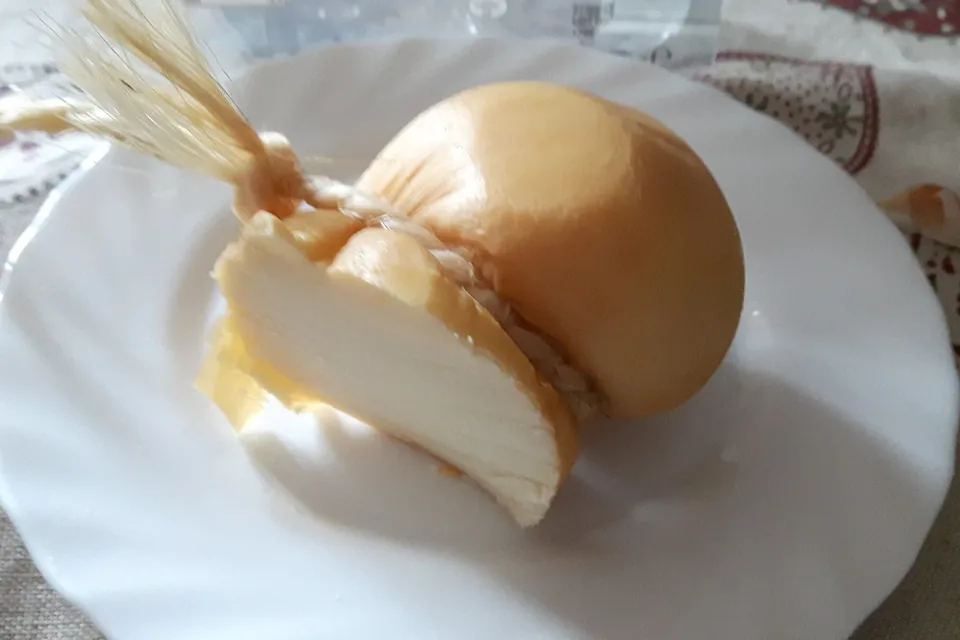
Scamorza and scamorzone
Exploring Puglian scamorza, from its pear shape to the larger scamorzone size.
Read the guide →Photo: FakirNL / Wikimedia Commons — CC BY-SA 4.0 · Resized and converted to WebP.
