
APULICA / MEATS AND CURED MEATS
Arrosticini (Abruzzo lamb skewers)
PAT · Meats and cured meats · Abruzzo
In brief
- Cubes of mutton or wether about one centimetre across, threaded on wooden skewers no longer than 20 cm. (Italia.it — Arrosticini abruzzesi)
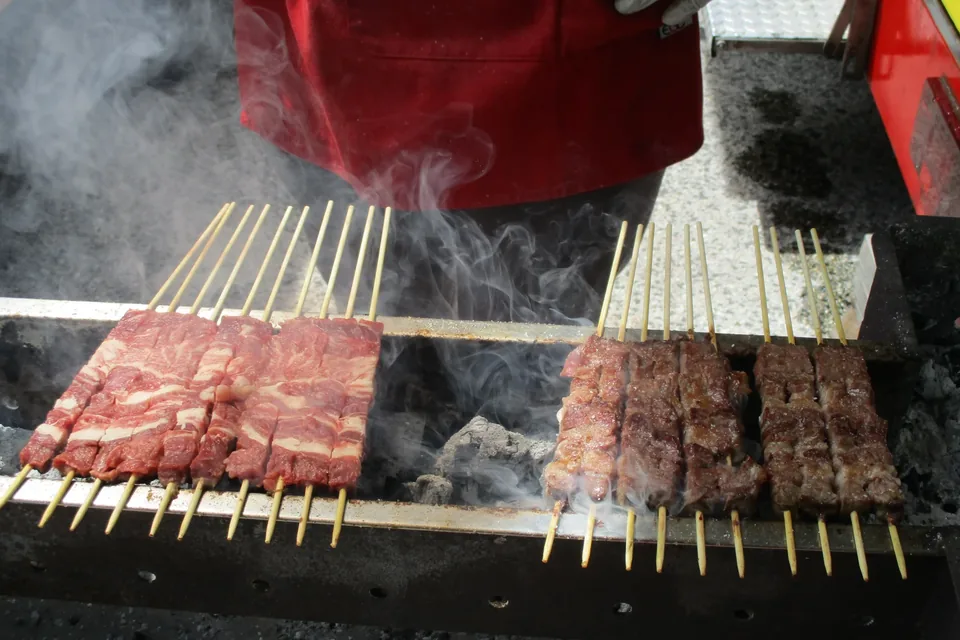
- They are grilled on the canala, a long narrow grill named for its likeness to a gutter. (Italia.it — Arrosticini abruzzesi)
- They come from the cooking of Gran Sasso shepherds; Teramo and Pescara both claim them, but today they are made across the region. (Italia.it — Arrosticini abruzzesi)
History and origin
Arrosticini come from shepherds' cooking. Their world is the valleys and mountains of the Gran Sasso, especially the area stretching from the Piana del Voltigno, near Villa Celiera, to where the provinces of L'Aquila, Teramo and Pescara meet. The provinces of Teramo and Pescara both claim them, and accounts of their origin do not always agree.
One story has it that in 1830 two shepherds from the Voltigno cut the meat of an old ewe into small pieces, threaded it onto wooden sticks and roasted it over a makeshift fire built from a piece of guttering. The old names are rustell', rustelle or arrustelle.
A photograph taken in Civitaquana in 1930 by two Swiss anthropologists shows pieces of mutton threaded on olive or dogwood twigs and roasted between two rows of bricks. Today arrosticini are made across the region and are listed among Italy's traditional food products.
Sources: Italia.it — Arrosticini abruzzesi · Masaf — Elenco nazionale dei prodotti agroalimentari tradizionali, XXVI revisione (2026)
Area and method of production
The original recipe uses mutton or wether, about a quarter of which is fat: the fat is essential, because it gives tenderness and flavour. Right after slaughter the meat is left to hang and mature in a cold room, or in the cold of winter, for three to seven days.
It is then cut into cubes about one centimetre a side and threaded onto a wooden skewer called «li cippe» or «li cippitill», no longer than 20 centimetres. Each skewer weighs 20 to 30 grams, and its colour, more or less deep red, depends on the age of the animal.
Besides the sheep-meat version there are now arrosticini of turkey, chicken and pork, and liver ones, alternated with bay leaves or onion slices to soften their strong taste. Some cooks add onion, chilli or sage as flavourings.
Sources: Italia.it — Arrosticini abruzzesi
How to recognise it
They are instantly recognisable: small, regular cubes on a thin skewer, cooked in a row on the «canala», the long narrow grill named for its resemblance to a gutter. Wood embers remain the best way to cook them.
While cooking, the meat is basted with oil mixed with vinegar and salt, brushed on with sprigs of rosemary. The fat between the pieces melts over the embers and gives off the aroma that has accompanied the life of Abruzzo's shepherds for centuries.
Arrosticini are eaten hot and with the hands, pulling the meat straight off the skewer: the one rule that stays the same in every version. Behind such a simple dish lies a long history of shepherds and transhumance.
Sources: Italia.it — Arrosticini abruzzesi · Italia.it — I sapori della terra d'Abruzzo
In the kitchen
The classic companion is «lu pane 'onde», toasted bread dressed with extra virgin olive oil and salt, along with a glass of Montepulciano d'Abruzzo. Tradition has them cooked and eaten outdoors, on a country outing in Abruzzo's countryside.
In the Gran Sasso and Monti della Laga National Park area arrosticini are the stars of every grill, alongside cured meats such as ventricina and first courses such as chitarra pasta and the scrippelle timballo. In inland Abruzzo they sit naturally beside other dishes of the pastoral tradition, such as pecora alla callara, mutton cooked for hours in a cauldron.
Those looking for something more refined can try arrosticini with truffle oil, but the guides' advice is simple: taste the right recipe in the right place, properly cooked on the canala.
Sources: Italia.it — Arrosticini abruzzesi · Italia.it — Parco Nazionale del Gran Sasso e Monti della Laga · Italia.it — Prodotti e piatti tipici abruzzesi: la guida
Where to taste it
They are found all over Abruzzo, but their landscape is the Gran Sasso: from the Piana del Voltigno at Villa Celiera to the hills between Teramo and Pescara, where shepherds invented them. Visitors to L'Aquila, Santo Stefano di Sessanio and the villages of the Gran Sasso park find them at every local grill, made with local sheep meat.
Many sagre celebrate them, mostly in summer, in July and August: among them the travelling Arrostiland, and the Arrosticinitreffen at Fonte Vetica, on the Campo Imperatore plateau, a motorcyclists' gathering where riders camp at 2000 metres and cook the skewers.
In autumn Civitaquana holds «Arrosticciere in Piazza», a historical re-enactment of the dish's origins with old crafts, folk shows and «primitive» cooking of the meat, inspired by the 1930 photograph. Another festival, «Degustando nel borgo», once produced an arrosticino ten metres long.
Sources: Italia.it — Arrosticini abruzzesi · Italia.it — Parco Nazionale del Gran Sasso e Monti della Laga
Protection
- Traditional agri-food product (PAT) — Abruzzo, n. 9, 26th revision (Masaf — Elenco nazionale dei prodotti agroalimentari tradizionali, XXVI revisione (2026) · Italia.it — Arrosticini abruzzesi)
When
- The sources consulted give no months.
Where
Read more
Abruzzo arrosticini
Mutton skewers cooked on the canala, a story tied to transhumance, recognition as a traditional product and the road towards EU protection: how and where to understand them.
Read the guide →Photo: Marica Massaro / Wikimedia Commons — CC BY-SA 4.0 · Resized and converted to WebP.
