
APULICA / OILS AND FATS
Olio di Puglia extra virgin olive oil
PGI · Oils and fats · Puglia
In brief
- Extra virgin oil from at least 70% Puglia varieties such as Coratina, Cellina di Nardò, Ogliarola salentina, Peranzana and Cima di Bitonto. (Qualigeo (Fondazione Qualivita) — Olio di Puglia IGP)
- It may be produced anywhere in Puglia. (Qualigeo (Fondazione Qualivita) — Olio di Puglia IGP)
- The olives are harvested from veraison until 31 January. (Qualigeo (Fondazione Qualivita) — Olio di Puglia IGP)
History and origin
In Puglia the olive tree has a very long history: the first traces of its cultivation date back to the Neolithic, around 5000 BC. The trade in Puglia's oil has left records closer to our time, starting with a document from 1792 and continuing through the nineteenth and twentieth centuries, attesting to its recognised quality.
In the last century, invoices and trade documents from the 1950s, 1960s and 1980s already carried the words Olio di Puglia, a sign that the region's name had long identified a specific product on the market. From this reputation comes the Protected Geographical Indication Olio di Puglia, registered in the European Union, which covers the whole region and its most typical varieties and is entrusted to a protection consortium.
Sources: Qualigeo (Fondazione Qualivita) — Olio di Puglia IGP · eAmbrosia — Olio di Puglia (PGI-IT-02381)
Area and method of production
The production area covers the whole administrative territory of Puglia. At least 70% of the oil must come from the varieties Cellina di Nardò, Cima di Bitonto, Cima di Melfi, Frantoio, Ogliarola salentina, Coratina, Favolosa, Leccino and Peranzana, alone or together; other Italian varieties may make up to 30%.
Harvest runs from veraison, when the fruit begins to ripen, until 31 January. The olives are picked from the tree, by hand, mechanically or with assisted harvesting, while fruit fallen to the ground or caught in permanent nets is excluded.
The specification sets a maximum of 12 tonnes of olives per hectare and an oil yield of no more than 20%, and requires the olives to be milled within 36 hours of picking.
Sources: Qualigeo (Fondazione Qualivita) — Olio di Puglia IGP
How to recognise it
Olio di Puglia PGI ranges in colour from green to straw yellow and changes over time. On the nose a clear olive fruitiness of variable intensity dominates, with green notes of freshly cut grass or leaf, fresh almond or artichoke.
In the mouth there are green hints, bitterness and pungency of variable intensity, sometimes with notes of green almond or cardoon, and a finish of grass, artichoke, vegetables and fresh almond. Bitterness and pungency, due to polyphenols, are a sign of freshness and must stay between 2 and 7 points.
Maximum acidity is 0.4 grams per 100 grams. The label shows the name, the European and product logos, the month and year of harvest, the batch, the bottling date and a best-before term of no more than 20 months.
Sources: Qualigeo (Fondazione Qualivita) — Olio di Puglia IGP
In the kitchen
According to the designation's record, Olio di Puglia PGI is at its best on first courses of vegetables or pulses and on meat and fish main courses. The simplest pairing is entirely Apulian: a drizzle of oil on a slice of Pane di Altamura PDO.
Like every extra virgin oil it is a delicate food. It should be kept away from light, in a cool place between 14 and 18 degrees, away from heat and strong-smelling products. To enjoy it at the peak of its flavour it is best used within four to six months of pressing, when the notes of grass and artichoke are at their liveliest.
Sources: Qualigeo (Fondazione Qualivita) — Olio di Puglia IGP
Where to taste it
Since the production area is the whole region, Olio di Puglia PGI can be found everywhere, from the Gargano to the Salento. The permitted varieties already trace a geography: Peranzana from the Foggia area, Coratina and Cima di Bitonto from the Bari area, Ogliarola salentina and Cellina di Nardò from the Salento.
A trip to Puglia during the harvest, from the start of ripening until the end of January, coincides with the season when the year's oil is made. In Altamura the oil meets the PDO bread that the record names as its ideal companion.
Sources: Qualigeo (Fondazione Qualivita) — Olio di Puglia IGP · Qualigeo — Dauno DOP, olio extravergine di oliva · Qualigeo — Terra di Bari DOP, olio extravergine di oliva · Qualigeo — Terra d'Otranto DOP, olio extravergine di oliva
Protection
- Protected geographical indication (PGI) — PGI-IT-02381 (eAmbrosia — Olio di Puglia (PGI-IT-02381))
When
- The sources consulted give no months.
Where
Read more
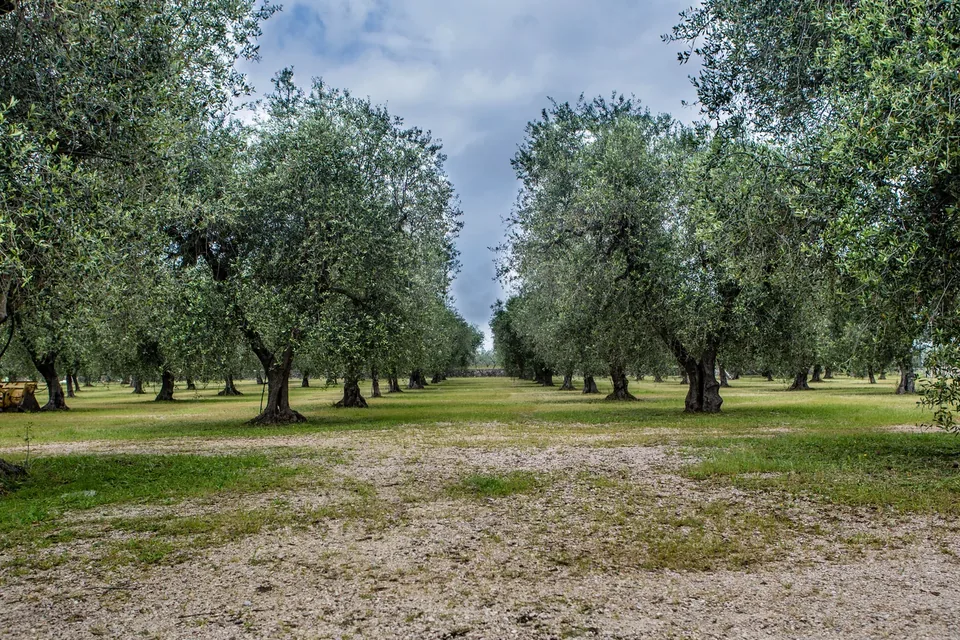
Puglian olive oil
Fruitiness, bitterness and pepperiness: exploring Puglian olive oils through flavour and place.
Read the guide →Photo: N i c o l a / Flickr — CC BY 2.0 · Resized and converted to WebP.