
APULICA / FAITH
Basilica of Santa Maria di Collemaggio
Basilica · L'Aquila · Abruzzo
In brief
- It was founded by Pietro da Morrone, the future Celestine V, and consecrated on 15 August 1288; he was crowned pope here on 29 August 1294. (Basilica di Santa Maria di Collemaggio a L'Aquila - Italia.it · Collemaggio, il sogno di Celestino e il perdono per tutti - Vatican News)
- With the Bull of Forgiveness Celestine V granted a plenary indulgence to all who, repentant and confessed, enter the basilica from vespers on 28 August to vespers on 29 August. (Perdonanza, il cardinal Petrocchi: L'Aquila 'capitale del perdono' - Vatican News · Prolungata per un anno la Perdonanza celestiniana - Vatican News)
- The Celestinian Forgiveness celebration has been inscribed since 2019 on UNESCO's Representative List of the Intangible Cultural Heritage of Humanity. (Celestinian forgiveness celebration - UNESCO Intangible Cultural Heritage · Celestian forgiveness celebration - Unesco Beni Culturali (Ministero della Cultura))
- The remains of Celestine V rest in the Renaissance mausoleum by Girolamo da Vicenza, to the right of the high altar. (Basilica di Santa Maria di Collemaggio a L'Aquila - Italia.it · Collemaggio, il sogno di Celestino e il perdono per tutti - Vatican News · Prolungata per un anno la Perdonanza celestiniana - Vatican News)
- Badly damaged by the 2009 earthquake, the basilica was returned to the city at the end of 2017 after a restoration that won a European award in 2020. (Basilica di Santa Maria di Collemaggio a L'Aquila - Italia.it · Collemaggio, il sogno di Celestino e il perdono per tutti - Vatican News)
Festivals and dates
- Celestinian Forgiveness: opening of the Holy Door: 28-29 August (from vespers on the 28th to vespers on the 29th) (Basilica di Santa Maria di Collemaggio a L'Aquila - Italia.it · Perdonanza, il cardinal Petrocchi: L'Aquila 'capitale del perdono' - Vatican News · Prolungata per un anno la Perdonanza celestiniana - Vatican News)
- Forgiveness Walk and Fire of Morrone: 16-23 August (Celestinian forgiveness celebration - UNESCO Intangible Cultural Heritage · Celestian forgiveness celebration - Unesco Beni Culturali (Ministero della Cultura))
- Summer
A church born of a dream
According to an old hagiographic text, the hermit Pietro Angelerio da Morrone, sleeping outside the walls of L'Aquila, saw a ladder rising from the altar of Collemaggio up to heaven and, at its top, the Virgin asking him to build a church there in her honour. The hill already held an ancient settlement and a small church dedicated to the Assumption. The basilica was consecrated on 15 August 1288 as Santa Maria Assunta di Collemaggio.
On 29 August 1294, while building work was still under way, Pietro was crowned pope as Celestine V before an enormous crowd. His pontificate lasted a few months and ended with his resignation on 13 December 1294; he died on 19 May 1296 in the fortress of Fumone, and in 1327 his remains were moved from Ferentino to Collemaggio.
The basilica has been destroyed and rebuilt several times, because of earthquakes and to hold the growing flow of pilgrims. The earthquake of 6 April 2009 brought down the transept; after a long restoration the church was returned to the people of L'Aquila at the end of 2017, and the work received the European Union Prize for Cultural Heritage in 2020.
Sources: Basilica di Santa Maria di Collemaggio a L'Aquila - Italia.it · Collemaggio, il sogno di Celestino e il perdono per tutti - Vatican News
Celestine V and forgiveness
With the Bull of Forgiveness, Celestine V granted the remission of sins to all who, sincerely repentant and confessed, come to Collemaggio from vespers on 28 August to vespers the following day, the feast of the beheading of St John the Baptist, a relic of whom the basilica once kept. The indulgence was free of charge, an extraordinary fact at the time, and many regard it as the first jubilee in Christian history, earlier than that of 1300. In 1967 Paul VI placed this indulgence first on the official list.
Pope Francis, the first pontiff to open the Holy Door of Collemaggio, recalled on 28 August 2022 that Celestine V was not 'the man of no' but 'the man of yes', a witness of humility and mercy, and asked that L'Aquila be a 'capital of forgiveness, peace and reconciliation'. For pilgrims the heart of the visit remains passing through the Holy Door and pausing to pray before the saint's remains.
Sources: Perdonanza, il cardinal Petrocchi: L'Aquila 'capitale del perdono' - Vatican News · Collemaggio, il sogno di Celestino e il perdono per tutti - Vatican News · Prolungata per un anno la Perdonanza celestiniana - Vatican News · Papa Francesco, Visita Pastorale a L'Aquila: Santa Messa (28 agosto 2022)
Façade, Holy Door and mausoleum
The basilica stands just outside the historic centre, in front of a wide lawn. The two-coloured façade, in pink and white stone, has three portals and three rose windows, the central one the most elaborate; at the right corner stands part of the great tower from which Celestine's relics were once displayed and the start of the Perdonanza announced. The floor too is in pink and white stone, with lozenges, crosses, flowers and concentric circles.
The three-aisled interior, with octagonal pillars and pointed arches, blends Romanesque, Gothic and Baroque elements. On the left side opens the Holy Door, topped by a frescoed lunette with the Madonna and Child between Celestine and John the Baptist and by a carved eagle recalling the city's role in the Perdonanza.
To the right of the high altar is the mausoleum of Celestine V, a Renaissance masterpiece by Girolamo da Vicenza (1517), paid for by the wool-workers' guild. Also worth seeing are the cycle of canvases by Carl Borromäus Ruthart on the saint's hermit life and the gilded Baroque organ to the left of the altar.
Sources: Basilica di Santa Maria di Collemaggio a L'Aquila - Italia.it · Collemaggio, il sogno di Celestino e il perdono per tutti - Vatican News · Prolungata per un anno la Perdonanza celestiniana - Vatican News
The Celestinian Forgiveness
The Perdonanza has been handed down without interruption since 1294 in the city and province of L'Aquila. The ritual opens on 16 August at the hermitage of Sant'Onofrio, at the foot of Mount Morrone near Sulmona, with the lighting of the Fire of Morrone and its descent in a torchlight procession. The Forgiveness Walk, more than 80 kilometres long, passes through twenty-three villages, where tripods are lit and the mayors sign a parchment recalling the values of the Bull; on 23 August the last tripod is lit in L'Aquila.
The climax is the Historical Parade of the Bull, with about a thousand citizens in costume, drums, clarions and flag-wavers, led by the Lady of the Bull, the Young Lord and the Lady of the Cross, symbols of hospitality, solidarity and peace. The original parchment, kept in the armoured chapel of the Town Hall tower, is carried from the centre to Collemaggio.
On the evening of 28 August, after the Bull has arrived in procession, the Holy Door is opened: until vespers on the 29th, those who pass through it, having confessed and received communion, can obtain the plenary indulgence.
Sources: Celestinian forgiveness celebration - UNESCO Intangible Cultural Heritage · Celestian forgiveness celebration - Unesco Beni Culturali (Ministero della Cultura) · Perdonanza, il cardinal Petrocchi: L'Aquila 'capitale del perdono' - Vatican News
Visiting the basilica
Collemaggio lies just outside L'Aquila's historic centre, along the route the Parade of the Bull follows every year from the Town Hall square to the basilica. Since the restoration the building has been permanently monitored to preserve its heritage.
Outside the days of the Perdonanza the basilica remains a place of reconciliation: Pope Francis asked that it be a 'temple of forgiveness' not just once a year but every day. Devout visitors can stop to pray before the mausoleum of Celestine V.
Sources: Basilica di Santa Maria di Collemaggio a L'Aquila - Italia.it · Celestian forgiveness celebration - Unesco Beni Culturali (Ministero della Cultura) · Collemaggio, il sogno di Celestino e il perdono per tutti - Vatican News · Papa Francesco, Visita Pastorale a L'Aquila: Santa Messa (28 agosto 2022)
Walks that reach it
Great Way of Celestine
L'Aquila, Basilica of Santa Maria di Collemaggio → Ortona, Cathedral of St Thomas the Apostle · The official site gives 204 km in 12 days for the full route. The original Maiella hermitage section measures 84 km according to the home page and the route overview, while the stage 5 page and the Maiella National Park site give 82 km. · 12 stages from L'Aquila to Ortona, plus a variant via Manoppello between Macchie di Coco and Serramonacesca. The "Classic" hermitage route corresponds to stages 5 to 9 and takes 5 days.
Abruzzo
The Way of Peace
L'Aquila, Basilica of Santa Maria di Collemaggio → Monte Sant'Angelo, Church of St Michael the Archangel · The official site gives 543 km on foot in its summary figures, but its descriptive text speaks of more than 520 km, and the waymarking page of 520 marked km. The cycling version measures 440 km. · The official site gives 37 stages in its summary figures and 35 stages in its descriptive text. The stage list numbers 29 main stages (13 and 14 are merged) plus eight variants marked "bis"; the guidebook describes 29 stages plus 3 stages of a mountain variant. By bike there are 9 stages.
Abruzzo, Molise, Puglia
The place
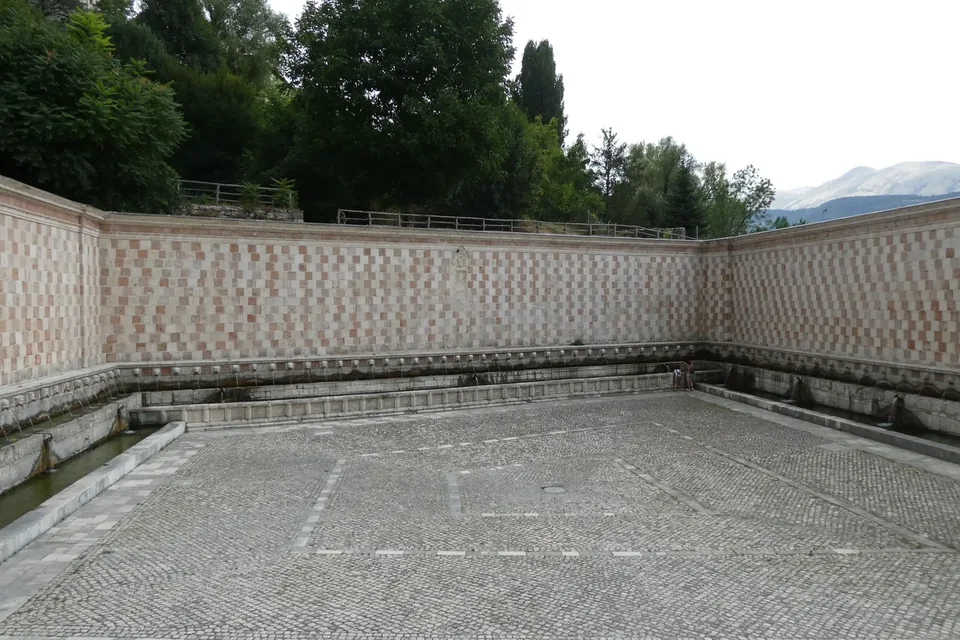
L’Aquila
A capital between the Gran Sasso and the Monti della Laga, with the UNESCO-listed Celestinian Forgiveness and reconstruction still under way.
Read the guide →Photo: Syrio / Wikimedia Commons — CC BY-SA 4.0 · Resized and converted to WebP.

Sources
- Basilica di Santa Maria di Collemaggio a L'Aquila - Italia.it
- Celestinian forgiveness celebration - UNESCO Intangible Cultural Heritage
- Celestian forgiveness celebration - Unesco Beni Culturali (Ministero della Cultura)
- Perdonanza, il cardinal Petrocchi: L'Aquila 'capitale del perdono' - Vatican News
- Collemaggio, il sogno di Celestino e il perdono per tutti - Vatican News
- Prolungata per un anno la Perdonanza celestiniana - Vatican News
- Papa Francesco, Visita Pastorale a L'Aquila: Santa Messa (28 agosto 2022)