Why go
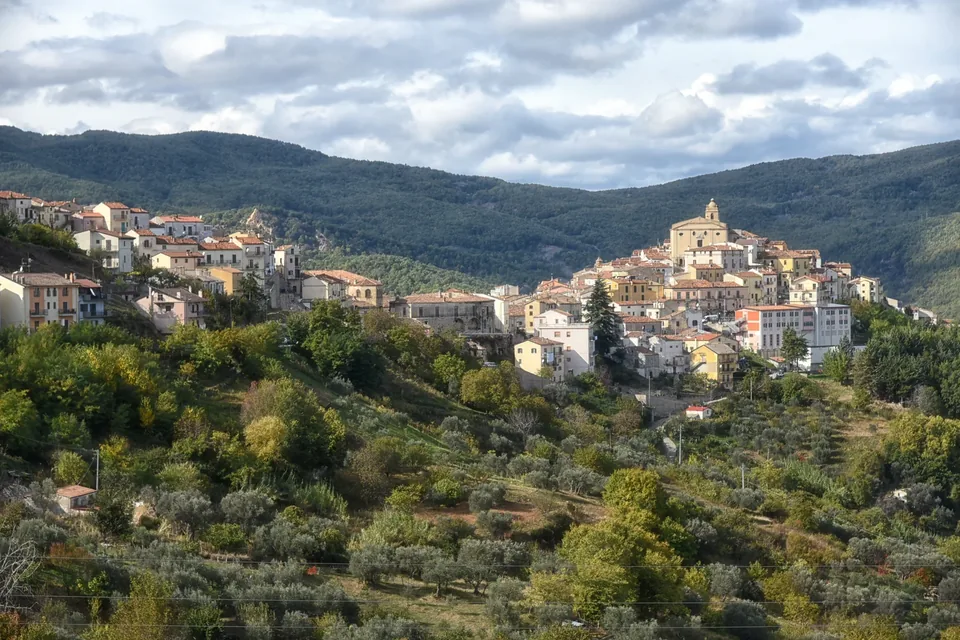
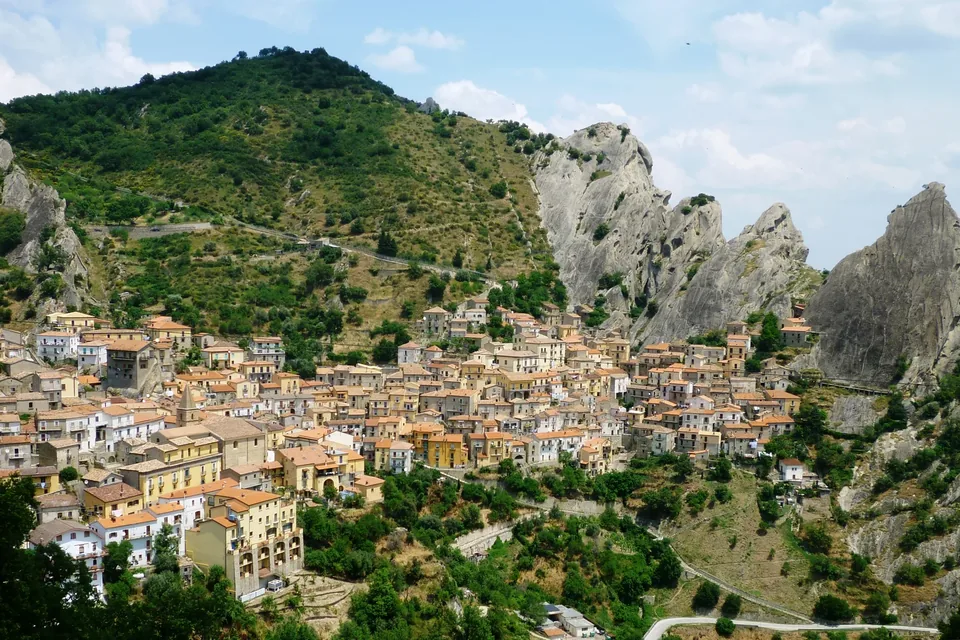
Oliveto Lucano is a small village in the province of Matera perched on the tip of a sheer cliff, surrounded by centuries-old olive trees which, the municipality says, gave it its name. Its land is hilly and wooded, with oak and beech, and belongs to the Gallipoli Cognato Piccole Dolomiti Lucane regional park together with Accettura, Calciano, Castelmezzano and Pietrapertosa.
From the village the view drops towards the plains of ancient Magna Graecia, while behind it rises the mountain of Croccia Cognato, once home to a fortified Lucanian town. The municipality describes the old centre as a weave of narrow lanes scented with jasmine and broom, with cellars opening along Corso Garibaldi and doors carved by local craftsmen between the late nineteenth and early twentieth centuries.
It suits travellers looking for a small, genuine place to explore without hurry: a village of a few streets from which you set off on foot towards the forest and the Monte Croccia reserve, and which celebrates its own Maggio, one of the area's tree rituals, for its patron Saint Cyprian.
Sources: Comune di Oliveto Lucano — Il territorio · Comune di Oliveto Lucano — Da visitare · Parco Gallipoli Cognato Piccole Dolomiti Lucane — Carta d'identità del Parco
History
Oliveto Lucano's history is tied to nearby Croccia Cognato. The park recalls that between the sixth and fourth centuries BC Oscan-Samnite peoples founded a town on the mountain, defended by more than two kilometres of walls built of squared blocks with techniques learned from the Greeks. The municipality puts forward an appealing hypothesis: the spur on which the village stands may have served as a lookout for that town, along a ridge-top drove road running down to the valley, and the highest point, where the mother church now stands, may have held a watchtower.
The village as we see it is medieval in origin. The first written records appear in bulls of 1060, 1070 and 1183; the fief then passed through several families, from the Grappino to the Diazgarlon, the Suardo, the De Leonardis and finally the De Lerma, dukes of Castelmezzano, who held it until feudalism was abolished. The municipality also recalls the earthquake of 1694 and the landslides that still erode the ridge.
In the nineteenth century the village grew along Corso Garibaldi, lined with noble mansions, and Piazza Umberto I became the new centre. In the twentieth century emigration greatly reduced the population.
Sources: Parco Gallipoli Cognato Piccole Dolomiti Lucane — Storia del territorio · Comune di Oliveto Lucano — Cenni storici
What to see
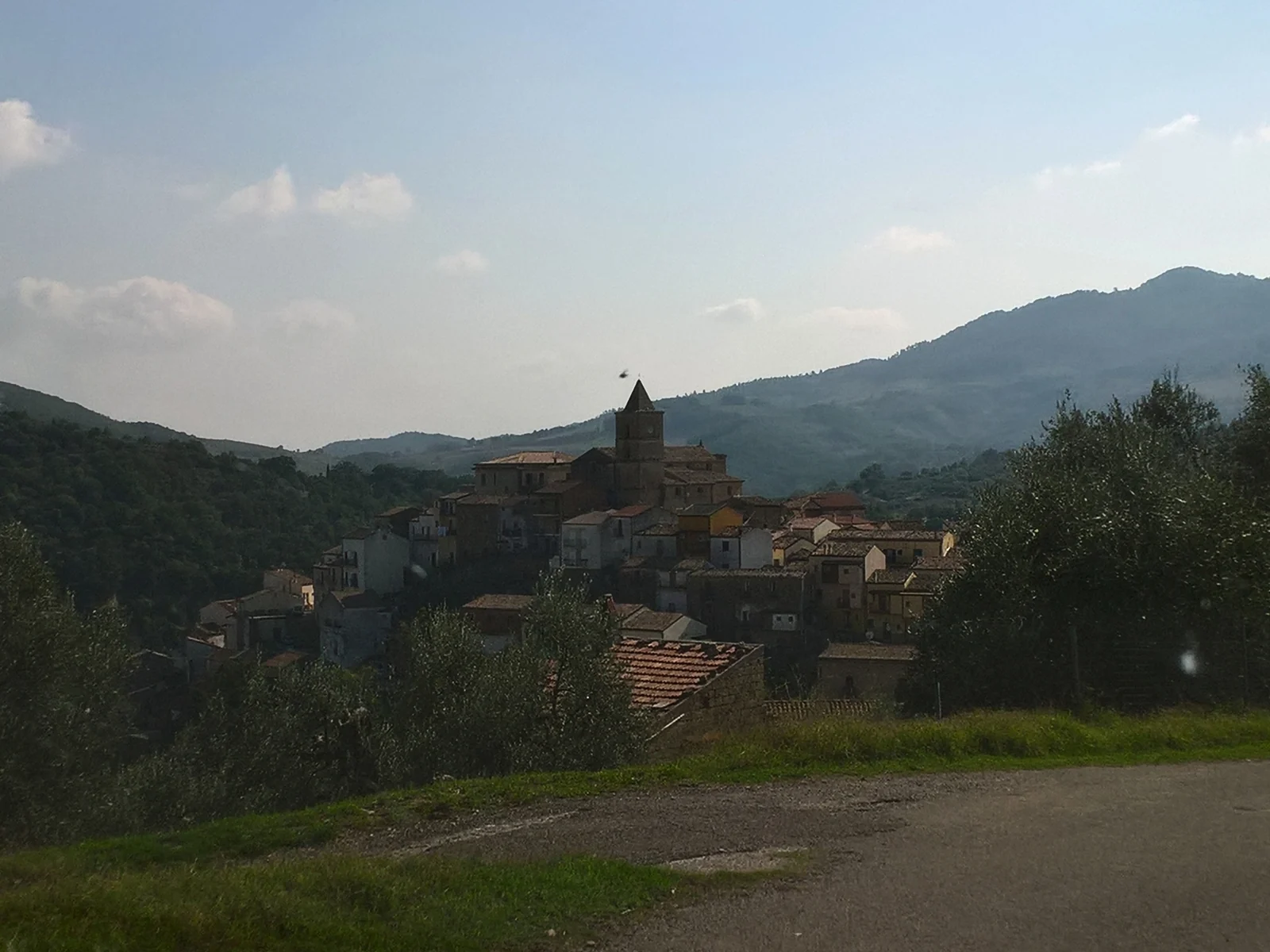
The old core occupies the highest level ground on the cliff, with the spindle-shaped plan described by the municipality: a ridge street running up to the highest point, where the mother church stands, and parallel lanes following the contours, linked by steep stairways that drop towards the edges of the ridge. The park describes Piazza Ducale, overlooked by the mother church with its three-aisled Romanesque basilica plan, and lower down Piazza Umberto I, almost directly linked to the woods through a small park.
Only stretches of wall, probably fifteenth-century, survive of the castle. Along Corso Garibaldi you see the nineteenth-century mansions, carved doors and cellars; the municipality also points to the chapel of San Giovanni, the mother church of Santa Maria delle Grazie and, outside the village, the church of the Madonna di Piano di Campo.
The most important site in the area, though, is the Monte Croccia anthropological nature reserve. Italia.it describes the great squared blocks of the town walls, at more than a thousand metres, the Neolithic finds nearby and the group of boulders known as Petre de la Mola, whose position lines up with the sunlight through the year.
Sources: Comune di Oliveto Lucano — Cenni storici · Parco Gallipoli Cognato Piccole Dolomiti Lucane — Oliveto Lucano · Comune di Oliveto Lucano — Da visitare · Italia.it — Riserva naturale antropologica Monte Croccia
Food and wine
Oliveto Lucano's cooking follows the rhythm of fields and woodland. The municipality describes an old economy in three bands: wheat fields below, vegetable plots, olive groves and vineyards around the village, and higher up pastures and forest, with free-range herds and transhumance. The village's very name recalls olive oil and olives.
Oliveto Lucano lies within the area of the Slow Food Presidium for pezzente della Montagna materana, a country sausage made with the humblest pork cuts, powdered Senise pepper, wild fennel and garlic. The Presidium for caciocavallo podolico della Basilicata covers the towns of the Lucanian Apennines and the Matera hills: a stretched-curd cheese from the milk of grazing cows, which can age for years. The park lists among local produce cheeses from Podolica milk, cured meats, honey, oil, preserves and mushrooms.
The festival calendar also has popular gatherings: the park mentions the Notte dei Forni, the night of the ovens, held in August, and the Spring Festival on 25 April. The cellars along Corso Garibaldi, pointed out by the municipality, speak instead of the village's bond with the vine.
Sources: Comune di Oliveto Lucano — Cenni storici · Fondazione Slow Food — Pezzente della Montagna materana · Fondazione Slow Food — Caciocavallo podolico della Basilicata · Parco Gallipoli Cognato Piccole Dolomiti Lucane — Prodotti tipici · Parco Gallipoli Cognato Piccole Dolomiti Lucane — Cultura e tradizioni · Comune di Oliveto Lucano — Da visitare
Things to do
Oliveto Lucano is a good base for walking in the Gallipoli Cognato forest, which the park describes as covering more than four thousand hectares across Accettura, Calciano and Oliveto Lucano. It climbs from about 200 metres along the Basento to 1,319 metres on Monte Impiso: Mediterranean scrub below, stately Turkey oaks higher up, Hungarian oak near Monte Croccia, maples and limes. In spring the undergrowth fills with cyclamen, anemones, violets and wild orchids.
The classic destination is the Monte Croccia reserve, established in 1971. Italia.it points to the trails leading into the woods around the reserve; the park reports research at the Pietra della Mola, where cuts and passages in the rock led an INAF scholar to suggest an ancient solar observatory tied to farming and ritual cycles. It is a place best visited with a guide who can read the stones and the marks on the ground.
Wildlife includes badgers, wolves, beech martens, porcupines and many birds of prey, while the streams running through the gorges around the village, such as the Pisciolo described by the municipality, shape the landscape.
Sources: Parco Gallipoli Cognato Piccole Dolomiti Lucane — La foresta di Gallipoli Cognato · Parco Gallipoli Cognato Piccole Dolomiti Lucane — Carta d'identità del Parco · Italia.it — Riserva naturale antropologica Monte Croccia · Parco Gallipoli Cognato Piccole Dolomiti Lucane — La Pietra della Mola · Comune di Oliveto Lucano — Cenni storici
When to go
The most heartfelt moment of the year is the Maggio, which the park describes as similar to Accettura's better-known one and held for the feast of the patron Saint Cyprian. As in the other tree rituals of the area, a large Turkey oak, the groom, and a holly crown, the bride, are brought from the woods to the village, joined and raised to the sound of bagpipes, pipes and drums. During those days Piazza Umberto I becomes market, fair and festival ground at once. Check each year's dates with the municipality.
The park mentions other events: the Spring Festival on 25 April and the Notte dei Forni in August. Spring is also the flowering season in the woods, when cyclamen, anemones and orchids make walks towards Monte Croccia more beautiful.
Summer and autumn suit hiking, with cooler temperatures at altitude than on the plains and, in autumn, the forest's colours. In winter the village is very quiet and trails can be muddy: it is the least suitable time for hikes, though a visit to the village remains possible.
Sources: Parco Gallipoli Cognato Piccole Dolomiti Lucane — Oliveto Lucano · Parco Gallipoli Cognato Piccole Dolomiti Lucane — Cultura e tradizioni · Parco Gallipoli Cognato Piccole Dolomiti Lucane — La foresta di Gallipoli Cognato
Getting there and around
The municipality places Oliveto Lucano about seventy kilometres from both Potenza and Matera. By car, take the SS407 Basentana, towards Metaponto from Potenza or towards Potenza from Matera, to the Scalo di Grassano-Garaguso-Tricarico exit; continue towards Garaguso for about ten kilometres and, past that village, for another seven to Oliveto Lucano.
The reference railway station, according to the municipality, is Grassano-Garaguso-Tricarico, about seventeen kilometres away, on the line linking the Ionian coast towards Taranto with the Tyrrhenian towards Salerno. The municipality also mentions bus services to and from Potenza, Matera, Tricarico and Stigliano: check times and frequency with the operators before travelling, as links to inland villages are limited. The airports listed are Bari, about 135 kilometres away, and Naples.
In the village you move on foot, along lanes and stairways. To reach Monte Croccia, the forest and the Palazzo visitor centre near Accettura, a car or an organised outing with the park's guides is useful.
Sources: Comune di Oliveto Lucano — Come arrivare · Parco Gallipoli Cognato Piccole Dolomiti Lucane — Centro attrezzato Palazzo
Where to stay
The municipality's page on accommodation and dining lists a small number of places in the village, at Croccia and in neighbouring towns such as Garaguso, Accettura and Tricarico. The park's list, searchable by town, includes farm stays, bed and breakfasts, guest rooms, holiday homes and a few hotels across the protected area.
With such a limited choice, decide first what kind of stay you want. A room in the village lets you enjoy evenings there and be present for the Maggio; a farm stay in the countryside or at the edge of the woods suits those coming to walk, looking for farm produce and silence. Travellers with a car can also base themselves in Accettura or another park village and visit Oliveto Lucano for the day.
For advice on lodging, trails and events, the park's visitor centre at Palazzo hands out maps and information. Apulica does not list specific properties here: choices are made case by case, weighing access, season and the kind of trip.
Sources: Comune di Oliveto Lucano — Ricettività e ristorazione · Parco Gallipoli Cognato Piccole Dolomiti Lucane — Dove dormire · Parco Gallipoli Cognato Piccole Dolomiti Lucane — Centro attrezzato Palazzo
Nearby
Accettura, a few kilometres away, is the tree-ritual village par excellence: its Pentecost Maggio and the Museum of Tree Rituals help place Oliveto Lucano's festival within a tradition shared across the area. Further west, Castelmezzano and Pietrapertosa are set among the sandstone spires of the Piccole Dolomiti Lucane, linked by trails and by the Volo dell'Angelo.
The municipality notes that Garaguso, now independent, was once part of Oliveto Lucano; the park adds that it split off in 1850, keeps a medieval layout and a landscape of olive groves, vineyards and cereal fields. Along the drove roads descending from the mountain you can reach Salandra, through a landscape of farmsteads.
The Palazzo visitor centre, in the heart of the forest, houses a natural history museum, the botanical garden and the church of Santa Chiara in an old monastic settlement, and is the starting point for many trails. With more days, continue to Matera or to the Ionian coast, following the Basento valley down to Metaponto.
Sources: Italia.it — Accettura · Parco Gallipoli Cognato Piccole Dolomiti Lucane — Cultura e tradizioni · Italia.it — Castelmezzano · Comune di Oliveto Lucano — Da visitare · Parco Gallipoli Cognato Piccole Dolomiti Lucane — Oliveto Lucano · Parco Gallipoli Cognato Piccole Dolomiti Lucane — Centro attrezzato Palazzo
Local tourist information
Local tourist offices help with opening times, events and transport on the day.
- Centro accoglienza visitatori del Parco Gallipoli Cognato Piccole Dolomiti Lucane — Centro attrezzato «Palazzo» · Località Palazzo, 75011 Accettura (MT) · +39 347 095 7967 · info@parcogallipolicognato.it · Official website
Source: Parco Gallipoli Cognato Piccole Dolomiti Lucane — Centro attrezzato Palazzo · checked on
Where to stay
In the municipality of Oliveto Lucano the national database of the Ministry of Tourism lists 2 accommodation businesses with a verified CIN code: 0 hotels, 1 other licensed accommodation and 1 other types such as B&Bs and private rentals.
Sources: Ministero del Turismo – Banca Dati Strutture Ricettive (dashboard pubblica), 2026-10-12
YOUR JOURNEY
How to shape a journey here
Look for the conversation between the town’s materials and its landscape: a carved doorway and an ancient structure show different ways of inhabiting the same area.
Talk to us about it