A land that does not hold water
Acquedotto Pugliese opens its own history with a geological fact. Apulia, between the Adriatic and Ionian seas, has limestone and karst ground that cannot store reserves: rainwater sinks deep, where it meets brackish and sea water. As early as the nineteenth century, the company’s account recalls, records spoke of epidemics and high mortality linked to the lack of safe water, so that for the new Italian state the problem soon became a national emergency.
In 1868 the Province of Foggia issued a call for bringing water to its territory. Among the proposals was that of engineer Camillo Rosalba, who suggested tapping the Caposele springs and crossing the Apennine watershed with a tunnel; the plan was not chosen then, but it anticipated the core idea.
In 1896 a decree of the Minister of Public Works set up a dedicated commission: the first official act by which the state took charge of Apulia’s water supply, driven by the political campaign of deputy Matteo Renato Imbriani.
Sources: Acquedotto Pugliese — La storia
1906–1915: from works to arrival in Bari
In 1902 a consortium of the state and the provinces of Bari, Foggia and Lecce was formed to build and run the aqueduct. After a first tender drew no bids, the contract went to a concession company in 1905, and in 1906 work began at the Madonna della Sanità springs in Caposele, digging the great Apennine tunnel and the intake works.
Acquedotto Pugliese’s account notes that the company managed to build the structure of the Main Canal and the tunnels beneath the Apennines and the Murge, but not to complete the contract. Water nonetheless reached Bari on 24 April 1915 and, in the same year, twenty-seven other towns of the province; Taranto and further towns followed in 1916.
To read this history while travelling, start from everyday consequences: fountains, household uses, the time needed to fetch water. A date gains meaning when linked to what people could finally do, and this is the thread connecting the places suggested in this guide.
Sources: Acquedotto Pugliese — La storia
After Bari: the network reaches the whole region
The First World War slowed the works and piled up delays and debts. In 1918 water reached Brindisi, but the source still describes towns with dirt streets, water available almost only at public fountains and no sewer network. The state cancelled the agreement, and in 1920 a law created in Bari the Autonomous Agency for the Apulian Aqueduct.
The new agency was given tasks far broader than construction alone: internal pipelines, sewers, connections for public buildings, reforestation of the Sele basin, irrigation works and even the clearance of unhealthy districts. In 1924 supply began in Foggia; in 1927, once the great Lecce siphon was completed, water reached Lecce, and in the 1930s it also reached the northern Gargano and Salento.
This chronology helps explain why in many Apulian towns the arrival of water is remembered as a transformation of public life, not only as a technical feat.
Sources: Acquedotto Pugliese — La storia
The Main Canal: the hidden river
Acquedotto Pugliese calls the Main Canal Apulia’s hidden river. It is a free-flow conduit 244 kilometres long, starting a few hundred metres from the Sanità springs in Caposele, in the province of Avellino, and ending near Montefellone, in the countryside of Martina Franca. Construction, begun in 1906, took more than ten years.
The route runs largely in tunnels, alternating with cuttings and canal bridges; the Pavoncelli Tunnel links the Sele valley with the Ofanto valley. Along the way, the source recounts, a hundred work sites were opened with twenty-two thousand labourers, sixty engineers and over four hundred technicians, across rugged places barely shown on maps.
The most surprising figure is the drop: between Caposele and Montefellone it is only 45 metres, and the water flows the whole way without pumps. This relationship between geography and engineering invites a reading of the landscape: it is a historical link, not a single route that can be walked or cycled today.
The springs in Irpinia
Water’s journey begins in Campania. Acquedotto Pugliese explains that its historic springs all lie in the province of Avellino: the Sanità, in Caposele, and a group of springs between Cassano Irpino and Montella, called Pollentina, Peschiera and Bagno della Regina. Water rises naturally, fed by rain seeping into the ground.
The Sanità spring gives birth to the Sele river, the Romans’ Silarus, and emerges at 420 metres above sea level from the slopes of the Cervialto massif. The Cassano Irpino and Montella springs lie in the northern part of the Montella plain. According to the source, the water drawn is only disinfected before entering the network.
Acquedotto Pugliese runs guided visits to the Caposele and Cassano Irpino springs by booking, with schedules that change by season and should be checked on the official site. For those extending the journey to Irpinia, the springs become the first chapter of the story, to be approached as a place with its own identity.
Sources: Acquedotto Pugliese — Sorgenti · Acquedotto Pugliese — Visite agli impianti e alle sorgenti
In Bari, water becomes art
In 1924 the agency’s commissioner entrusted the young Cesare Vittorio Brunetti with designing a building in Bari’s Murattian district, intended as a testimony to the conquest of water and as office headquarters. Acquedotto Pugliese recounts that it took seven years to complete; Brunetti himself called the style transitional Apulian Romanesque.
The exterior is clad in Trani stone, with capitals, mullioned windows and balconies carved by local stonemasons and references to the region’s great monuments. The decoration was entrusted to Duilio Cambellotti, who designed every detail: façades, ceilings, floors, doors, murals, sculptures, furniture, stained glass, carpets and lamps, even the lifts. The dominant theme is always water. The source notes that the palace, completed in 1934 in the presidential apartment, never had an official inauguration.
Acquedotto Pugliese presents the Water Palace as part of the city’s historical and artistic itinerary and offers guided visits by booking. Notice how the same subject runs through different materials and objects, rather than seeing it only as an office building.
The little fountain, a symbol in the squares
Alongside the great works there is an everyday object. Acquedotto Pugliese describes the public fountain, the small cast-iron column found for over a century in the squares of Apulian towns, as a symbol of redemption for a population that had struggled against water scarcity. It is the subject of La fontana racconta, a travelling exhibition aimed mainly at schools.
The exhibition gathers tools, objects, images and accounts of how water reached the towns, and has stopped in many municipalities, from Bari to Giovinazzo, from Castellaneta to Gallipoli, from Monte Sant’Angelo to Altamura. Acquedotto Pugliese has also created an app that locates the public fountains of the territory and tells their curiosities and details.
For travellers the little fountain is a good starting point: you find it almost everywhere, and stopping in front of one links a simple gesture, such as drinking or filling a bottle, to the long story that carried water from the mountains of Irpinia to the squares of Apulia.
The cycle route in the Itria Valley
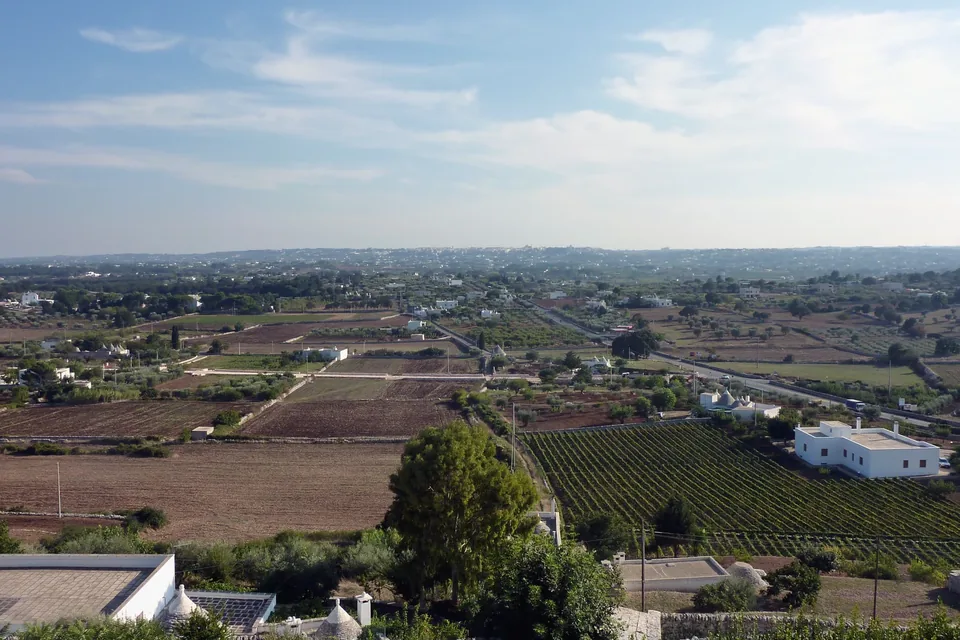
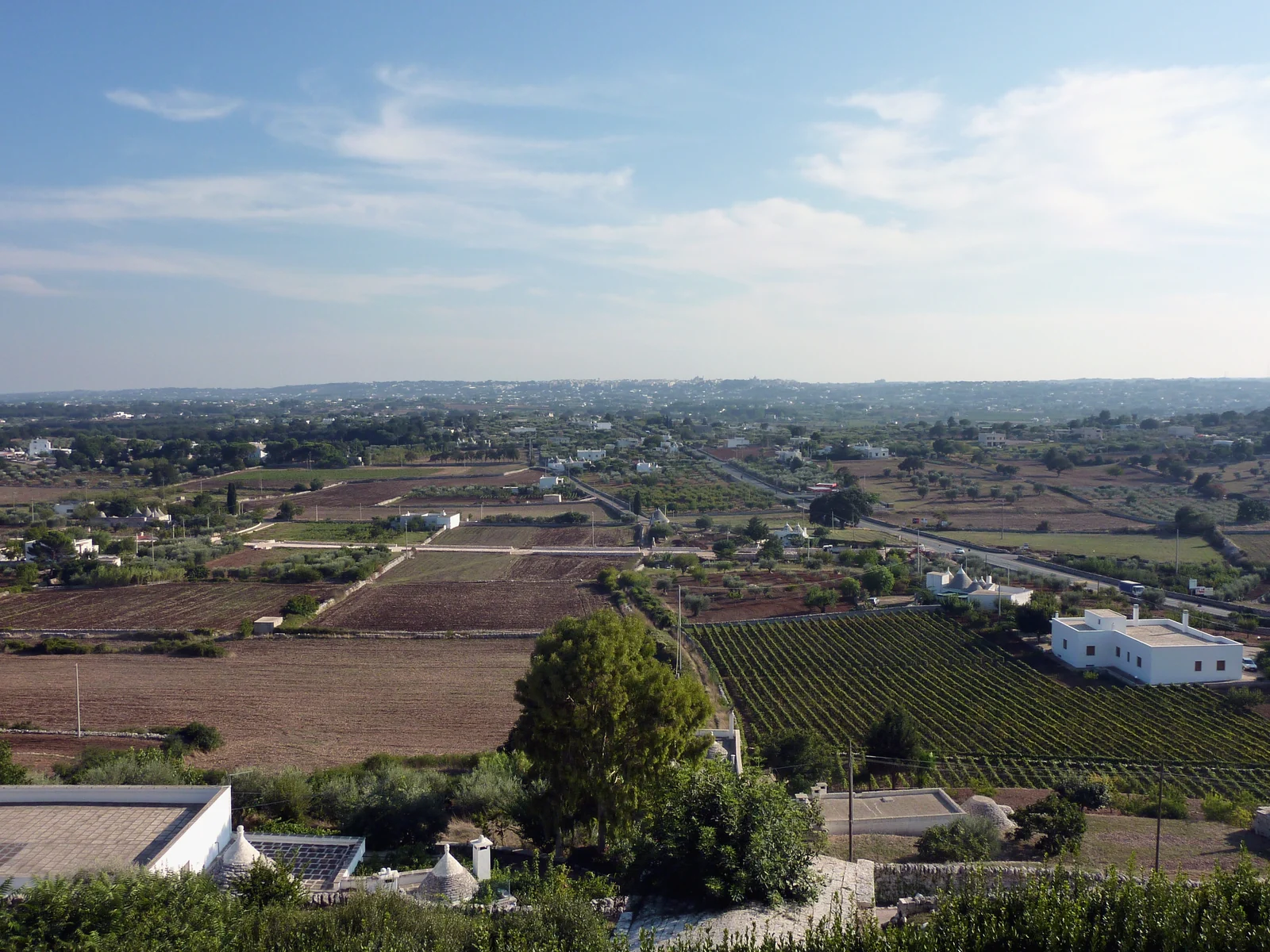
Acquedotto Pugliese describes a cycle route of about 22 kilometres following the water infrastructure between Cisternino and Ceglie Messapica, including the stretch through the Martina Franca countryside from Pineta Ulmo to Monte Fellone, where the Main Canal ends. Funded by the Apulia Region and built by the company, it crosses a landscape of trulli, olive trees and Mediterranean scrub.
The source explains that the route belongs to the national Apennine Cycle Route in the Bicitalia network and connects with the Adriatic Cycle Route; in 2014 it received the national Go Slow award. An extension project announced by the company aims to continue it along the aqueduct to the Basilicata border: this is separate from the stretch already open and should be checked before planning.
The cycle route offers a different scale from the historic canal: here the infrastructure becomes a way of moving slowly through the countryside. It is a chance to see up close, on an unpaved track, the relationship between a technical work and the farmland it helped transform.
Sources: Acquedotto Pugliese — La ciclovia
From fountain to bridge: changing scale
We suggest a reading in three steps. First a fountain, observing the relationship between water and public space; then a stretch of landscape that makes the infrastructure visible, such as the cycle route in the Itria Valley; finally the Water Palace in Bari, where the theme becomes decoration and furnishing. The journey gains a thread: what seems a simple tap belongs to a much larger story.
A few well-chosen places, with a map at hand, are enough to link the everyday to the geographical without chasing the whole network. The theme can join an urban day in Bari with a rural chapter in the Itria Valley; for those continuing to Irpinia, the springs become the third chapter.
When building the sequence we would keep separate time for visiting interiors and for observing the landscape: they are complementary experiences. Choose the period according to the kind of day you want, between museums, walks and cycling, rather than any single season of the aqueduct. A pause at the table offers time to discuss what changes when a territory receives water.
A thread for your journey
Bari for art and urban life, Valle d’Itria for canal and countryside, and Irpinia as a possible springs chapter: water connects different territories and functions.
Talk to us