
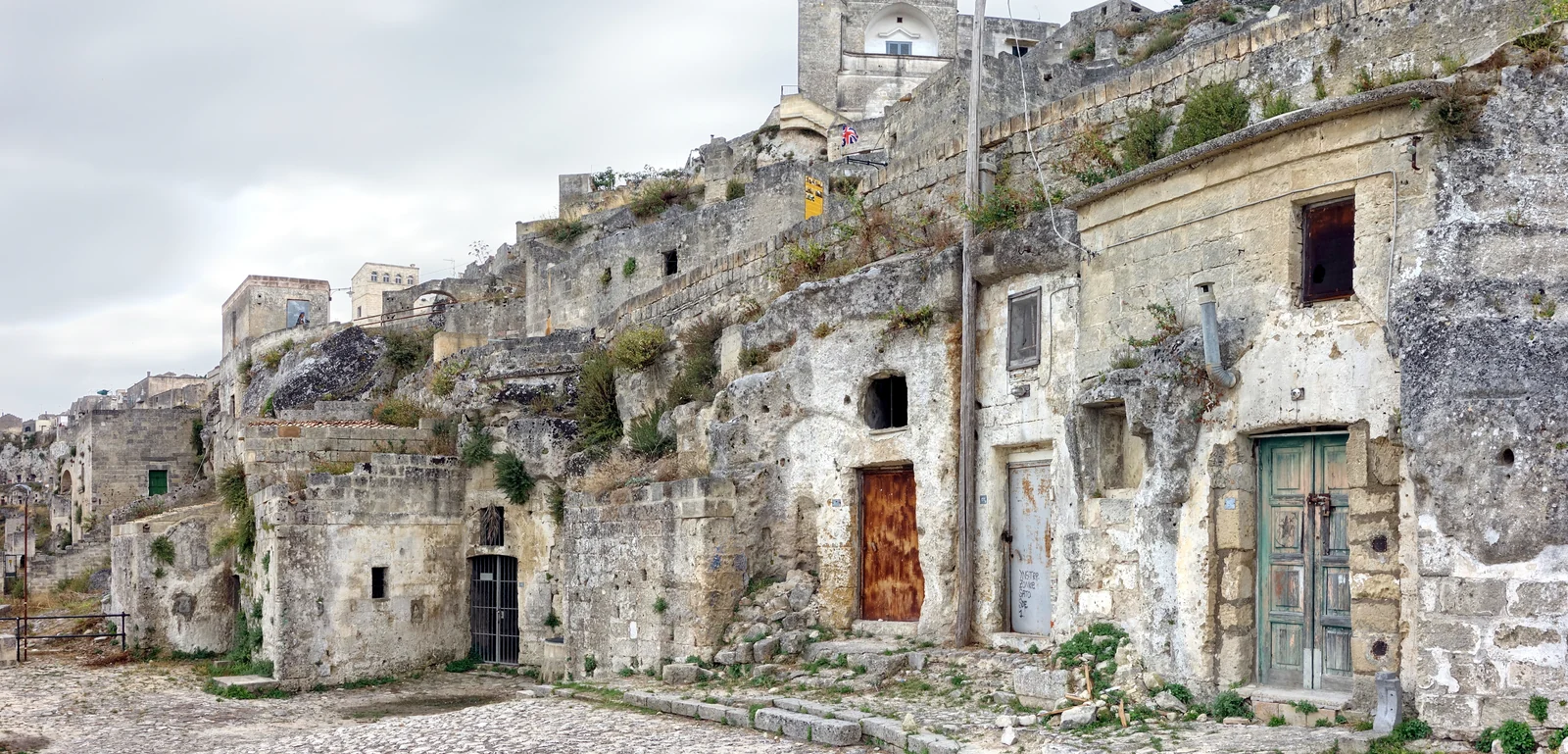
Matera: from documentaries to Pasolini
Italia.it recalls that Matera has come a long way since the 1950s, when the Sassi were extremely poor dwellings. Among the first to document both their poverty and their beauty was Carlo Lizzani, with two documentaries: Viaggio a Sud in 1949 and Nel Mezzogiorno qualcosa è cambiato in 1950.
In 1964 Pier Paolo Pasolini chose Matera and the Sassi as the setting for The Gospel According to Saint Matthew. According to the source, the director found more Jerusalem in the Lucanian city than in the real one, because he considered it purer and free of signs of modernity. From then on the city began to be recognised as a set able to represent places distant in time and space.
For travellers this history is a good starting point. The urban core, described by Italia.it as a weave of rock churches, frescoed crypts, cisterns cut into the rock, palaces and museums, is the same one directors have transformed. Looking at steps, rock and urban spaces helps understand how cinema transforms a real place, without confusing the history of the Sassi with the plot of a film.
Matera: Gibson, Tornatore and James Bond
After Pasolini, Matera again played Jerusalem in Mel Gibson’s The Passion of the Christ in 2004. Italia.it also recalls the opening scenes of Giuseppe Tornatore’s The Star Maker and two chapters of the 007 saga: Quantum of Solace in 2008 and No Time to Die in 2021.
In the latest Bond film, the source specifies, two of the most spectacular scenes involve recognisable places: the church and convent of Sant’Agostino, in front of which the secret agent speeds by car, and the church of the Madonna delle Vergini, where a British cemetery was recreated as the scene of an explosion. It is a good example of how the same building can take on, on screen, a role quite different from its function.
Those seeking these places will find buildings with a history much longer than the films. Start from the building rather than the shot: observe its position on the edge of the ravine, its relationship with the houses of the Sassi, the light at different times of day. The famous scene then becomes one detail in a broader story.
Beyond Matera: Barile, Melfi and Maratea
Italia.it’s itinerary on cinema in Basilicata does not stop at Matera. Gabriele Salvatores shot I’m Not Scared, from Niccolò Ammaniti’s novel, among the wheat fields of the Vulture Melfese, between Leonessa, Rapolla and Melfi, recognisable for its ten-towered castle and cathedral bell tower.
For The Gospel According to Saint Matthew Pasolini also chose Barile, a village of Arbëreshë origin, and its urban park of cellars, caves dug into the tufa by Albanian communities who arrived in the fifteenth century: there he set the Nativity, the Adoration of the Magi, the Massacre of the Innocents and the Flight into Egypt. Francesco Rosi filmed Christ Stopped at Eboli between Aliano and Craco; Maratea was the backdrop to Dino Risi’s A porte chiuse and the starting point of Basilicata coast to coast.
This map shows how varied Lucanian landscapes are: wheat hills, rock cellars, badlands, the Tyrrhenian coast. A themed journey can choose two or three, avoiding turning the region into a race from one set to another.
Carlo Levi and his internal exile in Aliano
The Aliano Museums website traces Carlo Levi’s life. Born in Turin in 1902, a medical graduate, painter and anti-fascist, he was among the founders of the Giustizia e Libertà movement. In 1935 he was sentenced to three years of internal exile: first assigned to Grassano, he was moved to Aliano, a small village then almost cut off by the lack of roads, because Grassano was considered too close to the railway.
The encounter with a reality he did not know struck him deeply. The book that came of it, Christ Stopped at Eboli, was written in Florence between Christmas 1943 and summer 1944 and published in 1945; the source notes that it was translated into a great many languages and helped bring the region’s social and economic problems to public attention.
Levi later became a senator and continued to paint. He died in Rome in 1975 and is buried in Aliano. Italia.it adds that in the book the village appears as Gagliano: this is the literary bond to start from, distinct from Matera’s cinematic fame.
Sources: Musei di Aliano (Comune di Aliano) — Carlo Levi · Italia.it — Aliano
Aliano: the house, the gallery and the set
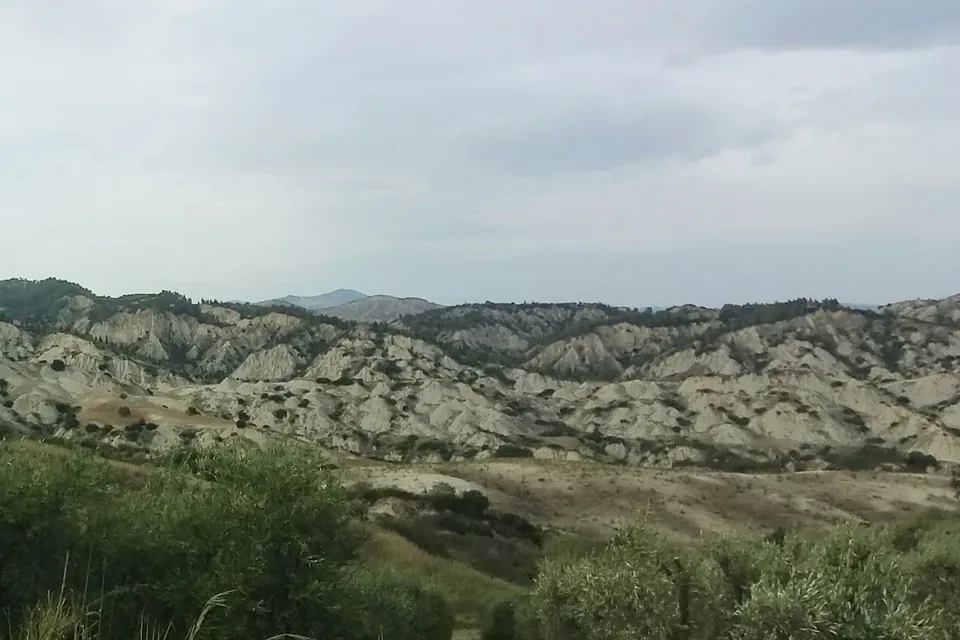
Italia.it describes Aliano perched on a clay ridge in the heart of the badlands, with wide views. In the village you can visit the Carlo Levi Gallery and the places of the Literary Park, which promotes local culture and traditions; the source also mentions the permanent exhibition in the former town hall, the restaged film set of Rosi’s film, the sixteenth-century church of San Luigi Gonzaga, the Museum of Peasant Life in an old oil mill, with horned Carnival masks, and the curious House of the Evil Eye.
The exile house, the Aliano Museums explain, has been restored with a multi-projection display: projectors make period images appear on the white walls, the house, the garden, the dog Barone, fireplaces and badlands, together with outlines of brushes and easels. The route ends on the terrace, with three painting corners inspired by the landscape. The gallery holds letters, documents and drawings from 1935–1936 and the book’s original lithographs donated by Levi himself.
The Literary Park provides up-to-date information on visits to the house, gallery and museum, to be checked before setting out.
Sources: Italia.it — Aliano · Musei di Aliano (Comune di Aliano) — Casa di confino Carlo Levi · Musei di Aliano (Comune di Aliano) — Pinacoteca Carlo Levi · Parco Letterario Carlo Levi — Aliano, casa, pinacoteca e museo
Craco: absence, landscape and image
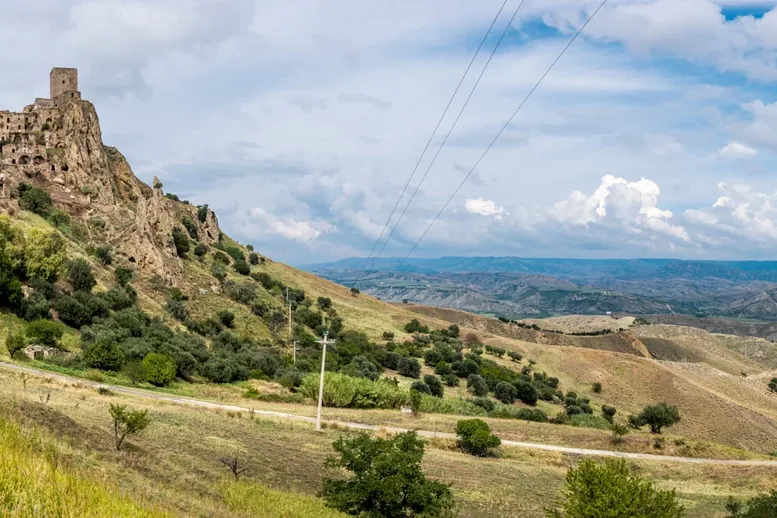
Italia.it presents Craco as a ghost town that has become one of Basilicata’s symbols worldwide: ruined buildings clinging to a rocky spur above the bare badlands landscape. In 1963 a landslide drove the inhabitants permanently from the medieval core, once a stopping place on the crusaders’ route to the Holy Land; residents moved to a modern district nearby.
Today the remains of some churches, abandoned houses and a wide view over the surrounding land survive. The same source, on its page about films shot in the region, recalls that Francesco Rosi chose Craco, together with Aliano, for Christ Stopped at Eboli.
Craco adds to the route the relationship between image, absence and landscape. It is not a third copy of the visit to Matera or Aliano: here the theme is depopulation and the power of a place still recognised precisely because it is empty. Access to the old village follows locally set rules, to be checked before the trip, and calls for respect for a place that was once a community.
Sources: Italia.it — Craco · Italia.it — Film girati in Basilicata: itinerario
A region on television too
The Basilicata Region’s press agency documents the region’s relationship with audiovisual production through an interview with the president of the Lucana Film Commission. At its centre is the success of the Rai series Imma Tataranni, along with new film productions, the prospects of the Centro Sperimentale di Cinematografia and the Fantastico Medioevo project, in which the Film Commission is a partner with the Region, the Matera Basilicata 2019 Foundation and the regional tourism agency. The same source mentions the Marateale festival, held in Maratea.
Television adds a perspective different from a single film: the landscape returns episode after episode and the city becomes a familiar setting for viewers. For Matera this means being recognised not only for historic or spectacular scenes but also for everyday streets and squares.
For the visit, alternate recognisable places with observation of the everyday city, leaving room for the life that continues outside the frame. Fans of a series can start from a square seen on screen and then move away from it, to discover what the camera does not show.
Sources: Regione Basilicata, AGR — Cinema, formazione e storia in Basilicata
Matera: looking at what stays outside the frame
In Matera we suggest two walks with different questions. The first follows the form of the image: steps, depth, light, the balance between solid and void. The second looks for the inhabited place, observing passages, doors, courtyards and how residents use the spaces.
Cinema then becomes a way of noticing something rather than replacing the visit with recognising a scene. The same spot can offer a famous photograph and a less obvious detail. It is better to dwell on that relationship than to multiply stops where only the film title is remembered.
For film lovers, a useful exercise is to watch a sequence again after the walk: you notice how editing brought distant places together or pushed nearby ones apart, and how the light chosen by the director differs from that of the day of your visit. It is a way to appreciate the work of the set and, at the same time, the real city that made it possible.
A sequence between screen and memory
Matera and Aliano complement each other if each stop keeps its own theme. In Matera we take cinema as a way into reading the city; in Aliano we follow literary memory and the objects of daily life. For Aliano the starting point can be a page chosen before departure: after reading, visiting the house and the images invites you to distinguish the author remembering, the village observed and those who tell its story today.
Keep a small notebook with a sentence of your own, not a list of quotations: what did meeting the place change? Craco can add the relationship between image, absence and landscape, without becoming a third copy of the same visit.
The period depends on the pace you want: more time in cultural spaces or more observation outdoors. Spring and autumn make walks among badlands and Sassi more pleasant. The idea remains to build a few recognisable chapters, with an evening to compare what the screen led you to imagine with what the journey showed.
A thread for your journey
Matera and Aliano as complementary themes: filming locations and literary memory.
Talk to us


.jpeg)