
APULICA / FRESH PASTA, BREAD AND PASTRY
Frisella (twice-baked bread ring)
PAT · Fresh pasta, bread and pastry · Puglia
In brief
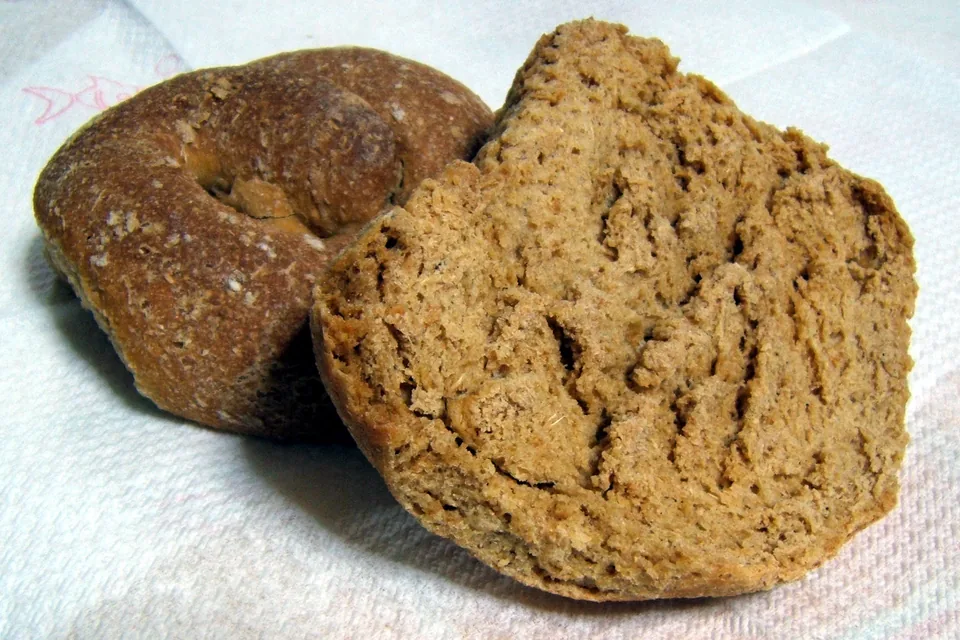
- A round rusk, smooth on one side and rough on the other, made from barley or wheat flour and weighing about 50 grams. (Atlante dei PAT di Puglia (Regione Puglia, Università di Bari) — Friselle di orzo e grano)
- The sourdough is coiled into a spiral, baked, split in half and returned to the oven for a second baking. (Atlante dei PAT di Puglia (Regione Puglia, Università di Bari) — Friselle di orzo e grano)
- It is softened in water and topped with fresh or hanging tomatoes and extra virgin olive oil. (Atlante dei PAT di Puglia (Regione Puglia, Università di Bari) — Friselle di orzo e grano)
- Festivals devoted to it are held in Putignano in July and in Supersano and Marittima in August. (Atlante dei PAT di Puglia (Regione Puglia, Università di Bari) — Friselle di orzo e grano)
History and origin
The frisella is a twice-baked bread found throughout Puglia and listed among the region's traditional products. Its origins are traced to very ancient times, when it is said to have been the travelling bread of seafarers, softened with seawater and flavoured with olive oil.
Over time it has changed its place at the table. After the war it was kept for the special occasions of better-off families; then it became a food of country tradition, topped with fresh or hanging tomatoes and extra virgin olive oil; today it is a meal in its own right, especially in summer.
Each area has its own name: fresèdde around Bari, fresèlla around Foggia, frasèdda, frisèdda or frisa in the Salento, frisoccula in Cellino San Marco. The food writer Luigi Sada recalled that they were once made from spelt flour and named those of the province of Lecce and of Manduria as the best.
Sources: Atlante dei PAT di Puglia (Regione Puglia, Università di Bari) — Friselle di orzo e grano · Masaf — Elenco nazionale dei prodotti agroalimentari tradizionali, XXVI revisione (2026)
Area and method of production
The traditional process begins in the morning. Barley flour, wheat flour or both are laid out on the board, sourdough or a piece of old dough, called llatu or criscituru, is added with lukewarm water and a little salt, and it is kneaded until soft and elastic.
With the palms of the hands, cylinders about fifteen centimetres long are rolled, twisted into a spiral and left to rise for about two hours. Meanwhile the oven heats to between 200 and 250 degrees.
After the first bake the rings are split in half horizontally and go back into the oven at a lower temperature, around 150 degrees, to dry out. It is this second baking that makes them dry and able to keep for a long time.
Sources: Atlante dei PAT di Puglia (Regione Puglia, Università di Bari) — Friselle di orzo e grano
How to recognise it
The frisella is round, made from dough twisted into a spiral, and weighs about fifty grams on average. It has two different faces: one smooth, the top of the ring, and one rough and porous, the cut side, which soaks up water and topping.
Its colour depends on the flour: cream for wheat, light brown for barley. It is hard and dry, and before topping it must always be sponzata, that is dipped and softened in water: a gesture that recalls the ancient seafarers' bread, softened with seawater.
Sources: Atlante dei PAT di Puglia (Regione Puglia, Università di Bari) — Friselle di orzo e grano · Atlante dei PAT di Puglia — Pomodori appesi
In the kitchen
The classic topping is the simplest: fresh tomato or hanging tomato, squeezed and rubbed on the softened frisa, with extra virgin olive oil. Hanging tomatoes, tied in bunches and kept in cool, airy rooms until the end of winter, made it possible to eat it this way in the cold months too.
In the Salento a typical pairing is pomodori scattarisciati, cherry tomatoes cooked over a high flame with sponsali onions and oil until they burst, which are also served on friselle. Today the frisella is enjoyed with many typical Puglia products, as an aperitif, snack or quick meal, especially in summer.
The regional record notes that it is also used to make the cialda, another traditional recipe.
Sources: Atlante dei PAT di Puglia (Regione Puglia, Università di Bari) — Friselle di orzo e grano · Atlante dei PAT di Puglia — Pomodori appesi · Atlante dei PAT di Puglia — Pomodori scattarisciati
Where to taste it
The frisella is made throughout the region and is sold by traditional retailers and directly by producers. Summer is its season, and several festivals celebrate it.
In Putignano, in the province of Bari, the Festa della frisella is held in July. In the Salento, in August, Supersano holds a festival devoted to the friseddhra and pomodori scattarisciati, and Marittima has its own Sagra della frisella; in Aradeo, also in August, the festival is devoted to the scattarisciati tomatoes that often accompany it. Ceglie Messapica, in the Brindisi area, hosts the Frisella Fest.
For exact dates it is best to check with the municipalities. Visitors to Lecce and the Salento in summer can enjoy it in its season, topped with local tomatoes and oil.
Sources: Atlante dei PAT di Puglia (Regione Puglia, Università di Bari) — Friselle di orzo e grano · Atlante dei PAT di Puglia — Pomodori scattarisciati
Protection
- Traditional agri-food product (PAT) — Puglia, n. 229, 26th revision (Masaf — Elenco nazionale dei prodotti agroalimentari tradizionali, XXVI revisione (2026) · Atlante dei PAT di Puglia (Regione Puglia, Università di Bari) — Friselle di orzo e grano)
When
Where
Read more
Salento frisella
Barley or wheat, sourdough, double baking and hanging tomatoes: how the frisa is made, how it is eaten in the Salento and where to look for it between Otranto, Lecce and the coast.
Read the guide →Photo: Florixc or Florixc, Calcagnile Floriano / Wikimedia Commons — CC BY-SA 3.0 · Resized and converted to WebP.
