
APULICA / FRESH PASTA, BREAD AND PASTRY
Matera bread
PGI · Fresh pasta, bread and pastry · Basilicata
In brief
- Bread of re-milled durum wheat semolina, at least 20% from local strains and old varieties, with sourdough starter, salt and water. (Qualigeo (Fondazione Qualivita) — Pane di Matera IGP)
- The starter is begun from ripe fruit pulp left to steep in water. (Qualigeo (Fondazione Qualivita) — Pane di Matera IGP)
- It comes in two shapes, the 'cornetto' and the tall loaf, with a crisp golden-brown crust. (Qualigeo (Fondazione Qualivita) — Pane di Matera IGP)
- It may be made anywhere in the province of Matera. (Qualigeo (Fondazione Qualivita) — Pane di Matera IGP)
History and origin
In Matera the art of bread is very old. Records from the time of the Kingdom of Naples describe local baking techniques, and works of art, literature, legends and folk tales show how much bread mattered in the life and economy of the area.
The stamps are one sign of this history. Until 1950 Matera families marked their dough with a wooden stamp, so as to recognise their own loaf after baking; the stamps were carved by shepherds during their months at pasture. Many of them are kept and displayed at the Domenico Ridola National Archaeological Museum in Matera.
Bread has always been one of the symbols of the city of the Sassi, a UNESCO World Heritage Site. Today Pane di Matera is a Protected Geographical Indication, entered in the European register, and it still carries a mark on the loaf: the letters MT.
Sources: Qualigeo (Fondazione Qualivita) — Pane di Matera IGP · Italia.it (Ministero del Turismo) — Bread from Matera · eAmbrosia — Pane di Matera (PGI-IT-0372)
Area and method of production
Pane di Matera can be made anywhere in the province of Matera. It uses re-milled durum wheat semolina or semolato, at least 20% of it from local ecotypes and old varieties, with sourdough starter, salt and water. The specification links the choice of old wheats such as Senatore Cappelli to the soil and climate of the Matera hills.
The starter is born from fruit: the pulp of ripe fresh fruit is left to steep in water for 48 hours, then mixed with semolina and water and left to double for 10 to 12 hours. The dough rises in the mixer bowl for about half an hour; the loaves are weighed, shaped by hand, rested under cloths and finally given their definitive shape.
Before baking, the stamp with the letters MT is pressed on top. Baking, in a wood-fired or indirectly heated oven, ranges from an hour for half-kilo loaves to four and a half hours for ten-kilo ones.
Sources: Qualigeo (Fondazione Qualivita) — Pane di Matera IGP · Italia.it (Ministero del Turismo) — Bread from Matera
How to recognise it
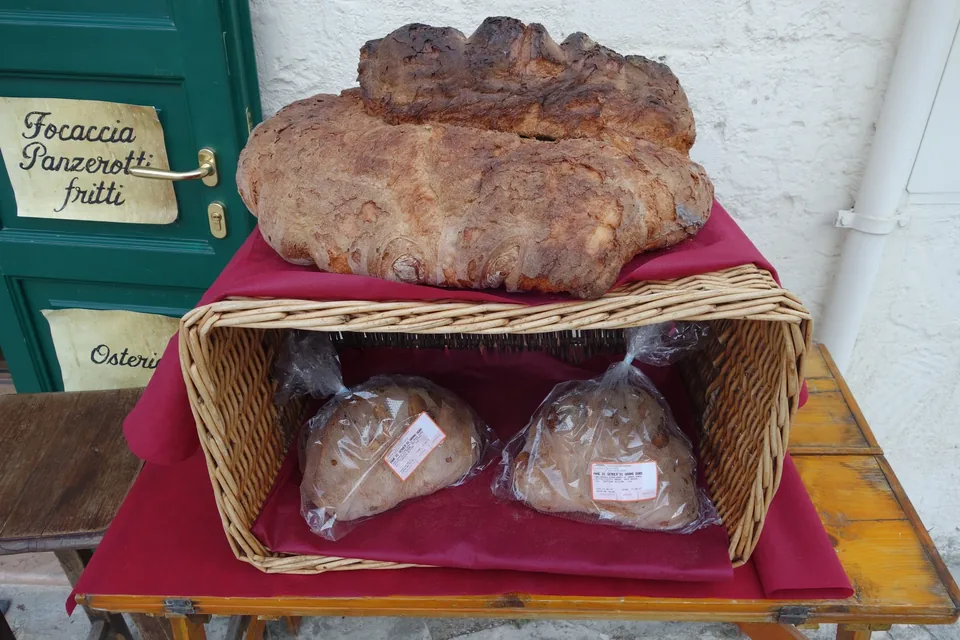
Pane di Matera comes in two shapes. The cornetto is long and slightly curved; the forma alta is tall and compact, with the characteristic "baciature" on its sides. The shape, according to Italy's official tourism portal, recalls the relief of the Murgia materana.
The crust is crisp, golden brown, at least three millimetres thick, with a typical toasted smell. The crumb is yellow, with very irregular holes; its taste and aroma are unmistakable.
It is sold fresh, in sizes from half a kilo to ten kilos, always marked MT; loaves baked in a wood-fired oven may say so on the label. Wrapped in a linen cloth it keeps for about a week in the one-kilo size and two weeks in the ten-kilo size.
Sources: Qualigeo (Fondazione Qualivita) — Pane di Matera IGP · Italia.it (Ministero del Turismo) — Bread from Matera
In the kitchen
It is good on its own, fresh from the oven, and goes well with local cured meats and cheeses. But Pane di Matera is also an ingredient in many home recipes.
Bread makes the feddarauss, a bruschetta with tomato, oil and oregano. It also goes into soups, hot and cold: cialledda calda, a soup of bread, water and onions or tomatoes, with seasonal vegetables added or, in other versions, egg, bay leaves, garlic and olives; and cialledda fredda, with moistened bread, tomatoes and garlic.
Sources: Qualigeo (Fondazione Qualivita) — Pane di Matera IGP · Italia.it (Ministero del Turismo) — Bread from Matera
Where to taste it
Pane di Matera's home is its city. Matera, with its Sassi and rock churches, is a UNESCO World Heritage Site, and the regional tourism agency of Basilicata lists it among the Città del Pane, as well as among the towns of oil and flavours; in 2019 it was European Capital of Culture.
In the city bread is found in bakeries and on every table, and its story can be traced at the Domenico Ridola National Archaeological Museum, which displays the old bread stamps carved by shepherds.
The designation covers the whole province, and a trip through the Matera hills, to villages such as Miglionico and Montescaglioso, reveals the durum wheat fields that give the semolina. Italy's tourism portal notes that durum wheat pasta and DOC Matera wines are also part of the city's table.
Sources: Italia.it (Ministero del Turismo) — Bread from Matera · APT Basilicata — Le collezioni 2018, Basilicata enogastronomica
Protection
- Protected geographical indication (PGI) — PGI-IT-0372 (eAmbrosia — Pane di Matera (PGI-IT-0372))
When
- The sources consulted give no months.
Where

Matera
The Sassi, Murgia and local bread: explore a city through architecture, nature and everyday life.
Read the guide →Photo: Velvet / Wikimedia Commons — CC BY-SA 4.0 · Resized and converted to WebP.

Read more
Pane di Matera PGI
The bread of the Sassi: durum semolina and heritage wheat, fruit-based sourdough, cornetto and forma alta shapes, family bread stamps, cialledda and feddarauss, and the city around it.
Read the guide →Photo: Kars Alfrink / Wikimedia Commons — CC BY 2.0 · Resized and converted to WebP.
