
APULICA / CHEESES
Caciocavallo podolico of Basilicata
Slow Food Presidium · Cheeses · Basilicata
In brief
- A stretched-curd cheese from the milk of Podolica cows raised free-range or semi-free-range in the Lucanian Apennines and Matera hills. (Fondazione Slow Food — Presidio Caciocavallo podolico della Basilicata)
- Large wheels of 4 to 8 kg can age for as long as four or five years. (Fondazione Slow Food — Presidio Caciocavallo podolico della Basilicata)
- The Podolica gives little milk and has fallen to about 25,000 head; the Presidium promotes it for both meat and milk. (Fondazione Slow Food — Presidio Caciocavallo podolico della Basilicata)
- It is made all year, peaking from March to May. (Fondazione Slow Food — Presidio Caciocavallo podolico della Basilicata)
History and origin
Caciocavallo is one of the symbols of the cheesemaking tradition of southern Italy. It comes from the pasta filata, or stretched-curd, technique developed over centuries to make cow's milk cheeses safer and longer-lasting; mozzarella, scamorza and provolone belong to the same family.
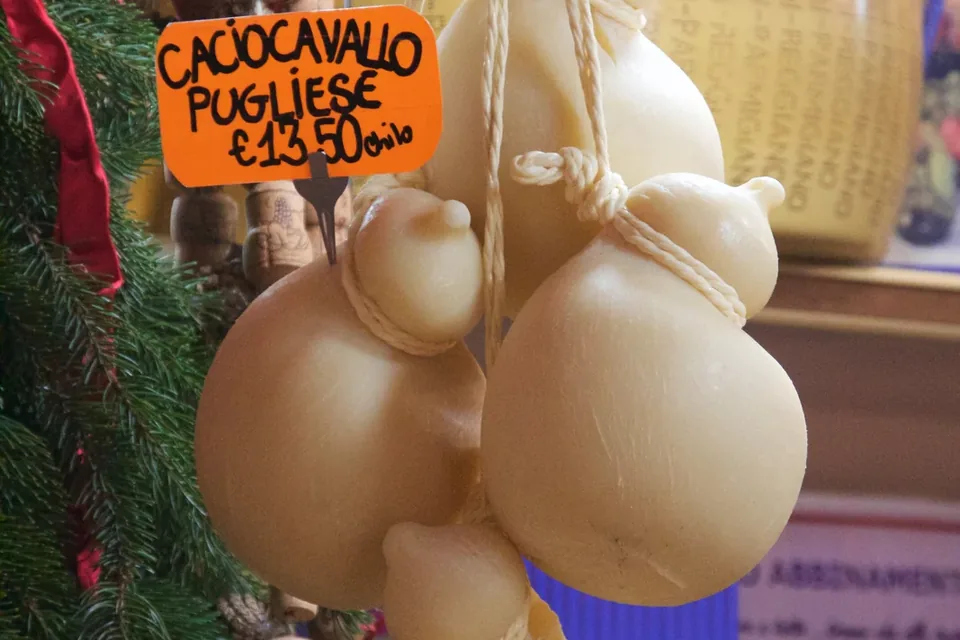
The name, the Appennino Lucano Park authority explains, comes from the way it is aged: the cheeses are tied in pairs with a rope and hung astride, "a cavallo", a ceiling beam.
Podolico caciocavallo owes its character to a specific breed, the Podolica cow, still found in the southern Apennines. Once the most widespread breed in the country, it now numbers about 25,000 head: it gives little milk and, being so hardy, must be raised in the wild or semi-wild, ill-suited to intensive farming. The Slow Food Presidium, set up by Anfosc, the association of cheesemakers who graze their animals, aims to protect it by promoting it in Basilicata as a dual-purpose breed for meat and milk and by increasing the number of farmers who make cheese from their own milk.
Sources: Fondazione Slow Food — Presidio Caciocavallo podolico della Basilicata · Parco Nazionale dell'Appennino Lucano Val d'Agri-Lagonegrese — Produzioni locali: Caciocavallo Podolico
Area and method of production
The Presidium area covers the municipalities of the Lucanian Apennines and the Matera hills, in the provinces of Potenza and Matera. The cows roam free in places rich in aromatic plants, shrubs and woodland herbs, which give the milk its particular scents.
Cheesemaking follows the pasta filata method. The milk is heated and curdled; the curd is then cooked a second time until it becomes elastic and can be worked by hand without breaking. The flask-shaped cheeses are tied in pairs and mature hanging.
It is made all year round, with the busiest period from March to May. The park authority notes that production is concentrated in spring and summer, when the animals move up to the pastures and the calves are born.
Sources: Fondazione Slow Food — Presidio Caciocavallo podolico della Basilicata · Parco Nazionale dell'Appennino Lucano Val d'Agri-Lagonegrese — Produzioni locali: Caciocavallo Podolico
How to recognise it
It is recognised by its flask shape and by the pairs of cheeses tied together. The paste is straw-coloured, fairly compact, elastic when young and with few holes. Very mature cheeses may show internal cracks: these are not a fault but a sign of long ageing.
It suits long ageing: the largest forms, from 4 to 8 kilos, can mature for four or five years. The longer the ageing, the more intense and sharp the flavour, with a complexity of aromas that the Presidium credits to the milk of grazing animals.
Many soften its strength with chestnut or strawberry-tree honey, a pairing that works well; the Presidium also invites tasting it on its own, so as not to miss any of its aromas. Since Podolica cows give very little milk, it is a rare and prized cheese.
Sources: Fondazione Slow Food — Presidio Caciocavallo podolico della Basilicata · Parco Nazionale dell'Appennino Lucano Val d'Agri-Lagonegrese — Produzioni locali: Caciocavallo Podolico
Where to taste it
Podolico caciocavallo is found in the villages of the Lucanian Apennines and the Matera hills where cows still graze freely. The authority of the Appennino Lucano Val d'Agri-Lagonegrese National Park lists it among the local products of its protected area.
The regional tourism agency of Basilicata points to two dedicated festivals. In Pescopagano, in the province of Potenza, the Sagra della Podolica serves meat and cheese from the breed and lets visitors watch the stretching of the curd from which caciocavallo is made. In Rapone, the Sagra della Soppressata e del Caciocavallo celebrates the town's two signature products.
Travelling through inland Basilicata, from the mountains around Potenza to the hills of the Matera area, it can be sought out from the Presidium's producers and at village festivals.
Sources: APT Basilicata — Le collezioni 2018, Basilicata enogastronomica · Parco Nazionale dell'Appennino Lucano Val d'Agri-Lagonegrese — Produzioni locali: Caciocavallo Podolico · Fondazione Slow Food — Presidio Caciocavallo podolico della Basilicata
Protection
- Slow Food Presidium — caciocavallo-podolico-della-basilicata (Fondazione Slow Food — Presidio Caciocavallo podolico della Basilicata)
When
- Production: March–May (Fondazione Slow Food — Presidio Caciocavallo podolico della Basilicata)
- Spring
Where
Read more
Caciocavallo podolico
The Podolica cow, the caciocavallo of the Gargano and Basilicata, the Slow Food Presidia, ageing and documented festivals.
Read the guide →Photo: Mike Peel / Wikimedia Commons — CC BY-SA 4.0 · Resized and converted to WebP.
