
APULICA / FRUIT, VEGETABLES AND PULSES
Turnip tops (cima di rapa)
PAT · Fruit, vegetables and pulses · Puglia
In brief
- The edible part is the still-closed flower head, with a piece of stalk and the tenderest leaves. (Atlante dei PAT di Puglia — Cima di rapa)
- Each plant yields a main head and several side shoots, so the same plant is cut more than once. (Atlante dei PAT di Puglia — Cima di rapa)
- Puglia growers traditionally saved their own seed, and local strains are named after their place or the length of their cycle. (Atlante dei PAT di Puglia — Cima di rapa)
History and origin
The turnip top is a brassica of ancient Mediterranean origin, and in Puglia it is very much at home: the region is its main growing area, with almost half of Italy's acreage, mostly in the province of Foggia. It has always been grown here with methods of its own, and for a long time every farmer produced his own seed, a practice the PAT atlas traces back to the early eighteenth century.
This home selection gave rise to a great many local populations, named after the place of cultivation, the length of the cycle, the harvest period or the size of the flower head: the Quarantina, the Sessantina, the Novantina, the Centoventina, the Natalina, down to those of January or of March-April. Research by the University of Bari has identified more than a hundred.
Written evidence is plentiful: a 1955-56 degree thesis on horticulture in the province of Lecce, many regional cookbooks and, in Minervino Murge, a 1930 school register in which a teacher notes the absences of a pupil busy harvesting and selling turnip tops. The turnip top has been on the national list of traditional products since 2006, and the Minervino variety has had its own entry since 2021.
Sources: Atlante dei PAT di Puglia — Cima di rapa · Atlante PAT Puglia (Università di Bari, Regione Puglia) — Nomi e curiosità delle cime di rapa · Atlante PAT Puglia (Università di Bari, Regione Puglia) — Cima di rapa di Minervino Murge
Area and method of production
The area of origin given in the PAT list is the whole of Puglia, and the season runs from late summer to spring. The technique is similar to that used for other brassicas, but the turnip top is fairly hardy. It is mostly sown in continuous rows and then thinned by hand; transplanting is increasingly used for late populations. Early varieties sown at the end of August are ready as soon as September or October, while the latest reach into spring: by alternating them, the vegetable is available for much of the year.
Harvesting means cutting the flower head when it has reached the right size, before the buds open, together with a piece of stalk and the most tender leaves. Each plant bears one main head and several secondary ones that ripen later, so the same plant is cut several times.
In Minervino Murge, on the edge of the Alta Murgia towards the Ofanto valley, the local turnip top grows in small plots, often unirrigated and with few external inputs. It is harvested with long stems: growers cut several stalks, remove the large leaves and the tough part and tie them into a bunch that looks like a bouquet.
Sources: Atlante dei PAT di Puglia — Cima di rapa · Atlante PAT Puglia (Università di Bari, Regione Puglia) — Nomi e curiosità delle cime di rapa · Atlante PAT Puglia (Università di Bari, Regione Puglia) — Cima di rapa di Minervino Murge
How to recognise it
The part of the turnip top that is eaten is the still-closed flower head, with a short piece of stalk and the youngest leaves. The basal leaves vary greatly and can exceed eighty centimetres: light green, often glossy, with very prominent veins, sometimes almost white, and edges ranging from nearly entire to deeply cut. Those along the stalks are small, lance-shaped and darker green, and a waxy bloom appears on the stem and young leaves.
The size of the head depends on earliness: early populations rarely exceed five centimetres across, while late ones can go beyond ten. To the touch the head should be firm, with the buds still tight.
The typical flavour is sweetish and the vegetable has no smell. According to the PAT atlas, a pronounced bitterness may signal excessive fertilising or watering, or insect damage. Old regional food guides already distinguished between growing areas, recalling the sweeter tops of Modugno and the slightly more bitter ones of Fasano.
Sources: Atlante dei PAT di Puglia — Cima di rapa · Atlante PAT Puglia (Università di Bari, Regione Puglia) — Nomi e curiosità delle cime di rapa
In the kitchen
The signature dish is known everywhere: orecchiette with turnip tops, itself listed among the traditional products. Orecchiette, a fresh durum-wheat pasta born around Bari, cook in the same pot as the tops, which are added when the water returns to the boil; then everything is tossed in a pan with oil, garlic, chilli, melted anchovies and sometimes breadcrumbs. The result combines the bitterish note of the vegetable, the savouriness of the anchovies and the heat of the chilli.
The tops are also enjoyed on their own. Braised turnip tops, another traditional dish, are cooked without water, pouring off the liquid as it forms, then dressed with garlic, bay leaf, oil and a glass of wine; a simpler version has them boiled and dressed with oil and lemon, while in Salento they are fried with chilli as rape 'nfucate.
With dried beans they make another classic, turnip tops and beans, a farmhouse dish served with toasted bread or friselle, which some Salento traditions call licurdia. Chickpea soup with turnip tops and braised turnip tops with salt cod from the Foggia area also appear among the historic recipes collected by the atlas.
Sources: Atlante dei PAT di Puglia — Cima di rapa · Atlante PAT Puglia (Università di Bari, Regione Puglia) — Orecchiette con le cime di rapa · Atlante PAT Puglia (Università di Bari, Regione Puglia) — Cime di rapa stufate · Atlante PAT Puglia (Università di Bari, Regione Puglia) — Cime di rapa e fagioli · Italia.it (Ministero del Turismo) — Prodotti e piatti tipici pugliesi
Where to taste it
The turnip top is a vegetable of all Puglia and can be found at markets, greengrocers and supermarkets for much of the year, peaking between autumn and spring. That is the best time to taste it fresh in traditional dishes, which the PAT atlas describes as common in the region's trattorias, agriturismi and restaurants.
Bari is the most natural place to begin: orecchiette come from this area, and in the streets of Bari Vecchia local women make them by hand on large wooden boards, ready to be dressed with turnip tops. Among the historic growing areas, old guides mention Modugno, on the outskirts of Bari, and Fasano, further south along the coast.
For a turnip top of particular character, a detour to Minervino Murge in the Alta Murgia is worthwhile: the local variety is sold there in its distinctive long-stemmed bunch, and an association of dozens of growers promotes it; since 2014 it has also been one of the town's products with a municipal designation (De.Co.).
Sources: Atlante dei PAT di Puglia — Cima di rapa · Atlante PAT Puglia (Università di Bari, Regione Puglia) — Cima di rapa di Minervino Murge · Atlante PAT Puglia (Università di Bari, Regione Puglia) — Ce se mange iòsce? Le orecchiette con le cime di rapa · Italia.it (Ministero del Turismo) — Prodotti e piatti tipici pugliesi
Protection
- Traditional agri-food product (PAT) — Puglia, n. 103, 26th revision (Masaf — Elenco nazionale dei prodotti agroalimentari tradizionali, XXVI revisione (2026) · Atlante dei PAT di Puglia — Cima di rapa)
When
- The sources consulted give no months.
Where
Read more
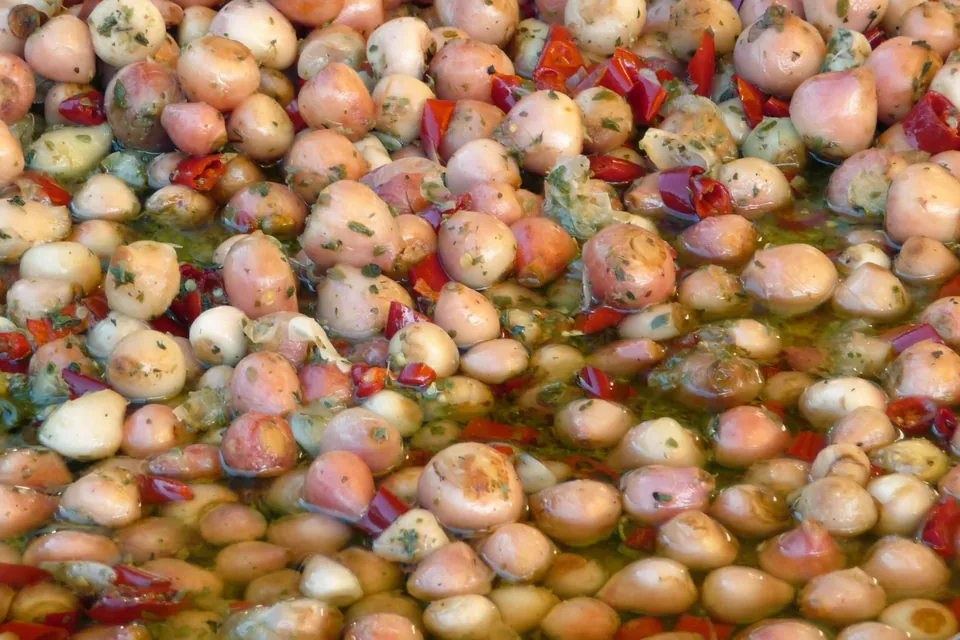
Lampascioni and turnip greens
Lampascioni, turnip greens and broad beans: simple ingredients worth tasting thoughtfully.
Read the guide →Photo: Lucarelli / Wikimedia Commons — CC BY-SA 3.0 · Resized and converted to WebP.
