
APULICA / FRUIT, VEGETABLES AND PULSES
Paganica beans
Slow Food Presidium · Fruit, vegetables and pulses · Abruzzo
In brief
- Climbing beans from Paganica and other hamlets of L'Aquila, grown in the basin of the Vera river, fed by Gran Sasso springs. (Fondazione Slow Food — Presidio Fagioli di Paganica)
- There are two ecotypes: the pane or olio bean, hazel-coloured with an eye, and the white pisello bean, rounder and creamier. (Fondazione Slow Food — Presidio Fagioli di Paganica)
- They cook in about half an hour and go into the local soup with guanciale. (Fondazione Slow Food — Presidio Fagioli di Paganica)
History and origin
In Paganica, a hamlet of L'Aquila, beans have been grown for more than a century. The credit goes to the alluvial soils, cool and deep, and to the streams fed by springs that come down from the Gran Sasso. Until a few decades ago this was a significant crop, sold on the local market and in neighbouring provinces such as Terni and Rieti.
From the 1970s cultivation shrank sharply. It needs a great deal of manual work, and a number of fertile fields were given over to industry and building, including during the reconstruction after the 2009 earthquake.
Today the future of this bean lies with a group of young growers. They have recovered the seed from older farmers and grow it sustainably, seeing the bean both as a living and as a driver of renewal for the area. The Slow Food Presidium supports them along the way.
Sources: Fondazione Slow Food — Presidio Fagioli di Paganica
Area and method of production
Cultivation is concentrated in the basin of the river Vera, which rises at the foot of the Gran Sasso, and covers the hamlets of Paganica, Tempera, San Gregorio, Bazzano and Onna, all in the municipality of L'Aquila.
The plants are climbers with a long cycle of 160 to 180 days. Supported by poles, they can reach two metres. The poles are willow, cut from the autumn pruning of the woods.
Most of the work is done by hand: weeds are pulled by hand, the supports are set up, the beans are picked in several passes over a few weeks, and finally the seeds are separated from the dry pods.
Sources: Fondazione Slow Food — Presidio Fagioli di Paganica
How to recognise it
There are two ecotypes, both with white flowers and a climbing habit. They differ in the colour of the seed.
The bread bean, also called oil bean, is beige shading to tan or hazel and has an eye in the centre. The white bean, also called pea bean, is ivory and slightly rounder.
The white one has a thinner skin and a buttery inside, so it is more tender. The oil bean keeps more aroma and flavour after cooking. For both, a short cooking time of about half an hour is a mark of quality.
They are climbing plants which, held up by willow poles, grow up to two metres: the fields are recognisable by their rows of supports.
Sources: Fondazione Slow Food — Presidio Fagioli di Paganica
In the kitchen
The simplest way to enjoy them is on their own, just cooked and dressed with extra virgin olive oil, salt and pepper. The short cooking keeps the bean whole and full of flavour.
The local dish is bean soup with guanciale, another typical product of the area, served with country bread. It is home cooking, tied to the farming life of the L'Aquila basin.
Texture guides the choice: the white bean is softer and more buttery, while the oil bean stays more fragrant and flavourful once cooked.
Guanciale, itself a characteristic product of the area, gives the soup its savoury note.
Sources: Fondazione Slow Food — Presidio Fagioli di Paganica
Where to taste it
The bean is found in several hamlets of L'Aquila: Paganica, Tempera, San Gregorio, Bazzano and Onna, in the basin of the river Vera at the foot of the Gran Sasso.
The area makes a good day out from the centre of L'Aquila, among fields irrigated by Gran Sasso water and villages rebuilding after the 2009 earthquake, which are finding part of their identity again in farming.
The bean is a dry product and keeps well: it can be taken home after the visit and cooked with the simplicity that local tradition suggests.
Production, which once reached Terni and Rieti too, is smaller today and in the hands of young growers who recovered the seed from older farmers.
Sources: Fondazione Slow Food — Presidio Fagioli di Paganica
Protection
- Slow Food Presidium — fagioli-di-paganica (Fondazione Slow Food — Presidio Fagioli di Paganica)
When
- The sources consulted give no months.
Where
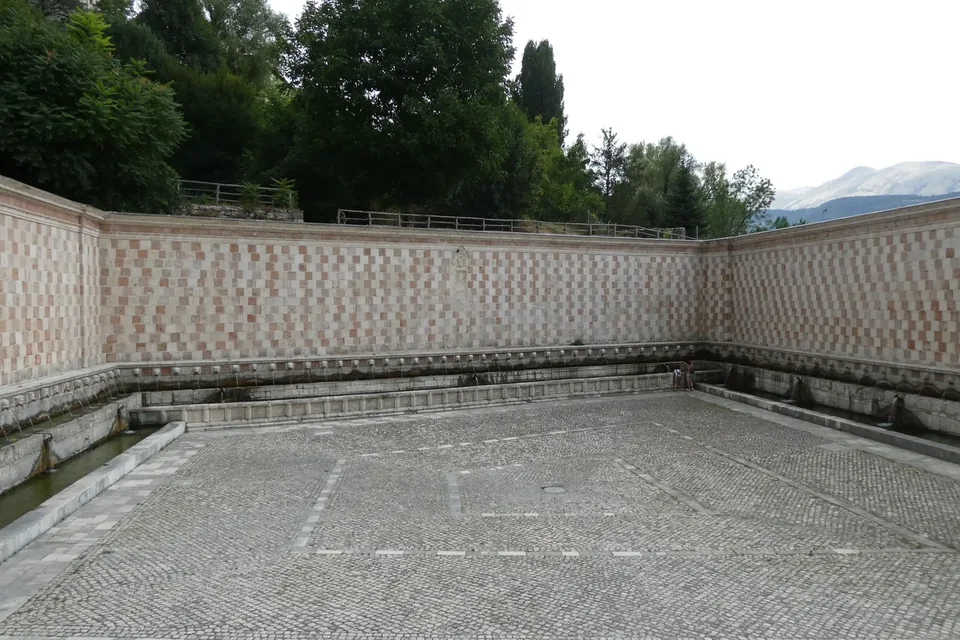
L’Aquila
A capital between the Gran Sasso and the Monti della Laga, with the UNESCO-listed Celestinian Forgiveness and reconstruction still under way.
Read the guide →Photo: Syrio / Wikimedia Commons — CC BY-SA 4.0 · Resized and converted to WebP.
