
APULICA / FRUIT, VEGETABLES AND PULSES
Liquirizia di Calabria (Calabrian liquorice)
PDO · Fruit, vegetables and pulses · Calabria
In brief
- It comes from Glycyrrhiza glabra of the local Cordara variety, grown or wild, and is sold as fresh root, dried root or extract. (Qualigeo — Liquirizia di Calabria DOP)
- The area covers 210 municipalities in every Calabrian province, up to 650 m above sea level. (Qualigeo — Liquirizia di Calabria DOP)
- The roots are dug up in every month of the year, including from registered wild stands. (Qualigeo — Liquirizia di Calabria DOP)
- The plant was already widespread in Calabria in the 17th century, and in the 18th it was grown along the Crati valley and the coasts. (Qualigeo — Liquirizia di Calabria DOP)
History and origin
Liquorice is a perennial legume found across the Mediterranean, southern Europe and Asia. In Calabria it finds such favourable conditions that, near the beaches or at the edge of olive groves, whole wild stretches of it can be seen. The plant was known to ancient medicine, and according to ARSAC it was spread in Europe by Dominican friars in the fifteenth century.
Many documents show that in the seventeenth century liquorice was widespread and used in Calabria and that in the following century plantations stretched along the Crati valley, the whole Ionian coast and large parts of the Tyrrhenian coast. Medical and pharmacological texts of past centuries cite Calabrian liquorice; its use in confectionery and cooking came later.
Before modern machinery the juice was extracted in the conci, workshops employing many hands, mostly women. Tradition has also left many dialect names: rigulizia, ligurizia, nicorizza, ciavurrina and more. Today Liquirizia di Calabria is a Protected Designation of Origin.
Sources: ARSAC (Regione Calabria) — I prodotti DOP, IGP e PAT della Calabria · ARSAC — Piante officinali in Calabria: liquirizia · Qualigeo — Liquirizia di Calabria DOP · eAmbrosia — Liquirizia di Calabria (PDO-IT-0644)
Area and method of production
The designation covers Glycyrrhiza glabra of the local Cordara variety, cultivated or wild, in 210 municipalities in all Calabrian provinces up to 650 metres above sea level. Natural liquorice stands may join the PDO if they are registered with the control body.
New plantings start from root cuttings. Liquorice fixes nitrogen and improves soil fertility; between harvests fodder crops, vegetables or pulses may be grown, with tillage no deeper than 20 centimetres. Roots are dug in every month of the year, never deeper than 60 centimetres.
Fresh roots are cut, graded and washed. Those to be sold dry are dried outdoors in airy, sunny places, or indoors or in ventilated ovens at controlled temperatures. For the extract the roots are chopped, shredded and washed with water only; the juice, concentrated with heat, sets as it cools into a dark, solid paste that is cut into various shapes.
Sources: Qualigeo — Liquirizia di Calabria DOP · ARSAC — Liquirizia di Calabria DOP · ARSAC (Regione Calabria) — I prodotti DOP, IGP e PAT della Calabria
How to recognise it
Liquirizia di Calabria comes in three forms. The fresh root is straw yellow, with a sweet, aromatic, intense and lingering taste. The dried root ranges from straw yellow to ochre and tastes sweet, fruity and slightly astringent.
The root extract ranges in colour from burnt umber to black and has a bittersweet, aromatic, intense and lingering flavour. It comes in sticks, broken pieces and flakes, as well as powder.
Packs are of cardboard, glass, metal, ceramic or other suitable materials, from a few grams up to 25 kilos. Liquorice keeps well somewhere cool and dry, away from heat.
Sources: Qualigeo — Liquirizia di Calabria DOP · ARSAC — Liquirizia di Calabria DOP
In the kitchen
The simplest form is the dried root, cut into sticks for chewing and sold in bundles or small boxes. Liquorice paste, made by boiling the roots, gives broken pieces, gums and powder; then sweets, wheels, sugared pieces and liquorice flavoured with violet, mint, aniseed or citrus. Liquorice, mint and aniseed liquorice and liquorice liqueur are among Calabria's traditional food products.
Liquorice goes into herbal teas and pairs with chocolate, biscuits, creams, cakes and ice cream, and it is the basis of many Calabrian liqueurs and bitters.
In recent years liquorice powder has also entered the kitchen, in pasta and in meat and fish main courses, and it is used to flavour honey, salt and even cheese.
Sources: ARSAC (Regione Calabria) — I prodotti DOP, IGP e PAT della Calabria · ARSAC — Piante officinali in Calabria: liquirizia
Where to taste it
Liquorice grows across most of Calabria below 650 metres, and the PDO area includes municipalities in every province. Among them are Corigliano and Rossano, on the Ionian coast of Cosenza province, and towns of the Crati valley and the Pollino such as Altomonte and Civita, as well as Tropea on the Tyrrhenian coast and Crotone on the Ionian.
Along the Ionian coast and the Crati valley, where plantations already stretched in the eighteenth century, the plant can still be spotted growing wild at the edge of olive groves and near beaches.
Travelling in Calabria, liquorice is met mostly in processed form: dried roots, pure liquorice in bars and pieces, sweets and liqueurs are the forms in which Calabrian producers offer it.
Sources: ARSAC — Liquirizia di Calabria DOP · Qualigeo — Liquirizia di Calabria DOP · ARSAC (Regione Calabria) — I prodotti DOP, IGP e PAT della Calabria
Protection
- Protected designation of origin (PDO) — PDO-IT-0644 (eAmbrosia — Liquirizia di Calabria (PDO-IT-0644))
When
- Harvest: all year round (Qualigeo — Liquirizia di Calabria DOP)
Where
Read more
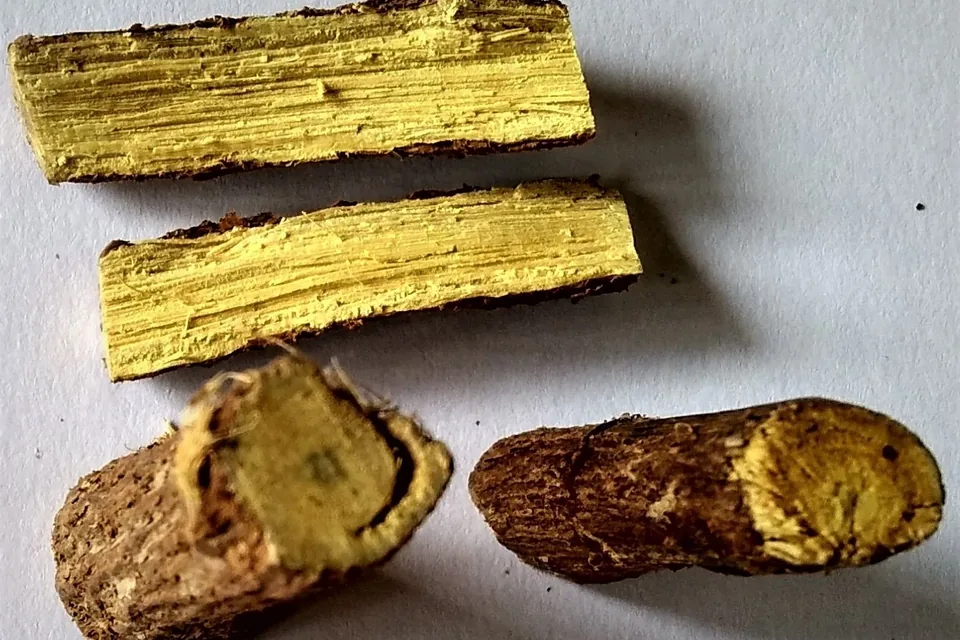
Liquirizia di Calabria PDO
Fresh root, dried root and extract: the Calabrian PDO, its industrial history between the Sibari plain and the Crati valley, and a day in Corigliano-Rossano.
Read the guide →Photo: Salil Kumar Mukherjee / Wikimedia Commons — CC BY-SA 4.0 · Resized and converted to WebP.
