
APULICA / FRUIT, VEGETABLES AND PULSES
Tondina almond of Alto Salento
Slow Food Presidium · Fruit, vegetables and pulses · Puglia
In brief
- A native almond variety grown around Ostuni, Carovigno, San Vito dei Normanni, Ceglie Messapica and San Michele Salentino, in the province of Brindisi. (Fondazione Slow Food — Presidio Mandorla Tondina dell'Alto Salento)
- It flowers early, in February, and ripens between August and September; the nut is small and round, with a hard shell and a sweet kernel. (Fondazione Slow Food — Presidio Mandorla Tondina dell'Alto Salento)
- It was the traditional almond for the confetto riccio of Francavilla Fontana and for the area's dry pastries. (Fondazione Slow Food — Presidio Mandorla Tondina dell'Alto Salento)
History and origin
The tondina is a native almond variety of the Alto Salento, the northern part of the province of Brindisi. In the towns where it grows it goes by many names: tondina ostunese, tonnin, sandricana, senacante. Its area covers Ostuni, Carovigno, San Vito dei Normanni, Ceglie Messapica and San Michele Salentino.
For generations it was the reference almond for local pastry: it was the traditional almond of the curly sugared almonds of Francavilla Fontana and of the area's dry sweets.
Today it is protected by a Slow Food Presidium that supports its cultivation. In Ostuni the town council lists it, together with the violet aubergine, as one of the results already achieved in the work to enhance the city's medieval market gardens, linked to the plan for a Park of Apulian vegetable biodiversity.
Sources: Fondazione Slow Food — Presidio Mandorla Tondina dell'Alto Salento · Comune di Ostuni — Convegno «Gli orti periurbani di Ostuni e il futuro Parco della biodiversità orticola pugliese»
How to recognise it
The tondina tree is an early one: it blossoms as early as February, while the Alto Salento countryside is still in midwinter, and ripens its fruit between August and September.
The nut is small and round, as the name says, with a hard shell protecting a sweet kernel. A round shape, a hard shell and a sweet kernel are the traits by which the Presidium describes it, and they are what make it recognisable.
The sweet kernel is also what made it the traditional almond for curly sugared almonds: to make them, shelled almonds are toasted in a wood-fired oven before being coated with sugar, and they stay crunchy under the coating.
Sources: Fondazione Slow Food — Presidio Mandorla Tondina dell'Alto Salento · Atlante dei PAT di Puglia — Mandorla riccia di Francavilla Fontana
In the kitchen
The sweet that ties it most closely to the area is the curly sugared almond of Francavilla Fontana, listed among Puglia's traditional products. Shelled almonds are browned in a single layer in a wood-fired oven; then, in a copper pan heated over embers, they are coated with sugar while being swayed for a long time. The curly finish forms in a second pan over a gentler heat, while syrup, the «giulebbe», drips from above; at the end a few drops of lemon and citron juice and a dusting of vanilla are added.
The result is an oval, white, grainy sweet, soft outside and crunchy inside thanks to the toasted almond. With its sweet kernel, the tondina was the traditional almond for this preparation and for the area's dry pastries.
Sources: Atlante dei PAT di Puglia — Mandorla riccia di Francavilla Fontana · Fondazione Slow Food — Presidio Mandorla Tondina dell'Alto Salento
Where to taste it
The tondina is found in the countryside between Ostuni, Carovigno, San Vito dei Normanni, Ceglie Messapica and San Michele Salentino, inland from the Brindisi coast. Ostuni, with its white old town and its market gardens of medieval origin, is the natural starting point.
To taste it in a sweet, head to Francavilla Fontana: during the feast of the Madonna della Fontana, the town's patron saint, curly sugared almonds are found in every street and square. At Carnival, on the two Thursdays before Shrove Tuesday, the custom of exchanging them lives on: on the first Thursday women give them to the men in their lives, on the second the men return the gesture.
Late summer is harvest time, while in February the almond trees in blossom announce the new season.
Sources: Fondazione Slow Food — Presidio Mandorla Tondina dell'Alto Salento · Atlante dei PAT di Puglia — Mandorla riccia di Francavilla Fontana · Comune di Ostuni — Convegno «Gli orti periurbani di Ostuni e il futuro Parco della biodiversità orticola pugliese»
Protection
- Slow Food Presidium — mandorla-tondina-ostunese (Fondazione Slow Food — Presidio Mandorla Tondina dell'Alto Salento)
When
- The sources consulted give no months.
Where
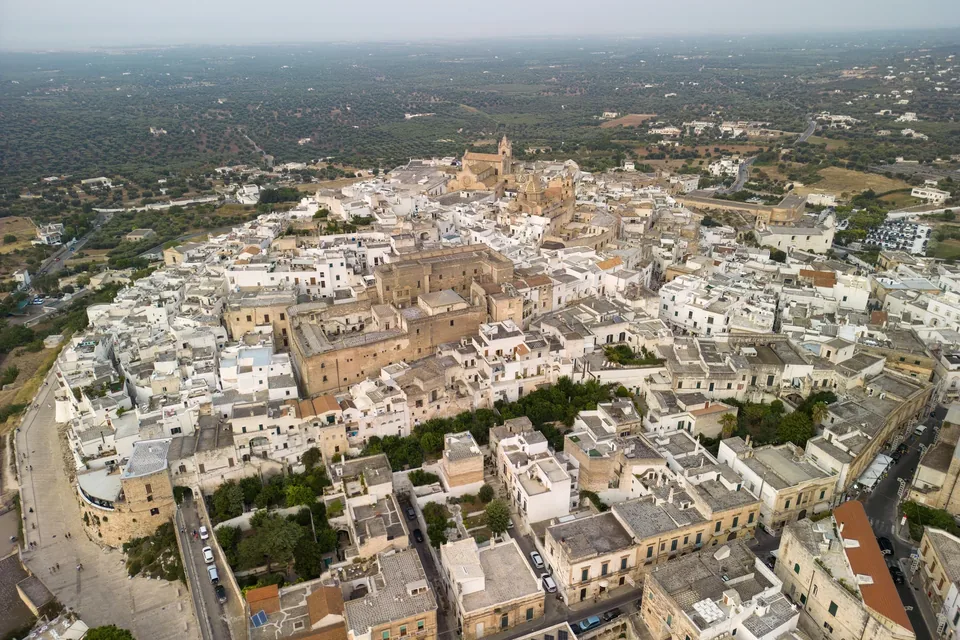
Ostuni
Houses, steps and agricultural landscape within one visit.
Read the guide →Photo: ParisTaras / Wikimedia Commons — CC BY 4.0 · Resized and converted to WebP.
