APULICA / Food guides
The citron of the Riviera dei Cedri: a fruit between pastry and ritual
On the Tyrrhenian coast of the province of Cosenza, a large, fragrant, thick-skinned citrus fruit has given its name to a whole stretch of shoreline: the Riviera dei Cedri. Here the citron serves pastry-making, but also a distant religious rite, the Jewish Feast of Tabernacles. Since 2023 the Cedro di Santa Maria del Cedro has been a Protected Designation of Origin. This guide explains the fruit, its delicate cultivation, its protection, the museum that tells its story and the towns of the coast.
The fruit and the PDO's eighteen towns
ARSAC, the regional agency for the development of Calabrian agriculture, describes the Cedro di Santa Maria del Cedro PDO as the fruit, or hesperidium, of the botanical species Citrus medica. It is oval with a stalked tip; the skin is a deep green turning to yellow, while the inner part is white, firm and well structured. The pulp is straw-yellow, seedless, with an aromatic scent and an intense, tart taste.
The production area covers eighteen towns in the province of Cosenza: Aieta, Belvedere Marittimo, Bonifati, Buonvicino, Cetraro, Diamante, Grisolia, Maierà, Orsomarso, Papasidero, Praia a Mare, Sangineto, San Nicola Arcella, Santa Domenica Talao, Santa Maria del Cedro, Scalea, Tortora and Verbicaro. They are coastal and hill towns, between the sea and the mountains rising towards the Pollino.
Packs on sale must show the product logo, the protected designation symbol, the packing plant's location, the producer's name and address and the commercial grade: useful details for recognising the certified fruit.
Sources: ARSAC Calabria — Cedro di Santa Maria del Cedro DOP
Liscia di Diamante, a delicate plant
Slow Food's Ark of Taste describes the smooth citron of Diamante, grown on the Tyrrhenian coast between Tortora and Cetraro, in the province of Cosenza. It is a light green fruit, oval to round, weighing on average one kilo; the skin is thick, hard and yellow, while the pulp is not very juicy, sweet and tart, with an intense and pleasant scent.
The plant is extremely delicate. It needs a mild climate, plenty of water and protection from the cold, which is why it is covered with special mats in winter. It flowers all year round, but the best fruit comes from the May and June blossoms; the harvest runs from October to December.
In the kitchen citrons are candied and used mainly for sweets, or eaten as they are, especially at Christmas. It is a fruit prized more for its peel and fragrance than for its juice, and the harvest season coincides with the months when the coast gets ready for the winter festivities.
Sources: Fondazione Slow Food — Arca del Gusto, Cedro liscio di Diamante
A coast named after a fruit
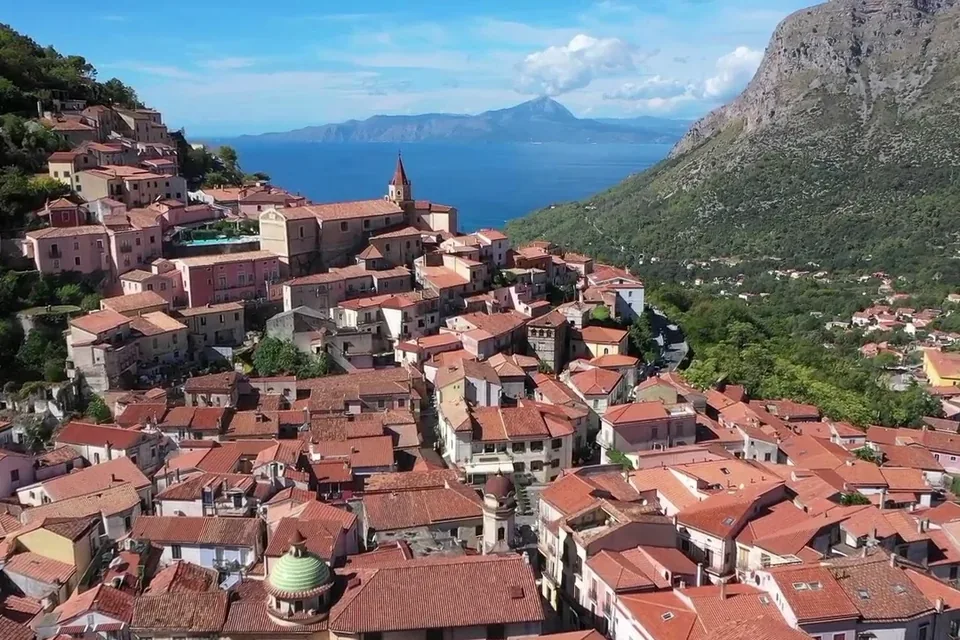
The Riviera dei Cedri, also called the Costa dei Cedri, is the stretch of the upper Tyrrhenian coast near Cosenza that takes its name from this citrus fruit. Italia.it describes it as a small natural paradise, where the citron finds its ideal habitat and the scent of citrus blossom accompanies sunsets over the sea.
The guide presents the fruit as a native citrus with unique features: smooth, glossy skin, large size, autumn flowering, use in pastry and cosmetics. It is this bond between landscape and crop that gives a whole coast its identity, from the seaside towns to those inland.
The Riviera is also known for its beaches and two islands, Dino Island off Praia a Mare and Cirella Island off Diamante, both part of the Riviera dei Cedri Regional Marine Park. Dino Island, the largest in Calabria, is full of caves and inlets, such as the Grotta delle Sardine and the Grotta Azzurra, and is loved by divers and by those seeking a holiday close to nature.
Sources: Italia.it — Costa dei Cedri, cose da vedere e da fare
The citron and the Feast of Tabernacles
The citron of this coast has a role that goes beyond the table. Italia.it explains that every year the Riviera dei Cedri welcomes rabbis from all over the world, who come to choose the best fruit for Sukkot, the Jewish Feast of Tabernacles, in which the etrog, the citron, is used in its most prized variety.
According to the guide, the rabbis come to Santa Maria del Cedro to gather the fruit the Bible calls Perì 'etz hadar, and the rite recalls the crossing of the desert through the building of huts. The variety at the heart of this tradition is the smooth citron of Diamante.
The regional agriculture councillor, in ARSAC's statement on the PDO, stressed precisely that the citron is a symbolic fruit in religious and cultural terms. For travellers it is an encounter with a tradition that is both living and distant: the choice of fruit is a religious moment and should be observed discreetly, without turning it into a show.
Sources: Italia.it — Costa dei Cedri, cose da vedere e da fare · ARSAC Calabria — Denominazione di origine protetta per il Cedro di Santa Maria del Cedro
From the Ministry's opinion to the EU register
The road to the PDO was long. On 6 May 2022, on the last day of Macfrut in Rimini, the leading fruit and vegetable fair, the Calabria Region announced the Ministry of Agriculture's favourable opinion on recognising the Cedro di Santa Maria del Cedro, described as a niche product with ancient roots, with the prospect of relaunching the Riviera dei Cedri for tourism and food as well.
Official status came with entry in the European register of PDOs and PGIs and publication in the EU Official Journal, announced by ARSAC in May 2023. The agency describes a process that lasted several years, with setbacks and fresh starts, and was completed thanks to the work of the Cedro di Calabria Consortium, with decisive support from the Region.
In the same statement the Region notes that the new production rules will guarantee quality and open further paths for promotion, including the development of the area. The citron thus joins the other Calabrian fruit and vegetable designations, such as Tropea red onion, Sila potato and the Clementine PGI.
Sources: Regione Calabria — Parere favorevole del Ministero alla DOP Cedro di Santa Maria del Cedro (2022) · ARSAC Calabria — Denominazione di origine protetta per il Cedro di Santa Maria del Cedro
The Citron Museum and the Laos park
Santa Maria del Cedro, the little capital of the Riviera, takes its name from the coast's leading citrus fruit. Italia.it places the fruit's home in the Citron Museum, housed in the monumental Palazzo Gabriele Marino: teaching panels and multimedia stations tell the citron's history, its harvesting and processing and the traditions tied to its ritual use in Judaism.
The museum also includes an art trail in the old town and an archaeological trail leading to the Laos Archaeological Park, on San Bartolo hill in the hamlet of Marcellina. Excavations document the settlement of an ancient Magna Graecia colony, attested around 510 BC, with buildings such as the House of the Ramp and the House of the Mint; the finds are displayed at the Scalea Antiquarium.
In a panoramic position stands the medieval Abatemarco complex, with the ruins of the castle of San Michele and the fully frescoed Basilian church of the same name. Museum, excavations and medieval complex fit well into a morning before heading down to the sea.
Sources: Italia.it — Costa dei Cedri, cose da vedere e da fare
Along the Riviera: Praia, Scalea, Cirella and Belvedere
Italia.it's itinerary starts in the north, at Praia a Mare, born as a fishing and farming village between the Noce and Lao rivers: here the Sanctuary of the Madonna della Grotta fills three rock caves, and the Fiuzzi Tower has guarded the coast since the 16th century. Nearby, Tortora has a Blue Flag beach.
Scalea, one of the oldest towns in Calabria, stands between the hill and the Lao valley. Torre Talao is now a terrace over the Tyrrhenian; in the old town, overlooked by the ruins of the Norman castle, the admiral Ruggiero di Lauria, remembered by Boccaccio, was born in 1250. In Diamante the municipality describes the ruins of old Cirella, destroyed in the early nineteenth century, and the Teatro dei Ruderi, which hosts shows and concerts in summer.
The last stop is Belvedere Marittimo, the lovers' village: the Capuchin convent keeps relics of St Valentine, visited by couples every 14 February, and the centre preserves the Aragonese castle restored in 1490. All these towns lie within the PDO area.
Sources: Italia.it — Costa dei Cedri, cose da vedere e da fare · Comune di Diamante — I ruderi di Cirella · ARSAC Calabria — Cedro di Santa Maria del Cedro DOP
Festivals and season: what we know
We have not found on official sources a citron festival with fixed dates to report, so we suggest none. The most interesting period remains autumn and early winter: it is harvest time and the season of Sukkot, when rabbis visit the citron groves.
The date of the Jewish feast changes every year according to the lunar calendar, and the choice of fruit is a religious moment, not a show: it should be observed discreetly and only where possible, accompanied by local operators. Visits to citron groves must always be arranged in advance.
Summer instead brings the sea, the islands and evening shows to the Riviera, such as those at the Teatro dei Ruderi in Cirella. It is a good time for the Citron Museum and for walks through the old towns, but the fruit on the trees is still far from ripe. Anyone wanting to see the citron in its full season would do well to choose October or November, when the coast is quieter.
In the kitchen
The citron is understood mainly through its peel and white pith, thick and fragrant, rather than through its tart pulp. I would taste it candied, in the coast's sweets, and fresh in thin slices with a pinch of salt or in a salad with fennel and olives, as is done with the more bitter citrus fruits.
A liqueur or a marmalade also conveys its scent well, which stays intense even after processing. At Christmas candied citron appears in many sweets, and the harvest season makes it easier to find fresh.
On a day along the Riviera dei Cedri I would look for at least two different preparations, to see how much the same fruit changes between fresh and preserved. It is worth asking sellers whether it comes from the towns of the designation and which variety it is: the Liscia di Diamante has a recognisable peel and scent, and tasting it beside an industrial candied peel helps to grasp its value.
Taking it home
Fresh citron, large and sturdy, can survive a few days of travel if kept cool and not crushed; wrapped in paper, it also copes well with hand luggage. Candied peel and preserves remain the most practical souvenirs, as they last a long time and take up little room.
To recognise the designated product, look on the label for the name Cedro di Santa Maria del Cedro, the PDO symbol and the product logo, together with the producer's and packer's details. If you buy fresh fruit out of season, ask where it comes from: not all the citron sold on the coast is grown in the towns of the designation.
At home, keep fresh fruit in a cool, dry place and use it within a few weeks, while the peel stays firm and fragrant. A single grated peel is enough to scent a cake or a salad, and is the simplest way to bring the memory of the Riviera dei Cedri back into the kitchen.
A thread for your journey
Journey idea: a morning in Santa Maria del Cedro between the Citron Museum and the Laos archaeological park, lunch with fresh and candied citron, an afternoon along the Riviera dei Cedri. Citron grove visits arranged with operators, ideally in autumn, during the harvest.
Talk to us