Spilinga and Monte Poro
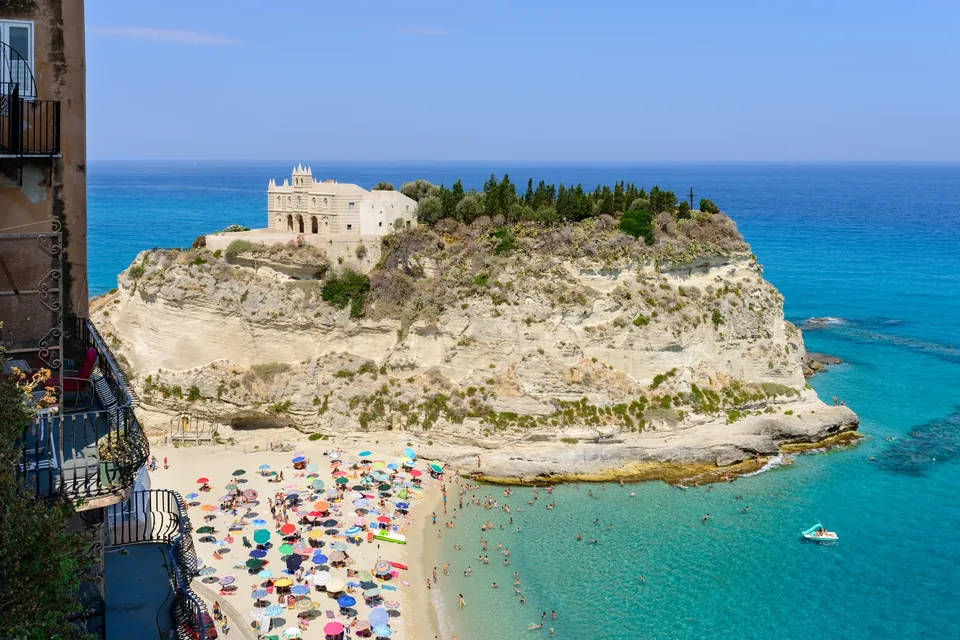
Slow Food, which has listed Spilinga 'nduja in its Ark of Taste, describes Spilinga as a small town on the slopes of Monte Poro and the best-known production centre of this sausage, which is made in all the villages around the Poro. The town council notes that the village name may come from Greek and refer to caves: there are many nearby, some bearing traces of hermits, such as the Madonna delle Fonti cave, perhaps originally a Basilian hermitage and now a sanctuary. Spilinga's history is tied to Tropea, of which it was a hamlet until 1807. On the summit of Monte Poro a small church is dedicated to Our Lady of Mount Carmel, celebrated on 16 July. Italia.it recommends climbing Monte Poro for sunset, with the sun dropping into the sea and the Aeolian Islands on the horizon.
Sources: Fondazione Slow Food — Arca del Gusto: 'Nduja di Spilinga · Comune di Spilinga — Spilinga · Italia.it — Vibo Valentia
Disputed origins
There is no single account of where 'nduja comes from, and Slow Food says so plainly. One theory links it to French andouille, a smoked sausage made from pig offal: the story goes that Joachim Murat, King of Naples in the early 19th century, gave andouilles to the Neapolitan people to win their favour. Another traces it to the cured meats brought by the Spanish who occupied these lands in the 16th century and also spread chilli from the Americas; the resemblance to sobrassada is clear, although, the same source notes, it may have been 'nduja that inspired Spanish butchers. On one point there is no doubt: 'nduja was born to use the humbler parts of the pig. In the past it was made mostly from rinds and offal; over time the recipe has become more refined.
Sources: Fondazione Slow Food — Arca del Gusto: 'Nduja di Spilinga
How it is made
According to the Slow Food sheet, 'nduja is now made mainly from secondary pork cuts: belly, cheek and trimmings of shoulder and leg. The meat is finely minced, traditionally by knife, a job once done by women. The cure uses little salt and a great deal of chilli, about 300 grams per kilo of meat, worked together with the fat for softness; the sheer amount of chilli makes preservatives unnecessary. The mixture rests for a few hours, then is stuffed into the caecum, giving the shapes called orbe, or into the crespone or muletta casings. The 'nduje were then smoked over resinous, aromatic woods for at least ten days, with ageing of at least a year. A good result needs meat from heavy pigs at least 14 months old; some producers use semi-wild Calabrian black pigs.
Sources: Fondazione Slow Food — Arca del Gusto: 'Nduja di Spilinga
The right chilli
'Nduja is first and foremost chilli. Slow Food explains that authentic 'nduja needs local chillies: the variety considered best is tri pizzi, though casalese is also used. They are grown locally, but not in sufficient quantity for all the butchers. These varieties were once grown by every family, even in pots on terraces; after picking, the stalk was pierced with a needle and, with sewing thread, strings were made to hang in the sun. In early December, at pig-killing time, they were taken down and ground for the cured meats. Today cultivation is recovering thanks to demand for 'nduja in Italy and abroad. The chilli, the sheet warns, must give intensity without masking the meat: this balance is what separates a good product from one that is merely hot.
Sources: Fondazione Slow Food — Arca del Gusto: 'Nduja di Spilinga
Protection: a process still open
'Nduja currently has no EU designation of origin. Slow Food reports that a group of Monte Poro producers has started the process to obtain one, aiming to protect the traditional recipe and the typical production area, which the sheet identifies as Spilinga and the other towns of Monte Poro in the province of Vibo Valentia. Meanwhile the name circulates freely and is used for products made far from Calabria, with very different recipes and ingredients. Italia.it, in its pages on the region, explicitly speaks of 'nduja di Spilinga as a soft, spicy spreadable salume, ideal on bread, on pizza and in sauces. For travellers, the reference to Monte Poro and Spilinga remains the simplest way to find their bearings among the many products sharing the same name.
Sources: Fondazione Slow Food — Arca del Gusto: 'Nduja di Spilinga · Italia.it — Calabria
Where to find it: the Costa degli Dei and beyond
Monte Poro overlooks the Costa degli Dei, the Tyrrhenian stretch italia.it describes from Nicotera to Pizzo, with Tropea and Capo Vaticano at its heart. For Capo Vaticano's cooking italia.it recommends maccheroni with 'nduja and filea, a homemade Vibo pasta of water and flour rolled on a stick of esparto grass. From Joppolo a sea-to-mountain path of about five kilometres climbs to a pine wood at 700 metres on Monte Poro. 'Nduja is found throughout the region, though: italia.it suggests it in Reggio Calabria as a first taste, spread on bread or used as a seasoning, and in Diamante, on the Cosenza coast, alongside chilli sauces. A trip can thus start from its home area and follow its traces along the coast, remembering that elsewhere it is a product that comes from here.
Sources: Italia.it — Capo Vaticano · Italia.it — Costa degli Dei · Italia.it — Reggio Calabria, guida · Italia.it — La terra del peperoncino
In the kitchen
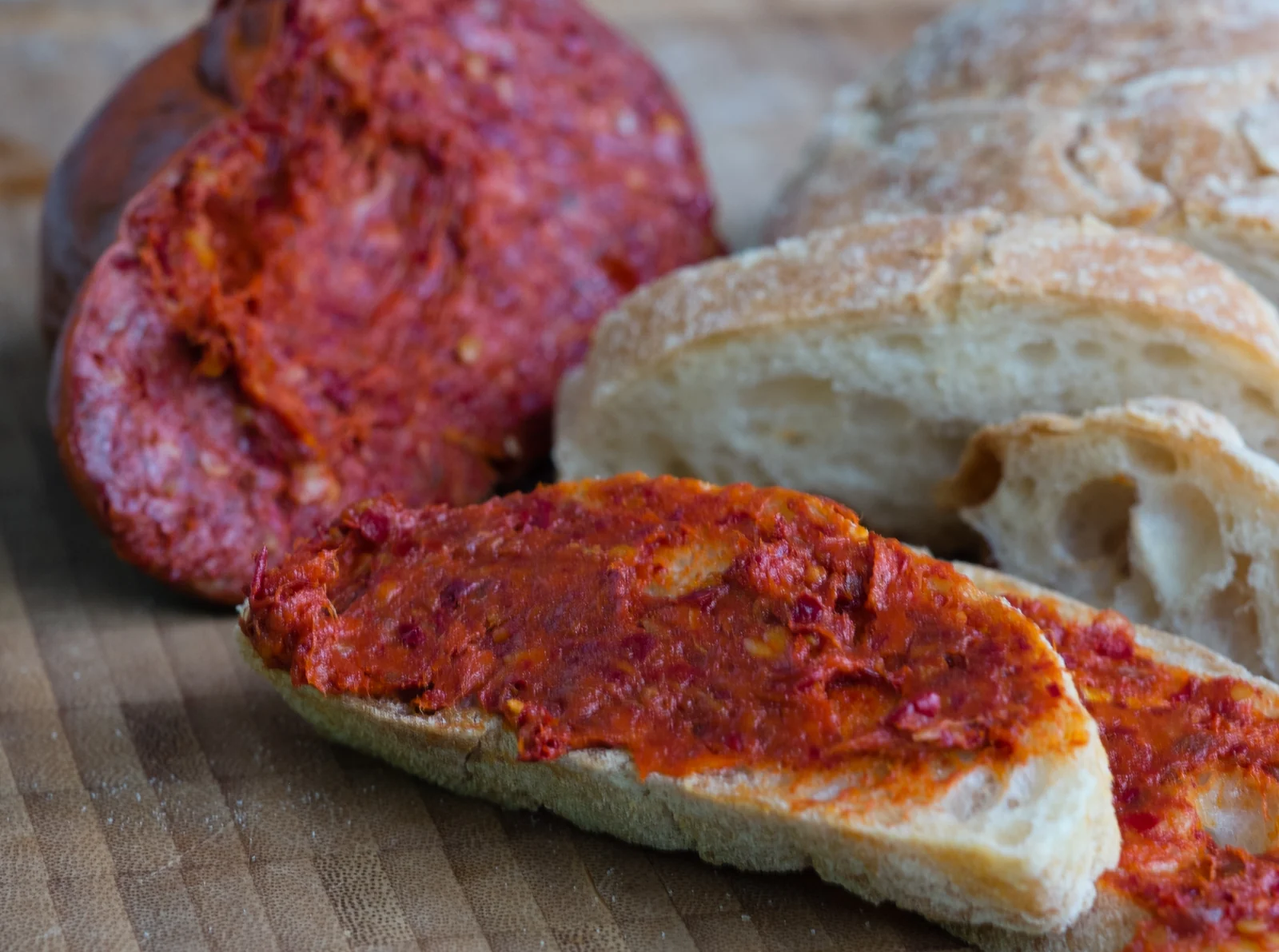
Slow Food lists the simplest uses: spread on crostini and bruschetta, to flavour sauces, top pizza, go with aged cheeses and give character to pulse dishes. In practice a little goes a long way. On a slice of still-warm toast 'nduja softens and releases all its aroma; in a tomato sauce a spoonful melted over low heat gives colour and heat to a whole dish of pasta. With an aged Calabrian pecorino the contrast of salt, fat and chilli is immediate. With beans or chickpeas, 'nduja replaces the soffritto. Those who dislike heat can start with tiny amounts, mixed into fresh ricotta. Avoid frying it over high heat: the fat burns and the chilli turns bitter.
Sources: Fondazione Slow Food — Arca del Gusto: 'Nduja di Spilinga
Buying it and taking it home
To find your way, read the label carefully: production area, ingredient list and whether there are preservatives and colourings tell a lot, because the traditional recipe is based on meat, fat, salt and chilli. Good 'nduja is bright but natural red, soft in texture, smelling of smoke and chilli, not just heat. Whole stuffed pieces travel well if kept cool; jars are handier for luggage but deserve the same care in choosing. Once opened, 'nduja should be kept in the fridge and eaten within a reasonable time. Buying in the Monte Poro villages lets you ask producers how they work: workshop visits must always be arranged in advance with operators.
Festivals and dates
Summer festivals in Spilinga are often mentioned in connection with 'nduja, but the official town council pages we checked show no events with confirmed dates, so we do not list any. On Monte Poro the most reliable calendar remains the religious one documented by the council: the feast of Our Lady of Mount Carmel on 16 July, at the small church on the summit, and the month of May devoted to the Madonna delle Fonti, a pilgrimage site. Summer visitors to the Costa degli Dei can still set aside an afternoon for the Poro villages, heading down to the sea at sunset. Before planning a day around a festival, always check on the council or pro loco website that the event is confirmed.
A thread for your journey
Journey idea: based in Tropea, a morning on the beaches of Capo Vaticano and an afternoon on Monte Poro, between Spilinga and the little church of Our Lady of Mount Carmel, with sunset over the Aeolian Islands; for dinner, maccheroni with 'nduja or filea with sauce. Visits to pork-curing workshops arranged with operators.
Talk to us