Why go
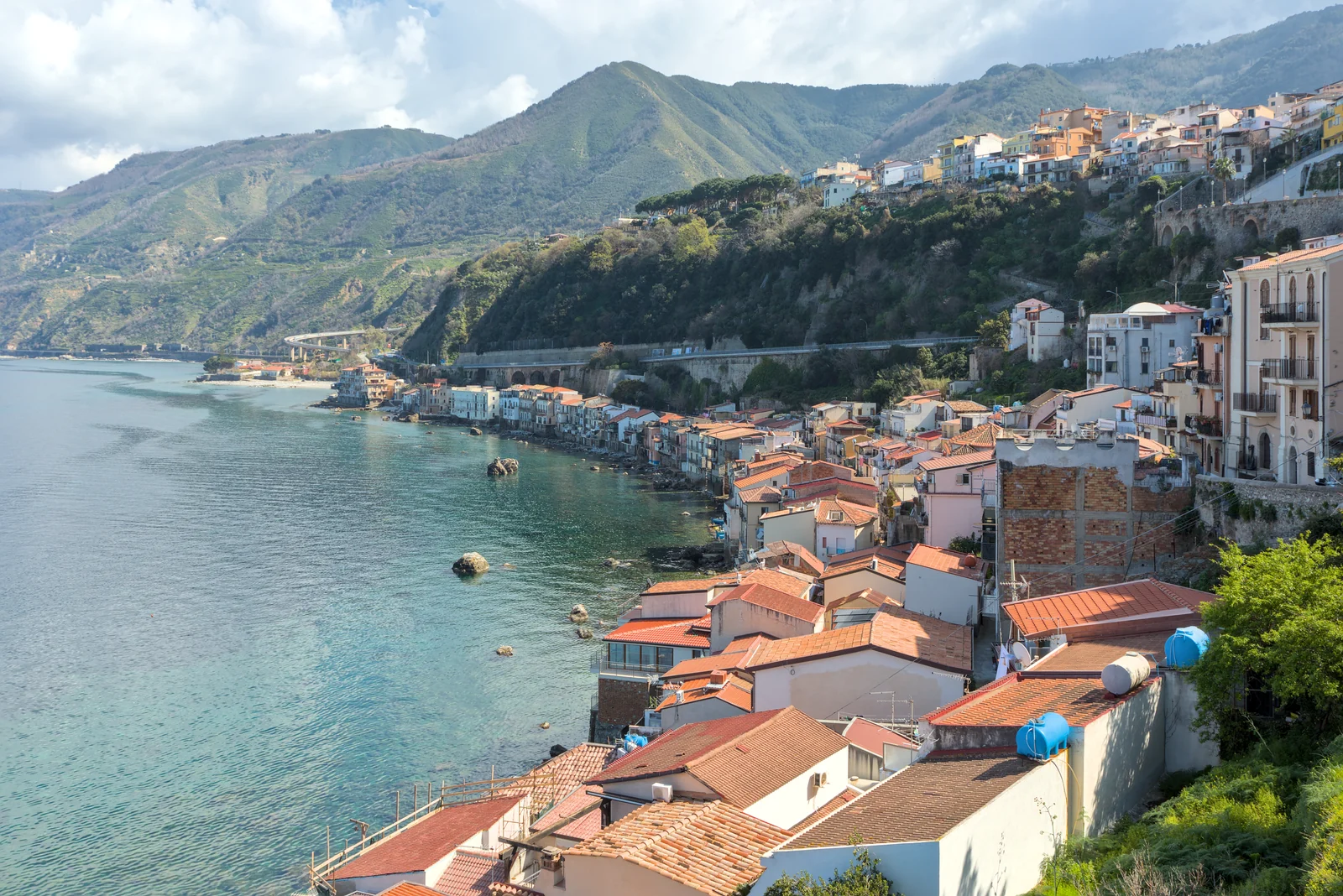
Scilla stands on a headland dropping sheer into the sea of the Costa Viola, the last stretch of Calabria’s Tyrrhenian coast before the Strait of Messina. It bears the name of the sea monster of Greek myth, the six-headed creature that terrified sailors, and the Homeric tale still seems to hang over the landscape: the rock with Castello Ruffo, the Chianalea houses rising from the water, the boats sheltered between the lanes.
It is a place to look at from the sea and from above. The Costa Viola owes its name to the colours sunset gives the water and sky; on the clearest days, the national portal notes, the two shores of the Strait mirror each other so sharply that they seem almost to touch, the phenomenon called Fata Morgana. From the castle and the Morselli viewpoint the view takes in the Strait and the town.
Above all, Scilla is a fishing village, tied for centuries to swordfish and tuna, with a simple cuisine that follows the sea. For travellers coming down the Calabrian Tyrrhenian from the north, it is the natural stop that closes the journey: two days are enough for Chianalea, the castle and a stretch of coast, with a sunset over the Strait.
Sources: Italia.it — Scilla · Italia.it — Chianalea di Scilla · Italia.it — Tour della Costa Viola in Calabria · Comune di Scilla — Marina Grande
History
The national portal notes that Greeks, Romans and then Normans all came to Scilla. The municipal page on Chianalea sums up a history of repeated destruction and rebirth: a first settlement linked to the legend of Trojan refugees, Vandal devastation, a Byzantine golden age with Basilian monks, Saracen raids between the 9th and 11th centuries and the arrival of the Normans in 1060. Under the Swabians the village traded profitably with the East and the Adriatic; Angevins and Aragonese followed.
Castello Ruffo is the thread of this story. The municipality describes it as a fortress of irregular plan, with parts from different periods, curtain walls, towers and loopholes; above the pointed stone portal are the Ruffo coat of arms and the plaque recording its 16th-century restoration. The residence, with large halls, belonged to one of the wealthiest families of the Kingdom of Naples. In 1523, according to the same source, Paolo Ruffo prevented Barbarossa from attacking the Chianalea coast.
Then came the earthquakes. The 1783 quake left the village in hardship until the Bourbons intervened in 1827, and in 1908 another earthquake struck the town. The church of the Spirito Santo, in Marina Grande, tells of this resilience: dating mostly from the mid-18th century and home since 1778 to the seafarers’ confraternity, it was hit by the earthquakes of the 19th and 20th centuries and each time restored thanks to the sailors’ devotion.
Sources: Italia.it — Scilla · Comune di Scilla — Chianalea · Comune di Scilla — Castello Ruffo · Comune di Scilla — Chiesa dello Spirito Santo
What to see
The castle rises on the headland separating the two beaches of Marina Grande and Chianalea. It is reached from Piazza Matrice along a ramp; inside, past the entrance bridge and the vaulted passage, a courtyard opens and a grand staircase climbs to the residence. Municipal sources note that the fortress also holds the Scilla lighthouse, run by the Navy, and that from the top the view reaches the Aeolian Islands.
Chianalea, the fishermen’s quarter, has about 350 inhabitants. Its name is said to come from “piano della galea” or “canalea”, after the narrow lanes that run down to the sea like canals between houses built on the rocks. You walk past fountains, the small harbour, the slipway where boats are hauled out to shelter from the waves, Villa Zagari in a 1930s eclectic style, and Palazzo Scategna with its three floors of stone balconies.
Marina Grande is the beach quarter, a long stretch of fine shingle between two rocky ridges along the Lungomare Cristoforo Colombo. Here are the railway station, the Baroque church of the Spirito Santo with altars in wood and polychrome marble and, on the southern ridge, the viewpoint dedicated to the writer Ercole Luigi Morselli. In the San Giorgio quarter, among colourful houses built against the rocks, stands the church of San Rocco, the town’s patron saint.
Sources: Comune di Scilla — Castello Ruffo · Comune di Scilla — Chianalea · Italia.it — Chianalea di Scilla · Comune di Scilla — Marina Grande · Comune di Scilla — Chiesa dello Spirito Santo · Italia.it — Scilla
Food and wine
In Scilla the cooking follows the sea. The signature product is swordfish, which the municipality calls an excellence of the Tyrrhenian coast: it is cooked simply, grilled or in a sauce for macaroni, so as not to mask its flavour. The national portal recalls that the Costa Viola villages have long been devoted to swordfish and tuna fishing, an ancient activity accompanied by rituals, songs and superstitions, which Vittorio De Seta documented in 1954 in the short film Lu tempu di li pisci spata. According to the same municipal source, fish dishes come with a white wine from local zibibbo grapes.
Not far from Scilla, the hamlet of Favazzina is known for the verdello lemon. A few kilometres along the coast, Bagnara Calabra is the only municipality where Torrone di Bagnara PGI is made: toasted almonds, honey, sugar, egg white, cocoa, spices and essential oils, in the martiniana version, coated in granulated sugar, or the cocoa-glazed torrefatto. The sources link the recipe to the monks of the Bagnara abbey as early as the 18th century, and the sweet remains tied to Christmas.
In the other direction, towards Reggio, Villa San Giovanni keeps its piparelle, almond, honey and spice biscuits sliced by hand very thin and baked a second time for hours, protected by a Slow Food presidium and made all year.
Sources: Comune di Scilla — Chianalea · Italia.it — Tour della Costa Viola in Calabria · Italia.it — Scilla · Qualigeo (Fondazione Qualivita) — Torrone di Bagnara IGP · Fondazione Slow Food — Presidio Piparelle di Villa San Giovanni
Things to do
The sea is best enjoyed by boat. The municipality notes that near the beaches several operators rent dinghies and small boats to explore the coves and see Scilla from a different angle; further out, the seabed suits snorkelling and diving. The national portal points to the Punta Pacì rocks as a snorkelling paradise and to the Marina Grande beach for a day by the sea.
On foot, you can climb from the village to the castle rock along lanes and paths through the greenery. For a longer outing, the Tremusa caves, at about 530 metres, are reached by trails starting from Scilla, Favazzina and Melia: the caves, with stalactites, stalagmites and fossil shells on the vault, open onto views of the Strait and the Costa Viola. The name is said to recall three statues of Muses, stolen during a raid according to myth.
The municipality devotes an initiative at Marina Grande to local small-scale fishing, “La pesca: ieri, oggi, domani”, aimed at protecting a community heritage. In the evening, wait for sunset: that is when sea and sky take on the colour that gave the Costa Viola its name. For film lovers, Scilla is one of the settings of the TV series Gente di mare.
Sources: Comune di Scilla — Chianalea · Italia.it — Scilla · Comune di Scilla — Le Grotte di Tremusa · Comune di Scilla — La pesca: ieri, oggi, domani · Italia.it — 10 motivi per scegliere il mare della Costa degli Dei d’inverno
When to go
Spring, summer and autumn are the best seasons for Scilla, each with its own appeal. In spring and autumn temperatures suit the trails to the Tremusa caves and the climb to the castle, and clear days are the most favourable for seeing the Sicilian shore of the Strait with the Fata Morgana effect.
Summer is the season for the sea: the Marina Grande beach, snorkelling at Punta Pacì and boat trips among the coves. It is also when the Costa Viola comes alive in nearby towns: on the last Sunday of August Palmi celebrates the Varia, the great shoulder-borne structure dedicated to Maria Santissima della Sacra Lettera, more than fifteen metres high and recognised as UNESCO intangible heritage.
Those travelling towards the end of the year find Bagnara nougat in its traditional season, tied to Christmas, while Villa San Giovanni piparelle are made all year. For the violet sunset that gives the coast its name, plan to be in Scilla towards evening, whatever the season. Castle visits and boat services vary with the period: check them beforehand.
Sources: Comune di Scilla — Le Grotte di Tremusa · Italia.it — Tour della Costa Viola in Calabria · Italia.it — Scilla · Qualigeo (Fondazione Qualivita) — Torrone di Bagnara IGP · Fondazione Slow Food — Presidio Piparelle di Villa San Giovanni · Comune di Scilla — Castello Ruffo
Getting there and around
Scilla has its own station on the RFI rail network, in the Marina Grande quarter, a few steps from the beach: it is the easiest way to arrive and to reach the village on foot. The SS18 road enters town from the south, coming from Reggio Calabria and Villa San Giovanni, and passes the Morselli viewpoint.
Ferries and hydrofoils for Sicily and the Aeolian Islands leave from the ports of Villa San Giovanni and Reggio Calabria: Scilla therefore also works as a stop before or after crossing the Strait. Palmi, further north on the Costa Viola, has a small marina useful for those sailing along Calabria.
Once there, you get around on foot. Marina Grande, the castle rock and Chianalea are close together, linked by streets, stairways and a lane climbing from the main church to the castle; the castle is reached from Piazza Matrice by a ramp. The municipality describes Chianalea as accessible to all, while for other places, such as the church of the Spirito Santo, accessibility information is limited and it is worth asking in advance.
Sources: RFI — Stazione di Scilla · Comune di Scilla — Marina Grande · Italia.it — Tour della Costa Viola in Calabria · Comune di Scilla — Castello Ruffo · Comune di Scilla — Chianalea · Comune di Scilla — Chiesa dello Spirito Santo
Nearby
Heading north along the Costa Viola you reach Favazzina, the hamlet of the verdello lemon and one of the starting points for the Tremusa caves, and then Bagnara Calabra, home of the PGI nougat. Palmi is the first town on the itinerary suggested by the national portal: the Casa della Cultura named after Leonida Repaci brings together an antiquarium with finds from the Tauriani archaeological park, the art gallery, the plaster-cast gallery and the museum devoted to Francesco Cilea; from Monte Sant’Elia and the Tre Croci viewpoint the view takes in the coast, Sicily and the Aeolian Islands.
To the south, Villa San Giovanni is the ferry port for Sicily and the home of piparelle; a little further on lies Reggio Calabria. Crossing the Strait opens the way to Messina and to the Aeolian Islands, reached by sea.
Travellers coming down the Tyrrhenian coast can combine Scilla with the Costa degli Dei: Tropea and Capo Vaticano, further north, complete an itinerary of seaside villages, headlands and sunsets, which the national portal also recalls as the setting of the TV series Gente di mare, filmed between Tropea, Pizzo, Capo Vaticano and Scilla.
Sources: Italia.it — Scilla · Comune di Scilla — Le Grotte di Tremusa · Qualigeo (Fondazione Qualivita) — Torrone di Bagnara IGP · Italia.it — Tour della Costa Viola in Calabria · Fondazione Slow Food — Presidio Piparelle di Villa San Giovanni · Italia.it — 10 motivi per scegliere il mare della Costa degli Dei d’inverno
Where to stay
In the municipality of Scilla the national database of the Ministry of Tourism lists 176 accommodation businesses with a verified CIN code: 4 hotels, 25 other licensed accommodation and 147 other types such as B&Bs and private rentals.
Sources: Ministero del Turismo – Banca Dati Strutture Ricettive (dashboard pubblica), 2026-10-12
YOUR JOURNEY
How to shape a journey here
Two days between Chianalea, the castle and a stretch of the Costa Viola, with a sunset over the Strait. Boat outings and accommodation to be arranged with local operators.
Talk to us about it