APULICA / Food guides
Tropea red onion: three shapes, three seasons, one coast
Tropea red onion is one of Calabria's best-known products in Italy and abroad: sweet, deep red outside and white within, it can even be eaten raw. Since 2008 the name Cipolla Rossa di Tropea Calabria has been a Protected Geographical Indication, tied to a stretch of the Tyrrhenian coast in the provinces of Vibo Valentia, Catanzaro and Cosenza. There is not just one Tropea onion, though: there are three local types and three ways of selling it, from spring onions to plaits for storage. This guide covers cultivation, history, the PGI rules, kitchen uses and the landscape of Tropea and Capo Vaticano.
Three types, three products
The Qualigeo profile explains that the PGI covers the bulb vegetable, fresh or dried, of the species Allium cepa, limited to three local types: Tonda piatta, early; Mezza campana, medium-early; and Allungata, late-ripening. There are three commercial types. Cipollotto and fresh-eating onion are sold green, in bunches, with the outer skin removed and the tops cut to between about 30 and 60 centimetres. The storage onion is sold dry, in plaits or nets. The onion is round or oval, with a red outer layer and white, fleshy concentric layers; it is notably sweet on the palate. For buyers on the spot, recognising the type helps you know how to use it and how long it will keep.
From sowing to plaits
According to Qualigeo, sowing starts in August, directly in the field, in nurseries or in cell trays, and seedlings are then transplanted. The harvest follows the three types: Tonda piatta is picked from mid-April to late May, Mezza campana from mid-May to mid-June, Allungata from mid-June to late July. Spring onions and fresh-eating onions are cleaned of their outer skin, trimmed and bunched. Storage onions instead dry in the field for at least seven days before being kept somewhere cool and dry. The same source attributes the quality to the meeting of three factors, genetic, climatic and soil-related, and argues that grown elsewhere the onion would not be as sweet. Italia.it links its sweetness to the climate and the nearness of the sea.
Sources: Qualigeo — Cipolla Rossa di Tropea Calabria IGP · Italia.it — Tropea
A history of sea and trade
The Qualigeo profile summarises the historical sources: the onion's introduction to the Mediterranean, and to Calabria in particular, is credited first to the Phoenicians and then to the Greeks. In the Middle Ages and Renaissance it was a staple food and an important part of the local economy, sold and shipped to Tunisia, Algeria and Greece. Travellers who reached Calabria in the 18th and 19th centuries wrote about Tropea's red onions, sweet and easy to digest, but cultivation spread more strongly only in the Bourbon period. Tropea itself, italia.it recalls, was already frequented in Roman times, became a bishopric in the 8th century and prospered under the Normans, Angevins and Aragonese; towers and walls, from the Torre Lunga to the Torre Maestra, were built to defend it from the sea.
Sources: Qualigeo — Cipolla Rossa di Tropea Calabria IGP · Italia.it — Tropea, gemma della Costa degli Dei · Italia.it — Tropea
The PGI and its area
The name Cipolla Rossa di Tropea Calabria is a PGI registered on 27 March 2008, as the Qualigeo record states. The production area, according to Qualigeo, covers the central-upper Tyrrhenian coast of Calabria and includes several towns in the provinces of Cosenza, Catanzaro and Vibo Valentia: not just Tropea, then, but a wider coastal strip. The product is overseen by a Protection Consortium. Italia.it notes that Calabria's EU-protected products include 13 PDOs and 7 PGIs, and among the PGIs lists Tropea red onion alongside Clementine di Calabria, Limone di Rocca Imperiale, Patata della Sila, Finocchio di Isola di Capo Rizzuto, Olio di Calabria and Torrone di Bagnara.
Sources: Qualigeo — Cipolla Rossa di Tropea Calabria IGP · Italia.it — Calabria, gastronomia e prodotti tipici
Tropea and the July festival
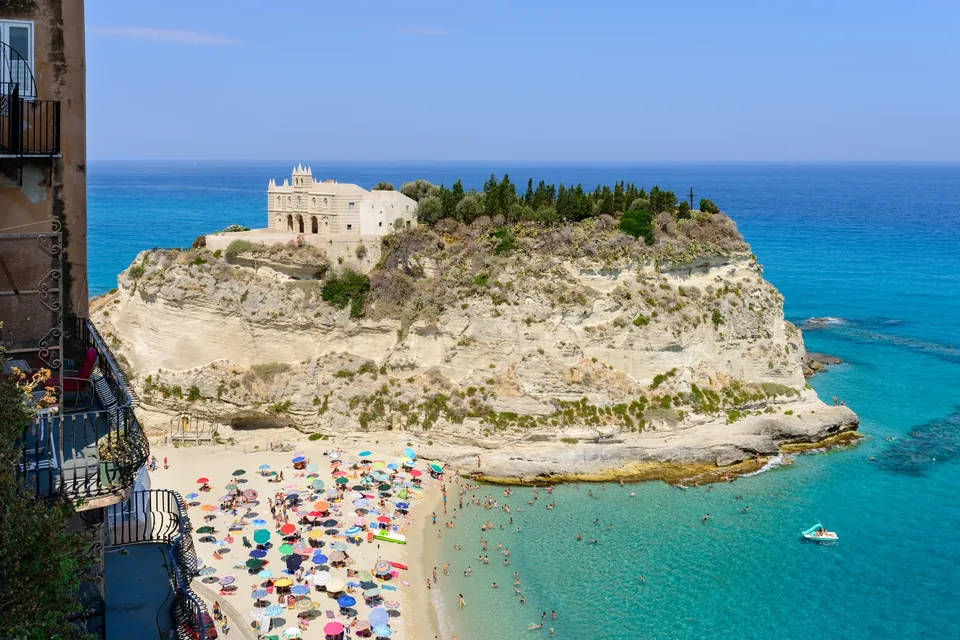
Italia.it describes Tropea as the jewel of the Costa degli Dei, in the province of Vibo Valentia. The old town holds the Norman-founded cathedral with its Gothic portals, 17th and 18th-century palazzi between via Boiano and largo Galluppi, the church of San Demetrio with a 14th-century chapel and, on a rock in front of the town, the Benedictine sanctuary of Santa Maria dell'Isola. Citrus groves, vineyards and olive groves surround the town, good for countryside outings. For the onion, the same source mentions a July festival of blue fish and Tropea red onion, which draws many visitors and serves numerous dishes made with both. Exact dates change every year and should be checked with the town council or organisers before travelling.
In the kitchen, raw and cooked
Qualigeo suggests many uses. Thanks to its sweetness the onion suits salads with other vegetables and cheeses; the green tops of fresh onions go into omelettes; dried onion is used mainly in sauces; small bulbs make good pickles. Tropea onions also go into jams and mostarda, paired with cheeses and meats, and a local starter, onion alla tropeana, browned in a pan with hot chillies and served on crostini. Italia.it, describing Capo Vaticano's cooking, places it alongside maccheroni with 'nduja and filea, the typical pasta of the Vibo area. The simplest way to understand it, though, is raw: thinly sliced with oil, salt and a ripe tomato, beside grilled blue fish.
Sources: Qualigeo — Cipolla Rossa di Tropea Calabria IGP · Italia.it — Capo Vaticano
Capo Vaticano and fields by the sea
The stretch of coast between Capo Vaticano, in the hamlet of San Nicolò di Ricadi, and Tropea is what italia.it calls the Costa degli Dei. The headland is white-grey granite, tuff cliffs and Mediterranean scrub, with old terraced vineyards held by dry-stone walls running down to the sea. The best-known beaches are Grotticelle, Torre Ruffa, Formicoli and Riaci; from the lighthouse at the top of the headland, sunset opens over Stromboli and the Aeolian Islands. The name Vaticano is said to recall the Latin vaticinium, oracle, from the legend of a cave where an oracle answered sailors. This farmed landscape facing the sea is where the red onion finds its context: in spring, from April to July, the fields tell the story of the harvest better than any shop.
Sources: Italia.it — Capo Vaticano
Buying it and taking it home
Plaits of storage onions are the classic souvenir, but choose them with a clear idea of when you will use them: according to Qualigeo, fresh onion lasts a few days and plaited onion a little over a month. Spring onions and fresh onions, lovely in spring bunches, are for eating on holiday or right after returning. To recognise the protected product, look on the label or tag for Cipolla Rossa di Tropea Calabria and the PGI reference: generic red onions presented as Tropea onions are also sold along the coast. By car, plaits travel well kept shaded and dry; by air, small packs or processed products such as jams and preserves are more practical. Visits to fields and packing centres must be arranged with operators.
A thread for your journey
Journey idea: two days in Tropea between late April and July. The first in the old town, with the cathedral and Santa Maria dell'Isola, and dinner with onion alla tropeana and blue fish; the second towards Capo Vaticano among beaches, terraces and fields, with sunset at the lighthouse. July travellers can match their stay with the festival. Field visits arranged with operators.
Talk to us