
APULICA / FRUIT, VEGETABLES AND PULSES
Cipolla Rossa di Tropea Calabria (red onion)
PGI · Fruit, vegetables and pulses · Calabria
In brief
- It covers three local ecotypes, from the early flat-round to the late elongated one, sold as spring onion, fresh onion and storage onion. (Qualigeo — Cipolla Rossa di Tropea Calabria IGP)
- It is grown in municipalities along the Tyrrhenian coast in the provinces of Cosenza, Catanzaro and Vibo Valentia. (Qualigeo — Cipolla Rossa di Tropea Calabria IGP)
- Harvest runs from mid-April to the end of July, depending on the ecotype. (Qualigeo — Cipolla Rossa di Tropea Calabria IGP)
- It has red outer skins, white flesh and a very sweet taste. (Qualigeo — Cipolla Rossa di Tropea Calabria IGP)
History and origin
The historical sources gathered by the Consortium and the Qualivita Foundation credit the Phoenicians, and then the Greeks, with bringing the onion to Calabria. From the Vibo area, helped by ancient landing places such as Parghelia, cultivation is said to have spread along the coast between Amantea and Capo Vaticano.
In the Middle Ages and the Renaissance it was an important food and a pillar of the local economy, shipped by sea to Tunisia, Algeria and Greece. Travellers of the eighteenth and nineteenth centuries praised its sweet, light taste; its wider spread came in the Bourbon period, when markets in northern Europe also asked for it.
The first organised statistics appear in the Reda agricultural encyclopaedia of the 1930s, and from the mid-twentieth century the onion reached markets across the ocean. Its qualities have earned it the name "Red gold of Calabria"; today it is protected as a Protected Geographical Indication under the name Cipolla Rossa di Tropea Calabria.
Sources: Consorzio di Tutela della Cipolla Rossa di Tropea Calabria IGP — La sua storia · Qualigeo — Cipolla Rossa di Tropea Calabria IGP · eAmbrosia — Cipolla Rossa di Tropea Calabria (PGI-IT-0369)
Area and method of production
The production area is a long stretch of Calabria's Tyrrhenian coast across three provinces: from Nicotera, in the Vibo area, through the Lamezia plain to the coast between Amantea and Fiumefreddo Bruzio, in Cosenza province. It includes, in whole or in part, municipalities such as Tropea, Ricadi, Spilinga, Parghelia, Pizzo, Lamezia Terme, Nocera Terinese, Amantea and Belmonte. The soils are sandy or medium-textured, deep and fertile, with a mild climate that the sea shields from sharp swings in temperature.
The specification admits three local ecotypes, told apart by shape and earliness: the flat round or early type, the half-bell or mid-early type and the elongated or late type. From August it is sown in the field or in nurseries and then transplanted; hand harvesting runs from mid-April to late May for the early type, from mid-May to mid-June for the half-bell and from mid-June to late July for the late one.
Storage onions are left to dry in the field for at least a week before being kept in cool, dry places.
Sources: ARSAC (Regione Calabria) — I prodotti DOP, IGP e PAT della Calabria · Consorzio di Tutela della Cipolla Rossa di Tropea Calabria IGP — Il territorio · Qualigeo — Cipolla Rossa di Tropea Calabria IGP · Consorzio di Tutela della Cipolla Rossa di Tropea Calabria IGP — Fasi di lavorazione
How to recognise it
The Cipolla Rossa di Tropea Calabria is round or ovoid depending on the ecotype, with red outer skins and fleshy white inner layers. On the palate it is very sweet, tender or crunchy according to type, and the Consortium links its colour to its richness in anthocyanins.
It is sold in three types. The spring onion, white-pink-purple, sweet and tender, is sold green in bunches; the onion for fresh use, white-red verging on purple, is also sold in bunches with its tops; the storage onion, red-purple, sweet and crunchy, comes dry, in braids or topped and packed in nets.
Between fresh, braided and dried, it can be found in every season. The fresh onion keeps only a few days, while braids last a little over a month.
Sources: Qualigeo — Cipolla Rossa di Tropea Calabria IGP · ARSAC (Regione Calabria) — I prodotti DOP, IGP e PAT della Calabria · Consorzio di Tutela della Cipolla Rossa di Tropea Calabria IGP — Caratteristiche · Consorzio di Tutela della Cipolla Rossa di Tropea Calabria IGP — Fasi di lavorazione
In the kitchen
Its sweetness makes it perfect raw: the traditional salad combines onion, tomato, extra virgin olive oil, salt and oregano, and it also pairs well with vegetables and cheese. The tops of the fresh onion go into omelettes, small bulbs become pickles, and the onion is made into jams and mustards to serve with cheese and meat.
A typical starter is onion alla tropeana, browned in a pan with hot chilli and served on toasted bread. The Consortium's recipe collection also suggests baked salt cod with onions and potatoes, onions stuffed with tuna and capers, sweet-and-sour baby onions and salads with beans and rocket.
ARSAC highlights the pairing with tuna and its ever wider use in sauces, caramelised dishes and preserves. In home cooking, the Consortium recalls, it was the base of every soffritto and of boiled meats.
Sources: ARSAC (Regione Calabria) — I prodotti DOP, IGP e PAT della Calabria · Qualigeo — Cipolla Rossa di Tropea Calabria IGP · Consorzio di Tutela della Cipolla Rossa di Tropea Calabria IGP — Le ricette
Where to taste it
The heart of production is the coast around Tropea, between Capo Vaticano, Ricadi, Parghelia and Zambrone, with sandy soils close to the sea, which the Consortium counts among the reasons for the onion's sweetness. In Tropea it can be found in every season in its different forms, from spring onions to braids.
The protected area continues north along the Gulf of Sant'Eufemia, through Pizzo, Lamezia Terme and Nocera Terinese, to the towns of the Cosenza coast such as Amantea and Belmonte Calabro: a Tyrrhenian route to follow in spring, when the early onions are harvested, or at the start of summer with the storage onions.
The protection consortium brings together growers, packers and processors across the area. The same coast offers other traditional foods of the Vibo area, such as the 'nduja of Spilinga, a town that also lies in the onion's production area.
Sources: Consorzio di Tutela della Cipolla Rossa di Tropea Calabria IGP — Il territorio · Consorzio di Tutela della Cipolla Rossa di Tropea Calabria IGP — Caratteristiche · Qualigeo — Cipolla Rossa di Tropea Calabria IGP · ARSAC (Regione Calabria) — I prodotti DOP, IGP e PAT della Calabria
Protection
- Protected geographical indication (PGI) — PGI-IT-0369 (eAmbrosia — Cipolla Rossa di Tropea Calabria (PGI-IT-0369))
When
- Harvest: April–July (Qualigeo — Cipolla Rossa di Tropea Calabria IGP)
- Spring
- Summer
Where
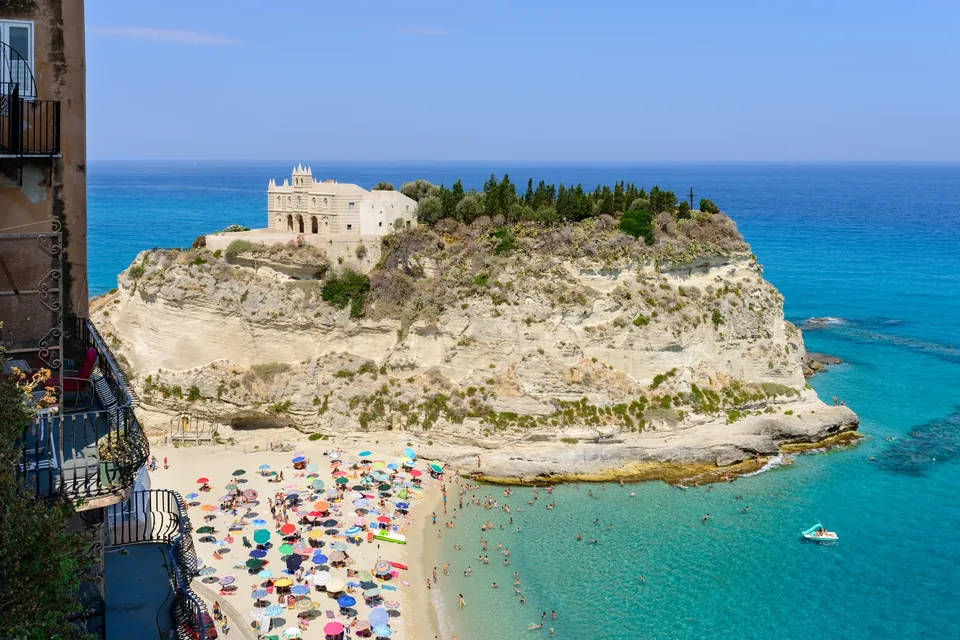
Tropea and Capo Vaticano
The clifftop town, the Tropea onion and the Capo Vaticano headland along the Costa degli Dei, on Calabria’s Tyrrhenian coast.
Read the guide →Photo: Norbert Nagel / Wikimedia Commons — CC BY-SA 3.0 · Resized and converted to WebP.

Read more
Cipolla Rossa di Tropea Calabria PGI
Spring onion, fresh onion and storage onion: the PGI of Calabria's Tyrrhenian coast explained with its calendar, history, kitchen uses, Tropea's July festival and a day between Capo Vaticano and the old town.
Read the guide →