APULICA / Food guides
Torrone di Bagnara: honey, almonds and open flame on the Costa Viola
Bagnara Calabra, on the Costa Viola north of Reggio Calabria, is known for swordfish and for a torrone unlike the soft ones of the North: crunchy, dark, with whole unpeeled almonds and a spicy finish. Since 2014 it has been a Protected Geographical Indication valid only for this town's territory. The guide follows the specification, from the torroniera kettle to hand cutting, then tells of the port from which shipments left and the link with a Calabrian Christmas.
A PGI born in 2014
The name Torrone di Bagnara was entered among Protected Geographical Indications by Commission Implementing Regulation (EU) No 882/2014 of 31 July 2014, after Italy's application was published in the EU Official Journal on 28 March 2014. The Ministry then published the specification in the Italian Official Gazette on 15 September 2014, in the category of bread, pastry, confectionery and biscuit products. The Protection Consortium, based in Bagnara Calabra, was recognised by a decree published in the Official Gazette on 16 May 2018. Qualigeo lists six certified operators and PGI output of a few thousand kilos a year, 3,251 in 2023: a small product, closely tied to a single town.
Sources: Regolamento di esecuzione (UE) n. 882/2014 della Commissione — iscrizione del Torrone di Bagnara (IGP) · Gazzetta Ufficiale n. 214 del 15 settembre 2014 — Disciplinare di produzione dell'IGP «Torrone di Bagnara» · Gazzetta Ufficiale — Riconoscimento del Consorzio di tutela del Torrone di Bagnara IGP (GU n. 112 del 16 maggio 2018) · Qualigeo (Fondazione Qualivita) — Torrone di Bagnara IGP
Martiniana and Torrefatto glassato
The specification describes a torrone made by cooking honey, sugar and toasted unpeeled almonds, with ground cinnamon and cloves. There are two versions, distinguished by their coating. Martiniana has a wrinkled brown surface, the so-called monk's cloak, covered with sugar grains. Torrefatto glassato is glossy, smooth and dark brown, coated with a mixture of sugar and bitter cocoa. The shape is a bar with rounded edges, 4 to 12 centimetres long and 1.5 to 2.5 wide and high, weighing between 14 and 35 grams. Inside, the paste is brown and full of almonds; the bite is crumbly and crunchy, and the sweetness is balanced by a clear brûlé note and a light spicy finish.
The recipe in numbers
For 100 kilos of product the specification sets about 40 kilos of sugar mass and 48 of sweet unpeeled almonds, with defined tolerances. The balance between sugar and honey changes: Martiniana uses about 35 kilos of granulated sugar and 5 of honey, Torrefatto glassato 10 of sugar and 30 of honey. The honey may be citrus, light wildflower or sulla. Cinnamon and cloves are added to taste; the glassato coating uses bitter cocoa with 22-24% cocoa butter. Egg white, vanillin and citrus essential oils are optional. The product contains no colourings or preservatives. The recipe leaves the makers room for skill, but fixes the ingredients and their weights precisely.
Open flame and the glassy break
The specification explains that the difference lies in the cooking. The sugar mass, with the almonds in the case of Martiniana, is cooked in a kettle over an open flame starting at 160-200 degrees, stirred until it takes on the monk's cloak colour; slow cooking follows, after which the mass, at room temperature, must snap under pressure like glass: this is the rottura vitrea, considered the product's hallmark. Other torroni, the text notes, are cooked in a bain-marie or at low temperatures. Spices are added and, for the glassato, toasted almonds; the paste is poured into moulds, cut by hand with a knife or by machine, dipped in sugar syrup cooked at 110-118 degrees and finished with sugar grains or cocoa.
The port, the spice shops and a trip round the world
According to the specification, the torrone grew out of the trade of Bagnara's seafaring community, which in the eighteenth century, with the opening of local spice shops, combined local almonds and honey with sugar and spices brought from elsewhere; Qualigeo adds the tradition of the abbey's monks making it then under the name martiniana. From 1846 torrone is explicitly mentioned as the speciality of a family of confectioners, and in the mid-nineteenth century the first true factory opened. In 1885 N. Marcone wrote, in his account of a journey in Calabria, that Bagnara's torroni travelled round the world. After the war many small firms formed a real district, with related trades that once included paper and crates for packing.
Sources: Gazzetta Ufficiale n. 214 del 15 settembre 2014 — Disciplinare di produzione dell'IGP «Torrone di Bagnara» · Qualigeo (Fondazione Qualivita) — Torrone di Bagnara IGP
Christmas, the Torrone Festival and the trade's words
The specification links the torrone to Christmas, among whose typical sweets it has traditionally featured, although today it is eaten all year; the 2014 text also mentions the Torrone Festival held in Bagnara at the end of November. For the current year's edition, check dates and programme with the town council. Old words survive in local usage: cotta for the hot, still shapeless torrone paste, torroniera for the makers' kettle, manto di monaco for the colour and rottura vitrea for the result of the cooking. Qualigeo suggests pairing it with a passito from Zibibbo grapes grown on the Costa Viola's terraces, called armacie.
Sources: Gazzetta Ufficiale n. 214 del 15 settembre 2014 — Disciplinare di produzione dell'IGP «Torrone di Bagnara» · Qualigeo (Fondazione Qualivita) — Torrone di Bagnara IGP
Bagnara and the Costa Viola
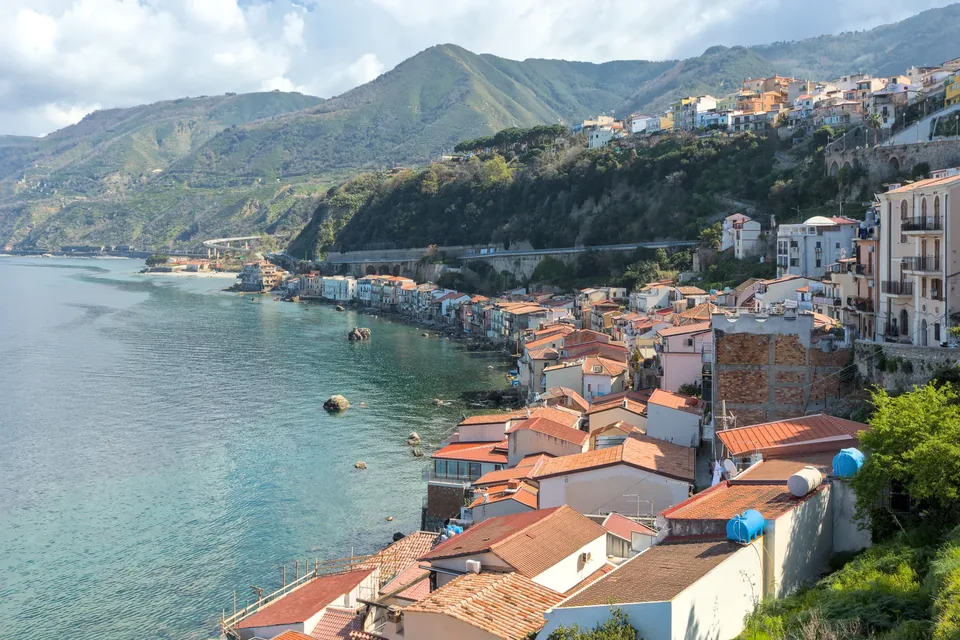
Italia.it presents Bagnara Calabra as a seaside town on the lower Tyrrhenian coast of Reggio, with its promenade facing the Strait and the old centre higher up. The name Costa Viola comes from a seaweed that colours this stretch of sea. The town is called the capital of Calabrian swordfish and produces, besides the PGI torrone, Costa Viola IGT wines. From the town before the 1908 earthquake survives the fifteenth-century Aragonese tower, also called Capo Rocchi; places to see include the Carmine church with its panoramic square, Castello Ruffo and the Marturano path, which leads from the castle hill back down to the harbour. According to the specification, the torrone's logo depicts the Rock of Bagnara above a siren.
Sources: Italia.it — Bagnara Calabra · Gazzetta Ufficiale n. 214 del 15 settembre 2014 — Disciplinare di produzione dell'IGP «Torrone di Bagnara»
Calabria's other torroni
Torrone di Bagnara is protected by a PGI, but it is not the region's only torrone. In the national list of traditional food products, under Calabria, there are also torrone a poglia with almonds, called turruni, peanut torrone with sugar and torrone gelato, the turruni gelatu. They are traditional products recognised by the Region, without a European specification, and show how deeply sweets of nuts and sugar are rooted in Calabrian festivities. For travellers it helps to know that the Bagnara name on a pack follows precise rules; the others are judged by look, taste and the word of those who make them.
Recognising it, tasting it, taking it home
Every piece sold as PGI is individually wrapped with the words Torrone di Bagnara, the term Protected Geographical Indication or the EU symbol, and the logo with the rock and siren: I would look for it on each wrapper, not just the box. When tasting, I would compare the two versions, first Martiniana then glassato, looking for a clean snap and the notes of caramel and spice. It is a sweet that suffers from humidity: Qualigeo gives a shelf life of a year and ideal eating within three months of packing, kept dry. Wrapped pieces travel well in a suitcase; I would keep them away from heat, because the cocoa glaze can melt.
Sources: Gazzetta Ufficiale n. 214 del 15 settembre 2014 — Disciplinare di produzione dell'IGP «Torrone di Bagnara» · Qualigeo (Fondazione Qualivita) — Torrone di Bagnara IGP
A thread for your journey
Journey idea: a day on the Costa Viola between Scilla and Bagnara Calabra, with the Marturano path, the Aragonese tower and a stop at a torrone workshop to be arranged with the operators; the most meaningful time is from late November to Christmas, when the sweet returns to the heart of the festivities.
Talk to us