APULICA / Food guides
Belmonte tomato: the oxheart that came back from America to the Cosenza coast
Belmonte Calabro is a small village on the Tyrrhenian coast of Cosenza, perched on a hill that looks like a ship with its bow towards the sea. Here grows a tomato with a curious history: it arrived from America in the early 20th century with an emigrant from the village and was kept by families for generations until it became a local symbol. It is large, pink and fleshy, so much so that it was once called the meat of the poor. This guide covers the Belmonte tomato, gammune, a cured ham that is a Slow Food Presidium in Belmonte, the village with its convent and the stretch of coast between Amantea, Belmonte and Fiumefreddo.
A tomato that came from America
Slow Food, which has listed the Belmonte tomato in its Ark of Taste, recounts that it was brought from America in the early 20th century by Belmonte emigrant Guglielmo Mercurio. Careful work by local growers has allowed it to survive in its pure form, and over time family selections have developed, seed lines kept and handed down by individual families. It shows how emigration, which deeply marked Calabria, also brought back seeds and know-how. The production area given by Slow Food is the municipality of Belmonte Calabro, in the province of Cosenza. For travellers, this means the tomato is found mainly here in the summer months, and its story is closely bound to the community that preserved it.
Sources: Fondazione Slow Food — Arca del Gusto: Pomodoro di Belmonte
Large, pink, fleshy
The Belmonte tomato is oxheart-shaped and very large: according to Slow Food it can reach a kilo and a half. It is pink, turning red when fully ripe. Cut into thick slices, it was once called the meat of the poor, because a single slice could serve as a main course. Slow Food also points out a concrete problem: the tomato is sold only on the local market and rarely leaves the province, so even a small change in output causes sharp price swings, to the detriment of small growers. The risk, the sheet says, is that a crop so tied to its territory might be abandoned. Tasting and buying it locally in season is therefore also a way to support those who grow it.
Sources: Fondazione Slow Food — Arca del Gusto: Pomodoro di Belmonte
Gammune, a Slow Food Presidium
Belmonte also has a rare cured meat. Slow Food describes gammune, made on the Belmonte hills since the 19th century and similar to culatello; the name may come from the Spanish jamón, or from the Calabrian gamma, leg. The pork leg is boned without damaging meat and sinews, leaving two fingers of fat; the meat is salted and flavoured with pepper sauce, once homemade, then stuffed into the pig's bladder or pleura. It weighs two to three and a half kilos and ages in village cellars for at least sixteen months, the sea breeze refining its maturation. The Presidium uses black pigs raised free-range in beech, chestnut and oak woods and slaughtered at sixteen months. Slow Food started it because the more complex Calabrian curing traditions are disappearing along with the craftsmen who know them.
Sources: Fondazione Slow Food — Presidio Gammune di Belmonte
The ship village and the Capuchin convent
Slow Food describes Belmonte Calabro as a village resting on the back of a rocky hill, at about 200 metres, like a ship with its bow reaching towards the sea. The town council tells the story of the Capuchin convent, built in 1606 by Maria Ravaschieri on land where Belmonte's green marble was quarried; the church is dedicated to St Joseph and became the burial place of the princes of Belmonte. The convent keeps its colonnaded atrium, the well in the middle of the cloister and a portico with two old sundials. The Capuchins promoted the cult of St Bonaventure, the town's patron, celebrated on 15 July. The convent was suppressed under Murat's decrees, briefly reopened and finally closed in 1872. In summer the village also uses an amphitheatre of about eight hundred seats for shows and concerts.
Sources: Fondazione Slow Food — Presidio Gammune di Belmonte · Comune di Belmonte Calabro — Convento dei Cappuccini · Comune di Belmonte Calabro — Anfiteatro
The sea between Amantea, Belmonte and Fiumefreddo
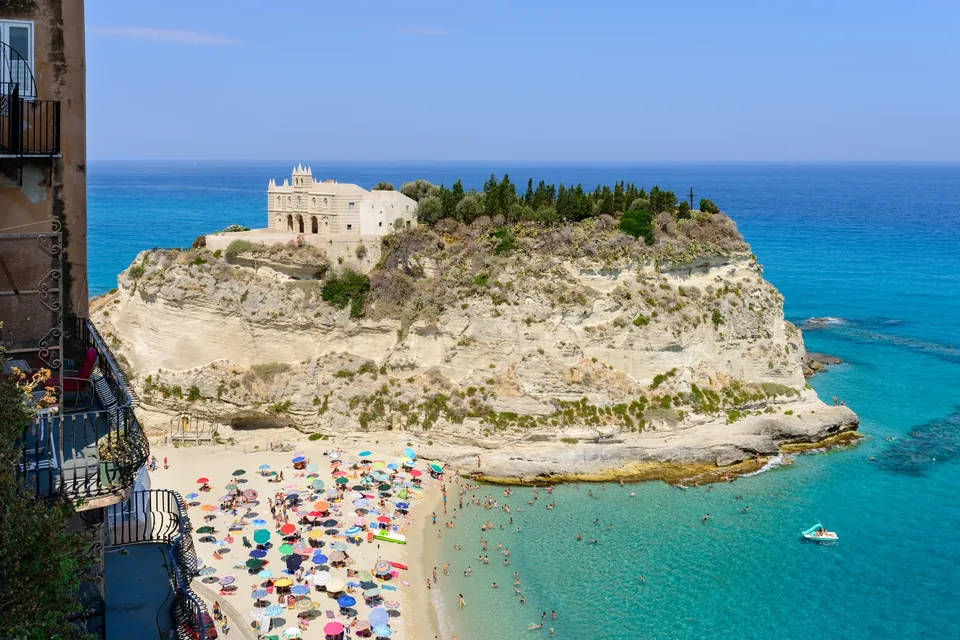
Italia.it, describing Calabria's Tyrrhenian coast, writes that one of the finest stretches of sea lies between Amantea and Belmonte: here are the two Isca rocks, where in 1991 WWF set up the protected area Oasi blu degli scogli di Isca, a favourite with divers. A little further north, Fiumefreddo Bruzio is described by italia.it as one of the oldest towns on the Tyrrhenian coast, with defensive walls largely intact, fortified gates and watchtowers, the nearby Abbey of Santa Maria di Fontelaurato and the remains of the 17th-century Alarcón Mendoza castle with frescoes by Salvatore Fiume; from the top of the village the view opens over the sea to the horizon. Between sea, hill villages and vegetable plots, it is a part of Calabria suited to a slow summer trip.
Sources: Italia.it — La costa tirrenica della Calabria · Italia.it — Fiumefreddo Bruzio
A network for small productions
The Belmonte tomato and gammune are part of a heritage of small productions that Calabria is trying to protect. The Calabria Region, together with Slow Food Italia and Slow Food Calabria, presented in Saracena, during the conference for the twentieth anniversary of the moscato al governo Presidium, the project Presidiamo la Calabria, created to protect small quality productions and give local farmers, breeders and fishers a leading role in their territories. A few kilometres from Belmonte, on the same coast, is another vegetable Presidium: the Longobardi violet aubergine, which Slow Food lists among local varieties threatened by depopulation and commercial hybrids. Together, Belmonte tomatoes and Longobardi aubergines tell the story of family farming made of saved seeds and homemade preserves.
Sources: Regione Calabria — Regione e Slow Food presentano a Saracena il progetto Presidiamo la Calabria · Fondazione Slow Food — Presidio Melanzana violetta di Longobardi
In the kitchen: the slice as a dish
A tomato like Belmonte's should be treated simply. The most direct version is the one that earned its nickname: a thick slice, salt, extra virgin olive oil, oregano and a piece of bread, perhaps with a fresh onion. It suits summer salads with cucumber and peppers, bruschetta with garlic and basil, or pasta with raw diced tomato left to infuse. Its fleshy pulp and thin skin make it better for eating fresh than for long cooking: for sauce, combine it with other more acidic tomatoes. Alongside, a few slices of gammune or another Calabrian cured meat and a glass of chilled white wine complete a summer lunch that tells the village's story in a few ingredients.
When to go and how to buy it
The Belmonte tomato is a summer product: the best time to find it is the height of salad-tomato season, in July and August, varying with the year. Since it is sold almost only locally, look for it in greengrocers in the village and nearby or directly from growers, with visits always arranged with operators. It is delicate and heavy, unsuited to long journeys: better eaten on the spot. Those wanting to take something home can choose locally made preserves, reading the label carefully. We found no official council source for a tomato festival with confirmed dates, so we do not list one; the feast of the patron St Bonaventure falls on 15 July.
A thread for your journey
Journey idea: a summer day on the Cosenza Tyrrhenian coast. Morning in Belmonte Calabro between the ship-shaped village and the Capuchin convent; lunch with a slice of Belmonte tomato, oil, oregano and local cured meats; afternoon by the sea towards the Isca rocks and sunset from the walls of Fiumefreddo Bruzio. Visits to vegetable plots arranged with operators.
Talk to us