
APULICA / Food guides
Provolone del Monaco: the Lattari Mountains cheese that travelled by sea
Provolone del Monaco is an aged stretched-curd cheese, a PDO since 2010, made in thirteen towns in the province of Naples between the Lattari Mountains and the Sorrento peninsula. Its name tells of a journey: cheesemakers took their provoloni to Naples by boat, at night, wrapped in cloaks like a friar's habit. Its raw material tells of an endangered breed, the Agerolese cow. This guide brings together history, rules, technique and a way to taste it slowly, between Agerola, Vico Equense and Sorrento.
Why it is called del Monaco
The specification tells how the name arose. In the early twentieth century 300 to 400 quintals of provolone a month left the Lattari Mountains; mainly aged cheeses were made because the market was nearby Naples, while for local farmers cheese was too expensive a food. With difficult land routes, the sea was the best road: the provoloni came down by mule to the beaches and left in the middle of the night on rowing boats. To shelter from the damp, the farmers turned traders wrapped themselves in large cloaks like a monk's habit; at the port market people began calling them the Monaco, and their cheese Provolone del Monaco. A Naples Chamber of Commerce guide gives the same account, with landings at dawn.
Sources: Disciplinare DOP Provolone del Monaco (Gazzetta Ufficiale n. 56 del 9 marzo 2010), pubblicato dal Consorzio di tutela · Camera di Commercio di Napoli — Le guide di Napoli: la Campagna (prodotti tipici)
Lactaria Montes and the Agerolese cow
According to the specification, cattle farming in the Lattari Mountains dates to 264 BC, when the Romans deported the Picentini here from the Marche; for the quantity and quality of their milk the mountains were named Lactaria Montes. Crosses with breeds brought in over the centuries, Bretonne, Brown Swiss, Jersey and Dutch Black Pied, produced the breed that since 1952, when its standard was presented to the Ministry of Agriculture, has been called Agerolese. The Consortium recalls that General Avitabile introduced Jersey cattle in 1845 and that in 2002 there were only 103 adults; today it estimates about 500 animals. The Slow Food Foundation lists it in the Ark of Taste: dark coat, dual purpose, considered endangered by FAO because of replacement crossing with the Friesian.
Sources: Disciplinare DOP Provolone del Monaco (Gazzetta Ufficiale n. 56 del 9 marzo 2010), pubblicato dal Consorzio di tutela · Consorzio di Tutela Provolone del Monaco DOP — Bovino di razza Agerolese · Fondazione Slow Food, Arca del Gusto — Vacca Agerolese
Thirteen towns and at least 20% Agerolese
The PDO has been registered since 10 February 2010. The Consortium lists the thirteen towns where the cows are raised and the cheese is made and aged: Agerola, Casola di Napoli, Castellammare di Stabia, Gragnano, Lettere, Massa Lubrense, Meta, Piano di Sorrento, Pimonte, Sant'Agnello, Sorrento, Santa Maria la Carità and Vico Equense. Only raw cow's milk is used; at least 20% must come from Agerolese cows, the rest from Friesian, Brown Swiss, Red Pied, Jersey and Podolica cows raised exclusively in the area. The Protection Consortium was founded in 2006 by breeders, cheesemakers and agers, and is based in Montechiaro, Vico Equense; Qualigeo lists 38 operators. The specification describes deep ravines, sharp changes in altitude and different microclimates even between neighbouring areas.
Sources: Qualigeo (Fondazione Qualivita) — Provolone del Monaco DOP · Consorzio di Tutela Provolone del Monaco DOP — Territorio · Disciplinare DOP Provolone del Monaco (Gazzetta Ufficiale n. 56 del 9 marzo 2010), pubblicato dal Consorzio di tutela
From curd to a six-sided cheese
Qualigeo summarises the technique. The milk coagulates in 40-60 minutes with kid rennet paste or natural liquid calf rennet; the curd is broken into grains the size of a maize kernel, rests, is heated to 48-52 degrees and rests again. Drawn from the whey and placed in hemp cloths or perforated baskets, it is cut into strips and stretched by hand in water at 85-95 degrees. The cheeses are firmed in cold water, salted in brine, tied in pairs and hung to dry for 10-20 days. Ageing lasts at least six months at 8-15 degrees, with only washing, mould cleaning and optional oiling with Penisola Sorrentina PDO extra virgin olive oil. The shape is elongated, like a melon or a pear without a head, with at least six faces; weight ranges from 2.5 to 8 kilos.
Sources: Qualigeo (Fondazione Qualivita) — Provolone del Monaco DOP
Milk from one milking and the wooden sassa
The Campania Region's page describes an old and laborious technique. Raw milk from a single milking, or at most two consecutive milkings, is curdled with kid rennet. The curd is broken into small grains with a wooden tool called a sassa, then scalded and stretched.
Stretching is the hardest stage: sometimes two people are needed to twist the paste. When it reaches the right texture it is shaped, like a pear or a cylinder, and the cheeses are tied in pairs with raffia, which leaves on the rind the light grooves that form the six faces. The pairs hang on wooden racks to dry and then age in cellars at 8-15 degrees.
The Region gives ageing times from 4 to 18 months, with the PDO requiring at least six, and notes that by nine months the cheese is at its best, while the rind darkens to the colour of ripe hazelnuts.
Sources: Regione Campania, Assessorato all'Agricoltura — Provolone del Monaco DOP · Qualigeo (Fondazione Qualivita) — Provolone del Monaco DOP
Sweet, buttery, then sharp
When cut, the paste is elastic, compact and even, with eyes up to 5 millimetres; the rind is thin, almost smooth and yellowish. Beyond seven or eight months the rind becomes yellower and thicker and the paste firmer. The flavour, Qualigeo writes, is sweet and buttery, with a pleasant sharp note that grows with ageing. The Naples Chamber of Commerce guide mentions aromas of milk and hay and ageing in caves and clefts of the Sorrento coast and Lattari Mountains, and recalls milk from pastures rich in aromatic herbs. The specification cites an 1878 report noting that some areas of the South had come to prefer the round provolone shape to the caciocavallo's; provolone production does not seem to predate the eighteenth century.
Sources: Qualigeo (Fondazione Qualivita) — Provolone del Monaco DOP · Camera di Commercio di Napoli — Le guide di Napoli: la Campagna (prodotti tipici) · Disciplinare DOP Provolone del Monaco (Gazzetta Ufficiale n. 56 del 9 marzo 2010), pubblicato dal Consorzio di tutela
Agerolese cows, fiordilatte and the cheeses of the Lattari
The Campania Region traces the breed's history. Cattle rearing on the Lattari Mountains dates back to the 3rd century BC, when the Picentini turned land cleared from the woods into pasture and fields. Under the Bourbons much work went into genetic improvement, and the soldier of fortune Avitabile, crossing mixed Brown and Podolica cattle with Jerseys, produced the animals from which the Agerolese descends. The first detailed description of the breed dates from 1909, by the veterinarian Mollo; the official standard came in 1952.
Today, the Region writes, the Agerolese is found only in the municipalities of Agerola and Gragnano. Its coat ranges from chestnut to black, with a ring of pale hair around the dark muzzle; yields are modest but the milk is of high quality, linked to pastures rich in aromatic herbs.
The same milk, blended, is also used for fiordilatte, scamorza and other stretched-curd cheeses of the area. The PDO, the Region notes, has also been a way of supporting livestock farming across the Lattari.
Sources: Regione Campania, Assessorato all'Agricoltura — Provolone del Monaco DOP · Consorzio di Tutela Provolone del Monaco DOP — Bovino di razza Agerolese
At the table and in Neapolitan cooking
Qualigeo advises keeping it in the fridge at no more than 8 degrees and notes that it goes into many Neapolitan recipes as well as being enjoyed as a table cheese. The suggested pairing is Penisola Sorrentina PDO red wine, especially with older cheeses. It is available all year, whole or in portions, including vacuum-packed or in protective atmosphere.
The Campania Region cites pasta e patate, a humble dish that with a little Provolone del Monaco, grated or in thin shavings, becomes full of aroma; it also notes that the cheese is at its best in antipasti and at the end of a meal. In its Pasta di Gragnano PGI profile, Qualigeo suggests mezzi rigatoni with cauliflower, sun-dried tomatoes and shavings of Provolone del Monaco PDO.
That dish combines two protected products of the same Lattari Mountains, since Gragnano is also one of the PDO towns: a good excuse to taste them on the same trip.
Sources: Qualigeo (Fondazione Qualivita) — Provolone del Monaco DOP · Regione Campania, Assessorato all'Agricoltura — Provolone del Monaco DOP · Qualigeo (Fondazione Qualivita) — Pasta di Gragnano IGP · Consorzio di Tutela Provolone del Monaco DOP — Territorio
A day in the Lattari Mountains
I would arrange the tasting up in the hills, in Agerola or above Vico Equense, where the Agerolese cow's story becomes visible in the pastures. I would ask to compare two ages, one of six or seven months and a longer one, to taste how sweetness gives way to sharpness and how the colour of the rind changes.
A visit to a dairy or ageing room must be arranged with the operators; it is worth it even just to see the cheeses tied in pairs and hanging. The road climbing from the Amalfi Coast to Agerola and down towards the Sorrento peninsula turns the day into a journey between two seas.
When buying, the full PDO name on the label is the first guarantee: provolone is a name shared by many cheeses. A vacuum-packed piece travels well if kept cool; a whole cheese, heavy as it is, makes sense only if you are driving home.
A thread for your journey
Journey idea: a day in the Lattari Mountains, climbing to Agerola from the Amalfi Coast and descending towards Vico Equense and Sorrento, with a dairy or ageing-room visit to be arranged with the operators and lunch of Gragnano pasta with shavings of aged provolone.
Talk to us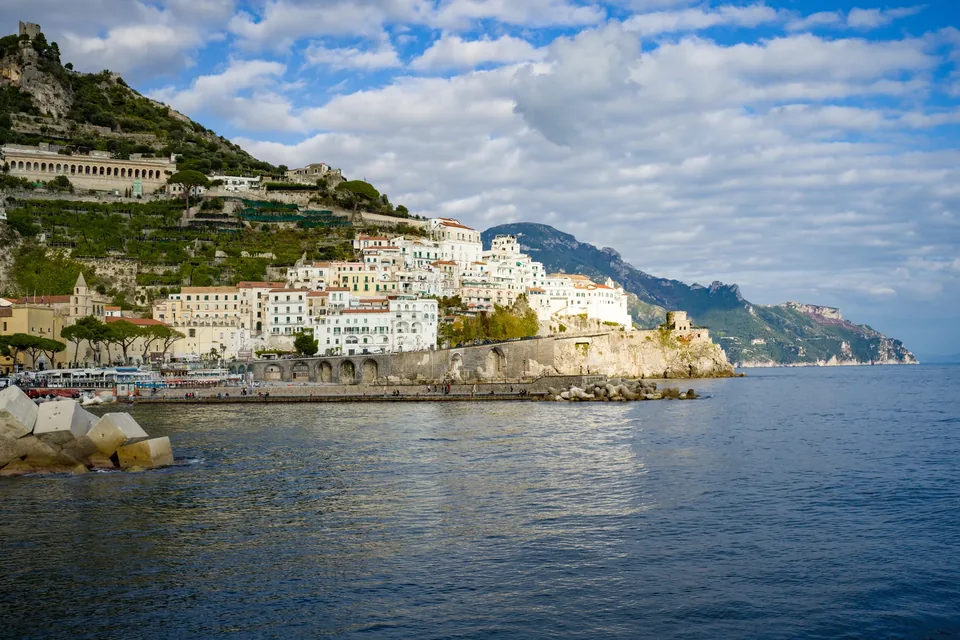


,_East_view.jpg)