
APULICA / OILS AND FATS
Dauno extra virgin olive oil
PDO · Oils and fats · Puglia
In brief
- Extra virgin oil from Peranzana, Coratina, Ogliarola garganica and Rotondella, always labelled with one sub-area: Alto Tavoliere, Basso Tavoliere, Gargano or Subappennino. (Qualigeo (Fondazione Qualivita) — Dauno DOP)
- It is made in many towns in the province of Foggia. (Qualigeo (Fondazione Qualivita) — Dauno DOP)
- The olives are picked from the tree by 30 January and milled within three days. (Qualigeo (Fondazione Qualivita) — Dauno DOP)
History and origin
In the province of Foggia, the land that gives Dauno oil its name, the olive tree has very ancient roots: its presence is documented since prehistory and it is one of the features that shape the landscape. Organised olive growing dates back to Roman times and has developed over the centuries into a commercial activity that is still among the most important in the area.
The Protected Designation of Origin Dauno, registered in the European Union and entrusted to a protection consortium, tells the story of this variety of landscapes through four geographical mentions: Alto Tavoliere, Basso Tavoliere, Gargano and Subappennino. Each corresponds to a different area and a different mix of olive varieties, so that one designation yields four oils with characters of their own.
Sources: Qualigeo (Fondazione Qualivita) — Dauno DOP · eAmbrosia — Dauno (PDO-IT-1517)
Area and method of production
The area of production and processing extends over many municipalities in the province of Foggia; bottling may take place anywhere in the province. The permitted varieties are Peranzana, also called Provenzale, Coratina, Ogliarola garganica and Rotondella, and the name Dauno must always be accompanied by one of the four mentions.
Each mention has its leading variety: Alto Tavoliere at least 80% Peranzana, Basso Tavoliere at least 70% Coratina, Gargano at least 70% Ogliarola garganica, Subappennino at least 70% from Ogliarola garganica, Coratina and Rotondella.
The olives are picked straight from the tree by 30 January and must be made into oil within three days of harvest.
How to recognise it
All four mentions range in colour from green to yellow, but the profile changes. Alto Tavoliere has a medium fruitiness with notes of fresh fruit and sweet almond. Basso Tavoliere, made mainly from Coratina, is fruity with slight bitterness and pungency. Gargano has a medium fruitiness with grassy hints and an almond finish. Subappennino combines a medium fruitiness with aromas of fresh fruit.
The specification sets a maximum acidity of 0.6 grams per 100 grams, a panel test score of at least 6.5 and at least 100 ppm of total polyphenols. The oil is sold in glass or tin up to five litres; the label shows the name with the sub-zone, the European symbol and the year, and each bottle carries a unique code for traceability.
In the kitchen
The designation's record describes Dauno as a very versatile oil, suited both to raw use and as an ingredient in many recipes. The four mentions offer different profiles to choose from at the table: the fresh fruit and sweet almond of Alto Tavoliere, the slight bitterness and pungency of Basso Tavoliere, the grassy notes and almond finish of Gargano, the fresh fruit of Subappennino.
Like every extra virgin oil, it should be protected from light and heat and kept in a cool place. To enjoy it at its most aromatic it is best used within four to six months of pressing.
Where to taste it
The best way to get to know Dauno is to follow its four mentions, which are also four landscapes of the province of Foggia. The Gargano gives its name to the Ogliarola garganica oil. The Tavoliere is split between the Alto Tavoliere of Peranzana and the Basso Tavoliere of Coratina. The Subappennino, where Ogliarola garganica joins Coratina and Rotondella, completes the designation.
Visitors to the Gargano, or anyone crossing the Foggia area during the harvest that ends in late January, meet the oil in its home territory, where it is produced and processed.
Protection
- Protected designation of origin (PDO) — PDO-IT-1517 (eAmbrosia — Dauno (PDO-IT-1517))
When
- The sources consulted give no months.
Where

Gargano
Gargano: villages, woodland and coast.
Read the guide →Photo: Bernard Gagnon / Wikimedia Commons — CC0 · Resized and converted to WebP.

Read more
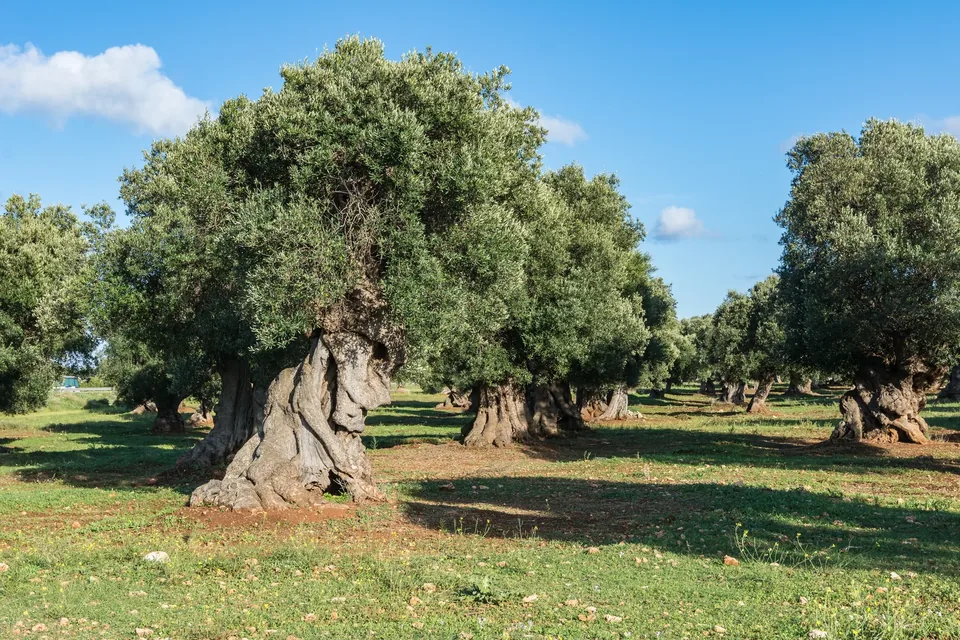
Puglian Ogliarola olives
Barese, Garganica and Salentina Ogliarola: understanding olive names and their regional connections.
Read the guide →Photo: Isiwal / Wikimedia Commons — CC BY-SA 4.0 · Resized and converted to WebP.
