
APULICA / OILS AND FATS
Terra d'Otranto extra virgin olive oil
PDO · Oils and fats · Puglia
In brief
- Extra virgin oil from at least 60% Cellina di Nardò, Ogliarola leccese, Leccino and other listed varieties. (Qualigeo (Fondazione Qualivita) — Terra d'Otranto DOP)
- The area covers the whole province of Lecce and several towns in the provinces of Taranto and Brindisi. (Qualigeo (Fondazione Qualivita) — Terra d'Otranto DOP)
- The olives must be harvested by 15 November. (Qualigeo (Fondazione Qualivita) — Terra d'Otranto DOP)
- The olive tree spread across Salento with the Messapians, in the fifth and fourth centuries BC. (Qualigeo (Fondazione Qualivita) — Terra d'Otranto DOP)
History and origin
In the Salento the olive tree has been present since prehistory, but its great spread is owed to the Messapians, between the fifth and fourth centuries BC. In the centuries that followed, olive growing drew on the experience of the Phoenicians, Greeks and Romans.
The oil trade began in the Middle Ages through the Basilian monks, followers of Saint Basil, who are also credited with the name Terra d'Otranto for the area that curves from the Murge to the meeting point of the Ionian and Adriatic seas. In the Renaissance the oil of this land was so prized that it was exported as far as the borders of the Ottoman Empire.
Today the Protected Designation of Origin Terra d'Otranto, registered in the European Union and entrusted to a protection consortium, has a renewed specification that supports the revival of Salento olive growing.
Sources: Qualigeo (Fondazione Qualivita) — Terra d'Otranto DOP · eAmbrosia — Terra d'Otranto (PDO-IT-1519)
Area and method of production
The area of production, processing and bottling covers the whole province of Lecce and the territory of several municipalities in the provinces of Taranto and Brindisi.
The specification requires at least 60% of the olives to come from the varieties Cellina di Nardò, Ogliarola, known locally as leccese or salentina, Leccino, FS17, Lecciana and Leccio del Corno, alone or together; other varieties in the groves may make up to 40%.
Harvest must end by 15 November, a choice that favours olives at the right stage of ripeness. Yield may not exceed 15 tonnes per hectare, the olives must be milled within a day of picking and the oil yield may not exceed 20%.
Sources: Qualigeo (Fondazione Qualivita) — Terra d'Otranto DOP
How to recognise it
Terra d'Otranto PDO oil is green or yellow with light green glints. The aroma is a medium fruitiness of olives at the right ripeness, and in the mouth too the fruitiness is medium, with slight bitterness and pungency.
To these traits are added sensations that vary with the time of harvest and the dominant variety: olive leaf, freshly cut grass, cardoon, artichoke, chicory, tomato, berries.
The specification sets a maximum acidity of 0.35 grams per 100 grams, a very low value. The oil is sold in containers of up to three litres; the label shows the year the olives were grown and the words Terra d'Otranto, and a seal with a unique code guarantees traceability.
Sources: Qualigeo (Fondazione Qualivita) — Terra d'Otranto DOP
In the kitchen
Its intensely aromatic taste makes Terra d'Otranto ideal for dressing durum wheat pasta dishes, boiled vegetables and pulses. It is also excellent on main courses of both meat and fish.
Like every extra virgin oil it fears light and heat: it should be kept in a cool place, between 14 and 18 degrees, away from strong-smelling products. To enjoy all its aromas it is best used within four to six months of pressing, when the notes of grass, artichoke and tomato are at their clearest.
Sources: Qualigeo (Fondazione Qualivita) — Terra d'Otranto DOP
Where to taste it
Terra d'Otranto largely coincides with the Salento: the whole province of Lecce is part of the designation, together with part of the territories of Taranto and Brindisi. Lecce is the natural starting point for getting to know the landscape of olive groves that surrounds the city and stretches to both seas.
Nardò gives its name to Cellina, one of the main varieties of the designation, a reminder of how closely the oil is tied to its places. The harvest, which the specification closes by mid-November, makes autumn the season when the new Terra d'Otranto oil is made.
Sources: Qualigeo (Fondazione Qualivita) — Terra d'Otranto DOP
Protection
- Protected designation of origin (PDO) — PDO-IT-1519 (eAmbrosia — Terra d'Otranto (PDO-IT-1519))
When
- The sources consulted give no months.
Where
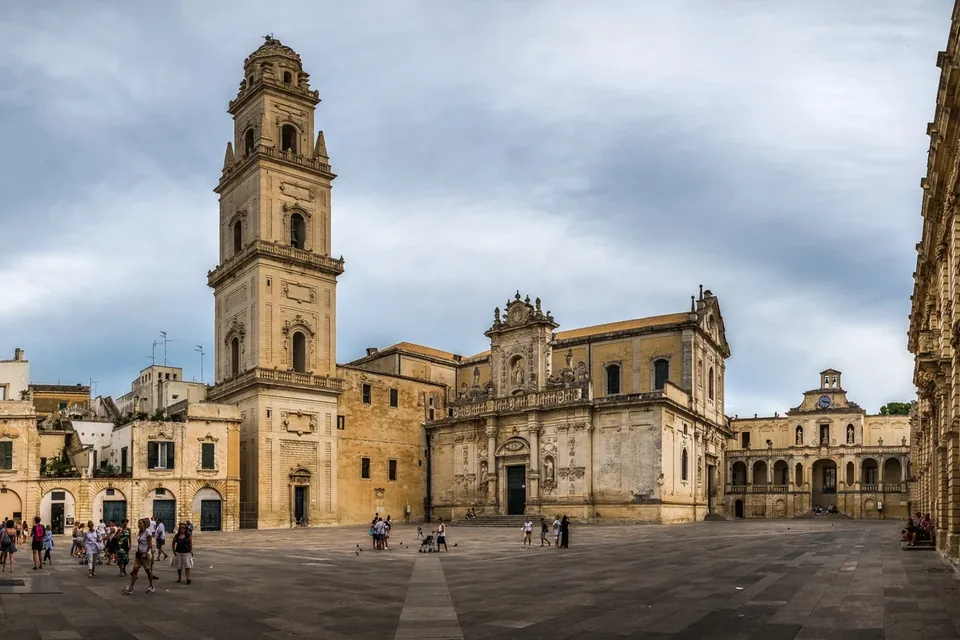
Lecce
Baroque architecture, papier-mâché and Salento food: a city of telling details.
Read the guide →Photo: Giuseppe Milo / Wikimedia Commons — CC BY 3.0 · Resized and converted to WebP.
.jpeg)
Read more
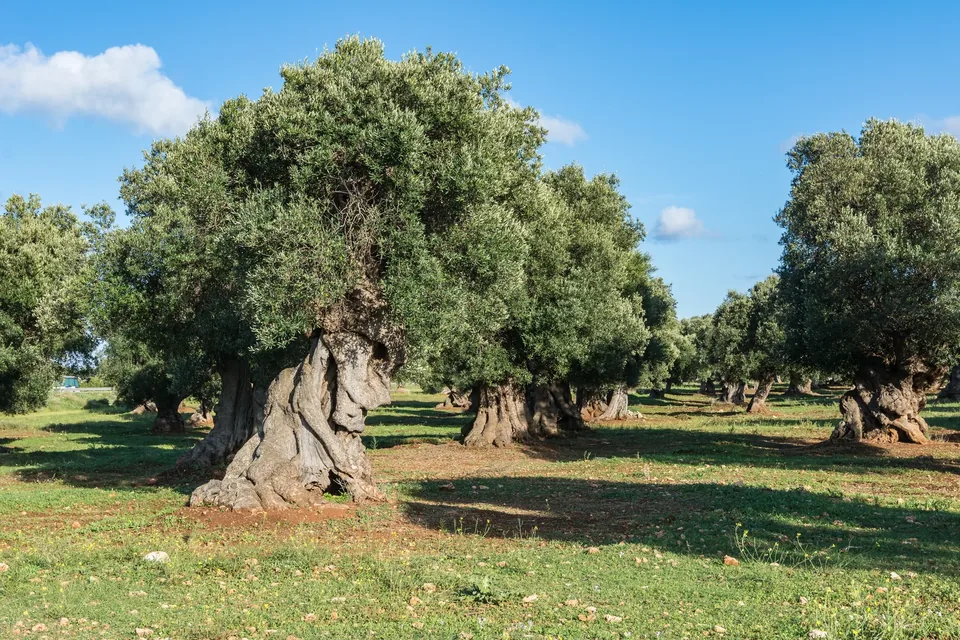
Puglian Ogliarola olives
Barese, Garganica and Salentina Ogliarola: understanding olive names and their regional connections.
Read the guide →Photo: Isiwal / Wikimedia Commons — CC BY-SA 4.0 · Resized and converted to WebP.
