
APULICA / FISH AND SEAFOOD
Taranto black mussel
PAT · Slow Food Presidium · Fish and seafood · Puglia
In brief
- A mussel farmed mainly in Taranto's Mar Piccolo, where undersea freshwater springs, the citri, shape its flavour and texture. (Atlante dei PAT di Puglia (Regione Puglia, Università di Bari) — Cozza tarantina)
- The Mar Piccolo is divided into piscarie, plots of water assigned to individual farmers and fenced by wooden poles driven into the seabed. (Fondazione Slow Food — Presidio Cozza nera di Taranto)
- About twelve to sixteen months pass between the larvae settling and the mussels going on sale. (Fondazione Slow Food — Presidio Cozza nera di Taranto)
- The Presidium was launched at the regional agriculture department, and its technical rules use compostable nets instead of plastic ones. (Regione Puglia — Presentato il Presidio Slow Food della cozza nera tarantina)
- According to Slow Food, the Presidium's mussels are on sale in spring and summer. (Fondazione Slow Food — Presidio Cozza nera di Taranto)
History and origin
In Taranto shellfish have been farmed since very early times. According to Slow Food, oyster farming was already flourishing in the late Roman period and in the Middle Ages, helped by the low salinity of the Mar Piccolo, and the first documents mentioning "black mussels" date from 1525. The Libro Rosso, the city's collection of rules, set limits to protect the coastal lagoons from overexploitation; the regional profile of traditional products also cites sixteenth- and seventeenth-century writers who describe mussel farming as an important source of income.
In the nineteenth century Taranto's mussels were shown at international exhibitions, and Taranto's mussel farmers set the example for other parts of Italy. Then came difficult decades for the Mar Piccolo environment; after the recovery work, in 2019 its waters obtained the "A" classification, which allows the mussels to be sold without going through purification.
The Taranto mussel has been on the national list of traditional food products since 2005. The Slow Food Presidium, presented at the regional agriculture department, brings dozens of mussel farmers together around shared production rules, the result of the ReMar Piccolo project run by the City of Taranto with Slow Food Puglia.
Sources: Fondazione Slow Food — Presidio Cozza nera di Taranto · Atlante dei PAT di Puglia (Regione Puglia, Università di Bari) — Cozza tarantina · Masaf — Elenco nazionale dei prodotti agroalimentari tradizionali, XXVI revisione (2026) · Regione Puglia — Presentato il Presidio Slow Food della cozza nera tarantina
Area and method of production
The mussels grow mainly in the Mar Piccolo, the inner bay closed off by the port of Taranto, where underwater freshwater springs, the citri, well up. The water is still divided into piscarie, plots assigned to individual farmers and marked by wooden posts driven into the seabed, linked underwater by plant-fibre ropes. In recent decades floating long-line systems have joined the traditional post-based farms.
The cycle begins with collecting the seed. The larvae settle on mats and ropes hung near the surface; in spring the ropes turn black with tiny mussels, and in April they are cut and hung from the lines of the farm, inside squares formed by four posts. Over the following months the mussels are thinned and the ropes are aired: every 40 to 50 days they are left out of the water for 24 hours to free the shells from the organisms that cling to them.
Twelve to sixteen months after the larvae settle, the mussels are ready. The Presidium's rules call for sustainable, traceable methods and use compostable nets instead of plastic ones, which often end up on beaches.
Sources: Atlante dei PAT di Puglia (Regione Puglia, Università di Bari) — Cozza tarantina · Fondazione Slow Food — Presidio Cozza nera di Taranto · Regione Puglia — Presentato il Presidio Slow Food della cozza nera tarantina
How to recognise it
The black mussel of Taranto belongs to the species Mytilus galloprovincialis. Slow Food describes an almost square shape, two shells 5 to 8 centimetres long of a glossy violet-black, a ridged shell, a curved umbo and a rounded rear edge. It can reach 11 centimetres, but the usual commercial size is about 6.
Inside, the shells are a pearly violet that varies with the breeding cycle and sex. The mollusc, wrapped in its mantle, ranges from white to pink, with a full, sweet taste.
That sweetness and firm texture are put down to the citri, the freshwater currents that mix with the salt water of the Mar Piccolo and lower its salinity, creating conditions in which the mussels grow quickly.
Sources: Fondazione Slow Food — Presidio Cozza nera di Taranto · Atlante dei PAT di Puglia (Regione Puglia, Università di Bari) — Cozza tarantina
In the kitchen
Mussels are one of the pillars of Apulian seafood cooking, and the regional list of traditional products records two classic dishes. Spaghetti with mussels is made in at least two ways: with tomato, which softens the brininess of the shellfish, or without, with garlic, chilli and parsley, where the taste of the sea comes first. Apulian cookbooks also record the debate between those who add the mussels raw to the sauce and those who open them first in the pan.
The other is the oven-baked dish of potatoes, rice and mussels, the tiella: layers of onions, tomatoes, pecorino, potatoes and rice, with mussels opened raw in the middle, covered with water and baked until the rice is done. It is also served warm and is a common dish in the region's trattorias and farm restaurants.
To clean black mussels, rinse them under running water, remove any encrustations and pull away the byssus, the thread that sticks out from the shells.
Sources: PAT Puglia — Spaghetti con le cozze · PAT Puglia — Teglia al forno con patate, riso e cozze
Where to taste it
The home of the black mussel is Taranto, the city founded by Spartan settlers on the gulf that bears its name, washed by the Mar Grande and the Mar Piccolo. The piscarie and mussel farms of the Mar Piccolo are part of the city landscape, and the Presidium is linked to the Mar Piccolo regional nature park and to the Palude La Vela and Mar Piccolo ecomuseum, which look after this environment.
A visit to the old town, the "island" with the Doric temple, the Aragonese castle and the cathedral of San Cataldo, combines with a crossing of the swing bridge and a stop at MArTA, the National Archaeological Museum: a way to get to know Taranto's history and the sea its mussels come from at the same time.
According to Slow Food, the Presidium's mussels are on sale in spring and summer. The regional profile of traditional products also mentions the Italian festival of Taranto mussel cooking, held in Gallipoli.
Sources: Italia.it — Taranto · Fondazione Slow Food — Presidio Cozza nera di Taranto · Regione Puglia — Presentato il Presidio Slow Food della cozza nera tarantina · Atlante dei PAT di Puglia (Regione Puglia, Università di Bari) — Cozza tarantina
Protection
- Traditional agri-food product (PAT) — Puglia, n. 402, 26th revision (Masaf — Elenco nazionale dei prodotti agroalimentari tradizionali, XXVI revisione (2026))
- Slow Food Presidium — cozza-nera-di-taranto (Fondazione Slow Food — Presidio Cozza nera di Taranto)
When
- The sources consulted give no months.
Where
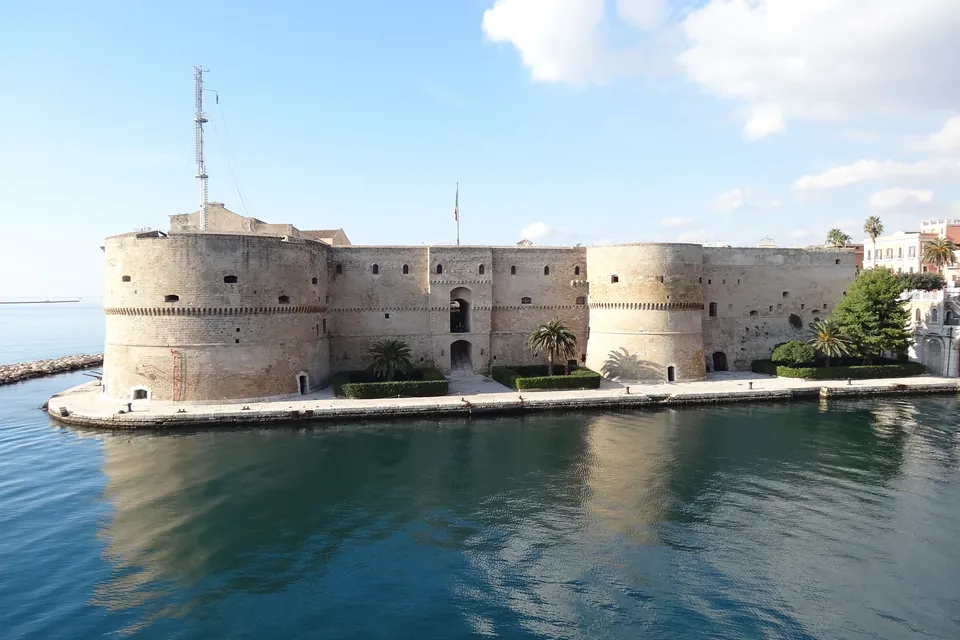
Taranto
Taranto: two seas and archaeology.
Read the guide →Photo: Livioandronico2013 / Wikimedia Commons — CC BY-SA 3.0 · Resized and converted to WebP.
.JPG)
Read more
Taranto mussels
The mussel of the Mar Piccolo: freshwater springs, pole and long-line farming, Slow Food Presidium, crisis and revival, and two days in Taranto between the old town island, the MArTA and the lagoon.
Read the guide →