
APULICA / Food guides
Taranto black mussels: the Mar Piccolo, its springs and an ancient craft
Taranto is the city of two seas, and in the inner one, the Mar Piccolo, mussels have been farmed for centuries. The Taranto black mussel, cozza gnure in dialect, owes its character to underwater freshwater springs called citri, which lower the lagoon's salinity. It is a traditional food product of Puglia and, since 2022, a Slow Food Presidium whose rules even require compostable nets. Its history runs from 16th-century records and 19th-century exhibitions to a crisis tied to industry and a recovery still under way. This guide keeps official sources apart from our advice.
A lagoon shaped like infinity
Italia.it describes the Mar Piccolo as a coastal lagoon that, seen from above, traces the infinity symbol: at Punta Penna and Punta Pizzone the shores almost touch and the Aldo Moro bridge links them, dividing two basins, only one of which opens onto the Mar Grande roadstead. The connection to the open sea runs through the navigable canal, which crosses the city, and the Porta Napoli channel. The two-day itinerary on the same portal gives an area of about twenty square kilometres. Underwater freshwater springs, the citri, are numerous here; legend says Saint Cataldus, the patron saint, made them gush by throwing his ring into the water. Since the late 19th century the lagoon has also been home to the naval Arsenal, active since 1889.
Sources: Italia.it — Mar Piccolo · Italia.it — Taranto: itinerario di 2 giorni
The cozza gnure: species, size, flavour
The Atlas of Apulian traditional products has listed the Taranto mussel, cozza gnure, as a PAT since 2005, with production in the province of Taranto and farming mainly in the Mar Piccolo. The species is Mytilus galloprovincialis. The record attributes its sweet flavour and firm texture to the citri, the lagoon's freshwater currents. The inside of the shells is purple and pearly; the mussel can reach eleven centimetres, but commercial size is usually six, with flesh from white to pink and a full, sweet taste. The Slow Food Presidium page speaks of a native strain documented as cozze negre as early as 1525, with glossy, ridged black-violet shells of five to eight centimetres, and notes that low salinity favours rapid growth. Italia.it calls it the undisputed queen of the Taranto table, cooked or raw.
Sources: Atlante dei PAT di Puglia — Cozza tarantina · Fondazione Slow Food — Presidio Cozza nera di Taranto · Italia.it — Taranto
Piscarie, poles and pergolari
The Presidium describes the traditional technique. The Mar Piccolo is divided into piscarie, plots worked by individual fishermen, marked by wooden poles driven into the bed and linked by submerged plant-fibre ropes, the libàni. The larvae attach by their byssus to frames submerged near the surface, the stramazzi; in April the seed is cut and hung vertically from structures called ventìe and crociere, and the loaded ropes become pergolari. During growth they are thinned and given the sciorinatura: every forty to fifty days the ropes are lifted into the air for twenty-four hours to clear the organisms smothering them. After twelve to sixteen months the mussels are ready. The PAT record adds that the poles were once chestnut and that floating long lines have spread in recent decades, with better water exchange. The method, Slow Food notes, needs neither feed nor energy.
Sources: Fondazione Slow Food — Presidio Cozza nera di Taranto · Atlante dei PAT di Puglia — Cozza tarantina
From the Libro Rosso to 19th-century exhibitions
According to Slow Food, mussels were already farmed in Taranto in Roman times and the Middle Ages; in the 16th century the Libro Rosso set rules against overexploiting the lagoons and using certain gear, and those rules later influenced the fishing laws of the Kingdom of Italy. The PAT record notes that the Libro Rosso of the Princes of Taranto, in the 15th century, mentions a palisade protecting the Chioma, possibly a reference to the farms, and that historians and poets of the 16th and 17th centuries describe the activity. The work Deliciae Tarentinae tells of moving grown mussels to the Ponte di Napoli and the Citrello, where fresh water and currents improved their flavour and growth, with harvesting lasting until the winter equinox. In the 19th century, Slow Food adds, Taranto mussel farming took part in international exhibitions and the Mar Piccolo became Italy's main centre for the trade.
Sources: Fondazione Slow Food — Presidio Cozza nera di Taranto · Atlante dei PAT di Puglia — Cozza tarantina
Crisis, clean-up and the Slow Food Presidium
At the end of the 19th century, Slow Food writes, a difficult period began: the Arsenal and later the large steelworks polluted land and water and plunged the trade into crisis. After clean-up work, in 2019 Mar Piccolo mussels obtained class A status, allowing sale without depuration. On 28 April 2022 the Puglia Region presented the Slow Food Presidium for the Taranto black mussel, the result of work by the Municipality of Taranto and Slow Food Puglia within the ReMar Piccolo project, with production rules that for the first time set traceability and quality standards and require compostable nets instead of plastic; the CNR and the Mar Piccolo regional park are also involved in its management. The Presidium page now lists twenty-one member farmers and names PDO status as the next goal.
Sources: Fondazione Slow Food — Presidio Cozza nera di Taranto · Regione Puglia — Presentato il Presidio Slow Food della cozza nera tarantina (2022)
Season, supply chain and open issues
On the season, the sources take different angles. The PAT record gives year-round availability; the Presidium places the black mussel on the market in spring and summer; at the 2022 Fiera del Levante, according to the Region's press release, farmers gave a production season from May to August, when the product competes with imports from Greece. At the same event the Taranto mussel was presented as Puglia's twenty-third Slow Food Presidium, with MaterBi nets and a possible future switch to hemp. The picture remains complex: in February 2025 the Municipality of Taranto announced a request to release seized areas of the First Basin occupied by unauthorised farms, so they can be removed and the waters assigned by public tender, together with a permanent technical committee and a request for a state of calamity over the sector's crisis.
Sources: Atlante dei PAT di Puglia — Cozza tarantina · Fondazione Slow Food — Presidio Cozza nera di Taranto · Regione Puglia — FDL 22: cozza tarantina presidio Slow Food (2022) · Comune di Taranto — Dissequestro delle aree del Primo Seno del Mar Piccolo (2025)
Taranto: the Island, San Cataldo, the MArTA
Italia.it's two-day itinerary starts in the old town, the Island, separated from the Borgo by the navigable canal, opened in 1481 and about four hundred metres long, overlooked by the Aragonese castle and spanned by the swing bridge. The Cathedral of San Cataldo stands on the site of a Greek temple and keeps the patron's relics in its Baroque chapel; his feast in early May includes a procession at sea and one on land, and the palio between the ten districts is rowed in two heats, in early May and around 20 July. In the Borgo the MArTA holds the Gold of Taranto, funerary jewellery from the 4th to 3rd centuries BC. The guide recommends Taranto-style mussel soup and cavatelli with beans and mussels. The PAT record also notes a Taranto mussel festival in Statte in August and a festival of Taranto mussel cooking in Gallipoli.
Sources: Italia.it — Taranto: itinerario di 2 giorni · Italia.it — Taranto · Atlante dei PAT di Puglia — Cozza tarantina
Raw or cooked: how to taste them
To understand the Taranto mussel, start with a simple preparation, an impepata or a soup, where the sweet flavour is not masked; then a pasta dish such as cavatelli with beans and mussels, which shows how mussels bind with pulses and pasta. Eating them raw is part of local tradition, but only do so where the venue clearly states origin and batch, and avoid it if in doubt or if you are vulnerable. Asking whether the mussels come from the Mar Piccolo and whether the producer belongs to the Presidium is a legitimate question, given the open issues over origin. A fresh white or an Apulian rosé goes well with mussels. The ideal time is late spring or early summer, when the black mussel is on the market.
Take them home? Better not
Live mussels need a cold chain and quick consumption: they are not a travel souvenir, unless you travel home the same day with a cool bag and buy from authorised sellers with an origin label. The best souvenir is an experience: a guided boat trip on the Mar Piccolo, where the poles and long lines explain the craft better than any text, must however be arranged with operators and checked against season and weather. For festivals, the dates of the Statte festival and the Gallipoli event mentioned in the PAT record should be checked each year on the town websites: we do not give them because the sources consulted contain no up-to-date calendar.
A thread for your journey
Journey idea: two days in Taranto, the first between the Cathedral of San Cataldo, the navigable canal and the Aragonese castle with a mussel dinner on the Island, the second between the MArTA's gold and the Mar Piccolo, where a boat trip among the mussel lines is to be arranged with operators according to season and weather.
Talk to us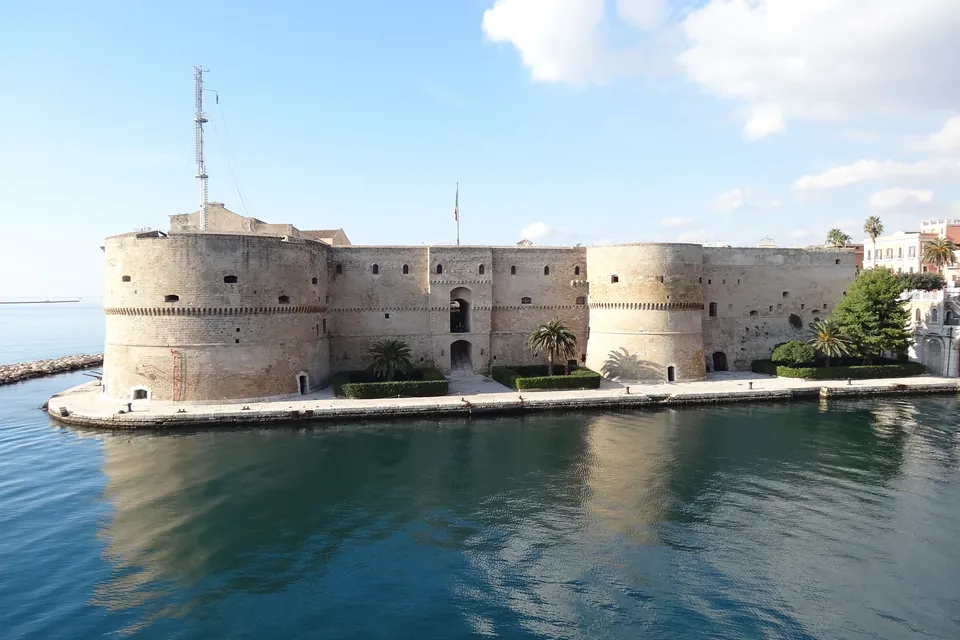
.JPG)
