
APULICA / WINES
Ostuni (wine)
DOC · Wines · Puglia
In brief
- It is made in Ostuni, Carovigno, San Vito dei Normanni and San Michele Salentino, and in parts of Brindisi, Latiano and Ceglie Messapica. (Qualigeo (Fondazione Qualivita) — Ostuni DOP)
- The white comes from the local Impigno and Francavilla grapes; the red is made only as Ottavianello, with at least 85% of that variety. (Qualigeo (Fondazione Qualivita) — Ostuni DOP)
- The regional genetic resources register lists Ottavianello as a variety at risk of genetic erosion, once vinified on its own only at Ostuni. (Regione Puglia — Registro regionale risorse genetiche autoctone, Vite Ottavianello)
- The designation has been registered since 1973. (Qualigeo (Fondazione Qualivita) — Ostuni DOP)
History and origin
Ostuni is a designation with a long history: it has been registered since 1973 and now appears in the European register as a PDO. It takes its name from the White City, which stands on the last spurs of the southern Murgia and looks out over a plain of ancient olive trees stretching to the sea.
Its identity is tied to rare grape varieties. The red is made only as Ottavianello, a grape whose history the regional register of genetic resources reconstructs: in the first half of the twentieth century it was grown mainly on the hills of Ostuni, Ceglie Messapica and San Vito dei Normanni, and after the Second World War it covered some 2,900 hectares in these areas. According to some authors it came from the area of Ottaviano, in Campania, brought to San Vito dei Normanni by a marquis.
In the past only Ostuni made a single-variety wine from it, while elsewhere in the Brindisi area it was blended with Malvasia nera and Negroamaro. Today it is classified as a variety at risk of genetic erosion: the designation is also a way to keep it alive.
Sources: Qualigeo (Fondazione Qualivita) — Ostuni DOP · eAmbrosia — Ostuni (PDO-IT-A0561) · Regione Puglia — Registro regionale risorse genetiche autoctone, Vite Ottavianello · Comune di Ostuni — Turismo
Area and method of production
The production area covers the whole territory of Ostuni, Carovigno, San Vito dei Normanni and San Michele Salentino and part of the municipalities of Brindisi, Latiano and Ceglie Messapica, all in the province of Brindisi. Winemaking takes place within the area, but by tradition it is allowed throughout the municipalities that fall only partly inside it.
The white is made from two local grapes: Impigno, between 50 and 85%, and Francavilla, between 15 and 50%, with Bianco d'Alessano and Verdeca allowed up to 10%. The red exists only with the variety's name, as Ostuni Ottavianello, and requires at least 85% of this grape; the rest may come from Negroamaro, Notar Domenico, Susumaniello and Malvasia nera.
The regional register describes Ottavianello as a vigorous plant, with long cylindrical bunches and large berries with thin, violet-black skins, so much so that it was once also used as a table grape. Scholars described it as resistant to cold and drought, which is why it was planted on the highest and driest ground.
Sources: Qualigeo (Fondazione Qualivita) — Ostuni DOP · Regione Puglia — Registro regionale risorse genetiche autoctone, Vite Ottavianello
How to recognise it
Ostuni bianco has an intense straw-yellow colour with hints of golden glints. The aroma is fairly intense, mainly fruity, with delicate hints of peach and floral notes of hawthorn; on the palate it is dry, fresh and balanced, with good length.
Ostuni Ottavianello is recognised by its cherry-pink colour, leaning towards a light ruby. The nose is delicate, with the typical scents of the fruit, and on the palate it is dry and balanced: a light, easy-drinking red.
The regional register notes that wine made from Ottavianello alone was described in the 1930s as a bright ruby red with moderate alcohol: a fresh character that the designation continues to preserve.
Sources: Qualigeo (Fondazione Qualivita) — Ostuni DOP · Regione Puglia — Registro regionale risorse genetiche autoctone, Vite Ottavianello
Where to taste it
The starting point is Ostuni and its old town, which locals call la Terra: a cluster of whitewashed houses climbing a hill and enclosed by walls with Aragonese towers, made of lanes, stairways, arches and small squares. At the top stand the Cathedral, which combines Romanesque, Gothic and Venetian elements, and the Bishop's Palace, with views over the plain of olive trees all the way to the sea.
Around the city, the towns of the designation trace a route between hills and coast: Carovigno, San Vito dei Normanni, San Michele Salentino and Ceglie Messapica, with part of the countryside of Latiano and Brindisi. This is where the wine can be tasted where it is made, and a chance to discover grapes that are hardly found elsewhere, such as Impigno, Francavilla and Ottavianello.
Ostuni itself is a destination worth more than a day, between the long history of the White City, the countryside of ancient olive trees and the nearby sea.
Sources: Comune di Ostuni — Turismo · Qualigeo (Fondazione Qualivita) — Ostuni DOP · Regione Puglia — Registro regionale risorse genetiche autoctone, Vite Ottavianello
Protection
- DOC, PDO wine — PDO-IT-A0561 (eAmbrosia — Ostuni (PDO-IT-A0561))
When
- The sources consulted give no months.
Where
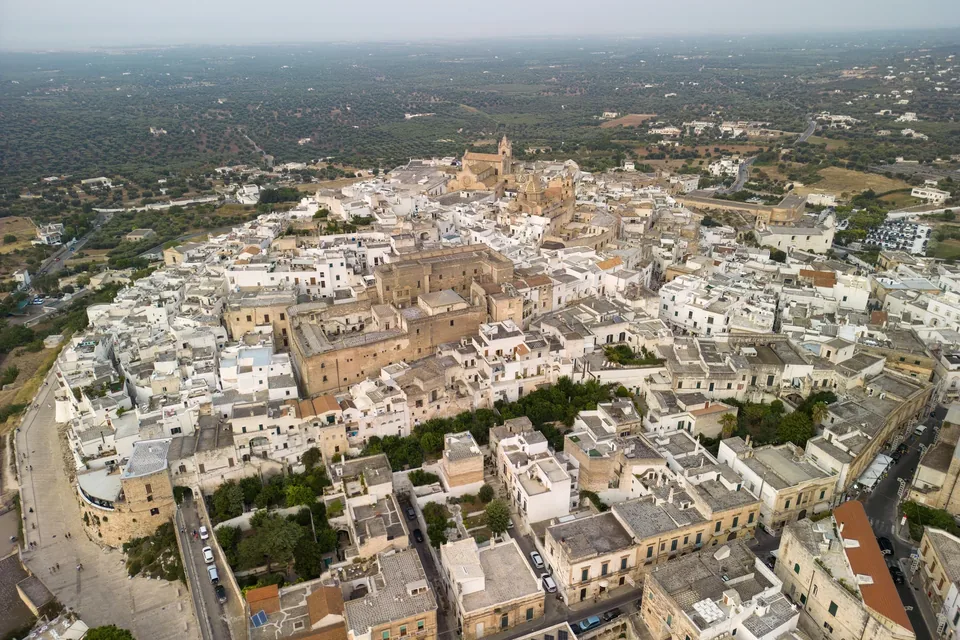
Ostuni
Houses, steps and agricultural landscape within one visit.
Read the guide →Photo: ParisTaras / Wikimedia Commons — CC BY 4.0 · Resized and converted to WebP.

Read more
The wines of Brindisi
The designations around Brindisi, from Negroamaro to Susumaniello and Ostuni's Ottavianello, and a day between the Appian Way's port, the countryside and the White City.
Read the guide →