
APULICA / Food guides
Wines of Brindisi: Negroamaro, Susumaniello and Ostuni's Ottavianello
The province of Brindisi is borderland between the Salento, the Valle d'Itria and the Murgia, and its wines show it. Negroamaro rules the plain towards Lecce, Susumaniello has returned to attention, and Ottavianello survives on the Ostuni hills. The appellations overlap and sometimes cross provincial borders: this guide puts them in order, using the regulations and official profiles, before the tasting.
Brindisi DOC: two municipalities, many types
According to the Puglia Region's page, Brindisi PDO is produced in the territories of Brindisi and Mesagne and includes white, red, rosé, sparkling, sparkling rosé and novello. Red and rosé require at least 70% Negroamaro; Qualigeo specifies that the rest may come from Malvasia nera di Brindisi, Susumaniello, Montepulciano and Sangiovese, up to 30%.
The designation also allows varietal wines: the Negroamaro type requires at least 85% of that grape, as does the Susumaniello type for its own variety. The white and sparkling wines are based on at least 80% Chardonnay and Malvasia bianca, with no muscats; other permitted varieties must be approved for the Salento-Arco Ionico zone.
Qualigeo describes the white as pale straw, sometimes with greenish glints, with aromas of white-fleshed fruit, flowers and herbs and a round, fresh, savoury taste: a less familiar side of a land known above all for its reds.
Sources: Regione Puglia — Produzioni di qualità, Brindisi DOP · Qualigeo — Brindisi DOP
Riserva, consortium and the red's profile
Qualigeo's page gives 1981 as the registration year of Brindisi PDO and names a protection consortium shared by the Brindisi and Squinzano PDOs, based at the Brindisi Chamber of Commerce; its mandate has been confirmed several times by decrees published in the Official Gazette. The area given is 275 hectares.
The red and the Negroamaro can become Riserva after at least two years of ageing, counted from 1 November of the harvest year. Qualigeo describes the red as more or less intense ruby, sometimes with brick-red glints with age, with aromas of ripe fruit that evolve towards spicy and mineral notes, vigorous tannins and a long fruity finish.
The rosé is of varying depth, slightly vinous and fruity when young, fresh and delicately floral on the palate. It is the wine that best matches the coastal cooking, and a good starting point for a first tasting.
Sources: Qualigeo — Brindisi DOP
Susumaniello and Squinzano PDO
Susumaniello is one of the black grapes permitted around Brindisi: it goes into Brindisi red alongside Negroamaro and, at 85% or more, gives its name to a type of its own within the PDO. The same applies to Squinzano PDO, registered in 1982, which according to Qualigeo covers the whole of Squinzano, San Pietro Vernotico, Torchiarolo and Novoli and part of Lecce, Campi Salentina, Cellino San Marco, Trepuzzi and Surbo.
Here too the red is based on at least 70% Negroamaro, with Malvasia nera, Sangiovese and other grapes up to 30%, and the Riserva ages at least two years from 10 November of the harvest year. Qualigeo describes the red as ruby turning orange with age, with notes of berries, pepper, cocoa and spice; the rosé, from light ruby to cherry pink, smells of berries and wild flowers.
Squinzano also includes whites from Chardonnay, Malvasia bianca, Fiano and Sauvignon: a border designation between the provinces of Brindisi and Lecce.
Sources: Regione Puglia — Produzioni di qualità, Brindisi DOP · Qualigeo — Brindisi DOP · Qualigeo — Squinzano DOP
Salice Salentino, across the provincial border
Salice Salentino PDO has its heart in the province of Lecce, in Salice, Veglie, Guagnano and part of Campi Salentina, but the Puglia Region notes that it also includes San Pancrazio Salentino, Sandonaci and part of Cellino San Marco, in the province of Brindisi. Red, rosé and sparkling rosé require at least 75% Negroamaro, the Negroamaro varietal at least 90%; there are also a white, a sparkling wine and a fortified wine.
The protection consortium relates that as early as the 1930s a group of growers was promoting Negroamaro and Malvasia nera, that the DOC specification arrived in 1976 and that the consortium was founded in 2003. Since 2013 it has represented about 80% of the supply chain and oversees it; the output given is about 195,000 quintals of grapes.
The consortium describes red soils and a favourable climate in which the sea tempers temperatures and brings saltiness to the nearest soils, and mentions the protection of old bush vines.
Sources: Qualigeo — Salice Salentino DOP · Regione Puglia — Salice Salentino DOP · Consorzio di tutela Salice Salentino — Storia · Consorzio di tutela Salice Salentino — Territorio
In the Salice glass
The Salice Salentino consortium describes its wines with images drawn from the land. The red has the colour of the countryside, an intense ruby with violet shades, and aromas of undergrowth, small black fruits and plum; in its fuller version it recalls red and black fruit and herbs, with a slightly bitter yet fresh finish, suited to meat and aged cheeses.
The rosé is, according to the consortium, the oldest type, the starting point of the whole area's history. Some growers still make it with the traditional 'a lacrima' method, selecting only very young grapes; it is coral pink, with scents of rose and blood orange, and pairs with starters, pasta, fresh vegetables and medium-aged cheeses.
There is also a white, the consortium notes, with a strong share of Chardonnay, golden yellow, with white-flower aromas and notes that evolve towards vanilla and hazelnut. For anyone travelling between Brindisi and Lecce, a Salice rosé and a Brindisi one make a natural comparison.
Ostuni: Impigno, Francavilla and Ottavianello
Ostuni PDO, registered in 1973, covers the municipalities of Ostuni, Carovigno, San Vito dei Normanni and San Michele Salentino and part of Brindisi, Latiano and Ceglie Messapica: the hilly part of the province, where the Negroamaro plain gives way to olive groves and the Murgia.
The white blends two local grapes, Impigno from 50 to 85% and Francavilla from 15 to 50%: Qualigeo describes it as straw yellow with golden glints, with notes of peach and hawthorn. The red exists only as Ottavianello, with at least 85% of that grape, cherry pink tending to pale ruby.
The page gives a very small output, on just three hectares. It is a designation to seek out patiently, more out of curiosity than habit, and best tasted on the spot, where producers can tell its story.
Sources: Qualigeo — Ostuni DOP
Ottavianello, a grape to be saved
The page of the regional register of native genetic resources relates that in the first half of the 20th century Ottavianello was grown mainly on the hills of Ostuni, Ceglie Messapica and San Vito dei Normanni, and after the war covered about 2,900 hectares. It then declined until it became a variety at risk of genetic erosion.
Some authors trace it to Ottaviano, in Campania, brought by a marquis and first planted at San Vito dei Normanni. 20th-century sources describe large berries with slightly crunchy flesh, resistant to cold, drought and the hot west wind; so it was planted in the higher, drier areas. It was made as a single-variety wine only in Ostuni, giving a bright ruby red of 10-11 degrees; elsewhere it was blended with Malvasia nera and Negroamaro.
Today it is conserved at a research centre in Locorotondo and is part of the Ostuni PDO and the Murgia, Tarantino, Salento and Valle d'Itria PGIs. In Ceglie Messapica it is called Uttamianuccij.
Sources: Regione Puglia — Registro regionale risorse genetiche autoctone, Vite Ottavianello (scheda 129)
Brindisi, port of the Appian Way
The Municipality of Brindisi traces a long history. The megalithic walls of Corte Capozziello and via Camassa date from the Messapian period, between the 7th-6th and 3rd centuries BC; a Latin colony from 244 BC, the city was linked to Rome by the Via Appia and the Via Appia Traiana. Its best-known monument is the Roman Columns, traditionally seen as the end of the Appian Way: one fell in 1528, and the capital of the other is now displayed in Palazzo Granafei-Nervegna.
After the Lombard destruction of the 7th century, the city revived under the Normans: the Cathedral was built between 1089 and 1132 and rebuilt after the 1743 earthquake, while the round church of San Giovanni al Sepolcro is considered the most faithful copy of the Anastasis in Jerusalem.
In Brindisi, the Municipality recalls, Frederick II married Yolande of Brienne in 1225, and the Swabians built the land castle. It is a city best seen on foot, before heading into the countryside.
Brindisi on foot, before the wine
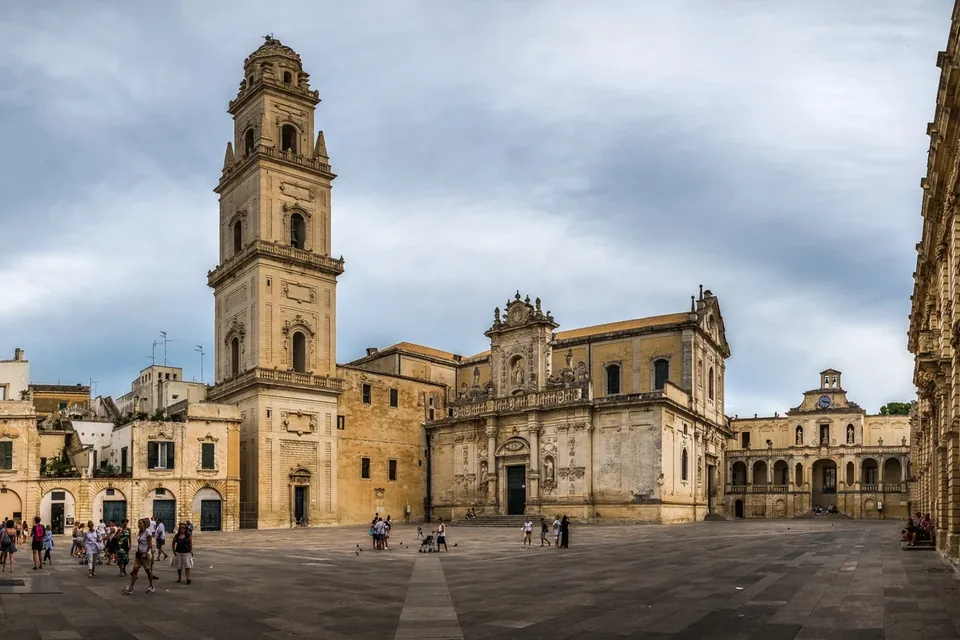
Italia.it and the Municipality suggest discovering Brindisi from the old town. From Piazza Duomo, the oldest square, you visit the Cathedral and the Archaeological Museum, then the former Scuole Pie complex with the municipal art gallery; from there you lose yourself in the lanes of the San Pietro degli Schiavoni quarter, where Roman house remains show beneath the Nuovo Teatro Verdi, as far as the small round church of San Giovanni al Sepolcro.
Towards the harbour you reach the Virgilian Steps topped by the Roman Columns, where up to 900 people sit during events. The seafront leads along the quays to Piazza Santa Teresa, overlooking the port.
A motorboat crosses to the opposite shore, the Casale district, and the Sailor's Monument: from its terrace, reached by lift, you see the whole harbour and the city. It is the best way to understand why Brindisi, before being wine country, was a gateway to the sea.
Sources: Italia.it — Brindisi · Comune di Brindisi — Itinerari turistici
Ostuni, the White City among the olives
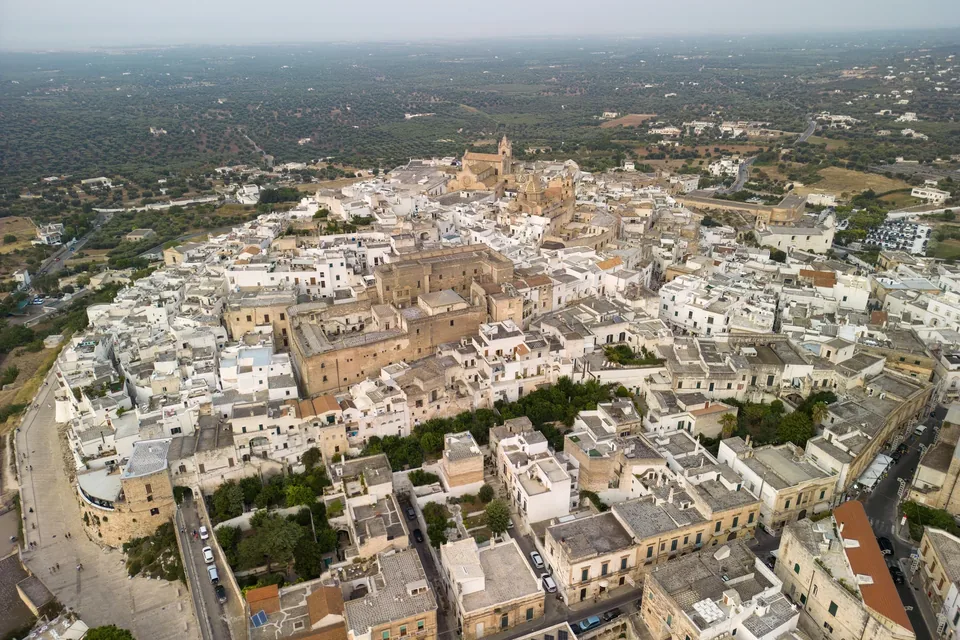
The Municipality of Ostuni describes a town of about 33,000 people on the last spurs of the southern Murgia. The old town, which locals call la Terra, is painted entirely in lime white, earning nicknames such as the White City, Queen of the Olives and Nativity-scene City. The old core, perhaps the site of the Messapian acropolis, climbs the sides of a hill inside walls strengthened by Aragonese towers, of which eight of the original fifteen survive.
The streets are a tangle of alleys, stairways, courtyards and arches that prop up the houses; the only real street to the top is via Cattedrale. At the summit stands the Cathedral, a blend of Romanesque, Gothic and Venetian influences, overlooking the plain of ancient olive trees down to the sea.
The Municipality also recalls an episode of the Risorgimento: on 26 August 1860 Ostuni was the first town in Puglia to tear down the Bourbon coats of arms. It is the ideal evening stop when looking for Impigno and Ottavianello.
Sources: Comune di Ostuni — Turismo, la città
At the table, seasons and bottles to take home
Around Brindisi, Negroamaro rosé is a wine for the whole meal rather than an aperitif: I would try it with oily fish, stuffed vegetables and tomato-based pasta. The fuller red goes well with meat in sauce and aged cheeses; Susumaniello, fruitier, also with cured meats and pulse dishes. Ostuni white and Ottavianello, light and rare, I would taste on the spot, on a day among farmsteads and dry-stone walls.
We found no regular event devoted to Brindisi wines on official sources with confirmed dates, so we do not suggest one. The late-summer harvest and autumn are the most telling times for a trip, but winery visits should always be arranged with the operators.
To take a bottle home, read the label carefully: Brindisi, Squinzano, Salice Salentino and Ostuni are different designations, while Susumaniello or Ottavianello name the grape, not the area.
A thread for your journey
Journey idea: a morning on foot in central Brindisi between the cathedral and the harbour, an afternoon in the Negroamaro countryside towards Mesagne or San Pancrazio, an evening on the Ostuni hills looking for Impigno and Ottavianello. Winery visits are arranged with operators.
Talk to us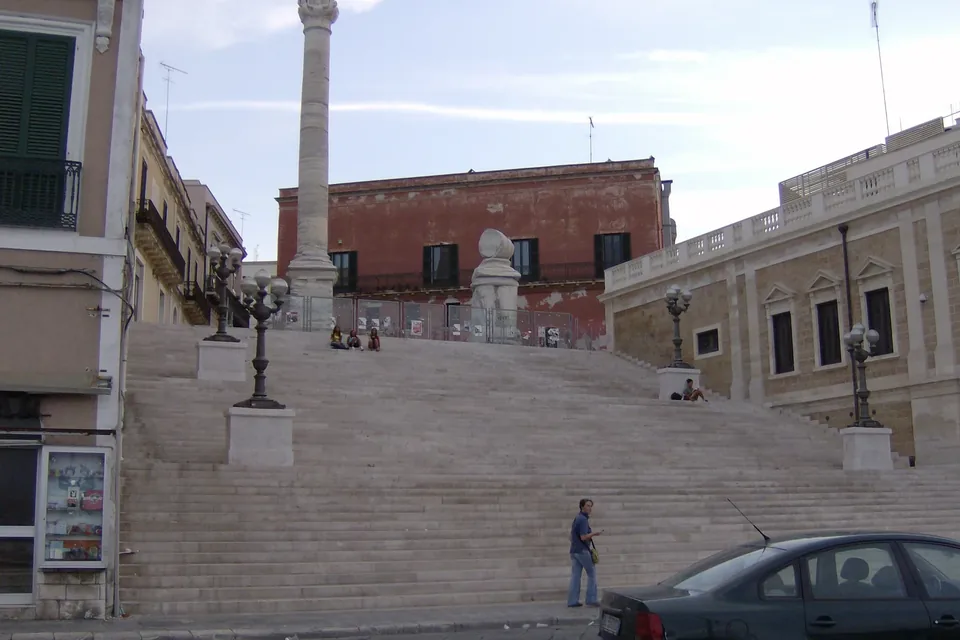


.jpeg)