
APULICA / WINES
Brindisi (wine)
DOC · Wines · Puglia
In brief
- The production area covers only the municipalities of Brindisi and Mesagne. (Regione Puglia — Produzioni di qualità, Brindisi DOP · Qualigeo (Fondazione Qualivita) — Brindisi DOP)
- It covers white, red, rosé, sparkling, sparkling rosé and novello wines. (Regione Puglia — Produzioni di qualità, Brindisi DOP · Qualigeo (Fondazione Qualivita) — Brindisi DOP)
- The red is at least 70% Negroamaro, with Malvasia Nera di Brindisi, Susumaniello, Montepulciano or Sangiovese; the Riserva ages at least two years. (Qualigeo (Fondazione Qualivita) — Brindisi DOP)
- The designation has been registered since 1981. (Qualigeo (Fondazione Qualivita) — Brindisi DOP)
History and origin
The designation bears the name of a city that has always lived by its port. Brindisi was a Latin colony from 244 BC, and the Via Appia and Via Appia Traiana linked it to Rome; the Roman Columns on the harbour, traditionally regarded as the end point of the Appian Way, are still its symbol. Around the city and nearby Mesagne lies the countryside where this wine is made.
Brindisi is a controlled designation of origin registered in 1981 and now entered in the European register as a PDO. Its production rules give pride of place to the traditional grapes of the Salento: Negroamaro, the backbone of the reds and rosés, alongside Malvasia nera di Brindisi and Susumaniello, a local grape that may appear alone on the label.
The regional profile of the designation stresses that these wines have clearly recognisable traits, tied to the geographical setting they come from, and that the typical aromas of the grape varieties prevail in their scent and taste.
Sources: Comune di Brindisi — Storia del Comune · Qualigeo (Fondazione Qualivita) — Brindisi DOP · Regione Puglia — Produzioni di qualità, Brindisi DOP · eAmbrosia — Brindisi (PDO-IT-A0543)
Area and method of production
The production area is one of the most compact in Puglia: it covers only the territory of the municipalities of Brindisi and Mesagne, in the province of Brindisi. The production rules allow white, red, rosé, sparkling, sparkling rosé and novello wines, as well as several varietal versions.
The red, rosé, sparkling rosé and novello are made from at least 70% Negroamaro, which may be joined by Malvasia nera di Brindisi, Susumaniello, Montepulciano or Sangiovese. The Negroamaro and Susumaniello versions require at least 85% of the named grape. The white and the sparkling wine use at least 80% Chardonnay and Malvasia bianca, and Fiano and Sauvignon are also among the white varietal mentions, at a minimum of 90%; Muscat grapes are excluded.
The red and the Negroamaro become Riserva after at least two years of ageing, counted from 1 November of the harvest year.
Sources: Qualigeo (Fondazione Qualivita) — Brindisi DOP · Regione Puglia — Produzioni di qualità, Brindisi DOP
How to recognise it
The red has a more or less intense ruby colour, which with time may take on brick-red glints. Its ripe-fruit aromas are enriched, with age, by spicy and mineral notes; on the palate it is fresh, with vigorous tannins and a long fruity finish.
The rosé is recognised by its more or less intense pink colour and a slightly vinous nose, fruity when young; on the palate it is fresh, delicately fruity and floral. The white is a pale straw yellow, sometimes with greenish glints, with aromas of ripe white-fleshed fruit, flowers and herbs, and a fruity, rounded, fresh and savoury taste.
The straw-coloured sparkling wine and the sparkling rosé have a fine, persistent bead, delicate aromas with notes of yeast and a fresh taste, from extra brut to extra dry. The novello is red, fresh, velvety and balanced. The varietal versions show the typical traits of the grape and of the soil it comes from.
Where to taste it
The Brindisi wine has two homes: the city of Brindisi and Mesagne, the only municipalities in the designation. It is here, in the countryside between the two towns, that the wine can be tasted where it is made.
In Brindisi the walk suggested by the city council starts at the Roman Columns facing the harbour and crosses Piazza Duomo, with the Cathedral and the Archaeological Museum, the lanes of the San Pietro degli Schiavoni quarter and the small round church of San Giovanni al Sepolcro. The seafront promenade, lined with venues overlooking the quays, is the natural place to stop for a glass and the flavours of Apulian cooking.
A visit to the city, where Roman remains live alongside modern spaces, and to its countryside offers a chance to discover, alongside Negroamaro, local grapes such as Susumaniello and Malvasia nera di Brindisi.
Sources: Qualigeo (Fondazione Qualivita) — Brindisi DOP · Comune di Brindisi — Itinerari turistici · Italia.it — Brindisi · Regione Puglia — Produzioni di qualità, Brindisi DOP
Protection
- DOC, PDO wine — PDO-IT-A0543 (eAmbrosia — Brindisi (PDO-IT-A0543))
When
- The sources consulted give no months.
Where
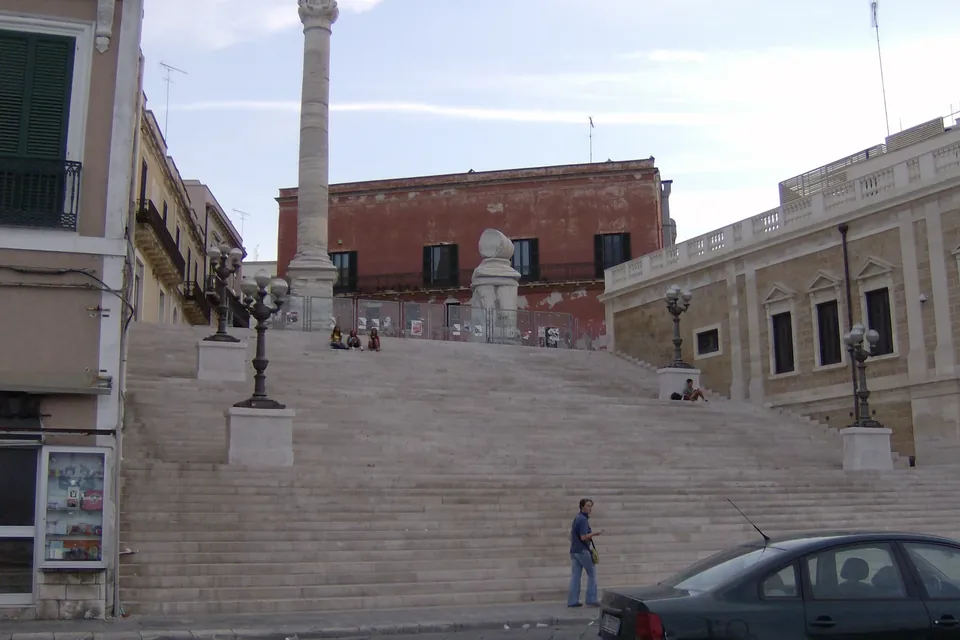
Brindisi
Brindisi: reading the city from its harbour. The Roman Columns above the Virgilian Steps, the castles built to defend the harbour and the Brindisi artichoke.
Read the guide →Photo: Zappuddu / Wikimedia Commons — Public domain · Resized and converted to WebP.

In Bottega
Brindisi (wine) has its own page in Bottega Apulica, the space on apulica.eu for typical products: there you find its story, its protection, the production areas and the producers where they are already listed. Purchases are not open yet: the page shows what will be on sale at opening.
Read more
The wines of Brindisi
The designations around Brindisi, from Negroamaro to Susumaniello and Ostuni's Ottavianello, and a day between the Appian Way's port, the countryside and the White City.
Read the guide →