Why go
Termoli is the largest town on the Molise coast, which runs for about thirty-five kilometres from the mouth of the Trigno to that of the Saccione. It has an important commercial port and modern districts, but its heart is the old town: a walled nucleus that follows the shape of a rocky spur reaching into the Adriatic, watched over by the Swabian castle.
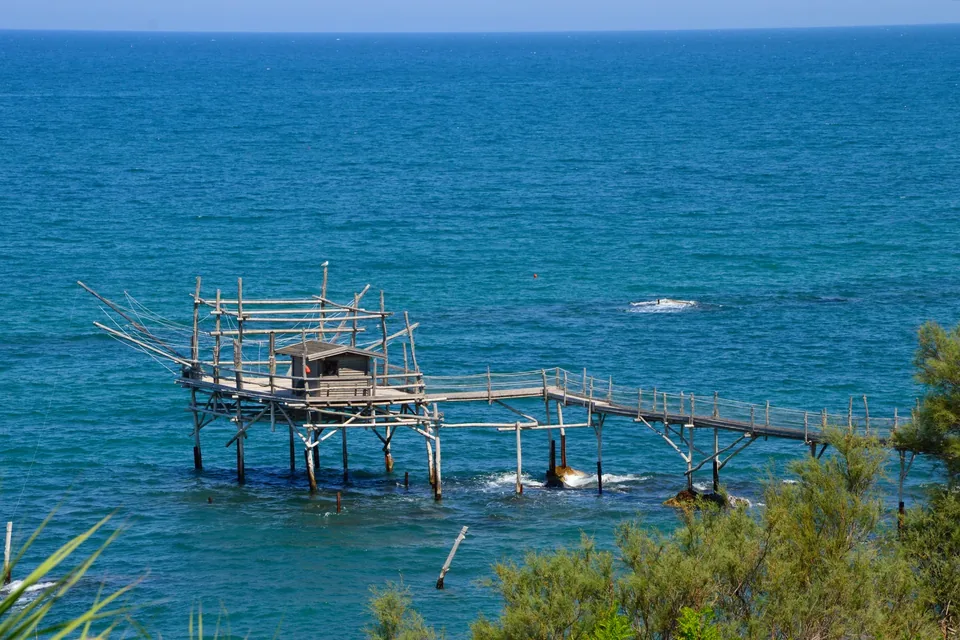
The reason to come is the way very different things sit within a few steps of each other: the walls and lanes of the old village, a Romanesque cathedral, the fishing trabucchi along the rocks, and two long beaches of fine sand on either side of the headland. The municipality notes that the town has received the Blue Flag for the fourth year in a row, and the national tourism portal lists it among the main destinations in Molise.
Termoli is also the point where the Tratturo Magno, the great grassy transhumance route linking L’Aquila to Foggia, reaches the sea. That makes it a natural stop on a journey along the Adriatic, or a base for exploring the inland Basso Molise, with its villages, olive groves and Roman remains.
Sources: Italia.it — Termoli · Italia.it — La costa molisana · Italia.it — I tratturi del Molise · Comune di Termoli — Turismo
History
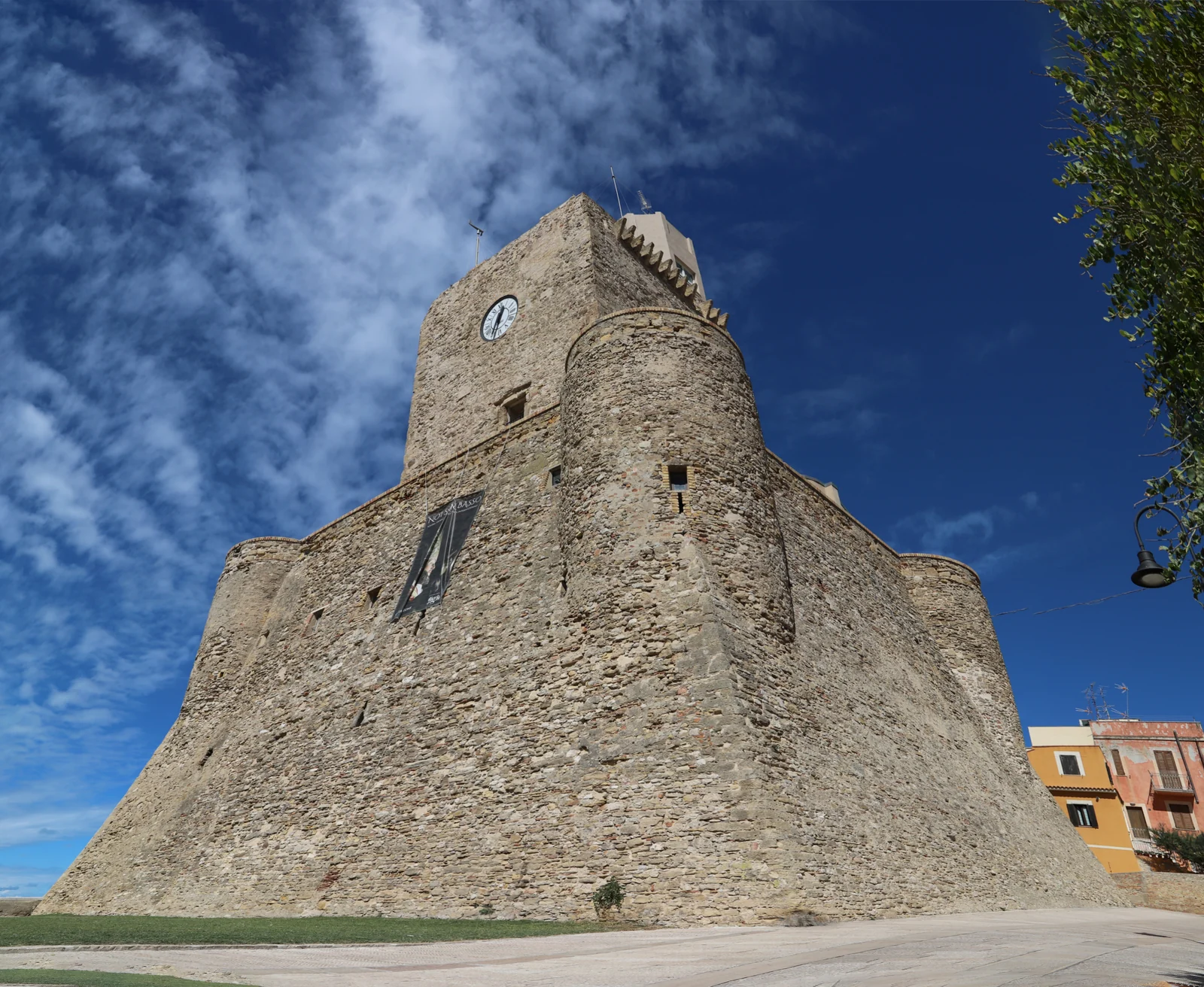
Termoli’s history can be read in its defences. According to the municipality, the castle’s features suggest a Norman origin in the eleventh century, beside an older Lombard tower; the name ‘Swabian’ would come from the restructuring ordered by Frederick II in 1240 after an attack by the Venetian fleet. The national tourism portal attributes the castle and much of the walls directly to Frederick II in the thirteenth century. Both accounts agree on the Swabian emperor’s role and on the rebuilding that followed the earthquake of 1456.
The cathedral was built between the twelfth and thirteenth centuries over an earlier basilica. The same 1456 earthquake destroyed the upper part of its façade, and in 1566 the town was sacked by the Turks. A restoration carried out between 1930 and 1969 removed the Baroque additions and brought back the Romanesque forms.
The cult of San Basso, the principal patron, is very old but poorly documented: the Diocese of Termoli-Larino explains that his relics probably arrived around the year 1000, were hidden beneath the cathedral and came to light again on 1 January 1761; those of San Timoteo, concealed in 1239, were found in 1945. Older still is the network of droving tracks, already used by the Samnites and reorganised by the Aragonese in the fifteenth century.
Sources: Comune di Termoli — Il Castello Svevo · Italia.it — Castello Svevo di Termoli · Comune di Termoli — La Cattedrale · Diocesi di Termoli-Larino — San Basso · Italia.it — I tratturi del Molise
What to see
The Swabian castle stands at the entrance to the old town, which locals call the Paese vecchio, and overlooks Sant’Antonio beach. It is a square building with round corner turrets and a large central tower, almost sheer above the sea. Some of its rooms host the municipal Art Gallery, exhibitions and meetings, and from the top the view reaches the mountains of Abruzzo. Inside, in the archers’ corridor, a large Roman anchor is kept.
At the centre of the medieval core, on the cathedral square, Santa Maria della Purificazione shows a Romanesque façade with a stone statue of San Basso on the portal. In the crypt beneath the presbytery lie the relics of the patron saints Basso and Timoteo.
Among the lanes is the Rejecelle, an alley only about forty centimetres wide that disputes with a lane in Ripatransone the title of narrowest street in Italy. Outside the walls, the Trabucchi Walk starts at the foot of the castle, follows the circuit of the old town and ends at the harbour: along the way you see the fishing machines on stilts, among them the trabucco of Celestino, one of the town’s symbols.
Sources: Italia.it — Termoli · Italia.it — Castello Svevo di Termoli · Comune di Termoli — Il Castello Svevo · Comune di Termoli — La Cattedrale · Comune di Termoli — Rejecelle · Comune di Termoli — I Trabucchi · Italia.it — La costa molisana
Food and wine
Termoli’s cooking looks to the sea. The dish most closely tied to the town is fish brodetto, ‘u vredette’ in dialect, which the national tourism portal lists among the region’s specialities. It is a soup of the local catch that pairs well with a walk around the harbour.
The hinterland completes the table. Along the Molise coast you find Biferno, a designated-origin wine linked to Campomarino, and the saggiciotto of Montenero di Bisaccia, a smoked pork sausage; the same area produces the Ventricina di Montenero di Bisaccia, one of the oldest cured meats of the Molise tradition, used in the sauce for cavatelli. Molise has four wine designations, Tintilia del Molise, Biferno, Molise and Pentro, and Tintilia del Molise carries the region’s name in its designation.
Other products worth looking for are Molise PDO extra virgin olive oil and, in the countryside around Larino, olives of the Gentile di Larino variety: wheat and olives are the main crops here, and Molise is Italy’s second region by quantity of truffles. A visit to an olive mill or winery inland, arranged in advance with the producers, adds a piece of the picture that the seafront alone does not show.
Sources: Italia.it — La costa molisana · Italia.it — Molise, prodotti e piatti tipici · Italia.it — Un viaggio nel Molise di Larino e Guglionesi
Things to do
The beaches are one of the town’s main assets. North of the headland lies Sant’Antonio beach, with many equipped lidos and services for families; to the south Rio Vivo, once called Marina di San Pietro, has a very wide stretch of sand where beach volleyball and beach tennis tournaments are held. The sand is fine and compact and the seabed shelves gently, which makes swimming suitable for children too.
The wind has made Termoli known to surfers and kitesurfers, who choose Rio Vivo or Sant’Antonio depending on its direction; Rio Vivo is also recommended for sailing and water sports.
For those who prefer walking, the Trabucchi Walk along the walls is the simplest and most evocative route, best early in the morning or at sunset. Slower and more demanding is the experience of the droving tracks: the Tratturo Magno, also called the King’s Track, crosses Molise to Termoli, and other grassy routes can be followed on foot or on horseback. It is a way to connect the sea with the hills inland and with the memory of transhumance.
Sources: Comune di Termoli — Le Spiagge · Comune di Termoli — I Trabucchi · Italia.it — La costa molisana · Italia.it — I tratturi del Molise
When to go
Summer is the season for the sea: the equipped beaches of Sant’Antonio and Rio Vivo, a Blue Flag confirmed for the fourth year running, and the long programme of the Estate Termolese, now in its sixty-seventh edition, with events for residents, visitors and children. It is also when sailings to the Tremiti Islands are most frequent, as the ferry company’s seasonal calendars show.
Spring and early autumn are the best times for walking in the old town, following the trabucchi promenade and heading inland without the heat of July and August. The wind in these seasons also draws surfers and kitesurfers.
Winter has its own calendar too. The municipality organises a Carnival parade each year: in the 2025 edition the masks gathered in Piazza Duomo and the procession moved to Piazza Vittorio Veneto, where a Carnival village was set up. Dates and programmes change from year to year and should be checked on the municipal website before travelling.
Sources: Comune di Termoli — Le Spiagge · Comune di Termoli — Turismo · Comune di Termoli — Estate Termolese · Comune di Termoli — La Parata di Carnevale 2025 · Italia.it — La costa molisana
Getting there and around
Termoli has a railway station managed by RFI, with five platforms in passenger use. The station’s official page lists assistance for people with disabilities and reduced mobility, coordinated by the Sala Blu in Bari, step-free routes to the platforms, a local bus stop and a car rental service. Timetables and connections are published on the railway companies’ official channels.
The harbour is the departure point for the Tremiti Islands: the operator NLG publishes the Termoli–Tremiti route with separate calendars for different periods of the year, and sailings should be booked and checked in advance, especially out of season.
Once there, the old town is explored on foot: it is small and gathered on a spur, and the walk along the walls links it to the harbour and the beaches. For the hinterland and for the coastal villages, such as Campomarino, Petacciato or Montenero di Bisaccia, a car or transfers arranged with a local operator are the practical choice.
Sources: RFI — Stazione di Termoli · NLG — Tratta Termoli–Tremiti · Italia.it — Termoli · Italia.it — I tratturi del Molise
Where to stay
Termoli is the town on the Molise coast with the widest choice of accommodation: the national tourism portal highlights its hotel and sports facilities, and the Sant’Antonio seafront is lined with beach establishments. Travellers who want to enjoy the old town in the evening can look for a place in the centre or near the walls, from where castle, cathedral and harbour are all within walking distance.
Along the coast, Campomarino offers a wide range of options, from hotels and residences to campsites and holiday villages, in an area surrounded by vineyards and by the Bosco di Ramitelli wildlife reserve; Petacciato also has an equipped seafront. These suit families and longer beach stays.
For those who prefer the countryside, the inland area of olive groves and hills lends itself to stays in rural accommodation, a good base for Larino, Guglionesi and the droving tracks. Apulica selects accommodation case by case, with no availability guaranteed in advance.
Sources: Italia.it — La costa molisana · Comune di Termoli — Le Spiagge · Italia.it — Termoli
Nearby
South of Termoli, Campomarino preserves the remains of a Roman villa at Arcora and the church of Santa Maria a Mare, built between the twelfth and thirteenth centuries with fifteenth-century frescoes; the area around the mouth of the Biferno is largely taken up by the Bosco di Ramitelli reserve. To the north, Petacciato has the Romanesque church of San Rocco and the Renaissance Palazzo Battiloro, while near Montenero di Bisaccia stands the sanctuary of Santa Maria di Bisaccia. Beyond the Trigno begins the Trabocchi Coast of Abruzzo.
Inland, Larino keeps the remains of the Roman town of Larinum, with an amphitheatre and, in the Civic Museum in Palazzo Ducale, celebrated mosaics including one showing the legend of the founding of Rome; the fourteenth-century cathedral is dedicated to San Pardo, celebrated in spring with ox-drawn carts. Guglionesi, spread over three hills, offers the church of Santa Maria Maggiore and the Portello viewpoint, from which the sea is visible.
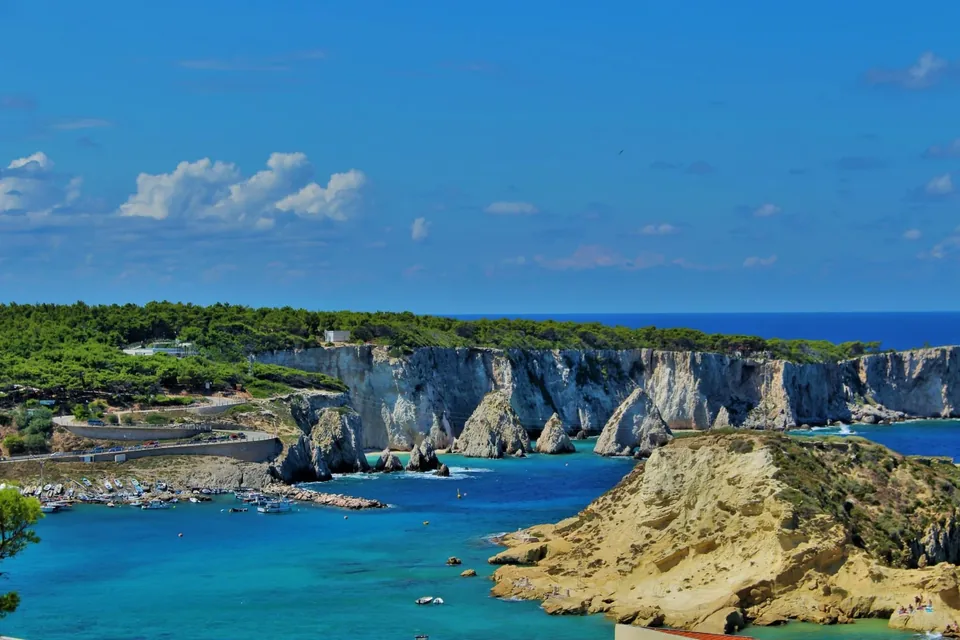
By boat you reach the Tremiti Islands, an archipelago of San Domino, San Nicola, Caprara, Cretaccio and Pianosa, protected as a marine area and managed by the Gargano National Park authority: a day at sea that rounds off a stay in Termoli naturally.
Sources: Italia.it — La costa molisana · Italia.it — Un viaggio nel Molise di Larino e Guglionesi · Ente Parco Nazionale del Gargano — Area marina protetta Isole Tremiti · NLG — Tratta Termoli–Tremiti
Local tourist information
Local tourist offices help with opening times, events and transport on the day.
- Comune di Termoli — Ufficio Cultura, turismo e sport · Via Sannitica 5, 86039 Termoli (CB) · 0875 7121 · cultura@comune.termoli.cb.it · Official website
Source: Comune di Termoli — Ufficio Cultura, turismo e sport · checked on
Where to stay
In the municipality of Termoli the national database of the Ministry of Tourism lists 699 accommodation businesses with a verified CIN code: 16 hotels, 111 other licensed accommodation and 572 other types such as B&Bs and private rentals.
Sources: Ministero del Turismo – Banca Dati Strutture Ricettive (dashboard pubblica), 2026-10-12
YOUR JOURNEY
How to shape a journey here
A day of old town, castle and cathedral, with an hour to look at the trabucco from the seafront. Visits to be arranged with local operators.
Talk to us about it