Why go
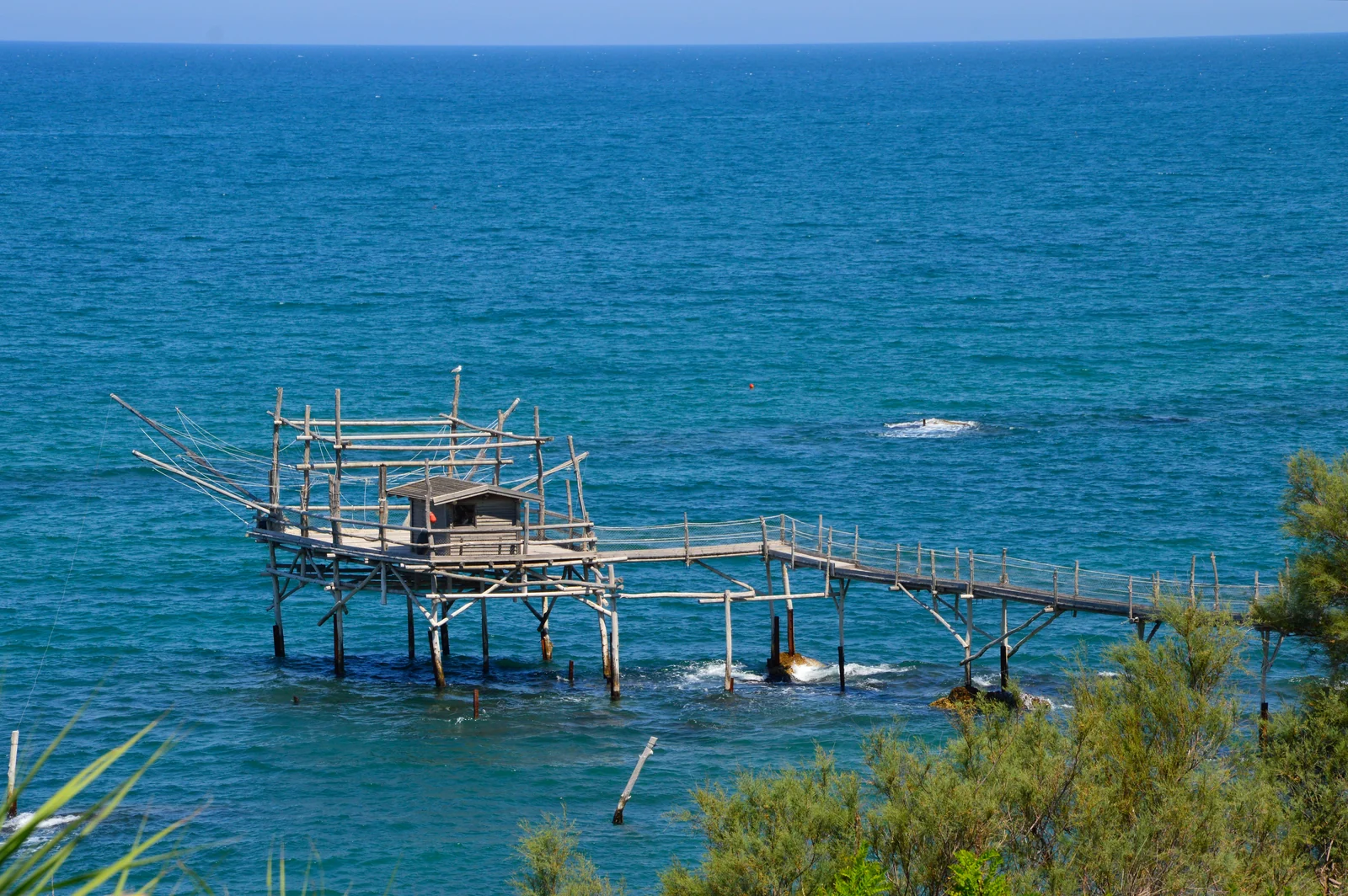
Between Ortona and Vasto the coast of the province of Chieti changes pace. After the long sandy beaches of northern Abruzzo the shoreline turns rocky and indented, with cliffs, small inlets and pebble coves. Around thirty trabocchi survive along this stretch of the Adriatic: wooden stilt structures standing over the water, joined to the shore by a walkway, which for generations allowed people to fish without putting out to sea.
That combination is the reason to come. A landscape to take in slowly, made of headlands, olive groves and orange groves running down to the sea, and a heritage of maritime architecture with no equivalent elsewhere on the Abruzzo coast. From the viewpoints of the hill towns, on clear days, the eye reaches the Majella, the Gargano and the Tremiti islands.
Many trabocchi have been restored and some now serve Adriatic fish: sitting down to eat on one of these structures, after crossing the walkway creaking above the water, is the experience that best captures the coast. Around them are nature reserves, medieval villages, a town holding the relics of an apostle and a cycle path laid on the old railway line: enough for two or three unhurried days.
Sources: Italia.it — La Costa dei Trabocchi in Abruzzo · Italia.it — Costa dei Trabocchi · Italia.it — Le terrazze sul mare d’Abruzzo · Italia.it — Trabocco Valle Grotte
History
The origins of the trabocchi remain uncertain. Some link them to the Phoenicians, but the most widely held explanation is a practical one: building a fishing machine anchored to the rocks to avoid the dangers of the open sea. An early witness is a fifteenth-century religious text on the life of Pietro da Morrone, the future Pope Celestine V, who around 1240 lived at the abbey of San Giovanni in Venere in Fossacesia: it describes a sea dotted with trabocchi, a sign that they were already a familiar sight. Building techniques were never written down but handed on by word of mouth and practice among the traboccanti: architecture without architects, hard to reduce to calculations and drawings.
The coast was inhabited long before that. At San Vito Chietino excavations by the archaeological superintendency between 1991 and 1995 uncovered a small Roman landing place later turned into a workshop for oil lamps, abandoned in the third century and reoccupied between the late fifth and seventh centuries, when the site watched over the coast for the Byzantines. Ortona, home in antiquity to the Frentani, received the relics of the apostle Thomas from the island of Chios in 1258.
In the summer of 1889 Gabriele d’Annunzio stayed with Barbara Leoni in a rustic house on the Portelle headland at San Vito, and in The Triumph of Death compared the trabocco to a colossal spider. Half a century later Ortona, the eastern end of the Gustav Line, was destroyed in the battle of 1943, which cost the lives of some 1,300 townspeople.
Sources: Italia.it — La Costa dei Trabocchi in Abruzzo · Italia.it — Trabocco Valle Grotte · Italia.it — Ortona · Comune di San Vito Chietino, Visit San Vito — L’area archeologica · Comune di San Vito Chietino, Visit San Vito — I luoghi dannunziani
What to see
The most famous trabocco is the Turchino at San Vito Chietino: the oldest on the coast according to the municipality, rebuilt several times and most recently in 2016 after a storm surge. It is the only one in the municipality without a restaurant and can be visited by booking through the tourist information office. From the Promontorio Dannunziano, a viewpoint on the SS16 coastal road, a path leads down to its walkway. Between San Vito and Ortona stand the trabocchi of Valle Grotte, Punta Fornace, San Giacomo, Lupone and Punta del Porto; further south Fossacesia has Pesce Palombo and Punta Rocciosa, Torino di Sangro the Punta Le Morge trabocco, reachable from the beach, and Vasto those of Punta Penna.
Ortona deserves more than a quick stop. The cathedral of San Tommaso, rebuilt in the twentieth century, keeps the apostle’s relics in its crypt. The Aragonese Castle, raised from the mid-fifteenth century on medieval foundations to defend the harbour, stands sheer above the sea and, after restoration in the 2000s, houses a small museum in one of its towers; Palazzo Farnese and Palazzo Corvo complete the centre, and the Passeggiata Orientale is the great balcony over the Adriatic.
Vasto, at the southern end, is best explored on foot: Palazzo d’Avalos with its eighteenth-century garden and sea terrace, the Caldoresco Castle, the cathedral and the church of the Carmine, and the remains of Roman baths with mosaic floors. At San Vito, finally, the Marconi and Mare e Monti viewpoints open a view from the Apennines down to Vasto.
Sources: Italia.it — La Costa dei Trabocchi in Abruzzo · Italia.it — Ortona · Italia.it — Castello Aragonese di Ortona · Italia.it — Vasto · Comune di San Vito Chietino, Visit San Vito — Trabocco Turchino · Comune di San Vito Chietino, Visit San Vito — I belvedere · Italia.it — Le terrazze sul mare d’Abruzzo
Food and wine
The cooking of the Chieti coast brings together the Adriatic catch and the vegetables of the hills that run down to the sea. The emblematic dish is brodetto, the fish stew whose name changes along the shore and which in Vasto is called vrudàtte: Brodetto alla Vastese is cited as a model of this double, seafaring and farming soul. Several trabocchi converted into restaurants serve fish dishes: dinner suspended over the water has become one of the best-known ways to experience the coast.
From the land come maccheroni alla chitarra, square-section spaghetti cut on a frame strung with steel wires and often served with tiny meatballs called pallottine, and olio santo, extra virgin oil in which chillies are steeped. Among cured meats the Ventricina del Vastese stands out, a Slow Food Presidium: pork cut with a knife, seasoned with salt and ground Peperone dolce di Altino and stuffed into a ball that cures for months.
The hills behind the sea are vineyard and olive country. San Vito Chietino, with its pergola-trained vines and olive groves, holds the title of Città dell’olio. In the glass you will find Montepulciano d’Abruzzo, the rosé Cerasuolo d’Abruzzo made from the same grape with brief skin contact, and the white Trebbiano d’Abruzzo, straw-yellow with a fruity bouquet; Cerasuolo in particular pairs with both land and sea cooking.
Sources: Italia.it — Trabocco Valle Grotte · Italia.it — Storia dei maccheroni alla chitarra e altre meraviglie dell’Abruzzo a tavola · Italia.it — Prodotti e piatti tipici abruzzesi · Fondazione Slow Food — Presidio Ventricina del Vastese · Comune di San Vito Chietino, Visit San Vito — Scopri San Vito
Things to do
The most natural way to travel the coast is by bicycle. The Via Verde della Costa dei Trabocchi follows the old route of the Adriatic railway between Ortona and Vasto and is designed as an accessible cycling and walking path, including for people with disabilities. It is part of Bike to Coast, the 131-kilometre cycle route that runs along the entire Abruzzo coast from Martinsicuro to San Salvo. From the Via Verde branches the Rete Ciclabile dei Trabocchi: 263 kilometres in twelve routes climbing into the hill country inland, among wineries, villages and natural sites. No special fitness is required, but it is worth spreading the ride over several days.
For walkers, the Punta Aderci Regional Nature Reserve north of Vasto was the first protected area established on the Abruzzo coast. It runs from the sandy, dune-backed beach of Punta Penna to the pebbles of the Libertini beach and up to the Punta Aderci headland, 26 metres above the sea, with views over the Majella, the Gran Sasso and the Sibillini. Beyond Mottagrossa beach a panoramic path of about three kilometres along the former railway bed crosses pinewoods and Mediterranean scrub to the mouth of the Sinello. The reserve’s emblem is the Kentish plover, which nests on the sand: watch it without disturbing it.
At Ortona a wooden staircase descends 65 metres down the cliff to the Ripari di Giobbe reserve, reachable only on foot, for a swim in clear water.
Sources: Italia.it — La ciclovia Bike to Coast in Abruzzo · Comune di San Vito Chietino — Rete Ciclabile dei Trabocchi · Riserva Naturale Regionale di Punta Aderci — La riserva · Italia.it — Punta Aderci · Italia.it — La Costa dei Trabocchi in Abruzzo
When to go
The coast is enjoyable in spring, summer and autumn, each with its own character. Summer is swimming season: the beaches of Punta Penna, with a sandy, gently shelving seabed, suit families, while the pebble coves and cliffs draw those looking for clear water and quiet. These are also the months when the trabocco restaurants are busiest, so it pays to plan ahead.
Spring and autumn are the best seasons for cycling and walking: temperatures are milder and the paths through the pinewoods and along the Sinello, which the Punta Aderci reserve advises avoiding in the hottest hours of summer, become pleasant. Sea lilies, spurge and helichrysum grow on the dunes, and birdwatchers may see grey herons, little egrets and, with luck, flamingos. The Kentish plover nests on the beaches and should be left in peace during that period.
Winter is the quietest season: storm surges test the wooden structures, as the history of the repeatedly rebuilt Turchino shows, and the landscape turns harsher. Those who love the coast without crowds can still find clear days when the snow-capped mountains appear above the sea from the viewpoints.
Sources: Italia.it — Punta Aderci · Riserva Naturale Regionale di Punta Aderci — La riserva · Italia.it — La ciclovia Bike to Coast in Abruzzo · Italia.it — Trabocco Valle Grotte
Getting there and around
The main gateway is Pescara, with its airport and the station served by long-distance trains. From Pescara, Trenitalia regional trains and Sangritana services run down the Adriatic line to San Vito-Lanciano station, in the heart of the coast; the municipality of San Vito refers travellers to the Trenitalia website for timetables. From Pescara airport city buses reach the centre and the station, from where you continue by train or bus towards Lanciano and the coast.
Bus services are largely run by TUA, the Trasporto Unico Abruzzese, which in summer has also operated a town shuttle between San Vito Chietino and San Vito Marina; other private coach lines link Pescara and Lanciano and run from Rome Fiumicino and Ciampino to Lanciano. By car, take the A14 motorway to the Lanciano exit, or the SS16 Adriatica road, which runs parallel to the coast and passes headland after headland and trabocco after trabocco.
Once there, the easiest and most pleasant way to move between trabocchi is the Via Verde, ridden or walked along the old railway route. For the hill towns such as San Vito or Rocca San Giovanni, and for the hinterland, you need a car or local buses.
Sources: Comune di San Vito Chietino, Visit San Vito — Come arrivare · TUA — Trasporto Unico Abruzzese · Italia.it — La ciclovia Bike to Coast in Abruzzo · Italia.it — La Costa dei Trabocchi in Abruzzo
Where to stay
The coast offers small-scale, widely spread hospitality. The list of accommodation published by the municipality of San Vito Chietino shows the range: bed and breakfasts in the village and along the marina, holiday homes and flats with sea views, campsites near the beach, and relais and farmhouses set among olive groves in the countryside. The municipality is made up of three separate centres, the hill town, the marina and Sant’Apollinare, and the choice depends on what you want: the village for its viewpoints and evenings in the square, the marina for the sea and the Via Verde on the doorstep.
Ortona and Vasto, at either end, are the most convenient bases for those who prefer a town with services, museums and evening life. Upper Vasto, half a kilometre from the sea, lets you combine walks in the old centre with swims at Vasto Marina and Punta Aderci; Ortona, perched above the coast, has twenty kilometres of beaches below it.
In the hills inland, among vineyards and olive groves, there are country houses and agriturismi, suited to travellers with a car who want to alternate sea and villages. Apulica does not name individual properties here: it selects them case by case according to the trip, with no availability promised in advance.
Sources: Comune di San Vito Chietino, Visit San Vito — Dove dormire · Comune di San Vito Chietino, Visit San Vito — Scopri San Vito · Italia.it — Vasto · Italia.it — Ortona
Nearby
Just above the coast, Rocca San Giovanni stands on a rocky hill: its first settlement dates from 1076 and soon became a castle, a refuge for the nearby abbey of San Giovanni in Venere. The medieval walls survive, while olive and orange groves run down towards the coves. The Fossacesia abbey, tied to the youth of Pietro da Morrone, is itself one of the places offering the widest view over this stretch of coast.
San Vito Chietino, which d’Annunzio called the village of broom, sits on a spur above the sea and keeps parts of its walls and old churches; from the Mario Lanci viewpoint at Sant’Apollinare you look over the valley of the river Moro, a physical marker of the Gustav Line. To the south, the Lecceta di Torino di Sangro Regional Nature Reserve protects 175 hectares of woodland crossed by trails, where roe deer have returned. San Salvo, the last Abruzzo town before Molise, has a medieval centre and the Quadrilatero archaeological park.
Travellers continuing along the Adriatic can link this coast with Termoli and, further south, with the trabucchi of the Gargano, close relatives of the Abruzzo trabocchi.
Sources: Italia.it — Rocca San Giovanni · Italia.it — Le terrazze sul mare d’Abruzzo · Italia.it — La ciclovia Bike to Coast in Abruzzo · Italia.it — San Vito Chietino
Local tourist information
Local tourist offices help with opening times, events and transport on the day.
- Ufficio Sport e Turismo — Comune di San Vito Chietino · Largo Carlo Altobelli 1, 66038 San Vito Chietino (CH) · +39 0872 619192 · Official website
Source: Comune di San Vito Chietino — Ufficio Sport e Turismo · Comune di San Vito Chietino — Rete Ciclabile dei Trabocchi · checked on
Where to stay
In the municipality of San Vito Chietino the national database of the Ministry of Tourism lists 229 accommodation businesses with a verified CIN code: 2 hotels, 23 other licensed accommodation and 204 other types such as B&Bs and private rentals.
Sources: Ministero del Turismo – Banca Dati Strutture Ricettive (dashboard pubblica), 2026-10-12
YOUR JOURNEY
How to shape a journey here
Two days along the coast from Ortona to Vasto, with a stop at the Eremo Dannunziano and a meal on a trabocco. To be arranged with local operators.
Talk to us about it