
Why go
Martignano, Martignàna in Griko, is the smallest village of the Grecìa Salentina: about 1,700 inhabitants on olive-covered ridges, 95 metres above the sea. The municipality describes it as lively despite its size, with clean air, green countryside, well-kept public spaces and many cultural initiatives, and as an ideal base from which to set out each day towards the places and flavours of the Grecìa and Salento.
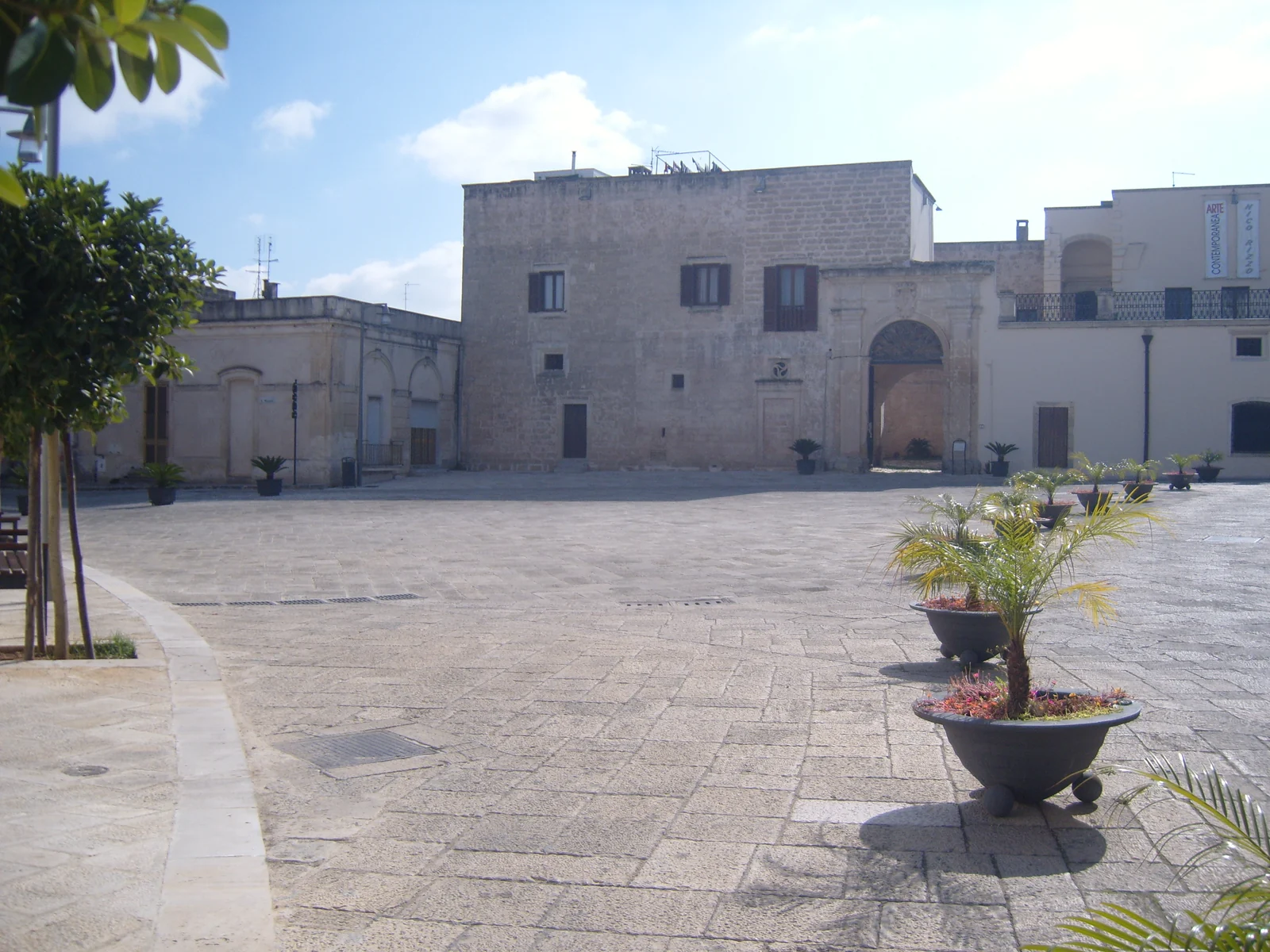
The heart of the village is Palazzo Palmieri, the residence where the Enlightenment thinker Giuseppe Palmieri was born, now a tourist and cultural park: a garden turned public park, a semi-underground olive press open to visitors, rooms for exhibitions and meetings, a media library and the tourist info point. Around it, Via Chiesa keeps decorated portals and courtyard houses, and the church of Santa Maria dei Martiri holds Baroque altars and statues of the patron saint Pantaleon.
Then there is water, a precious resource on this land: in the lowest part of the village, the wells of San Pantaleo show how the community collected rainwater for centuries. Martignano can be seen in a few hours, but it is better understood by staying for an evening, perhaps during one of its festivals.
Sources: Comune di Martignano — Cenni storici · Comune di Martignano — Via Chiesa e Piazza Palmieri · Comune di Martignano — Chiesa di S. Maria dei Martiri · Unione dei Comuni della Grecìa Salentina — Martignano
History
Martignano's origins remain uncertain: the municipality considers unproven the idea of a Roman origin from the name Martinius, and fanciful the derivation from the marten, the animal adopted as the town emblem in the sixteenth and seventeenth centuries. Strong, by contrast, is the link with the Greek-Byzantines, who settled these lands in the ninth and tenth centuries, and with monks inspired by Saint Basil and their work of agricultural settlement.
The first written documents date from the second half of the thirteenth century, when under the Angevins Martignano and Sternatia were granted as a fief to Simone Belvedere. The Briennes followed, then Maria d'Enghien and, from the sixteenth century, several families: the Pignatelli, the Palmieri, the Pisanelli and finally the Granafei. Until the mid-seventeenth century services were held in Griko; with the archpriest Francesco Giannuzzo, elected in 1650, the line of Latin-rite archpriests began.
The seventeenth and eighteenth centuries were hard, with epidemics, flight and a sharp fall in population. Feudalism ended in 1806, and from 1808 to 1832 the village was merged with Sternatia. Martignano was the birthplace of Giuseppe Palmieri, an Enlightenment economist who helped dismantle the feudal system in the Kingdom of Naples.
Sources: Comune di Martignano — Cenni storici · Comune di Martignano — Cultura grica · Unione dei Comuni della Grecìa Salentina — Cenni storici · Unione dei Comuni della Grecìa Salentina — Martignano
What to see
Via Chiesa is the street to walk slowly: the municipality points out richly decorated portals with animal motifs, such as the Volpe and Pasca portals, and old courtyard houses. At its end opens Piazza Palmieri, dominated by the palace built in the sixteenth century as both residence and stronghold and enlarged until the eighteenth. The complex includes the garden, the semi-underground olive press, used for guided tours, tastings and cultural evenings, a vaulted conference room and the chapel of San Giovanni Battista, whose interior is frescoed with two cycles: Christ with apostles and saints below, the life of the Baptist above.
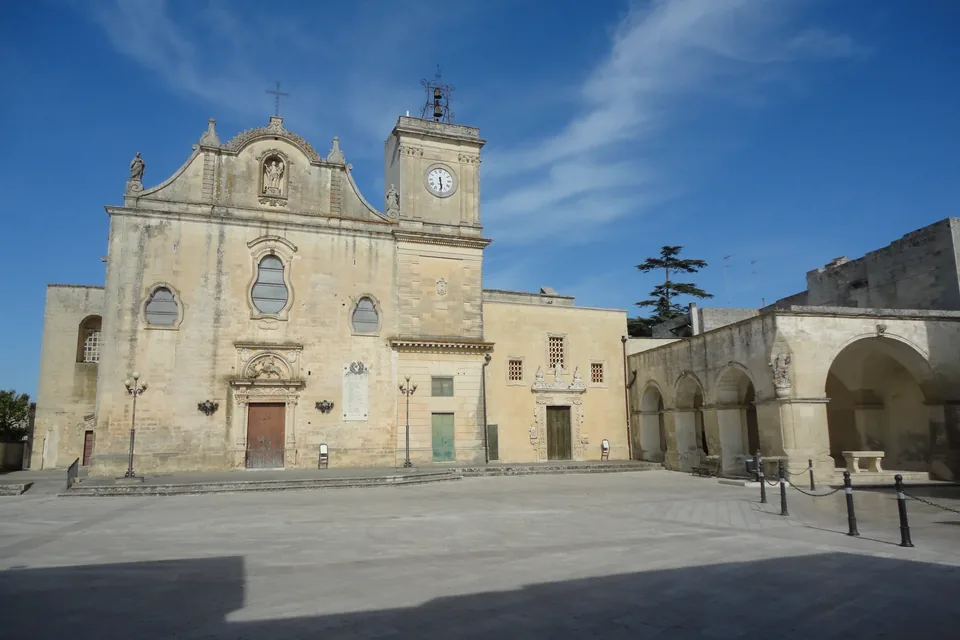
In Piazza della Repubblica, the church of Santa Maria dei Martiri, with its sixteenth-century façade, holds Baroque altars, including the imposing altar of the Madonna del Rosario, canvases by Pasquale Grassi and Oronzo Tiso, a mosaic with geometric and floral motifs and statues of Saint Pantaleon, in papier-mâché, in silver and, outside on the square, in Lecce stone.
In the lower part of the village, in Largo Pozzelle, are the wells of San Pantaleo, old rainwater collection systems. The convent of San Francesco, from the early seventeenth century, and, on the outskirts, the chapels of the Madonna delle Grazie and of the Mantovano complete the visit.
Sources: Comune di Martignano — Via Chiesa e Piazza Palmieri · Unione dei Comuni della Grecìa Salentina — Martignano · Regione Puglia — Parco Palmieri · Comune di Martignano — Chiesa di S. Maria dei Martiri · Comune di Martignano — Largo Pozzelle, i pozzi di San Pantaleo
Food and wine
The dish that represents Martignano is the insalata grika, the star of a food festival organised by the Pro Loco since 1992. The municipality lists its ingredients, all from the Grecìa Salentina: tomatoes, small melons called minunceddhe, horn peppers, white onion, chilli, wild rocket, black olives cured in jars, capers, oregano and fresh primo sale cheese, all dressed with extra virgin olive oil. It recalls the meals of farm workers after the grain harvest or the tobacco harvest, once an important source of income for the village.
At the festival it comes with grilled sausage, pittule fritters, minchiareddhi of fresh pasta, horse meat stewed in tomato, meatballs, panzarotti and friselle, the twice-baked bread that the Atlas of traditional Apulian products describes as dampened in water and dressed with tomato and oil.
The oil is that of the Terra d'Otranto PDO, produced throughout the province of Lecce; the semi-underground press of Palazzo Palmieri, now used for tastings, shows how much its making weighed in village life. Among the pulses of the Grecìa, the Slow Food Foundation protects the dwarf pea of Zollino, grown without irrigation in nearby villages and eaten only dried.
Sources: Comune di Martignano — Feste, sagre e fiere · Atlante dei PAT di Puglia — Friselle di orzo e grano · Qualigeo — Terra d'Otranto DOP · Comune di Martignano — Via Chiesa e Piazza Palmieri · Fondazione Slow Food — Piselli tradizionali salentini
Things to do
Palazzo Palmieri is where the village's cultural life is concentrated. The municipality describes it as a tourist and cultural park, with the semi-underground olive press open for guided tours, tastings, exhibitions and evenings, a conference room and the Mediterranean Media Library; the park's cultural programmes draw audiences from across the area. It is also the ideal starting point for a walk through the historic centre.
The village is a good base for getting to know Griko culture. Griko, the municipality notes, is an ancient Greek still spoken by older people, and Martignano shares a common historical and linguistic heritage with the other municipalities of the Union of the Grecìa Salentina. The Cammino del Salento, described by the national portal, crosses the Grecìa on foot with a stage ending in Sternatia, a few kilometres away.
The distances given by the municipality explain the convenience of the location: Lecce and Torre dell'Orso are about 15 kilometres away, Otranto 20, Gallipoli 38, Santa Maria di Leuca 50. You can therefore alternate days in villages, at the sea and in the city while returning to Martignano each evening.
Sources: Comune di Martignano — Via Chiesa e Piazza Palmieri · Comune di Martignano — Cenni storici · Italia.it — Cammino del Salento in 6 tappe · Comune di Martignano — Come raggiungerci
When to go
The festival calendar is the best guide to when to come. The patron Saint Pantaleon is celebrated on 26 and 27 July, and the municipality notes that the patronal festival, like the Martignano and Grecìa Salentina Carnival, brings thousands of people to the small village. The events mentioned also include the Morte te lu Paulinu and the cultural programmes of the Palmieri Park.
The festival of insalata grika and sausage, organised by the Pro Loco without interruption since 1992, draws thousands of visitors every year with Salento and Griko specialities prepared by village associations: a chance to taste the cooking of the Grecìa in the square, to be checked in the Pro Loco's calendar.
Spring and autumn are ideal for walking between the village and the olive countryside, visiting the olive press and the churches at leisure and moving on to other Grecìa towns without the summer heat. In autumn the olive harvest brings attention back to the work that shaped the village's history.
Sources: Comune di Martignano — Largo Pozzelle, i pozzi di San Pantaleo · Comune di Martignano — Cenni storici · Comune di Martignano — Feste, sagre e fiere · Qualigeo — Terra d'Otranto DOP
Getting there and around
The municipality gives distances to get your bearings: Martignano is 15 kilometres from Lecce, 55 from Brindisi, 20 from Otranto, 38 from Gallipoli, 50 from Santa Maria di Leuca, 15 from Torre dell'Orso and 38 from Porto Cesareo. The village stands at the crossing of the ancient Via Traiana Calabra and the road from Roca Vecchia to Nardò, and it remains a convenient crossroads for Salento.
Those arriving by train on the national network get off at Lecce: the station, run by RFI, offers assistance to passengers with reduced mobility and integrated mobility services such as a bus stop, bike sharing and car rental. From Lecce, Martignano is reached by car or local connections. The nearest airport, judging by the municipality's distances, is Brindisi.
The village can be explored entirely on foot, from Piazza Palmieri to Piazza della Repubblica and Largo Pozzelle. To visit the Grecìa Salentina, with Calimera, Martano, Sternatia and Melpignano close by, it is best to travel by car or bicycle; walkers can follow the stages of the Cammino del Salento.
Sources: Comune di Martignano — Come raggiungerci · Unione dei Comuni della Grecìa Salentina — Martignano · RFI — Stazione di Lecce · Italia.it — Cammino del Salento in 6 tappe
Local tourist information
Local tourist offices help with opening times, events and transport on the day.
- Info Point turistico di Martignano · Palazzo Palmieri, Piazza Palmieri, Martignano (LE)
Source: Comune di Martignano — Via Chiesa e Piazza Palmieri · checked on - Pro Loco Martignano · Parco Sabra e Chatila, presso la Stanza della storia, Martignano (LE) · +39 389 554 4424
Source: Comune di Martignano — I.A.T. e Pro Loco · checked on
Where to stay
In the municipality of Martignano the national database of the Ministry of Tourism lists 15 accommodation businesses with a verified CIN code: 0 hotels, 4 other licensed accommodation and 11 other types such as B&Bs and private rentals.
Licensed businesses from the official list of Regione Puglia, each with a checked national CIN code: matching municipality and category. Private individuals are not listed. Check directly with the property before booking.
B&B Le Due Corti
B&B
CIN IT075041B400126842
Sources: Regione Puglia – ARET Pugliapromozione (DMS), CC BY 4.0, 2026-10-12 · Ministero del Turismo – Banca Dati Strutture Ricettive (dashboard pubblica), 2026-10-12
YOUR JOURNEY
How to shape a journey here
Water, courtyards and olive-oil history. Interior access and guiding are arranged for the visit.
Talk to us about it
_-_piazza.JPG)


