
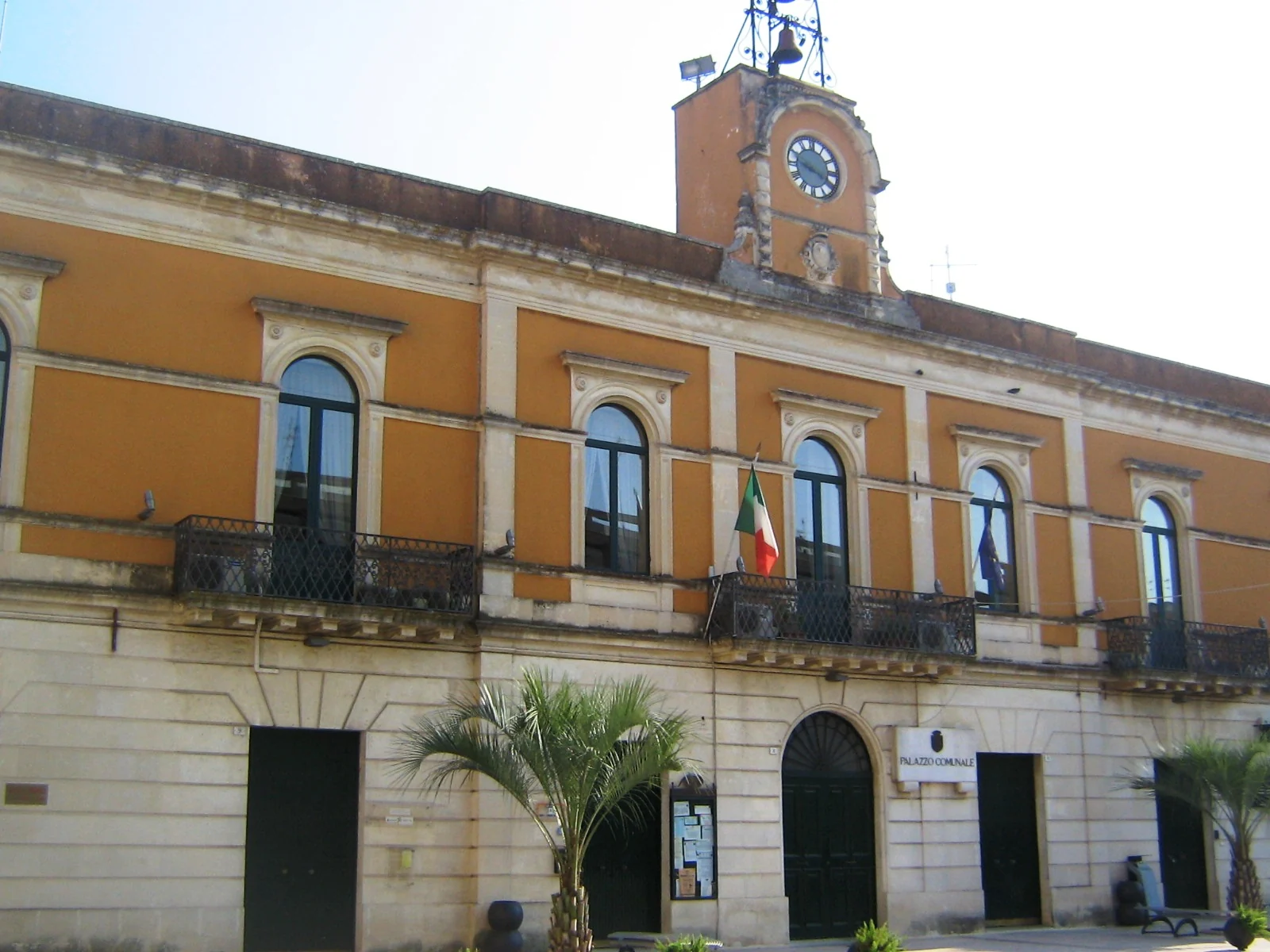
Why go
Calimera is one of the villages of the Grecìa Salentina, the part of Salento where Griko, a language of Greek origin handed down orally for centuries, has survived. The municipality has made it the centre of intense cultural work to recover this identity, and you sense it as you walk: in the public gardens an Attic stele donated by Athens in 1960 bears an inscription in Griko telling visitors that here they are no strangers.
The village is best explored slowly. The mother church of San Brizio in Piazza del Sole, the courtyard houses of Via Costantini and Via Montinari, the seventeenth-century chapels and, just outside the village, the country chapel of San Vito with its great pierced stone tell of a community that for centuries combined the Greek and Latin rites, poor soil and a strong religious and popular life.
It is also a place to learn about rural life: the House-Museum of Peasant Civilisation and Griko Culture, in a typical courtyard house, gathers objects, books and recordings. Calimera makes a good base for the Grecìa Salentina, a short distance from Lecce and the Adriatic coast.
Sources: Comune di Calimera — La storia · Comune di Calimera — Itinerari culturali e turistici · Comune di Calimera — Casa-museo della Civiltà Contadina e della Cultura Grika · Unione dei Comuni della Grecìa Salentina — Calimera
History
The village stands on the Via Traiana Calabra, the ancient road linking Otranto with Lecce and Brindisi, in an area inhabited since the Bronze Age. Its origins remain uncertain: as with the other Greek-speaking centres, scholars link it either to Byzantine settlement or to older Magna Graecia roots. The Union of Municipalities of the Grecìa Salentina recalls the arrival of many Greek clergy in the Byzantine period, between the ninth and tenth centuries, and the slow decline of the rite and the language after that rule ended.
Calimera long remained one of the places where Greek clergy were active, and until the end of the nineteenth century the village was entirely Greek-speaking. The land was poor and many inhabitants lived by making charcoal from the wood of the great forest: they were the craunàri, charcoal burners and pedlars, whose protector was Saint Blaise. Palazzo Montinari may have been the residence of the last protopapas of the Greek rite, who died in 1621.
In the twentieth century emigration and television reduced the number of speakers; since the 1990s the municipalities of the area have worked together to save the language and culture, eventually forming in 2001 the Union of Municipalities of the Grecìa Salentina, which is based in Calimera itself.
Sources: Comune di Calimera — La storia · Unione dei Comuni della Grecìa Salentina — Calimera · Unione dei Comuni della Grecìa Salentina — Cenni storici · Comune di Calimera — Itinerari culturali e turistici
What to see
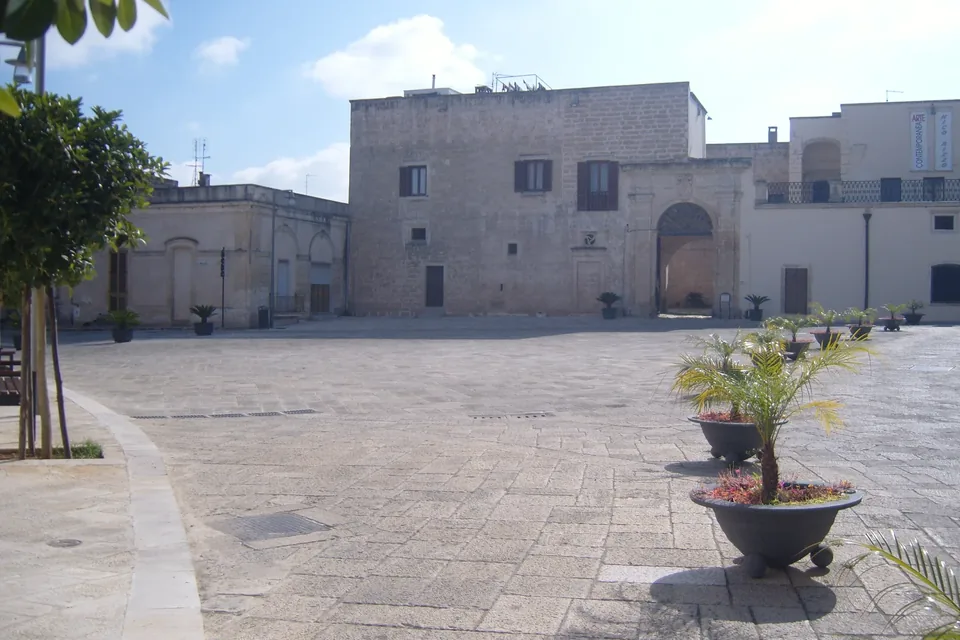
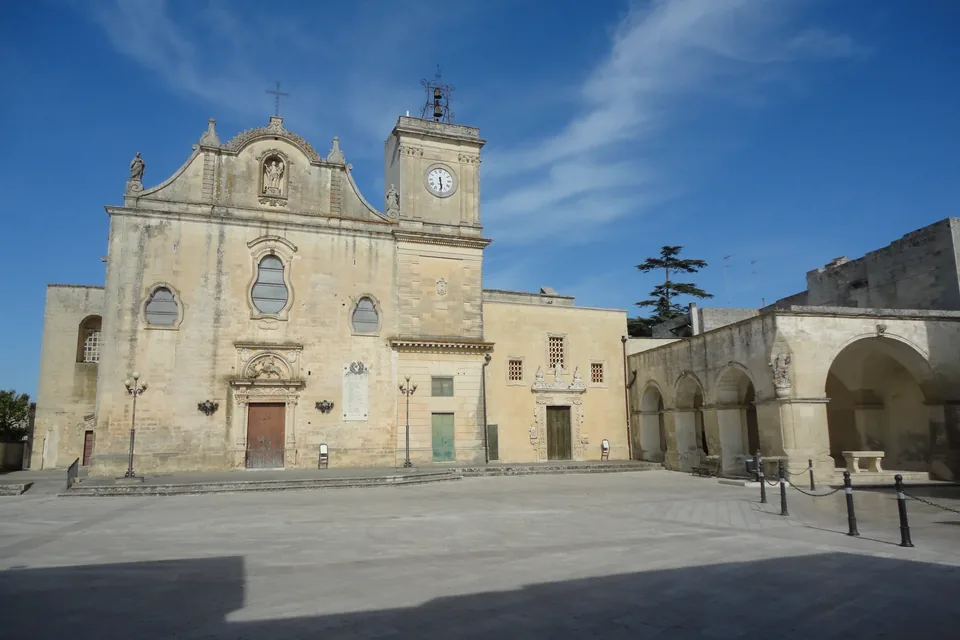
The route suggested by the municipality starts from Piazza del Sole. The mother church, rebuilt with a single nave in 1689, has a Baroque portal with the patron saint's statue and nine altars; the most unusual is that of the Madonna della Misericordia, shown expecting a child. From here Via Costantini displays seventeenth-century building and, in Vico San Vito, the typical hierarchy of spaces between street, courtyard and house; at number 41 a low courtyard house shows the dwelling of a poor peasant family.
Via Montinari, the main street, leads to the church of Sant'Antonio, beside which a hospice for pilgrims once stood, to the courtyards of San Calimero and San Paolo, to the Carmine chapel dated 1577 and to the portal of Palazzo Montinari. In the public gardens, among busts of local Hellenists, stands the fourth-century BC marble stele donated by Athens. On Via Mayro you find Palazzo Murrone, the birthplace of the Hellenist Vito Domenico Palumbo and the Crocifisso chapel of 1698, with its frescoed vault.
The House-Museum of Peasant Civilisation on Via Costantini and the country chapel of San Vito complete the visit. Outside the village, the Salento Natural History Museum houses the provincial wildlife observatory and centres caring for wild animals and sea turtles.
Sources: Comune di Calimera — Itinerari culturali e turistici · Comune di Calimera — Chiesa madre · Comune di Calimera — Casa-museo della Civiltà Contadina e della Cultura Grika · Comune Calimera — Chiesa di San Vito · Comune di Calimera — Museo di Storia Naturale del Salento
Food and wine
The cooking of the Grecìa Salentina comes from poor land and careful farming. Among the products most closely tied to the area is the dwarf pea of Zollino, grown in the Grecìa villages and protected as a Slow Food Presidium together with other traditional Salento peas: it is eaten only dried and grows without irrigation, like many pulses of this countryside.
Pulses are the basis of many home dishes. Ciceri e tria, pasta partly boiled and partly fried with chickpeas, is according to the Atlas of traditional Apulian products the dish of Saint Joseph's feast; in Calimera the feasts of saints of eastern origin, such as Saint Blaise, whom the municipality also recalls as protector of the throat, still mark the year.
The oil is that of the Terra d'Otranto PDO, produced throughout the province of Lecce from Cellina di Nardò and Ogliarola Leccese. The village has few but genuine places to eat: the municipal hospitality page lists trattorias, pizzerias and a delicatessen, useful for extending the visit, while the House-Museum also preserves the memory of the rural life behind these flavours.
Sources: Fondazione Slow Food — Piselli tradizionali salentini · Atlante dei PAT di Puglia — Ciciri e tria · Comune di Calimera — Feste · Qualigeo — Terra d'Otranto DOP · Comune Calimera — Accoglienza · Comune di Calimera — Casa-museo della Civiltà Contadina e della Cultura Grika
Things to do
The most distinctive experience is stepping into Griko culture. The House-Museum, created by the Ghetonìa association, is more than a display of objects: it has a library, a newspaper archive and a collection of videos and recordings, and the municipality presents it as the starting point for discovering the Grecìa Salentina. The Union of Municipalities notes that Griko, born as a spoken language, now also survives as a language of study and culture; Calimera hosts a Griko school and a heritage of religious, work and mourning songs.
For a walk in the green there is the nine-hectare municipal pine wood, protected for its landscape value, with an equipped nature trail of just over a kilometre and picnic areas. The countryside among the olive trees leads to the chapel of San Vito, where on Easter Monday the rite of passing through the pierced stone is repeated.
Folk music is another thread: the Notte della Taranta Foundation recalls that the festival was born in 1998 in the villages of the Grecìa Salentina and travels from square to square before the final concert in nearby Melpignano. Nature lovers can visit the Salento Natural History Museum.
Sources: Comune di Calimera — Casa-museo della Civiltà Contadina e della Cultura Grika · Unione dei Comuni della Grecìa Salentina — Il Griko · Comune di Calimera — La storia · Unione dei Comuni della Grecìa Salentina — Calimera · Comune di Calimera — Beni naturali e artistici · Comune di Calimera — Feste · Fondazione La Notte della Taranta — Festival itinerante · Comune di Calimera — Museo di Storia Naturale del Salento
When to go
Calimera can be visited all year, and the festival calendar described by the municipality is the best way to choose when. On 3 February Saint Blaise is celebrated in a clearing at the edge of the old forest; on Easter Monday people go to the chapel of San Vito for the pierced-stone rite. On the first Saturday of May there is a pilgrimage to the sanctuary of the Madonna di Roca on the Adriatic, the place from which inhabitants moved inland in the sixteenth century; the following Sunday brings the fair.
On 21 June, for Saint Aloysius, the village fills with lanterns made of tissue paper, cane and string in the shape of ships, stars or bell towers, up to five or six metres tall and lit from inside, with music and folk dancing: a festival the municipality traces possibly to the Byzantine period. On 28 and 29 July the patron Saint Brice is celebrated, a time of reunion with Calimera people living elsewhere. On the last Sunday of September the fair of the Madonna di Costantinopoli marks the return of village life.
Spring and autumn are ideal for walking between village and countryside; in summer it is best to visit the centre in the cooler hours and leave the evening to the festivals.
Sources: Comune di Calimera — Feste
Getting there and around
Calimera is a short distance from Lecce. The municipality gives the simplest way to arrive by car: from the Lecce-Leuca dual carriageway follow the signs for the centre to reach Piazza del Sole, where you can park and start exploring on foot. The historic centre is compact and all the stops on the municipal route are close together; for the chapel of San Vito you follow the country lane of the same name, and for places outside the village, such as the Salento Natural History Museum, it is best to take the car again.
Those arriving by train on the national network get off at Lecce, whose station, run by RFI, offers assistance to passengers with reduced mobility and integrated mobility services such as a bus stop and car rental; from there the villages of the Grecìa Salentina are reached by local connections or by car.
To visit several Grecìa villages in a day, such as Martano, Martignano, Sternatia and Melpignano, a car or a bicycle lets you move freely between centres close to one another. The Cammino del Salento, described by the national portal, crosses the Grecìa Salentina on foot, with a stage ending in Sternatia.
Sources: Comune di Calimera — Itinerari culturali e turistici · Comune di Calimera — Museo di Storia Naturale del Salento · RFI — Stazione di Lecce · Italia.it — Cammino del Salento in 6 tappe
Where to stay
The municipality's hospitality page describes a small, family-scale offer, suited to those who want to enjoy the village at a slow pace. For accommodation it lists a few bed and breakfasts in the village streets and a masseria on the provincial road between Calimera and Martano: two different ways to stay, one inside everyday village life, the other in the olive countryside.
For food, the same page lists trattorias, pizzerias and a delicatessen. Among them, the Filippu e Panaru trattoria on Via Costantini, the same street as the House-Museum, is a convenient reference for combining visit and lunch; the municipal entry dates from 2024, so opening, menu and group availability should be checked with a current contact.
Calimera works well as a base for exploring the Grecìa Salentina: neighbouring villages are a few minutes away, Lecce is close by and the Adriatic coast, with Torre dell'Orso and Roca, is within reach for a beach day. Those who prefer the city can stay in Lecce and give Calimera half a day.
Sources: Comune Calimera — Accoglienza · Comune di Calimera — Feste
Where to stay
In the municipality of Calimera the national database of the Ministry of Tourism lists 28 accommodation businesses with a verified CIN code: 1 hotels, 3 other licensed accommodation and 24 other types such as B&Bs and private rentals.
Licensed businesses from the official list of Regione Puglia, each with a checked national CIN code: matching municipality and category. Private individuals are not listed. Check directly with the property before booking.
TENUTA MASSERIA DEL GALLO
Farm stay
CIN IT075010B500022469
Azzurra Aparthotel
Hotel · ★★★★ · Website
CIN IT075010A100104880
Sources: Regione Puglia – ARET Pugliapromozione (DMS), CC BY 4.0, 2026-10-12 · Ministero del Turismo – Banca Dati Strutture Ricettive (dashboard pubblica), 2026-10-12
YOUR JOURNEY
How to shape a journey here
Language and rural memory in Grecìa Salentina. Cultural visits and guiding are arranged for the journey.
Talk to us about it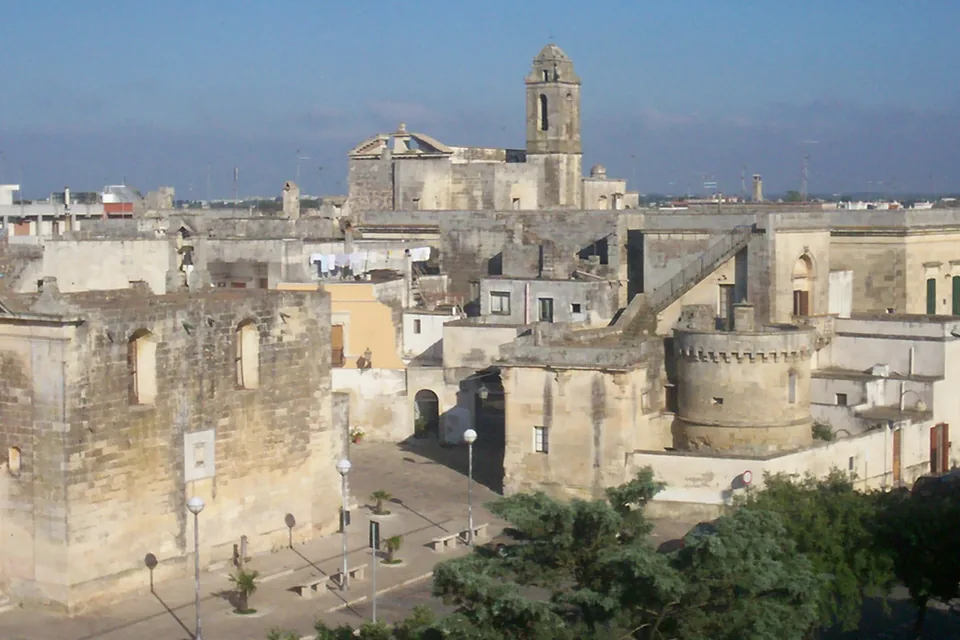


_-_piazza.JPG)

