
Why go
Spongano is a village in inland Salento, 98 metres above sea level, tied for centuries to the county of Castro and its Adriatic coast. It is not a crowded destination, and that is precisely its interest: a place where the story of one family, the barons Bacile di Castiglione, is intertwined with the work of olive oil and the changes Salento went through in the nineteenth and twentieth centuries.
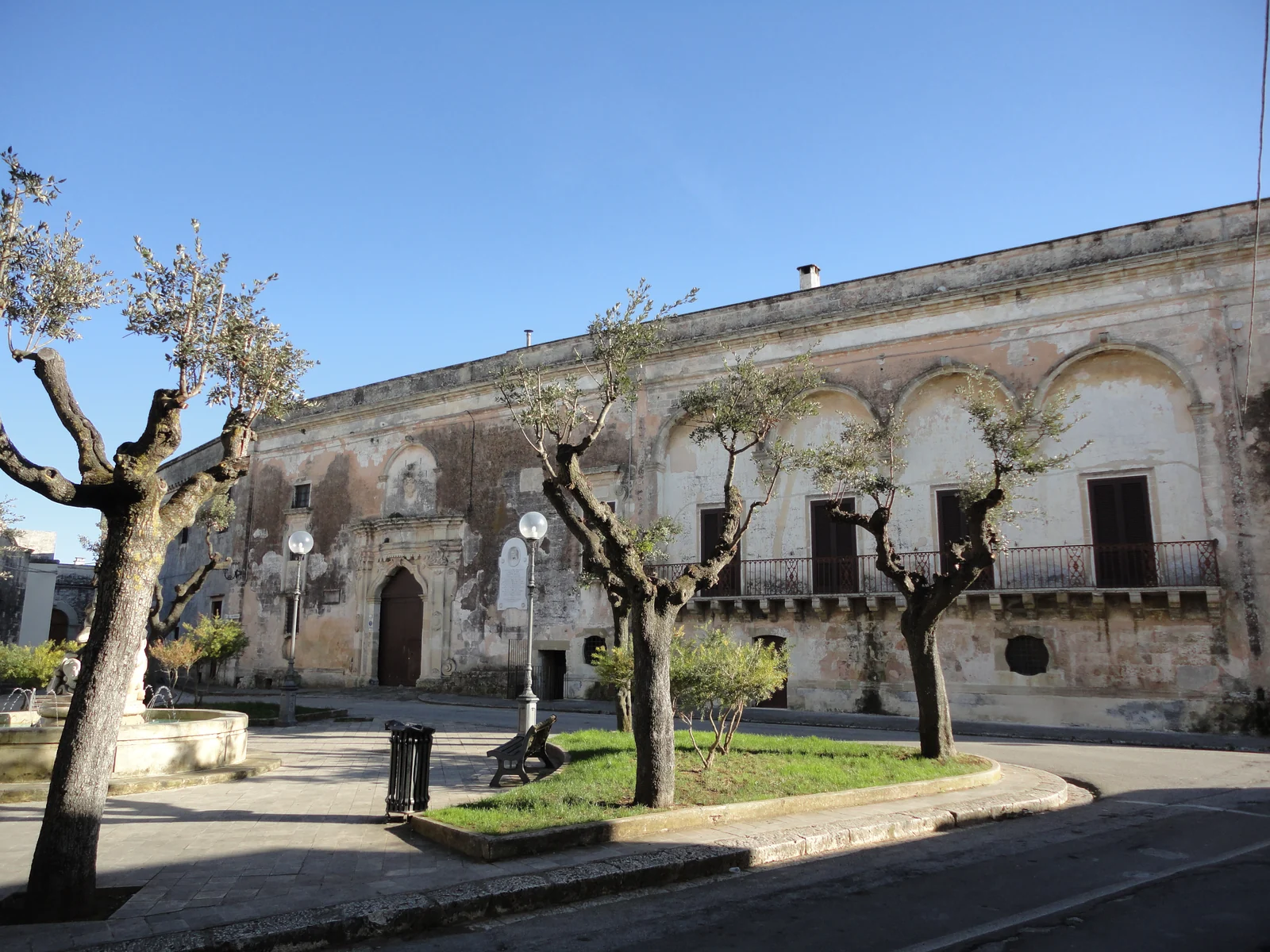
The tree-lined square named after Filippo Bacile ends with the family palace, a sixteenth-century building to which Baroque decoration added a lively, refined eighteenth-century portal. Not far away, the mother church of San Giorgio keeps altars paid for by the townspeople and the barons, and the Calvary, built in 1911, is one of the village's most unusual pieces of devotional architecture.
Spongano suits a stop of a few hours on a route between the interior and the coast: the sea is close, Otranto and Santa Maria di Leuca are easy to reach, and the village tells the story of an agricultural and bourgeois Salento of olive presses, railways and palaces.
Sources: Comune di Spongano — Stemma e cenni storici · Comune di Spongano — Luoghi e patrimonio · Comune Spongano — Palazzo Bacile · Comune di Spongano — Chiesa Madre di San Giorgio · Comune di Spongano — Calvario
History
According to the municipality, the name Spongano has two explanations: some derive it from spongia, sponge, for the soil's ability to absorb water; others from spolium, remains, referring to the peoples of Vaste or Castro. In 1103 the hamlet belonged to Tancred of Hauteville, lord of the county of Castro, and then followed that county's fortunes: the principality of Taranto, the Orsini Del Balzo with Raimondello, Maria d'Enghien and Giovanni Antonio, until 1463.
After a period in the royal domain, in 1534 Charles V granted the county of Castro and its dependent fiefs to the Gattinara family; the Ruiz de Castro and the Lopez de Zuñiga followed, ruling until 1777. Spongano remained part of the county until 1806, and its story finally merges with that of the barons Bacile di Castiglione, the last feudal lords.
Among the Baciles, Filippo stands out, who lived from 1827 to 1911: inspector of monuments for the Terra d'Otranto and an expert in heraldry, in 1894 he designed the coat of arms of the city of Lecce. In 1878 he conceived, and later designed at his own expense, the Maglie-Gagliano del Capo-Gallipoli railway, intended for a land rich in oil and wine and for travellers heading to the seaside resorts. A friend of Benedetto Croce, he hosted him several times at the palace.
Sources: Comune di Spongano — Stemma e cenni storici · Comune di Spongano — Personaggi illustri e produzione dell’olio
What to see
Palazzo Bacile di Castiglione closes the tree-lined square named after Filippo Bacile. The municipality describes it as a sixteenth-century building whose massive severity was softened by Baroque decoration. The most expressive feature of the façade is the eighteenth-century portal, designed in late Neapolitan Baroque taste: slightly convex, with a sinuous broken arch topped by a curious fringe motif. Beside the palace stretched the large garden where the baron organised the storage of olives.
The mother church of San Giorgio has a façade divided by panels and pilasters, with a statue of the Immaculate Conception in local stone on the pediment. Built with a single nave, it was enlarged around the mid-nineteenth century with two side aisles: the right one, built with contributions from the townspeople, houses the altar of Saint Victoria, the village's patron, and the marble baptistery; the left one, commissioned by Baron Bacile, the altars of Our Lady of the Rosary and Saint Anthony. The apse is decorated with stucco, with a stained-glass window of Saint George.
The Calvary, on Via Sant'Angelo, combines a 1911 chapel with a statue of the Sacred Heart and a stone dome enclosing an octagonal structure with carved Latin verses and a cross surrounded by four others.
Sources: Comune Spongano — Palazzo Bacile · Comune di Spongano — Personaggi illustri e produzione dell’olio · Comune di Spongano — Chiesa Madre di San Giorgio · Comune di Spongano — Calvario · Comune di Spongano — Luoghi e patrimonio
Food and wine
In Spongano olive oil is not just a product: it is a story of innovation. The municipality recounts how Baron Filippo Bacile transformed the family's old olive press, replacing dark cellars with large, bright, airy rooms and requiring a thorough yearly cleaning of millstones, vats and presses. In the garden beside the palace he had a covered shed built with a waterproof floor where olives were spread in thin layers, turned often to prevent fermentation: in this way he obtained fine and table oils that fetched higher prices than others, and his example was followed by other producers in the Lecce area.
Today the area is part of the Terra d'Otranto PDO, the extra virgin oil produced throughout the province of Lecce from Cellina di Nardò and Ogliarola Leccese, with olives picked by mid-November.
Oil goes with the frisella, the barley or wheat rusk softened in water and topped with tomato: the Atlas of traditional Apulian products mentions the festivals devoted to it at Supersano and Marittima, in southern Salento. On the nearby coast, at Vitigliano in Santa Cesarea Terme, the quarantinu pea is grown, one of the traditional Salento peas protected by the Slow Food Foundation.
Sources: Comune di Spongano — Personaggi illustri e produzione dell’olio · Qualigeo — Terra d'Otranto DOP · Atlante dei PAT di Puglia — Friselle di orzo e grano · Fondazione Slow Food — Piselli tradizionali salentini
When to go
Spongano can be visited all year, and the choice of season depends mainly on how it fits into the trip. In spring and autumn mild temperatures allow an unhurried walk between the square, the palace, the mother church and the Calvary, and a combination with a walk on the coastal park's trails between Otranto and Leuca.
Autumn has a special link with the village, because it is olive season: for the Terra d'Otranto PDO the harvest must end by 15 November, the moment when the story of the Bacile olive press is easiest to picture. In summer Spongano is a quiet inland base, a short distance from the Adriatic resorts, which can be reached for the day.
The village's patron is Saint Victoria, to whom an altar in the mother church is dedicated; festival dates and the programme of celebrations should be checked with the parish or the municipality before travelling.
Sources: Parco naturale regionale Costa Otranto - Santa Maria di Leuca e Bosco di Tricase · Qualigeo — Terra d'Otranto DOP · Comune di Spongano — Chiesa Madre di San Giorgio
Getting there and around
Spongano is reached from Lecce, served by the national rail network: the station, run by RFI, offers assistance to passengers with reduced mobility and integrated mobility services such as a bus stop, bike sharing and car rental. From Lecce you continue south towards Maglie and the Adriatic coast.
The village has a historic link with the railway: it was Filippo Bacile, the municipality recalls, who in 1878 conceived, and later designed at his own expense, the Maglie-Gagliano del Capo-Gallipoli line, which crosses lower Salento. Those arriving by air usually land at Brindisi, whose website lists buses, taxis and car hire for reaching towns in the area.
To move between Spongano, the coast at Castro and Santa Cesarea, Otranto and the Cape of Leuca, a car is the most flexible option. Walkers can follow the Cammino del Salento, which runs from the Grecìa Salentina down the Adriatic coast to Santa Maria di Leuca, and the trails of the Costa Otranto - Santa Maria di Leuca Regional Nature Park.
Sources: RFI — Stazione di Lecce · Comune di Spongano — Personaggi illustri e produzione dell’olio · Aeroporti di Puglia — Aeroporto di Brindisi, collegamenti bus · Italia.it — Cammino del Salento in 6 tappe · Parco naturale regionale Costa Otranto - Santa Maria di Leuca e Bosco di Tricase
Nearby
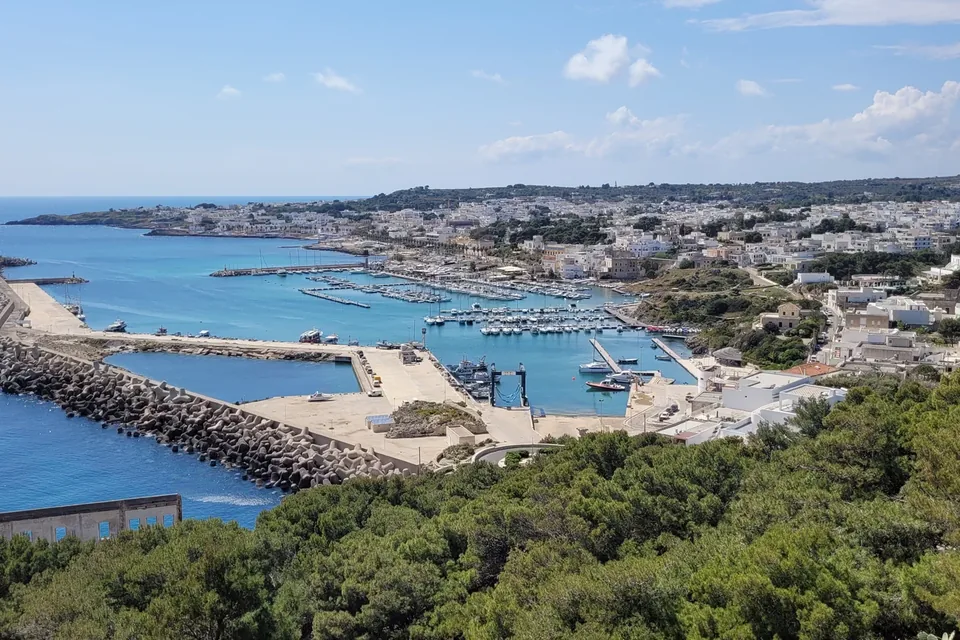
Spongano lies between the interior and one of the loveliest stretches of Salento's Adriatic coast. The municipality notes that the name itself may recall the remains of the peoples of Vaste or Castro, and that the village was part of the county of Castro for centuries: the coast bearing that name is a short distance away.
The coastline between Otranto and Santa Maria di Leuca is protected by the Costa Otranto - Santa Maria di Leuca and Bosco di Tricase Regional Nature Park, which offers trails and hiking guides. The Cammino del Salento covers it on foot: according to the national portal, the penultimate stage runs from Otranto to Santa Cesarea Terme and on to Marina Serra, while the last crosses Tiggiano, Corsano, the Cipolliane path and the Ciolo inlet to the Leuca waterfall.
To the north Otranto, with its cathedral and mosaic, is easy to reach; to the south Santa Maria di Leuca closes the peninsula. For those travelling inland, Sternatia and the villages of the Grecìa Salentina continue the story of oil with their underground presses.
Sources: Comune di Spongano — Stemma e cenni storici · Parco naturale regionale Costa Otranto - Santa Maria di Leuca e Bosco di Tricase · Italia.it — Cammino del Salento in 6 tappe
Where to stay
In the municipality of Spongano the national database of the Ministry of Tourism lists 61 accommodation businesses with a verified CIN code: 1 hotels, 15 other licensed accommodation and 45 other types such as B&Bs and private rentals.
Licensed businesses from the official list of Regione Puglia, each with a checked national CIN code: matching municipality and category. Private individuals are not listed. Check directly with the property before booking.
I Tre Bacili
Guest rooms · Website
CIN IT075078B400060151
LE CINQUE STANZE
Guest rooms
CIN IT075078B400127829
LE PANARE DI BORLIZZI DANIELE
Guest rooms
CIN IT075078B400120793
PALAZZO RIZZO
Guest rooms
CIN IT075078B400113368
LA MACCHIOLA & CORTI DEL MITO
Farm stay · Website
CIN IT075078B500023298
TELARI
B&B
CIN IT075078B400026770
CASE FRA GLI ULIVI
Holiday home · Website
CIN IT075078B400021786
Terra home resort di Daniele Mengoli
Holiday home · Website
CIN IT075078B400078876
CASINA COPINI HOTEL
Hotel · ★★★ · Website
CIN IT075078A100034643
Sources: Regione Puglia – ARET Pugliapromozione (DMS), CC BY 4.0, 2026-10-12 · Ministero del Turismo – Banca Dati Strutture Ricettive (dashboard pubblica), 2026-10-12
YOUR JOURNEY
How to shape a journey here
Heritage and production history in southern Salento. Interior visits and encounters are arranged for the journey.
Talk to us about it


.jpeg)