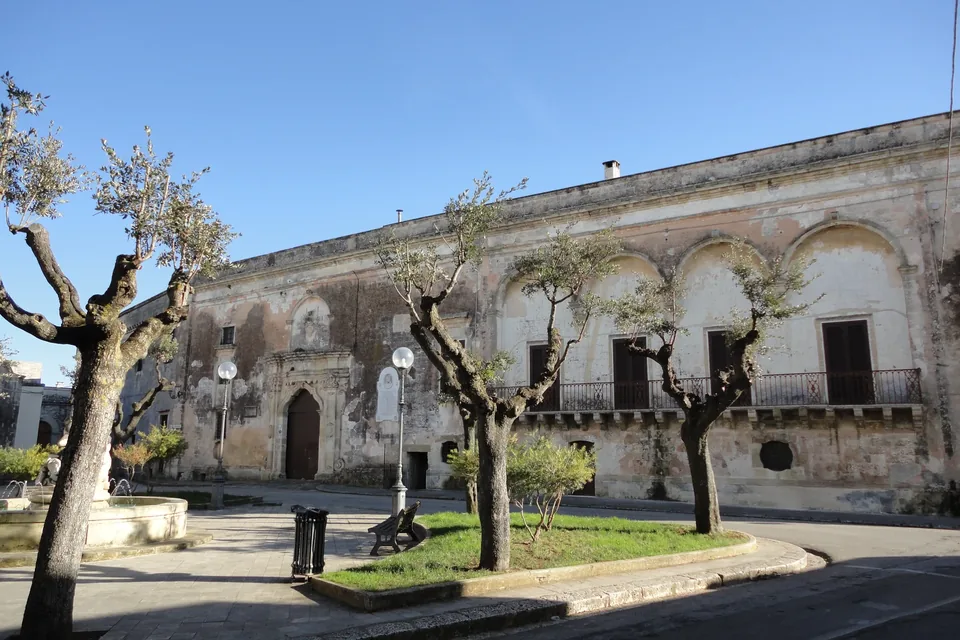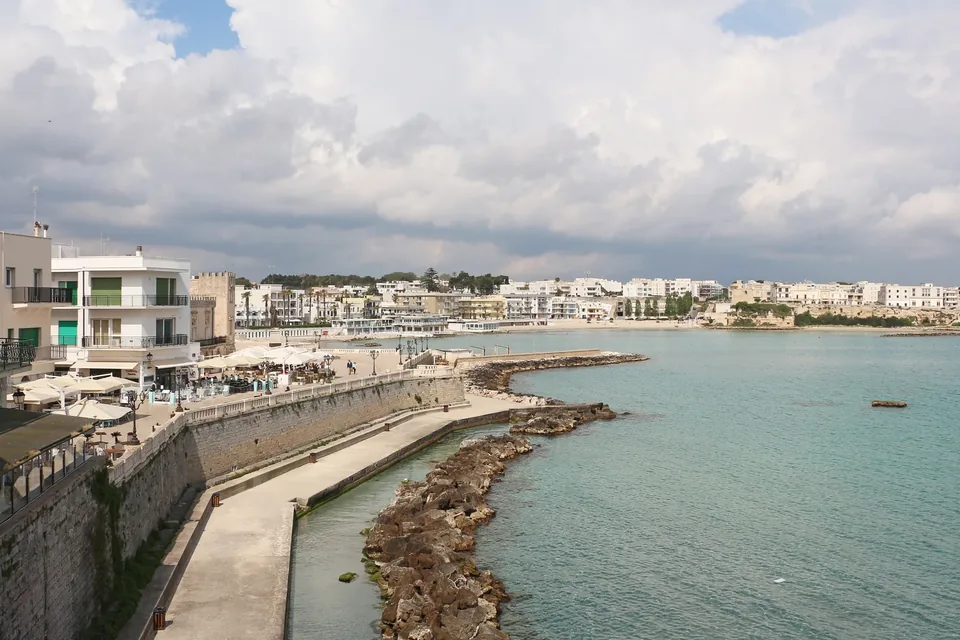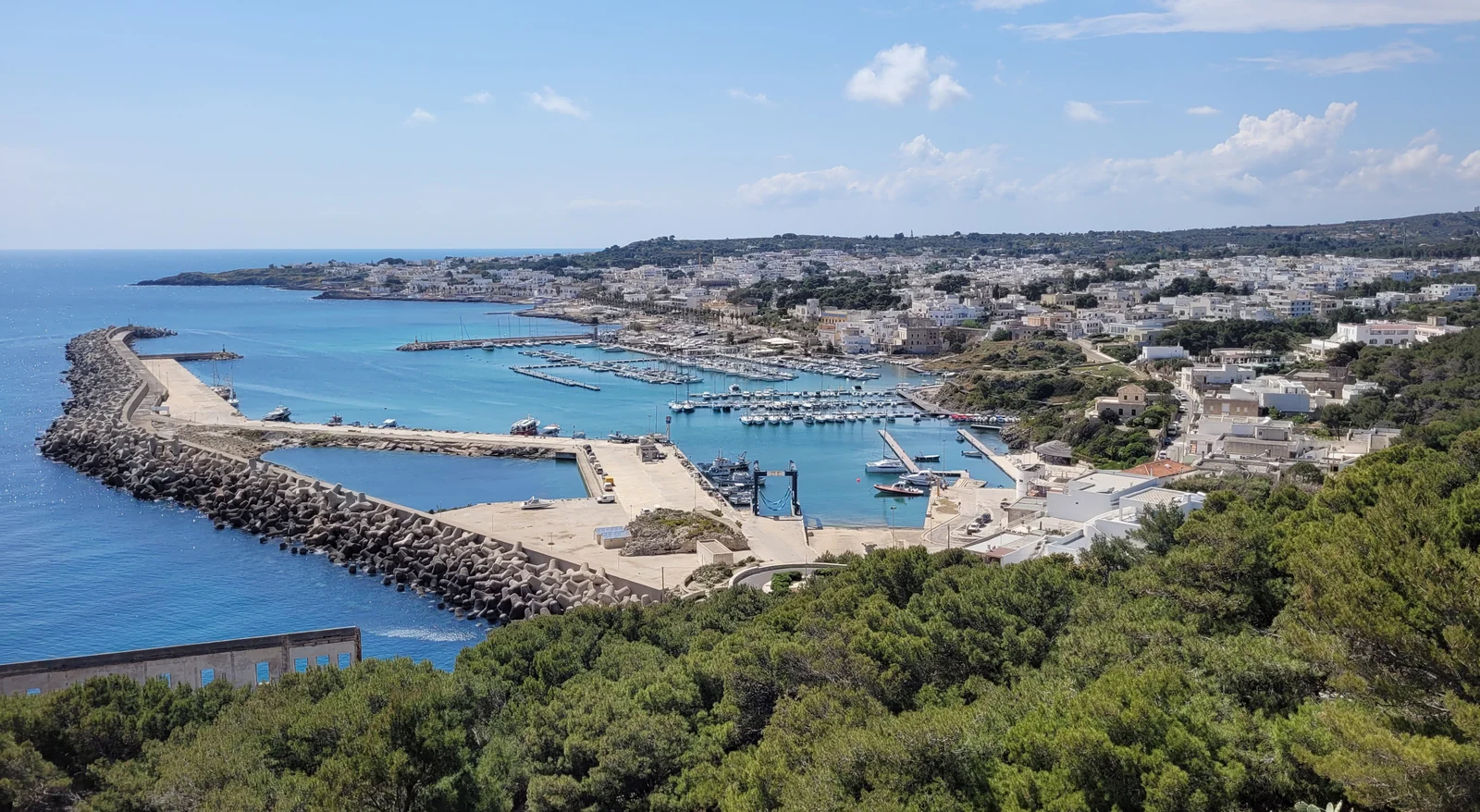
Why go
Santa Maria di Leuca is the southernmost tip of Salento, the cape where, according to the national tourism portal, you witness the embrace of the Adriatic and the Ionian seas. A hamlet of Castrignano del Capo, it takes its name from the church called de finibus terrae, at the end of the lands, built according to an ancient belief at the edge of all dry land. From the promontory, on clear days, the coasts of Greece can be glimpsed on the horizon.
Leuca reads on two levels. Above, on the headland, stand the basilica-sanctuary, the lighthouse, the Marian column and the long stairway with the waterfall celebrating the arrival of the Apulian Aqueduct. Below, the marina stretches between Punta Mèliso and Punta Ristola, with the harbour, the oleander-lined seafront and nineteenth-century villas in eclectic, Moorish or neo-Gothic style.
The third reason is the sea: the caves of the Cape, inhabited as early as the Neolithic, are visited by boat from the harbour, and the seabed draws divers and snorkellers. Leuca is also the final destination of the Cammino del Salento and part of the regional nature park that protects the coast as far as Otranto.
Sources: Italia.it — Santa Maria di Leuca, tra due mari · Italia.it — Basilica di Santa Maria di Leuca · Italia.it — Santa Maria di Leuca · Italia.it — Cammino del Salento in 6 tappe, da Lecce a Leuca
History
The headland was a sacred place long before Christianity. The municipality and the national portal recall that the basilica stands on the remains of a temple dedicated to Minerva, and a large monolithic stone kept inside, known as Minerva's Altar, preserves that memory. According to tradition, local people converted as early as the first century; the church was destroyed several times, during persecutions and later by raids from the sea, and always rebuilt.
The present building was reconstructed between 1720 and 1755 by Monsignor Giovanni Giannelli, who gave it a fortified look to protect it from looting; alongside, rooms were built to house pilgrims. Ships carrying pilgrims to the Holy Land sailed past the cape. In 1990 the sanctuary was raised to a minor basilica.
The nineteenth century brought the lighthouse, built in 1866, and the holiday villas of Lecce's middle classes along the seafront, partly converted during the Second World War to shelter evacuees. In 1939 the monumental waterfall, the final section of the Apulian Aqueduct, was completed. A plaque in the basilica commemorates the French cruiser Léon Gambetta, sunk off Leuca in April 1915.
Sources: Comune di Castrignano del Capo — Basilica di Leuca · Italia.it — Basilica di Santa Maria di Leuca · Italia.it — Santa Maria di Leuca, tra due mari · Comune di Castrignano del Capo — Cascata monumentale
What to see
The basilica of Santa Maria de Finibus Terrae has a plain façade and three bronze doors made for the 2000 Jubilee by Armando Marrocco. Inside are Baroque decorations, a pulpit carved in Lecce stone, papier-mâché statues and, on the high altar, the Madonna and Child by Palma the Younger. The complex also includes a museum of contemporary art. On the square rises the Marian column of 1694 and, in front, the 47-metre lighthouse, which from the sea looks like a towering column.
From the headland runs the monumental stairway with the waterfall, a work celebrating the Apulian Aqueduct: the municipality describes it as cut into the rock and about 250 metres long, with a Roman column at its foot. In the pine wood of the Cape winds a monumental Way of the Cross with fifteen sculptural groups from 2001.
Down on the seafront you stroll among the late nineteenth-century eclectic villas: the blue pagoda roof of Villa Episcopo, the red towers of the neo-Gothic Palazzo Mellacqua, the striped dome of Villa Meridiana, the Egyptian-style Villa Mariuccia and the Moorish Villa Daniele. The White Coral Museum, in a former school, tells the story of the sea with educational workshops; at Salignano, a hamlet of Castrignano, stands a round tower from 1550.
Sources: Italia.it — Basilica di Santa Maria di Leuca · Comune di Castrignano del Capo — Basilica di Leuca · Comune di Castrignano del Capo — Cascata monumentale · Italia.it — Santa Maria di Leuca · Comune di Castrignano del Capo — Museo del corallo bianco · Comune di Castrignano del Capo — Torre di Salignano
Food and wine
The national portal describes Leuca through its scents: the tomato, oil and oregano used to dress frise or friselle. This is the frisella of the Atlas of traditional Apulian products, a round barley or wheat bread baked twice, softened in water and dressed with fresh or hung tomato and extra virgin oil. Among the festivals devoted to it, the Atlas mentions those held in August at Supersano and Marittima, in southern Salento.
The oil is that of the Terra d'Otranto PDO, which covers the whole province of Lecce: Cellina di Nardò and Ogliarola Leccese, olives picked by mid-November, and a history going back to the Messapians. Along the road to Leuca, centuries-old olive trees are part of the landscape, as the portal notes.
The hinterland of the Cape also grows traditional pulses: among the traditional Salento peas protected by the Slow Food Foundation is the pea of Vitigliano, a hamlet of Santa Cesarea Terme on the coast towards Otranto, called quarantinu because the plant stays low. From the harbour, where fishermen return, comes the fish that completes the table of a place that lives by the sea.
Sources: Italia.it — Santa Maria di Leuca, tra due mari · Atlante dei PAT di Puglia — Friselle di orzo e grano · Qualigeo — Terra d'Otranto DOP · Fondazione Slow Food — Piselli tradizionali salentini
Things to do
The classic excursion starts from the harbour: fishermen and operators take visitors by boat to the caves of the Cape, already inhabited in the Neolithic. The national portal names the Giants', Crib, Devil's and Dragon caves and the Porcinara, with carvings dedicated to Jupiter or Fortune; it advises visiting the eastern caves in the morning light and the western ones at sunset. The seabed is a destination for diving and snorkelling.
Those who prefer walking can reach Leuca on foot. The last stage of the Cammino del Salento, described by the national portal, starts on the Sentiero del Nemico, passes through Tiggiano, Corsano and Marina di Novaglie, follows the Cipolliane path suspended above the sea to the Ciolo inlet, crosses Gagliano del Capo and reaches the foot of the waterfall: from there 284 steps lead up to the sanctuary, the final goal of the walk.
The entire coast up to Otranto is protected by the Costa Otranto - Santa Maria di Leuca and Bosco di Tricase Regional Nature Park, which offers trails and hiking guides. Inland, trekking and mountain biking reveal centuries-old olive trees, rock settlements and small villages.
Sources: Italia.it — Santa Maria di Leuca, tra due mari · Italia.it — Basilica di Santa Maria di Leuca · Italia.it — Cammino del Salento in 6 tappe, da Lecce a Leuca · Parco naturale regionale Costa Otranto - Santa Maria di Leuca e Bosco di Tricase · Italia.it — Santa Maria di Leuca
When to go
Leuca is at its best from spring to autumn. In summer the marina is a lively seaside resort, with the harbour and seafront bustling; it is also when the sea is best suited to boat trips and diving. The national portal notes that the monumental waterfall is opened only on rare occasions: in August, once a week, water flows down to the sea again in a spectacle that draws many people.
May has a special appeal, because according to the national portal it is the month when the nineteenth-century seafront villas open to visitors. Spring and autumn are also the best seasons for walking the last stage of the Cammino del Salento and the park's trails, with mild temperatures and a light that makes the headland even more striking.
In every season the sanctuary remains a place of pilgrimage, and the municipality notes how devotion to the Madonna de Finibus Terrae has grown since the sanctuary was raised to a basilica in 1990. In autumn, with the olive harvest, the hinterland of the Cape shows its agricultural face.
Sources: Italia.it — Basilica di Santa Maria di Leuca · Italia.it — Santa Maria di Leuca, tra due mari · Italia.it — Cammino del Salento in 6 tappe, da Lecce a Leuca · Comune di Castrignano del Capo — Basilica di Leuca · Qualigeo — Terra d'Otranto DOP
Getting there and around
Leuca lies, as the national portal notes, about seventy kilometres from Lecce, at the tip of the Salento peninsula. Lecce is the reference rail hub on the national network: its station, run by RFI, offers assistance to passengers with reduced mobility and integrated mobility services such as buses, bike sharing and car rental. From there you continue to the Cape on regional connections or by car.
Those arriving by air usually land at Brindisi: the airport website lists buses, taxis and car hire for reaching towns in the area. To explore the Cape and the coast between Leuca and Otranto freely, with its marinas and inland villages, a car remains the most practical choice.
Then there is the slow way: the Cammino del Salento, which starts in Lecce and reaches Leuca in six stages through the Grecìa Salentina and the Adriatic coast. Locally, the headland and the marina are linked by the monumental stairway; the harbour is the departure point for boat trips to the caves.
Sources: Italia.it — Santa Maria di Leuca, tra due mari · RFI — Stazione di Lecce · Aeroporti di Puglia — Aeroporto di Brindisi, collegamenti bus · Italia.it — Cammino del Salento in 6 tappe, da Lecce a Leuca · Italia.it — Basilica di Santa Maria di Leuca
Where to stay
Those arriving in Leuca as pilgrims find a welcome with ancient roots. The municipality recalls that buildings to house pilgrims were built together with the sanctuary, and that during restoration the wall niches where people rested after arriving on foot from days of walking came to light again. Today, according to the national portal, the sanctuary offers pilgrims hospitality in a holiday house and a guest house, with simple rooms and a unique position on the headland.
For a seaside stay, the marina of Leuca is a busy resort with its harbour and seafront: sleeping here lets you head out by boat early in the morning, when the eastern caves have the best light, and stroll among the villas in the evening.
Those who want to combine the sea with the hinterland can look for accommodation in the countryside of the Cape, among centuries-old olive trees and small villages, convenient for driving to both Leuca and the coast towards Otranto. For those walking the Cammino del Salento, it is wise to arrange overnight stops along the stages in advance.
Sources: Comune di Castrignano del Capo — Basilica di Leuca · Italia.it — Basilica di Santa Maria di Leuca · Italia.it — Santa Maria di Leuca, tra due mari · Italia.it — Cammino del Salento in 6 tappe, da Lecce a Leuca
Where to stay
In the municipality of Castrignano del Capo the national database of the Ministry of Tourism lists 573 accommodation businesses with a verified CIN code: 7 hotels, 84 other licensed accommodation and 482 other types such as B&Bs and private rentals.
Licensed businesses from the official list of Regione Puglia, each with a checked national CIN code: matching municipality and category. Private individuals are not listed. Check directly with the property before booking.
ADUA ART
Guest rooms
CIN IT075019B400032499
Alma Mater
Guest rooms
CIN IT075019B400122631
B&B FERNANDO
Guest rooms
CIN IT075019B400077001
CASA BRANCA
Guest rooms
CIN IT075019B400022208
GALATI MARCO
Guest rooms
CIN IT075019B400022518
IL PAPPAGALLO
Guest rooms · Website
CIN IT075019B400046945
LA CHIOCCIOLA
Guest rooms
CIN IT075019B400022769
Leucos Rooms & Suite
Guest rooms
CIN IT075019B400126862
VILLA LA MERIDIANA
Guest rooms
CIN IT075019B400020889
MASSERIA LA VERNA
Farm stay
CIN IT075019B500021372
SERINE MASSERIA
Farm stay
CIN IT075019B500020891
AURA SOLIS
B&B
CIN IT075019B400027639
B&B Leuca santa maria
B&B
CIN IT075019B400123489
BIANCA LEUCA
B&B
CIN IT075019B400024616
LEUCAINEOUT
B&B · Website
CIN IT075019B400053632
Mimi Leuca B&B
B&B · Website
CIN IT075019B400064530
VILLA MARTINA
B&B
CIN IT075019B400077926
VILLA STASI
B&B
CIN IT075019B400022338
Villa Romasi
B&B · Website
CIN IT075019B400117195
Camping Villa Paradiso - Mini Area di sosta-
Campsite · ★ · Website
CIN IT075019B100112762
VILLA PARADISO
Campsite · ★ · Website
CIN IT075019B100020766
MARIS STELLA
Holiday house
CIN IT075019B700020887
Azzurra Dimora
Holiday home
CIN IT075019B400127004
CASA VACANZE LEUCA
Holiday home
CIN IT075019B400057148
CORTE DEGLI ALLORI
Holiday home
CIN IT075019B400024148
Estatesalento
Holiday home · Website
CIN IT075019B400101274
HOTELS 4U SRL
Holiday home
CIN IT075019B400127563
LE CAMMIRE LUXURY APARTMENT
Holiday home
CIN IT075019B400114321
TERRA GRECI
Holiday home
CIN IT075019B400057964
Tenuta Lavati
Holiday home
CIN IT075019B400102996
Villa di Punta
Holiday home
CIN IT075019B400109296
DUE MARI
Hotel · ★★
CIN IT075019A100020447
L'APPRODO
Hotel · ★★★★
CIN IT075019A100020420
MESSAPIA HOTEL & RESORT
Hotel · ★★★★ · Website
CIN IT075019A100112312
MONTIRO' HOTEL
Hotel · ★★★★
CIN IT075019A100024652
RIZIERI
Hotel · ★★★
CIN IT075019A100020445
SANTUARIO
Hotel · ★★
CIN IT075019A100022860
TERMINAL
Hotel · ★★★
CIN IT075019A100020446
leuca twenty rooms
Hotel · ★★★
CIN IT075019A100071696
Residence Bellevue
Residence · Website
CIN IT075019B400082723
Sources: Regione Puglia – ARET Pugliapromozione (DMS), CC BY 4.0, 2026-10-12 · Ministero del Turismo – Banca Dati Strutture Ricettive (dashboard pubblica), 2026-10-12
YOUR JOURNEY
How to shape a journey here
Journey idea: connect Leuca with Otranto for an Adriatic chapter, or with Gallipoli for an Ionian contrast. Choosing the thread before the stops leaves room for landscape and spontaneous pauses.
Talk to us about it