Coast to Coast: from Maratea’s Christ towards the Ionian
Basilicata coast to coast, a 2010 comedy directed by Rocco Papaleo with a cast including Alessandro Gassmann, Paolo Briguglia, Max Gazzè and Giovanna Mezzogiorno, follows a group of musicians who decide to cross the region on foot, from the Tyrrhenian to Scanzano Jonico. The Italy for Movies portal reconstructs the film’s route stage by stage.
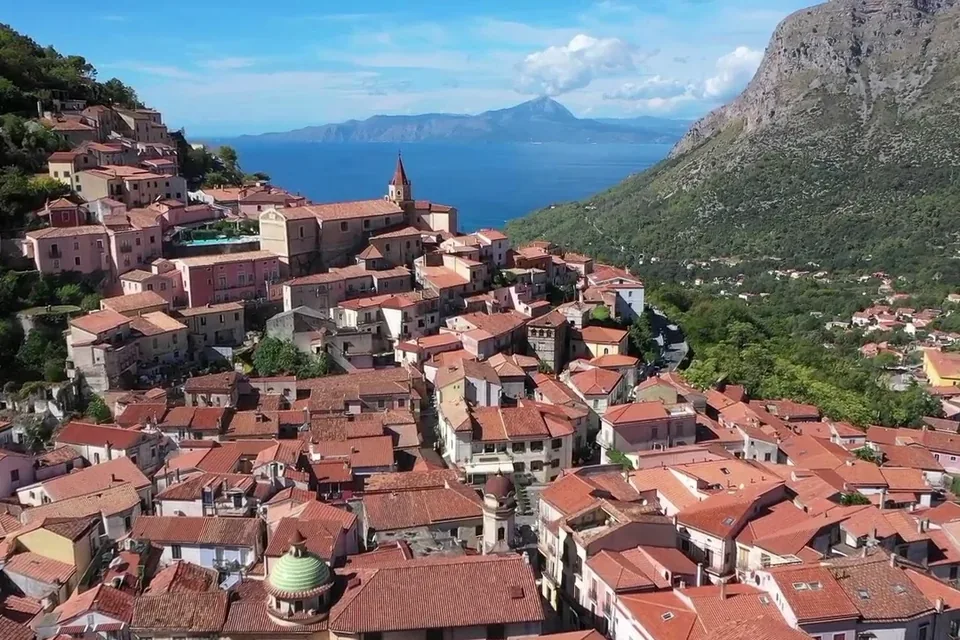
The first shot shows the statue of Christ the Redeemer at Maratea, raised in 1965 on the summit of Monte San Biagio, beside the sanctuary and the ruins of an old castle, overlooking the Gulf of Policastro. From Maratea, which the source recalls as the town of forty-four churches, the group sets off with a cart towards Trecchina and then Lauria, home town of the main character and of the actor who plays him.
The journey to Scanzano Jonico, Italy for Movies explains, is just over 120 kilometres by car, but in the film it becomes a route of about 233 kilometres covered in ten days through villages, mountains and back roads. This slowness is the real theme: giving stops the time to become part of the story.
The inland stages: Aliano, Craco and the Val d’Agri
Coast to Coast crosses very different places. Italy for Movies notes the passage through Moliterno and Tramutola, whose name, the source recalls, refers to land rich in water, and a stop at the Pertusillo lake dam in the territory of Grumento Nova. One character, having left the group, finds himself near Viggiano, where the film pays tribute to the cult of the Black Madonna of the Sacred Mount.
In Aliano the musicians salute Carlo Levi on the terrace where he lived during his internal exile, and Gian Maria Volonté, who played him in Christ Stopped at Eboli. The source describes the village on a clay spur, a representative example of the badlands landscape, surrounded by olive, peach and citrus trees. The route continues to Craco, the town abandoned after the 1963 landslide.
The descent to the Ionian passes Tursi, a town of medieval origin, and Policoro, near ancient Siris-Heraclea, before arriving at Scanzano Jonico. For travellers the film works as a thematic map: it suggests a sequence of landscapes, from the coast to inland valleys and badlands, to be chosen according to the time available.
Scordato: a journey into memory
In Vision Distribution’s synopsis, Orlando is a gentle piano tuner troubled by back pain. Meeting Olga, a physiotherapist who diagnoses an emotional contracture and asks him for a photograph of himself as a young man, sets him travelling and reliving, almost as a spectator, the events that made him the solitary man he has become. The film is produced by Indiana Production, Less Is More and Vision Distribution, in collaboration with Sky.
Italy for Movies specifies that Papaleo plays Orlando, while the singer Giorgia, in her film debut, plays the physiotherapist; the cast also includes Simone Corbisiero, Angela Curri, Giuseppe Ragone and Antonio Petrocelli. The film was presented at the Bif&st and, as in Coast to Coast, music remains the guiding thread.
The title pairs music and memory: an out-of-tune instrument and a life to be retuned. On a real journey this thread invites you to listen to the stories of towns, not only to recognise a location, and to ask what it means to return to a place known in youth.
Sources: Vision Distribution — Scordato · Italy for Movies — Scordato: Lauria, Maratea e Salerno
Scordato: Lauria, Maratea and Trecchina
Italy for Movies identifies Scordato’s main locations. The first is Lauria, home town of the director and of the main character; next comes Maratea, which the source recalls as the only Basilicata municipality on the Tyrrhenian Sea. Filming also involved Trecchina, a small inland town in the Lucanian Apennines, and crossed into Campania, to Salerno.
With this film, the source points out, Papaleo returns to the home region already portrayed in Coast to Coast. Comparing the two is interesting: in the first the region is crossed horizontally, from sea to sea; in the second the journey is vertical, through time, and the places become the setting of a return.
This link helps distinguish the author’s biographical memory from the character’s geography: the places are real, while Orlando’s journey follows the film’s narrative construction. For visitors it means choosing a respectful approach, looking at the towns as they are today and letting the film offer only the first question.
Sources: Italy for Movies — Scordato: Lauria, Maratea e Salerno
Lauria, the town of return
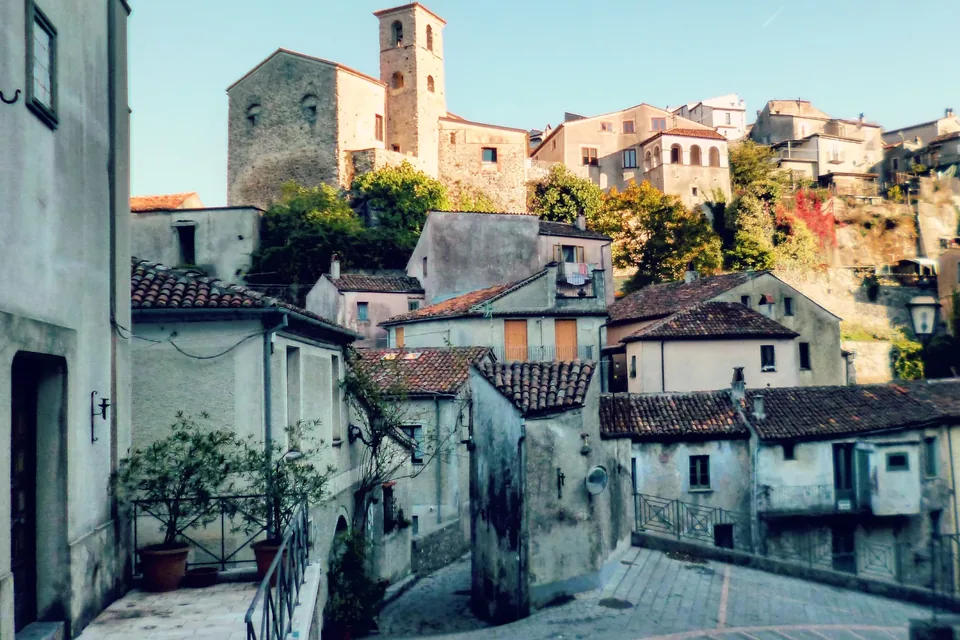
Italia.it presents Lauria as the largest town in the Noce Valley, divided into two districts: Upper Lauria, called the Castle, and Lower Lauria, the Borgo. In the upper part stand the ruins of the castle linked to Roger of Lauria, admiral of the Aragonese fleet. The historic centre, with houses clinging to the hill, keeps lanes, arches, porticoes, stone portals, coats of arms and wrought-iron railings of noble palaces.
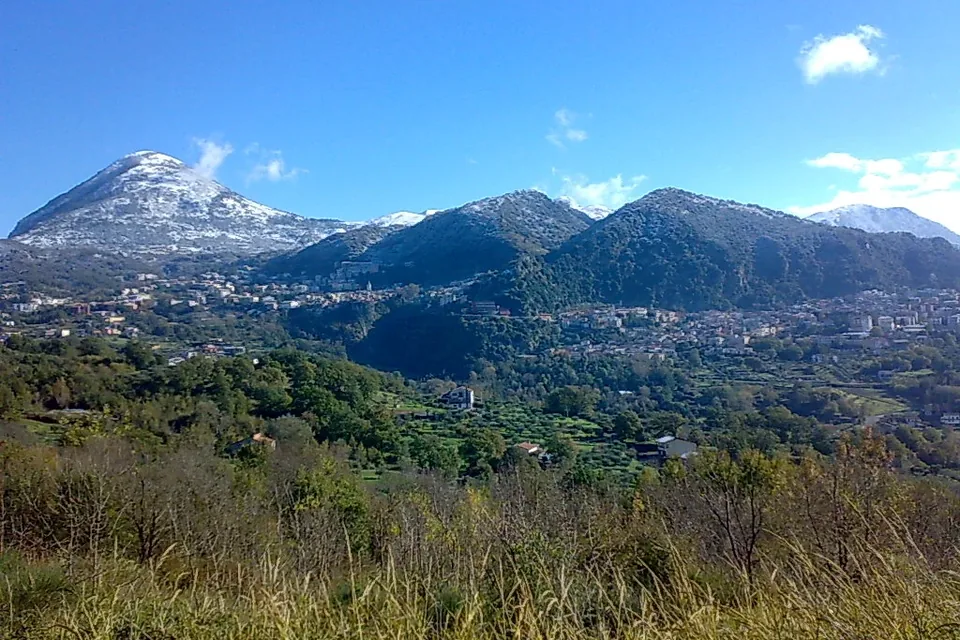
The same source notes that Lauria is the birthplace of Rocco Papaleo and of Blessed Domenico Lentini, the town’s patron, whose relics lie in the mother church of San Nicola di Bari, a pilgrimage destination. The Pollino National Park, which includes Lauria on its Lucanian side, adds further places: the sanctuary of the Madonna dell’Armo, the church of San Giacomo, the Capuchin convent, Palazzo Viceconti, Monte Alpi and the mineral springs.
For those arriving through the films, Lauria is where fiction and biography meet. Allow at least half a day, alternating the historic centre with a look at the mountain landscape around it.
Sources: Italia.it — Lauria · Parco nazionale del Pollino — Lauria
Il bene comune: a walk in the Pollino
The Basilicata Region’s press agency presents Il bene comune, Papaleo’s fifth film as director, written with Valter Lupo and released in cinemas on 12 March. It tells of a hiking guide who accompanies a group of women prisoners on a reward trip in the Pollino National Park, with unforeseeable consequences. The cast includes Claudia Pandolfi, Teresa Saponangelo, Vanessa Scalera and Andrea Fuorto.
Filming, which lasted six weeks between Basilicata and Calabria, covered the Pollino area and the Bosnian pine, the ancient tree that symbolises the park, as well as Civita, Saracena and Campotenese; in Calabria the film also includes sea scenes at Diamante. At a public meeting in Montescaglioso, the same agency recalls, Papaleo spoke about the images and music of a film shot in summer 2025 and supported by the Lucana Film Commission.
The film provides a cultural link with the mountains; however, the fictional walk does not describe an available hike. Anyone wishing to know the Pollino should give it a day planned for the mountains, with the park’s official guides and trails.
Sources: Regione Basilicata, AGR — A Montescaglioso Papaleo e Il bene comune · Regione Basilicata, AGR — In uscita il nuovo film di Rocco Papaleo
A film before, a question during the journey
To prepare the trip, choose a single film and note three things: how the characters move, where they stop, what they listen to. Once in the town, change your point of view: look at an entrance, a square or the relationship between houses and terrain, leaving the scene with the task of having sparked a curiosity.
The comparison becomes interesting when the place surprises you compared with the image. There is no need to find every shot: one recognised detail and a conversation about returning can be worth more than a collection of look-alike photographs. People living in these towns are not extras, and their daily life deserves the same respect given to a monument.
Those travelling in a group or as a family can share roles: someone follows the music, someone the landscape, someone the dialogue. At the end of the day, putting observations together turns the film into a way of knowing the region better, and the region into a key for seeing the film with new eyes.
Maratea, Lauria and a mountain chapter
Picture the route in separate chapters: Maratea to observe the relationship between town and coast, Lauria to explore the theme of return, Trecchina to continue inland. The Pollino opens another scale and deserves a day planned for the mountains, not a quick detour added to the seaside.
Music can accompany the thread between stops, through listening before departure and a pause for discussion afterwards. Those with more days can follow, by car and calmly, part of the Coast to Coast route towards Aliano and Craco, bearing in mind that inland distances take time and that the landscape changes greatly from one valley to the next.
Choose the period according to landscape and activities: cinematic memory does not require waiting for a festival or a screening. Spring and autumn suit those who want to walk in the mountains or visit villages without the heat; summer brings out the Maratea coast. In any season, alternate a day on the road with a day of rest, as the films’ characters do.
A thread for your journey
A film thread between Lauria, Maratea, Trecchina and Pollino, with time in towns and outdoors.
Talk to us